The Phone Call Every Factory Manager Dreads
It is 7:15 on a Monday morning. The production floor is warming up. The cafeteria is filling with the first shift. And your maintenance supervisor is at your door with the news: the RO plant went down overnight. There is no purified water. The process line that depends on it is offline. The cafeteria is shutting down the drinking dispensers. And the last service visit the plant received was — he pauses — fourteen months ago.
What follows is a cascade of consequences that experienced facilities managers know in painful detail: emergency calls to multiple vendors, none of whom know your specific system. A technician who arrives and spends the first hour simply understanding the plant layout. A spare part that has to be sourced from another city. A two-day production interruption while the repair is completed. An invoice for emergency service rates — three to five times what a scheduled maintenance visit would have cost. And a production manager asking a question that has no comfortable answer: why did we not have an AMC in place?
Emergency repairs for industrial RO plants cost 3–5 times more than equivalent preventive maintenance. And the most common root cause — skipping filter replacement schedules — results in membrane fouling and replacement bills of ₹2–5 lakhs per incident.
This is the real cost of running a commercial or industrial RO plant without a structured Annual Maintenance Contract. And it is entirely, predictably, preventably avoidable.
This guide is the complete resource for facilities managers, plant managers, procurement teams, and business owners who operate commercial or industrial RO plants in Karnataka and South India — and who want to understand exactly what an AMC should cover, what it should cost, what to watch for in AMC agreements, and why Bangalore Aqua and Energy Pvt. Ltd. is the AMC partner that consistently delivers where others fall short.
What an AMC for an Industrial or Commercial RO Plant Actually Is
An Annual Maintenance Contract (AMC) is a formal service agreement between the RO plant owner and a qualified service provider — specifying the scope of maintenance activities, frequency of service visits, response time commitments for breakdowns, spare parts coverage, and the total annual cost.
For a domestic household RO unit, an AMC is a convenience that prevents minor frustrations. For an industrial or commercial RO plant, an AMC is a mission-critical operational commitment — the difference between reliable, continuous water treatment and an unpredictable sequence of breakdowns that affect production quality, regulatory compliance, employee health, and business continuity.
The distinction matters because commercial and industrial RO plants operate very differently from domestic units:
Scale: A commercial plant produces 100–2,000 LPH; an industrial plant typically produces 1,000–20,000+ LPH. The volume of water processed daily — and the operational consequences of any disruption — is orders of magnitude larger than a domestic system.
Operating hours: Domestic RO units run on demand — a few hours per day. Commercial plants run 8–12 hours daily. Industrial plants in continuous process environments run 18–24 hours a day, seven days a week. This continuous operation accelerates component wear and makes maintenance intervals more critical.
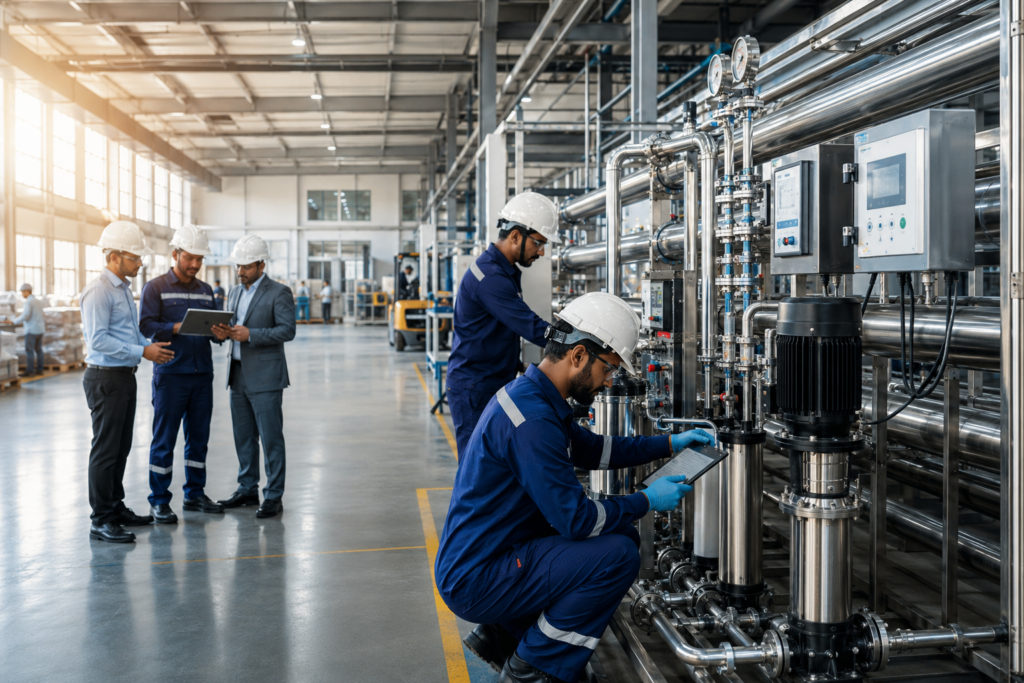
Complexity: Industrial RO plants include multi-stage pre-treatment trains (multimedia filtration, carbon filtration, iron removal, softening, anti-scalant dosing), high-pressure pump assemblies operating at 150–600 psi, multiple membrane housings with multiple elements, automated control panels, online monitoring sensors, and reject water management systems. Each component requires its own maintenance schedule and expertise.
Consequences of failure: When a domestic unit fails, a family uses bottled water while waiting for repair. When an industrial RO plant fails, a pharmaceutical facility cannot produce purified water for its process line. A food manufacturer cannot run its production. A hospital cannot maintain sterile water supply. A large corporate campus cafeteria shuts down. The operational and financial consequences are immediate and severe.
This is why a serious industrial or commercial RO plant AMC is not a simple document — it is a comprehensive service commitment that requires an experienced, locally present, technically qualified partner.
The Six Pillars of a Best-in-Class RO Plant AMC
Not all AMC agreements are created equal. The most important step in evaluating any AMC offer is understanding exactly what is covered — and what is conspicuously absent. Here are the six components that every credible industrial and commercial RO plant AMC should include:
Pillar 1: Scheduled Preventive Maintenance Visits
Scheduled, regular maintenance visits are the foundation of any AMC. The frequency depends on plant capacity, operating hours, source water quality, and system complexity:
Monthly visits are appropriate for high-volume industrial plants (2,000 LPH+), plants operating 18–24 hours daily, plants with particularly challenging source water (high TDS 1,500+ mg/L, high iron, high hardness), and pharmaceutical or food-grade water systems where regulatory compliance requires frequent documentation.
Quarterly visits are standard for most commercial plants (100–1,000 LPH), apartment community plants, and industrial plants operating 8–12 hours daily with moderate source water challenges.
Semi-annual visits are acceptable only for low-volume, simple commercial systems with mild source water and limited daily operating hours — and should always be supplemented by the plant operator’s own daily monitoring protocol.
Each scheduled visit by Bangalore Aqua’s AMC team includes a systematic inspection and service sequence:
- Visual inspection of all components for leaks, corrosion, wear, or unusual noise
- Pre-filter differential pressure measurement and cartridge replacement as needed
- Carbon filter performance check and replacement per schedule
- Anti-scalant dosing system verification — chemical level, dosing pump calibration, injection point check
- High-pressure pump performance check — inlet and outlet pressure, flow rate, noise, vibration
- Membrane performance evaluation — feed pressure, permeate flow rate, TDS rejection, recovery ratio
- UV lamp intensity verification (UV meters, not visual inspection — UV lamp brightness fades below bactericidal efficacy before visible dimming)
- Online TDS meter calibration against handheld reference meter
- Pressure gauge verification across all stages
- Control panel inspection — contactors, relays, timer settings, alarm functions
- Storage tank level controls and float valve operation
- Reject water management system check
- Documentation of all readings and activities in the plant’s maintenance log
Pillar 2: Consumable Replacement — On Schedule, Not on Breakdown
The single most impactful maintenance activity in any RO plant is timely consumable replacement. Pre-filters should be replaced every 3–6 months; membranes typically last 2–3 years depending on feed water quality. When TDS rejection drops below 90% or product water TDS exceeds 100 ppm, the membrane needs replacement.
The most common and most expensive AMC failure mode is a supplier who includes consumable replacement “as needed” rather than on a defined schedule — and then consistently defers the schedule because replacement costs eat into their margin.
A credible AMC specifies consumable replacement intervals explicitly:
| Component | Replacement Interval | What Happens Without It |
|---|---|---|
| Sediment pre-filter (5 micron) | Every 3 months | Particulate fouling of RO membrane |
| Sediment pre-filter (1 micron) | Every 3 months | Colloidal fouling accelerates |
| Activated carbon filter | Every 6–12 months | Chlorine breakthrough destroys membrane |
| Anti-scalant chemical | Continuous refill | Carbonate scaling on membrane |
| UV lamp | Every 12 months | UV intensity below bactericidal threshold |
| RO membrane | Every 2–3 years (monitored) | TDS rejection failure, quality risk |
| High-pressure pump seals | Every 2–3 years | Pressure loss, pump failure |
| O-rings and gaskets | As inspected (typically 2–3 years) | Bypass leaks reduce rejection efficiency |
| Post-carbon polish filter | Every 12 months | Taste and odour return to output |
| Mineralisation cartridge | Every 6–12 months | pH drift below safe range |
Businesses with active AMC plans experience 68% fewer emergency breakdowns compared to those relying on need-based repairs. The data is unambiguous: scheduled consumable replacement, not reactive breakdown repair, is the mechanism that keeps commercial and industrial RO plants performing reliably.
Pillar 3: Membrane Performance Monitoring and Chemical Cleaning
The most common RO membrane problems include fouling from suspended solids or organics, scaling due to mineral buildup, chemical attack from improper cleaning agents or feedwater chemicals, pressure drops caused by blockages or flow restriction, and natural membrane aging over time.
Sudden pressure drops or abnormal flow indicate membrane fouling or leaks. Industrial water sources often contain higher levels of contaminants compared to potable water, which can rapidly clog or damage membranes, reduce filtration efficiency, and strain pumps and motors.
A competent AMC includes systematic membrane performance monitoring at every visit — tracking the key performance indicators (KPIs) that reveal developing membrane issues before they become failures:
Normalised Permeate Flow (NPF): Corrected for temperature and pressure variations, NPF measures whether the membrane’s actual output is declining relative to its design specification. A 15–20% decline in NPF signals developing fouling and triggers either chemical cleaning or accelerated monitoring.
Normalised Salt Rejection (NSR): Measures TDS rejection efficiency, corrected for temperature. Declining NSR indicates membrane integrity issues — potential O-ring bypass, membrane element degradation, or chemical damage.
Differential Pressure (dP) Across Membrane Train: Rising dP indicates particulate or biofouling accumulating in the lead elements. Tracking dP trends over time allows prediction of cleaning requirements before performance degrades.
Recovery Ratio: The percentage of feed water converted to permeate. Declining recovery at constant feed pressure indicates scaling or fouling. Rising recovery at low operating pressure may indicate membrane compression issues.
When monitoring data indicates developing fouling, the appropriate response is chemical cleaning — Cleaning In Place (CIP) — before the fouling becomes irreversible. Bangalore Aqua’s AMC teams are trained in CIP procedures including alkaline cleaning (for organic fouling and biofouling), acid cleaning (for carbonate and sulphate scale), and specialised cleaning agents for silica fouling — common in certain Karnataka geological zones.
Pillar 4: Water Quality Testing and Certification
A commercial or industrial RO plant is producing water that people drink, that food is prepared with, that pharmaceutical products are made from, or that industrial processes depend on. Regular water quality testing is not optional — it is the fundamental accountability mechanism that confirms the plant is actually doing what it is supposed to do.
A competent AMC includes water quality testing at defined intervals, with results documented and provided to the plant owner:
Monthly or quarterly: In-line TDS testing at inlet, permeate, and reject points using calibrated meters. UV intensity verification. pH measurement of permeate.
Semi-annually: Water quality testing at an NABL-accredited external laboratory covering: TDS, pH, hardness, iron, turbidity, and total coliform/E. coli count. For pharmaceutical applications: USP purified water specification testing as required.
Annually: Comprehensive laboratory analysis including: TDS, pH, hardness, calcium, magnesium, iron, manganese, fluoride, nitrates, chlorides, turbidity, total coliform, E. coli, and other parameters relevant to the specific industrial application.
Bangalore Aqua provides NABL-accredited laboratory test certificates with every annual AMC cycle — giving plant owners documented proof of water quality compliance suitable for regulatory inspections, FSSAI audits, customer quality documentation, and internal quality management records.
Pillar 5: Emergency Breakdown Response — Committed Response Times
Scheduled maintenance prevents most failures. But mechanical systems in demanding industrial environments occasionally fail unpredictably — pump seal failure, power surge damage, membrane housing O-ring failure, control panel fault. When unplanned failure occurs, the AMC’s emergency response commitment is what determines the business impact.
A credible AMC specifies response time commitments explicitly:
For critical industrial applications (pharmaceutical, food processing, hospitals, large corporate campuses): 4-hour maximum response time commitment during business hours; 8-hour maximum for after-hours failures.
For commercial applications (restaurants, hotels, co-working spaces, smaller commercial plants): Same-day response during business hours.
For community and apartment plants: Next-day response standard; same-day for situations affecting all building residents.
Response time commitments are meaningless without local presence. A supplier based in another city who dispatches technicians by train or bus cannot commit to 4-hour emergency response. Bangalore Aqua’s locally based service teams cover all of Bengaluru and the surrounding Karnataka zones — making their emergency response commitments achievable, not aspirational.
Equally important: spare parts availability. Emergency response that requires a technician to “assess and order parts” is not emergency response — it is emergency delay. Bangalore Aqua maintains local stock of the most common failure-mode spare parts for the systems they install and service: sediment cartridges, carbon filter media, pump seals and O-rings, UV lamps, solenoid valves, pressure gauges, flow restrictor orifices, TDS meter probes, and anti-scalant dosing pump components. For less common parts — membrane elements, control boards, high-pressure pump components — Bangalore Aqua’s procurement network can source and deliver within 24–48 hours for most Karnataka locations.
Pillar 6: Documentation and Performance Reporting
Every AMC visit, every consumable replacement, every water quality test, every emergency response — should be documented in a systematic plant maintenance log. This documentation serves multiple functions:
Operational continuity: Any technician arriving at the plant — whether the regular AMC technician or a substitute — can immediately understand the plant’s history, current condition, and upcoming maintenance requirements from the maintenance log.
Warranty and compliance support: Documented maintenance records are required to support warranty claims on membrane elements, pumps, and other major components. They are also required for regulatory compliance audits in food, pharmaceutical, and healthcare applications.
Performance trending: Maintenance records that systematically track feed pressure, permeate flow, TDS rejection, and UV intensity over time allow performance trends to be identified — distinguishing normal aging from developing fouling or equipment deterioration.
CSR and BRSR reporting: For community water plants funded through CSR programmes, maintenance documentation supports annual CSR impact reporting to CSR committees and BRSR disclosure.
Bangalore Aqua’s AMC teams complete a standardised digital service report for every visit — capturing all measured parameters, all work performed, all consumables replaced, and all recommendations. Plant owners receive a copy of every service report, and annual summary reports are prepared for regulatory compliance documentation.
What Is NOT in Most AMC Agreements — And Why It Matters
Understanding what a typical low-cost AMC excludes is as important as understanding what it includes. Here is what many AMC providers omit — and the real-world consequences of each omission:
❌ Membrane Replacement Not Included
Most AMC agreements for commercial and industrial plants exclude membrane replacement — citing the high cost of membrane elements. But an AMC that monitors membrane performance closely and replaces membranes at the right time (based on performance data, not just elapsed time) is more valuable than one that runs membranes until they produce non-compliant water.
Bangalore Aqua structures its AMC agreements to include membrane performance monitoring, with transparent pricing for membrane replacement when triggered by performance data. The replacement decision is data-driven — neither deferred beyond the point of quality compromise nor triggered prematurely.
❌ Lab Testing Not Scheduled — Only “On Request”
Some AMC providers include water quality testing only “if requested” — putting the burden on the plant owner to identify that testing is needed and to request it. This defeats the purpose of professional maintenance. By the time a non-technical plant owner notices a water quality problem, the water quality has already deteriorated.
Bangalore Aqua’s AMC schedules include laboratory testing as a defined, calendar-fixed deliverable — not a reactive service.
❌ Response Time Not Contractually Committed
The most common failure in commercial AMC agreements: emergency response time described as “best effort” rather than a contractual commitment with defined consequences. “Best effort” from a supplier based in another city could mean two or three days.
Bangalore Aqua’s AMC agreements state specific response time commitments in writing — and are backed by local team capacity to deliver them.
❌ Spare Parts at “Additional Cost” Without Price Transparency
Many AMC agreements include a labour-only service scope and then charge full retail price plus margin for every spare part used — with no visibility on pricing until after the work is done. For major consumables like membranes and high-pressure pump components, this lack of price transparency is a significant financial risk for the plant owner.
Bangalore Aqua’s AMC proposals include explicit pricing for all common consumables and schedule 1 spare parts — giving plant owners cost visibility before they commit to the agreement.
Spare Parts: The Inventory That Keeps Your Plant Running
One of the most significant and most overlooked components of RO plant AMC is spare parts availability. An AMC that covers maintenance visits but cannot supply common spare parts from local stock is an AMC that creates delays whenever something needs replacement.
Here is a practical guide to the spare parts that every commercial and industrial RO plant owner should know about:
Tier 1 — Daily / Monthly Monitoring Items (No Replacement Required, Regular Inspection)
- TDS meter probes and calibration solutions
- Pressure gauge condition
- UV intensity indicator function
- Anti-scalant chemical level in dosing tank
- Brine tank salt level (for systems with softener pre-treatment)
Tier 2 — Quarterly Replacement Consumables (High-Frequency)
- Sediment pre-filter cartridges (5 micron and 1 micron) — polypropylene spun
- Carbon block or GAC media — replacement or backwash as indicated by differential pressure
These are low-cost items (typically ₹100–₹500 per cartridge) whose failure to replace on schedule causes disproportionately expensive downstream consequences.
Tier 3 — Semi-Annual / Annual Replacement Items
- UV lamp — the most commonly deferred and most consequential omission. UV lamps lose germicidal efficacy significantly before they visibly dim. Annual replacement is mandatory regardless of visual appearance.
- Post-carbon polish cartridge
- Mineralisation cartridge (for systems with post-RO mineralisation)
- Anti-scalant dosing pump diaphragm and tubing check
- Flow restrictor inspection
Tier 4 — 2–3 Year Cycle Replacement Items (Major Maintenance)
- RO membrane elements — triggered by performance data (NPF decline > 15%, NSR decline, feed pressure rise), not solely by elapsed time
- High-pressure pump mechanical seal
- Pump inlet and outlet valves
- System O-rings and housing gaskets
- Solenoid valves
- Pressure gauges (all stages)
- Electrical panel contactors and relays
Tier 5 — 5+ Year Cycle or Conditional Replacement (Capital Items)
- High-pressure pump body (if pump efficiency has degraded beyond economical repair)
- Membrane housing vessels (FRP or SS)
- Control panel upgrade
- Pre-treatment media replacement (multimedia filter media: sand, gravel, anthracite)
- Activated carbon granular bed replacement
Bangalore Aqua maintains stock of all Tier 2 and Tier 3 items for same-day or next-day supply across their service territory in Karnataka. Tier 4 items are sourced from their established supply network with 24–48 hour typical lead time for most locations.
Maintenance Schedules by Plant Type: What Bangalore Aqua Covers
Commercial RO Plant AMC (100–500 LPH) — Restaurant, Hotel, Office, Cafe
Daily (operator-managed):
- Verify system is running (flow rate at dispenser points)
- Check TDS display reading on permeate output
- Confirm UV indicator light is on
- Anti-scalant chemical level check (for systems with dosing)
Monthly (Bangalore Aqua AMC visit):
- Pressure readings across all stages
- TDS at inlet, permeate, and reject
- UV lamp intensity verification
- Pre-filter differential pressure — replace if dP exceeds 0.5 bar above baseline
- Dosing pump calibration and chemical level
- Storage tank level controls
- System flush of any low-usage circuits
Quarterly:
- Full scheduled maintenance as above
- Sediment cartridge replacement (standard interval)
- Carbon filter check and replace as indicated
- Leak inspection of all fittings, connections, and housing O-rings
- Pump inlet pressure, outlet pressure, and bypass valve condition
- NABL-accredited TDS and bacterial count testing
Annually:
- UV lamp replacement (mandatory, regardless of apparent function)
- Membrane performance evaluation (NPF and NSR calculation)
- Post-carbon and mineralisation cartridge replacement
- Full system cleaning — pre-filter housings, storage tank sanitisation
- Comprehensive water quality laboratory report (full parameter panel)
- System performance report for the year — trends, observations, recommendations
Industrial RO Plant AMC (1,000 LPH and Above) — Factory, Hospital, Large Campus
Daily (operator-managed with digital log):
- Feed pressure, permeate pressure, reject pressure recorded
- Permeate flow rate and recovery ratio calculated
- TDS at permeate point recorded (online meter)
- UV lamp status and intensity indicator
- Anti-scalant dosing pump running confirmation
- Abnormal noise or vibration check on high-pressure pump
Monthly (Bangalore Aqua AMC visit):
- All daily parameters verified against operator log
- Pre-filter differential pressure measurement across each housing
- Sediment cartridge inspection and replacement as indicated
- Anti-scalant dosing pump diaphragm check, tubing inspection, chemical level
- High-pressure pump condition: vibration, bearing temperature, flow and pressure
- Control panel inspection: contactors, timers, alarm test
- Normalised performance calculation: NPF and NSR
- Reject water management system check
- Detailed service report submitted to plant manager
Quarterly:
- Full monthly service scope
- Sediment cartridge replacement (scheduled regardless of appearance)
- Carbon filter backwash or replacement as indicated
- System CIP assessment — is chemical cleaning required based on NPF trend?
- NABL laboratory testing: TDS, pH, hardness, total coliform, E. coli
- Membrane flux normalisation graph updated
- Operator refresher review
Annually:
- UV lamp replacement (all lamps)
- Post-carbon and mineralisation cartridge replacement
- Pump seal inspection and replacement if indicated
- O-ring and gasket inspection across all membrane housings
- Full membrane performance evaluation — element-by-element if multi-train
- Multimedia filter backwash performance assessment
- Activated carbon iodine number test (if GAC bed more than 18 months old)
- Complete water quality laboratory report (full parameter panel including heavy metals and microbiological)
- Annual performance report and maintenance recommendation report
- Next-year AMC renewal discussion
Community RO Plant AMC (500–5,000 LPH) — Apartment Associations, Village Plants
Community RO plant AMC follows the commercial and industrial schedule adapted for the specific capacity and operating context. Critical additions for community plants:
- Operator competency check at every quarterly visit — is the designated community operator actually monitoring the plant daily per the checklist?
- Storage tank visual inspection and sanitisation annually — SS tanks require periodic internal inspection
- Distribution line pressure check for apartment complex pipe networks
- Gram panchayat or RWA committee briefing at annual visit — informing community leadership of system status, any upcoming maintenance requirements, and water quality results
- Seasonal adjustment — particularly important for community plants in water-scarce zones where seasonal source water TDS variation is significant; pre-treatment settings may need seasonal calibration
The Real Cost of Not Having an AMC: A Financial Analysis
Facilities managers sometimes question whether an AMC is worth the annual spend compared to call-out-based maintenance. The financial case for a structured AMC is clear and straightforward.
Without AMC: The Reactive Maintenance Cost Model
Consider a typical 500 LPH commercial RO plant in a large Bangalore restaurant. Without an AMC, maintenance happens only when something fails or when someone notices a problem:
- 2–3 emergency breakdown incidents per year: ₹3,000–₹8,000 per call-out visit + parts at retail
- Unscheduled membrane replacement due to fouling from missed pre-filter changes: ₹15,000–₹40,000 per replacement event
- Increased electricity consumption from fouled membranes operating at elevated pressure: ₹1,500–₹3,000 per month above optimal
- FSSAI compliance risk from undocumented water quality: potential ₹1–₹5 lakh regulatory penalty exposure
- Production downtime during breakdown episodes: revenue and reputational cost
Conservative 3-year reactive maintenance cost for a 500 LPH commercial plant: ₹80,000–₹1,60,000 — excluding regulatory penalty risk and production/operational disruption costs.
With AMC: The Preventive Maintenance Cost Model
A comprehensive Bangalore Aqua AMC for a 500 LPH commercial plant:
- Annual AMC fee: ₹36,000–₹60,000 per year
- Consumables included: sediment cartridges, UV lamp, post-carbon, minor chemicals
- Quarterly visits scheduled and delivered
- Annual laboratory water quality certification included
- Emergency breakdown response within same day
3-year AMC total cost: ₹1,08,000–₹1,80,000
But the 3-year comparison is not ₹1,60,000 vs ₹1,80,000. The reactive model does not include:
- Membrane fouling replacement at ₹15,000–₹40,000 (which does not happen in a properly maintained plant)
- Revenue loss during downtime (typically ₹10,000–₹50,000 per day for a restaurant, depending on scale)
- Regulatory compliance documentation gaps
- The management time and stress of managing reactive breakdown situations
The real 3-year total cost comparison is closer to ₹1,20,000–₹2,50,000 reactive vs ₹1,08,000–₹1,80,000 AMC — and the AMC wins on cost alone, before accounting for reliability, compliance, and peace of mind.
For industrial plants of 1,000 LPH and above, where a single unplanned production shutdown can cost ₹1–₹10 lakhs in lost output, the AMC case is even more decisive.
Red Flags When Evaluating an RO Plant AMC Provider
Not every AMC offer delivers what it promises. Here are the warning signs to watch for when evaluating an AMC proposal from any provider:
🚩 Visit frequency that is lower than your plant actually needs
A 2,000 LPH industrial plant running 20 hours daily with challenging source water that is offered quarterly visits (instead of monthly) is being undersold a service that will result in problems.
🚩 No committed response time for breakdowns
“We will get back to you as soon as possible” is not an AMC commitment. Require a specific hours-to-response figure for emergency service, in writing.
🚩 Consumables excluded or “extra charge” on every item
If every filter cartridge, every UV lamp, every chemical refill is billed separately and at unstated prices, the AMC headline fee is misleading. Ask for a complete price schedule for all consumables before signing.
🚩 No water quality testing included
An AMC that does not include periodic laboratory water quality testing is not giving you evidence that the plant is actually producing safe water. This is particularly critical for food, pharmaceutical, and healthcare applications.
🚩 No service report documentation
If the technician visits, works, and leaves without leaving a written service report, you have no record of what was done, what was found, or what needs follow-up. Insist on written service reports for every visit.
🚩 No local spare parts inventory
“We will order that part and install it next week” is not acceptable for critical systems. Confirm that your AMC provider stocks common spare parts locally and can replace cartridges, UV lamps, and pump consumables on the day of the visit.
🚩 Technician unfamiliar with your specific system
If a different, unfamiliar technician shows up at every quarterly visit, with no prior knowledge of your plant’s history, the “service” is little better than a generic inspection. Bangalore Aqua assigns consistent technicians to AMC accounts — technicians who know your plant, its history, and its quirks.
Why Bangalore Aqua Is Bangalore’s Most Trusted Industrial and Commercial RO Plant AMC Partner
They Know the Systems They Service
Bangalore Aqua is not just a maintenance contractor — they are a manufacturer of the same category of systems they maintain. This manufacturing knowledge gives their service technicians a depth of understanding of how commercial and industrial RO plants function at a component level that pure-service providers simply cannot match.
When a Bangalore Aqua AMC technician sees an unusual pressure differential across the second-stage membrane housing, they are not looking it up in a manual — they know what it means and what to do. When a high-pressure pump is making a sound that suggests early seal wear, they recognise it immediately. This technical depth is the product of manufacturing experience, not just maintenance experience.
Single-Point AMC for Multi-Site Clients
For businesses operating multiple locations across Bengaluru and Karnataka — a restaurant chain with 8 outlets across South and North Bangalore, a corporate with multiple campus locations, an industrial group with factories in Nelamangala and Hoskote — Bangalore Aqua offers consolidated multi-site AMC agreements.
A single contract, a single point of contact, consolidated billing, and coordinated scheduling — with all sites on the same maintenance cycle and a single annual water quality and performance report covering all locations. Multi-site clients typically receive a 10–15% per-site discount on standard AMC rates.
Manufacturer’s Parts Advantage
Because Bangalore Aqua manufactures RO systems using specified components, their parts procurement network has direct relationships with component suppliers — Grundfos, Toray, Dow FilmTec, Hydranautics membrane suppliers, Fleck and Clack valve manufacturers, and Indian component manufacturers for pre-filter housings and control panel components.
This means genuine, quality-verified parts at competitive prices — not grey market components of uncertain origin bought from the cheapest available source. For membrane elements in particular, where the difference between a genuine Dow FilmTec 4040 and an unbranded alternative can mean 30–40% difference in rejection efficiency and 50% difference in usable life, the parts source matters enormously.
Local Presence = Real Emergency Response
Bangalore Aqua’s primary base in Kogilu Layout, Bengaluru provides efficient routing to every commercial and industrial zone in the city:
- North Bangalore (Yelahanka, Devanahalli, Doddaballapur, Nelamangala): 20–45 minutes
- East Bangalore (Whitefield, ITPL, Marathahalli, Bellandur): 35–60 minutes
- South Bangalore (Koramangala, Electronic City, HSR Layout, JP Nagar): 25–50 minutes
- Central Bangalore (Rajajinagar, Yeshwanthpur, Basaveshwaranagar): 20–35 minutes
For AMC customers throughout Karnataka — Mysuru, Hubballi, Mangaluru, Tumakuru — a dedicated field service team provides coverage with committed response time agreements appropriate for the distance.
100+ Five-Star Reviews — Service Quality Verified
Bangalore Aqua’s independently verified review record — over 100 five-star ratings on Google and IndiaMart from real customers across Karnataka — consistently cites after-sales service quality as a primary reason for customer satisfaction. Reviews mention punctual technicians, clear service documentation, effective problem resolution, and the continuity of having the same technical team who knows the system. This review record is the most honest indicator of what an AMC with Bangalore Aqua actually delivers in practice.
Choosing the Right AMC Tier for Your Plant
Bangalore Aqua structures its AMC offerings in tiers to match the service intensity to the plant’s operational requirements:
AMC Tier 1 — Comprehensive Care (Industrial Clients)
For industrial plants 1,000 LPH and above, pharmaceutical and food-grade systems, plants operating 16+ hours daily.
- Monthly scheduled visits
- All Tier 2 and Tier 3 consumables included
- 4-hour emergency response commitment (business hours)
- Monthly performance report with normalised KPI tracking
- Semi-annual NABL laboratory testing
- Annual comprehensive water quality certification
- Online TDS monitoring support
AMC Tier 2 — Complete Commercial (Commercial Clients)
For commercial plants 100–1,000 LPH, restaurants, hotels, corporate offices, clinics, co-working spaces.
- Quarterly scheduled visits
- All Tier 2 and Tier 3 consumables included
- Same-day emergency response (business hours)
- Quarterly service report
- Annual NABL laboratory testing and certification
- FSSAI-compatible water quality documentation
AMC Tier 3 — Community and Apartment (RWA and Panchayat Plants)
For community plants 250–5,000 LPH serving apartment associations and village communities.
- Quarterly scheduled visits
- Sediment cartridges, UV lamp, and standard consumables included
- Next-day emergency response
- Quarterly service report to RWA committee
- Annual NABL laboratory testing and certification
- Annual impact report (for CSR-funded plants)
- Community operator refresher training at each visit
Contact Bangalore Aqua for custom AMC proposals for specific plant configurations, multi-site requirements, or pharmaceutical-grade systems.
Frequently Asked Questions — RO Plant AMC Services
Q: My RO plant was installed by another company. Can Bangalore Aqua take over the AMC? Yes. Bangalore Aqua regularly takes over AMC responsibilities for commercial and industrial plants installed by other manufacturers or suppliers. The process begins with a system assessment visit — Bangalore Aqua’s technician evaluates the plant’s current condition, identifies any deferred maintenance, and prepares a report that forms the baseline for the AMC. If significant deferred maintenance is needed before the AMC can begin, this is clearly communicated with transparent pricing before any commitment is made.
Q: What is the typical cost of an AMC for a commercial RO plant in Bangalore? AMC costs depend on system capacity, visit frequency, consumable scope, and application. Indicative ranges for Bangalore: commercial 250 LPH plant — ₹30,000–₹55,000 per year; commercial 500 LPH — ₹45,000–₹80,000 per year; industrial 1,000 LPH — ₹80,000–₹1,40,000 per year; community 1,000 LPH — ₹1,00,000–₹1,80,000 per year. Contact Bangalore Aqua for a specific quotation based on your plant’s configuration and requirements.
Q: Does the AMC include RO membrane replacement? Bangalore Aqua’s AMC agreements include membrane performance monitoring. Membrane replacement — when triggered by performance data — is priced transparently in the AMC schedule. The replacement decision is made jointly with the plant owner based on documented performance data, not unilaterally. Membrane replacement cost is additional to the base AMC fee but at pre-agreed rates without surprise.
Q: How does Bangalore Aqua handle emergency breakdown response outside business hours? For Tier 1 industrial AMC clients, an emergency contact line provides after-hours response. For Tier 2 commercial clients, after-hours breakdowns are assessed and scheduled for same-business-day response on the next working day. Clients who need 24/7 emergency coverage can discuss this specific requirement as a custom AMC provision.
Q: Can we get a single AMC for our RO plant and water softener? Yes. Bangalore Aqua regularly covers combined softener + RO system configurations under a single AMC agreement — coordinating the different maintenance schedules for each component (softener salt regeneration, resin inspection, brine tank cleaning alongside the RO consumable and membrane schedule) under one service plan and one invoice.
Q: What documentation will we receive for FSSAI or ISO audit purposes? Bangalore Aqua provides: service reports for every AMC visit (technician’s observations, measurements, work performed); NABL-accredited laboratory test certificates (semi-annually or annually depending on AMC tier); annual water quality summary report; maintenance log in a format consistent with ISO 9001 quality management documentation requirements. For specific FSSAI or pharmaceutical audit documentation needs, contact Bangalore Aqua to discuss custom documentation formats.
Also Read on Bangaloreaqua Blog
https://bangaloreaqua.com/csr-community-development-water-projects-india/
https://bangaloreaqua.com/ro-plant-vs-water-softener-bangalore/
https://bangaloreaqua.com/best-ro-plant-manufacturer-koramangala-bangalore/
https://bangaloreaqua.com/best-community-ro-project-plants/
https://bangaloreaqua.com/domestic-ro-water-purifier-flow-diagram/
https://bangaloreaqua.com/best-csr-project-ro-plants/
https://bangaloreaqua.com/best-csr-project-ro-plants/
The Decision That Protects Everything Else
Your industrial or commercial RO plant is infrastructure — the backbone of safe water delivery for your production, your employees, your customers, and your community. Every other investment in your facility — your equipment, your workforce, your product quality, your regulatory compliance — depends on that plant producing consistently safe, clean water without interruption.
An AMC is not maintenance overhead. It is the insurance policy that keeps your backbone infrastructure functioning — and the professional relationship that means someone with full knowledge of your specific system is accountable for its performance every day of the year.
The consequence of skipping maintenance is clear: membrane fouling and premature failure costing ₹2–5 lakhs, plus emergency repairs at 3–5x the cost of prevention. Against this, a structured AMC with Bangalore Aqua is not an expense — it is the most cost-effective investment in your plant’s reliable, compliant operation.
Protect your RO plant investment. Partner with Bangalore Aqua for your annual maintenance contract today.
📞 +91 76763 93939 | +91 97387 04753 📧 info@bangaloreaqua.com 🌐 bangaloreaqua.com 📍 107/209 2nd Cross, 4th Main Kogilu Layout, Bengaluru – 560064, Karnataka
Industrial and commercial RO plant AMC services across Bengaluru, Yelahanka, Whitefield, Electronic City, Koramangala, Nelamangala, Hoskote, Doddaballapur, Devanahalli, Mysuru, Hubballi, Mangaluru, Tumakuru, and all Karnataka locations. Free AMC proposal — no obligation.
Related reads: RO Plant vs Water Softener – Which One Does Your Bangalore Home Need? 2026 | Best Community RO Project Plants 2026 | Top 10 RO Plant Companies in India 2026 | Best RO Plant Manufacturer in Whitefield Bangalore 2026 | Best RO Plant Manufacturer in Koramangala Bangalore 2026