
Best Industrial RO Plant Manufacturer in Udupi (2026)
DRINK SAFE AND PURE
Bangalore Aqua - Industrial RO Plant Manufacturer for Udupi District
Udupi district is two things simultaneously that most of Karnataka’s industrial cities are not: a major institutional and educational hub, and a coastal industrial zone with a genuinely world-class power generation facility at its core.
Manipal – technically a town within Udupi district – is home to Manipal University, one of India’s largest and most internationally recognised private universities, and to the Kasturba Medical College Hospital, one of the country’s most significant private teaching hospitals. Together they constitute a campus community of over 25,000 students, faculty, and staff whose water treatment requirements are institutional in scale but clinical in quality standard.
Simultaneously, the coast north of Mangaluru hosts the Udupi Power Corporation Limited (UPCL) thermal power plant – one of Karnataka’s significant power generation facilities – alongside fishing communities, seafood processors, coconut product manufacturers, and the coastal tourism establishments that serve pilgrims and tourists visiting the Udupi Sri Krishna Temple.
Bangalore Aqua and Energy Pvt. Ltd. serves Udupi district’s full industrial, institutional, commercial, and community water treatment requirements – with industrial RO systems, commercial RO plants, water softeners, SS316 storage tanks, and structured AMC services.
📞 +91 76763 93939 | +91 97387 04753 📧 info@bangaloreaqua.com 🌐 bangaloreaqua.com
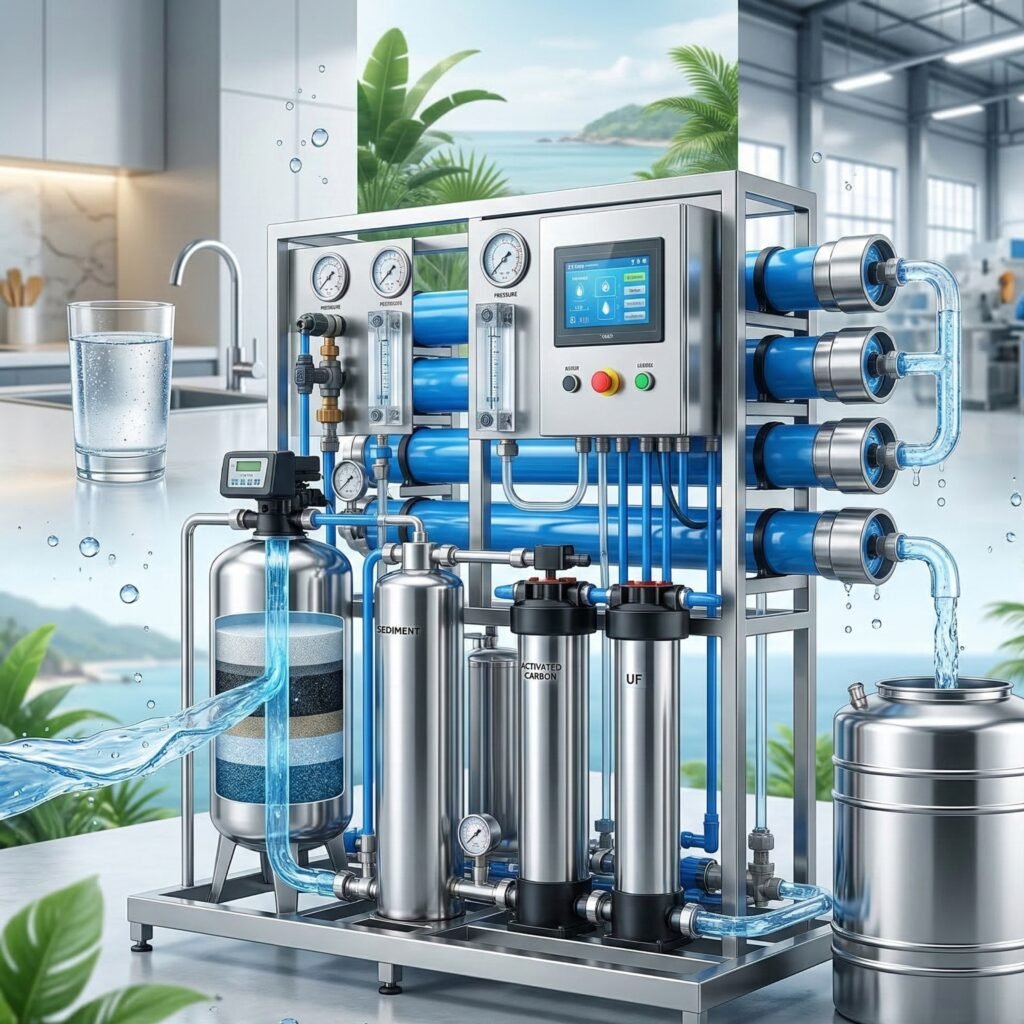
Udupi's Key Sectors and Water Treatment Requirements
Manipal University – India’s Largest Private University Campus
Manipal Academy of Higher Education (MAHE), known as Manipal University, is one of India’s most significant private university ecosystems – with medical, engineering, pharmacy, management, and humanities faculties hosting over 28,000 students from 57 countries across its Manipal campus.
This creates a water treatment requirement that is simultaneously residential-institutional, healthcare-clinical, and research-laboratory in character:
Student and staff drinking water (campus-wide): A campus community of 28,000+ students in residential hostels, eating at campus canteens, requires reliable, safe purified water at institutional scale. A centralised community or institutional RO plant of 3,000–10,000 LPH supplying purified water to hostel blocks, canteen distribution points, and classroom buildings is the appropriate infrastructure.
Research laboratory water: Manipal’s science, engineering, and pharmacy faculties run analytical laboratories requiring ISO 3696 Type 2 water (conductivity below 1 μS/cm) for general analytical work and Type 1 for high-precision techniques. Laboratory water systems – central RO supply with in-lab ultrapure polishing – are the standard approach for research university settings. See TDS levels for different industries for laboratory water specifications.
International student expectations: With students from 57 countries, Manipal’s campus population includes a significant international cohort with high drinking water quality expectations. Purified water meeting WHO and BIS standards, dispensed through SS304 tanks and quality point-of-use dispensers, is the standard for a globally positioned university.
Typical requirement: 3,000–10,000 LPH institutional community RO plant; laboratory water systems; distributed water dispensers throughout campus
Kasturba Medical College Hospital (KMC Manipal) – Tertiary Healthcare
KMC Manipal is one of India’s most significant tertiary care hospitals – a 2,000+ bed teaching hospital attached to Manipal’s medical college. The hospital’s water treatment requirements span every healthcare application from drinking water safety to the most stringent clinical water specifications.
Dialysis unit water: KMC’s nephrology department operates dialysis services where a patient is exposed to 120–150 litres of water per dialysis session – water that interacts directly with the bloodstream through the dialysis membrane. AAMI-compliant water quality (bacterial count below 100 CFU/mL, endotoxin below 0.25 EU/mL) is a patient safety requirement, not a convenience. See hospital water treatment solutions.
CSSD and autoclave water: Surgical instrument sterilisation in a hospital of KMC’s scale consumes significant volumes of softened water. Udupi’s laterite borewell hardness (150–400 mg/L as CaCO₃) causes rapid autoclave scaling without softener pre-treatment – compromising sterilisation quality and dramatically shortening autoclave life.
Pharmaceutical preparation water: Where KMC’s in-house pharmacy prepares IV fluids or injectable solutions, Indian Pharmacopoeia Purified Water specifications apply – conductivity below 1.3 μS/cm. This requires at minimum a double-pass RO system with SS316L distribution loop.
NABH compliance documentation: KMC maintains NABH accreditation – water quality management documentation is part of the NABH assessment. Bangalore Aqua provides NABH-compatible water quality reporting as standard with every hospital AMC cycle.
Typical requirement: Multi-system hospital water infrastructure – commercial/industrial RO for drinking (1,000–3,000 LPH), AAMI-compliant dialysis system, CSSD water softener, pharmacy purified water system; all with NABH documentation
UPCL – Udupi Power Corporation Limited
UPCL operates a 1,200 MW coal-based thermal power plant near Udupi – one of the largest power generation facilities on Karnataka’s coast. Thermal power plants are among the most water-intensive industrial operations in existence.
Cooling tower makeup water: UPCL’s cooling towers require enormous volumes of treated makeup water. Scale prevention in cooling tower heat exchangers is critical for plant efficiency and equipment life. Water softening and chemical scale inhibitor treatment of cooling tower makeup water is standard practice in correctly operated power plants.
Boiler feed water: High-pressure utility boilers in power generation require ultra-pure boiler feed water – at operating pressures above 100 bar (supercritical and ultra-supercritical boilers), feed water TDS requirements are below 0.1 mg/L and conductivity below 0.1 μS/cm. Treatment train: clarification → filtration → softening → RO → mixed bed deionisation → degasification.
Auxiliary water (potable and sanitation): The large workforce at UPCL’s plant requires safe drinking water for Factories Act compliance, canteen operations, and welfare facilities.
While large power plant water treatment of UPCL’s scale involves specialised boiler chemistry and plant-specific engineering beyond standard industrial RO packages, Bangalore Aqua’s industrial water treatment expertise covers the auxiliary and boiler pre-treatment components. Contact our industrial projects team to discuss specific UPCL auxiliary water treatment requirements.
Seafood Processing and Coastal Food Industry
Udupi district’s coast – from Kaup to Kundapur – has significant fishing communities and seafood processing operations. Like Baikampady in Mangaluru, seafood export operations in Udupi require MPEDA-compliant potable process water with zero detected coliforms and NABL-certified water quality documentation.
Iron removal from laterite borewell sources is the critical pre-treatment requirement – orange-coloured water from laterite borewells cannot contact export seafood without causing product rejection.
Udupi food specialties: Beyond seafood, Udupi is the origin of India’s Udupi cuisine tradition – papad manufacturers, coconut product processors, and masala manufacturers in the district use water as a process ingredient in food preparation operations that must meet FSSAI standards.
Typical requirement: Iron removal + commercial or industrial RO plant 500–2,000 LPH; FSSAI/MPEDA documentation; SS316 storage for coastal applications
Coastal Hotels and Religious Tourism Hospitality
Udupi’s combined religious tourism (Sri Krishna Temple pilgrim traffic, which is substantial year-round) and coastal leisure tourism (Malpe Beach, Kaup Beach, delta area resorts) creates a significant hospitality cluster ranging from budget pilgrim accommodation to premium coastal resorts.
For coastal hotels and resorts within 3 km of the sea, Bangalore Aqua specifies SS316 storage tanks as standard – the same coastal corrosion protection it specifies for Mangaluru’s coastal hospitality sector. See does SS316 stainless steel rust with RO water? for technical detail.
Typical requirement: Commercial RO plant 250–1,000 LPH; building-level water softener; SS316 tanks for coastal installations; iron removal pre-treatment from laterite borewell sources
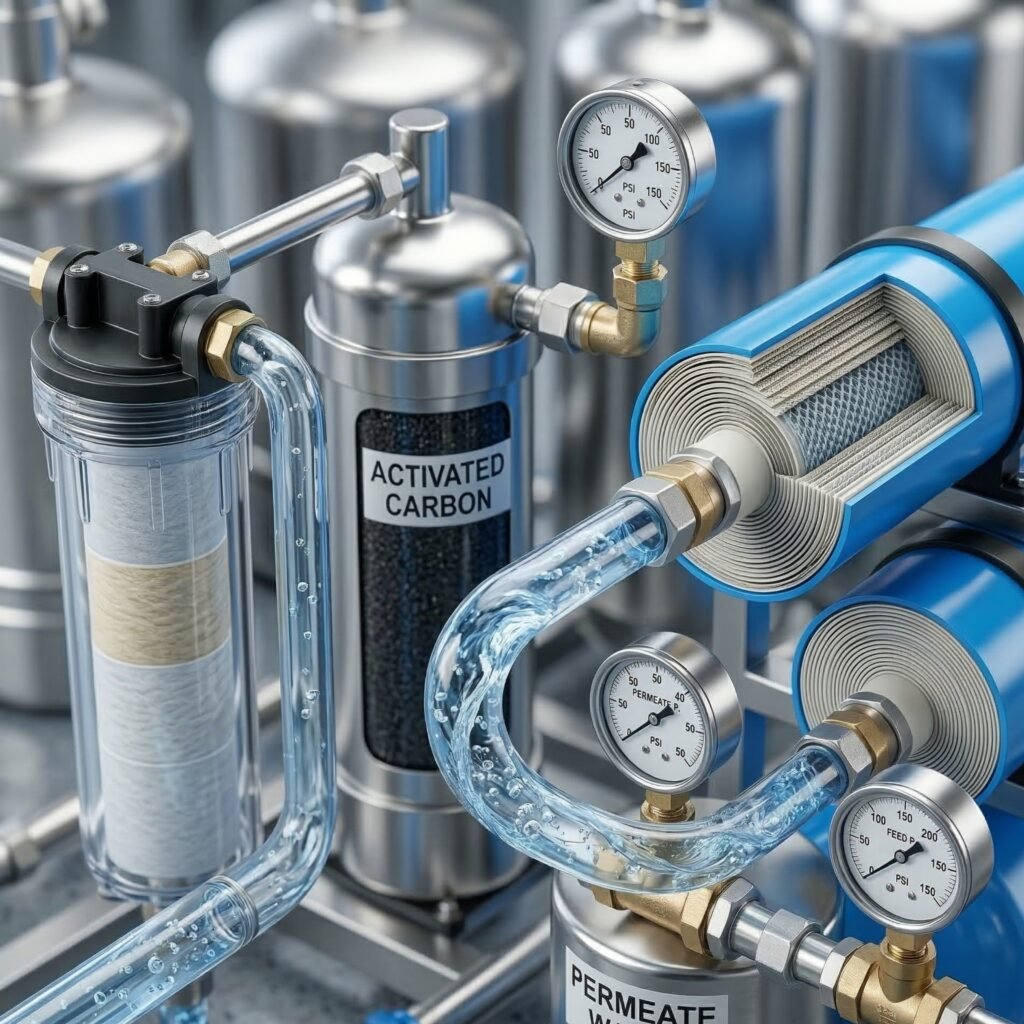
Pre-Treatment: What Udupi's Laterite Borewell Water Requires
For every Bangalore Aqua installation in Udupi district drawing from laterite borewell sources, the pre-treatment train includes:
Iron removal (standard for Udupi laterite sources): Aeration oxidation filter with greensand media or oxidation-filtration unit, sized for the full system feed flow rate. Iron removal is not optional for Udupi laterite sources – it protects softener resin from permanent iron fouling and protects RO membranes from iron fouling that destroys them within months.
Multimedia sediment filter: Dual-media (sand + anthracite) pressure filter for turbidity reduction after iron oxidation.
Activated carbon filter: Coconut shell GAC for organic compound and taste/odour control. Relevant for Udupi sources where agricultural land use influences shallow borewell chemistry.
Water softener: For Udupi laterite borewell hardness (150–400 mg/L), a water softener with Fleck or Clack multiport valve and quality resin protects the RO membrane from carbonate scaling.
Anti-scalant dosing: Polymer anti-scalant as secondary protection.
Cartridge pre-filters (5 micron + 1 micron): Standard final polishing stage.
Storage: SS316 tanks for coastal proximity; SS304 minimum for all applications.
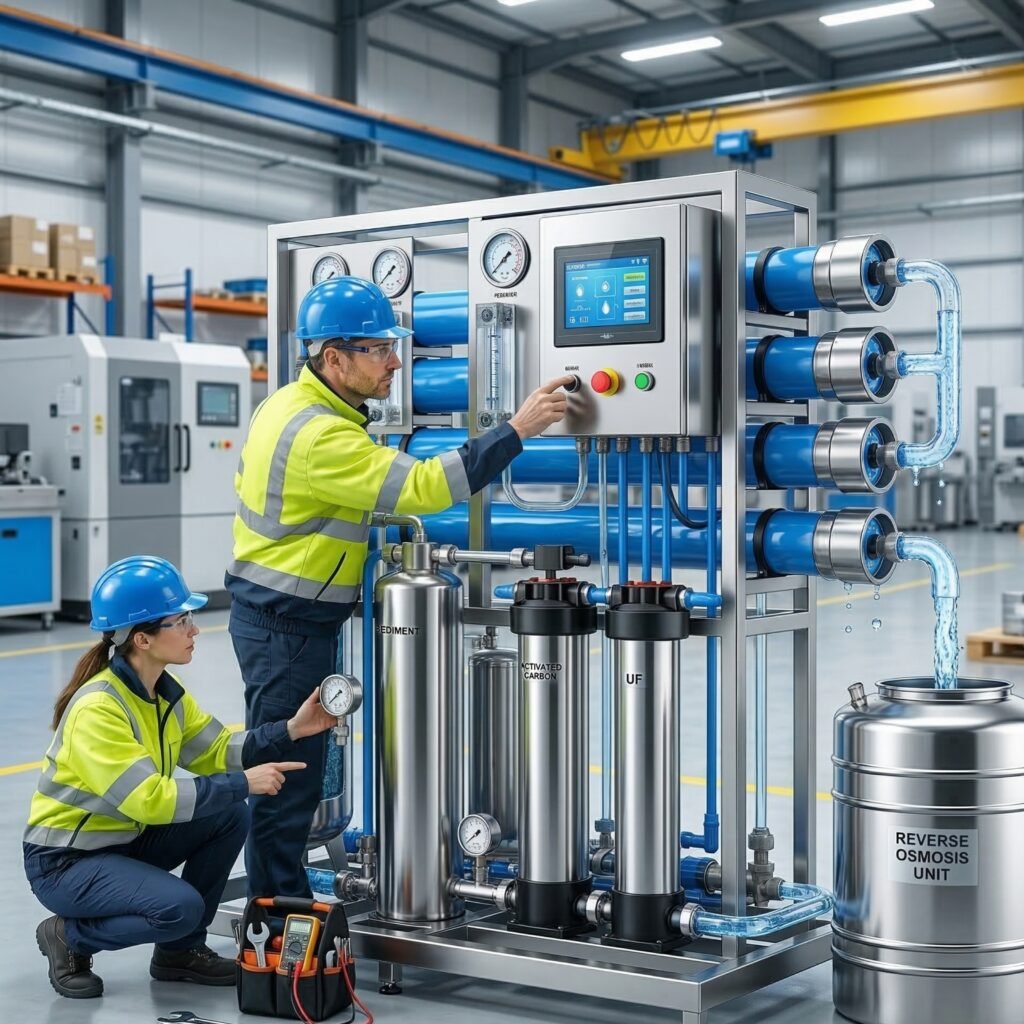
Industrial RO Plant Pricing - Udupi 2026
Capacity | Application | Daily Output | Indicative Cost |
250–500 LPH | Coastal hotel, restaurant, clinic | 2,000–5,000 L | ₹2–₅ lakh |
500–1,000 LPH | Mid-size hotel, seafood unit, small institution | 4,000–10,000 L | ₹4.5–₁0 lakh |
1,000–2,000 LPH | Hospital auxiliary, large hotel, college block | 8,000–20,000 L | ₹9–₂0 lakh |
2,000–5,000 LPH | University hostel cluster, large hospital, seafood processor | 16,000–50,000 L | ₹20–₅5 lakh |
5,000+ LPH | University campus central plant, UPCL auxiliary, large institution | 40,000+ L | Custom quote |
Udupi pricing includes iron removal pre-treatment (standard for laterite borewell sources) and SS316 tank specification for coastal proximity. Contact Bangalore Aqua for a Udupi site-specific proposal after NABL water testing.
Coverage: Udupi District and Surrounding Coastal Districts
Bangalore Aqua’s Udupi service covers the full district:
- Udupi city and Manipal – institutional, healthcare, commercial
- Kundapur – seafood processing, agro-industrial, coastal
- Karwar – Uttara Kannada coastal coverage
- Karkala, Hebri, Brahmavar – light industrial and commercial
- Kaup, Malpe, Padubidri – coastal hospitality and fishing
- Mangaluru and Dakshina Kannada – adjacent district coverage
- Frequently Asked Questions
Our Manipal University hostel block houses 2,000 students. What community water plant do we need?
A 2,000-student residential hostel block requires approximately 10,000–14,000 litres of safe drinking water per day (at 5–7 litres per student). A 1,000–1,500 LPH community or institutional RO plant producing 10,000–15,000 litres per 10-hour operating day, with SS304 storage tanks and a distribution pump to hostel floor dispensers, is the appropriate infrastructure. For Udupi’s laterite borewell sources, full iron removal pre-treatment is included as standard. Contact Bangalore Aqua for a Manipal campus site assessment.
KMC Manipal is considering a new dialysis water system. What are your specifications?
For a dialysis unit at KMC scale, Bangalore Aqua designs AAMI TIR34-compliant systems: softener pre-treatment (essential for Udupi borewell hardness), dedicated dialysis-grade RO membrane selection, UV disinfection, SS316L electropolished recirculating distribution loop, point-of-use endotoxin-retentive filters at each machine connection, and the full AAMI monitoring and documentation programme. We work with the KMC nephrology team and infection control officer to align clinical requirements with engineering specification before any system is designed. Contact +91 76763 93939.
Our coastal resort in Malpe has SS304 tanks that have developed orange spots after 8 years. What happened and what should we replace them with?
The orange spots are pitting corrosion – a characteristic failure mode of SS304 exposed to coastal salt spray containing chloride. SS304 lacks the molybdenum content that resists chloride-induced pitting; over 5–15 years in a coastal environment within 3 km of the sea, localised pitting can develop at surface defects. Replacement tanks should be SS316 – which has 2% molybdenum, providing the chloride resistance that SS304 lacks. See does SS316 stainless steel rust with RO water? for the full technical explanation. Contact Bangalore Aqua for a Malpe site assessment and SS316 tank supply.
Our seafood processing unit near Kundapur has orange-coloured borewell water. Can we use it after RO treatment?
Yes – with appropriate pre-treatment. The orange colour is iron (0.5–2.5 mg/L range is typical for Udupi laterite borewells). The treatment train is: aeration oxidation or iron filter (removes iron before it can foul the softener or membrane) → multimedia sediment filter → carbon filter → water softener → 5-micron and 1-micron cartridge filters → RO plant → UV disinfection. The output water is iron-free, TDS compliant with BIS 10500, and zero-coliform – meeting MPEDA and FSSAI requirements for seafood export processing. Bangalore Aqua’s Udupi specifications include iron removal as standard for all laterite borewell applications.
Can Bangalore Aqua service systems in the entire Udupi district including Kundapur and Karwar?
Yes – Bangalore Aqua’s coastal Karnataka service coverage extends from Mangaluru through Udupi and Kundapur to Karwar (Uttara Kannada). Karwar is covered under Uttara Kannada service. For the Udupi district, quarterly AMC visits are coordinated as dedicated coastal Karnataka field trips. Emergency parts dispatch from Bengaluru reaches Udupi and Kundapur next working day; Bangalore Aqua’s remote support (phone/WhatsApp/video) provides immediate guidance for urgent troubleshooting while field support is arranged.
Book Your Free Udupi Industrial RO Plant Assessment
📞 +91 76763 93939 | +91 97387 04753 📧 info@bangaloreaqua.com 🌐 bangaloreaqua.com 📍 Manufacturing base: 107/209 2nd Cross, 4th Main Kogilu Layout, Bengaluru – 560064
Free Udupi site assessment, NABL-accredited water testing (iron, TDS, hardness, coliform, E. coli, and coastal-specific parameters), and a complete specification proposal – no obligation.
About Bangalore Aqua | Our Karnataka presence | Gallery | Brochure
Also See:
- RO Water Treatment Plant Supplier Mangaluru
- Best RO Water Treatment Supplier Dakshina Kannada
- RO Water Treatment Plant Uttara Kannada Karwar
- Does SS316 Stainless Steel Rust with RO Water?
- Water Treatment Solutions for Hospitals
- Community RO Water Plant Karnataka
- Best Industrial RO Plant Manufacturer Bangalore