You specified 316 stainless steel for your RO water storage tanks, distribution pipework, or pharmaceutical water system because you were told – correctly – that it is one of the most corrosion-resistant alloys available for aqueous environments. You paid a premium over standard 304 stainless steel specifically because of that corrosion resistance. You were confident the material was right for the application.
And then one day you notice it. A reddish-brown stain on the inner surface of your SS tank. A tiny pit in your distribution pipework. A suspicious discoloration in the weld zone of your RO storage vessel. And the question that immediately follows is one that confuses engineers, procurement managers, and plant operators across pharmaceutical manufacturing, food processing, and water treatment facilities all over India:
How is 316 stainless steel rusting – in a system that uses the purest water available?
The answer involves a counterintuitive truth that catches many people completely off guard: in certain conditions, RO water – precisely because of its extraordinary purity – can actually be more corrosive to stainless steel than ordinary tap water. Not despite being pure, but because of it.
In this complete guide, Bangalore Aqua explains what 316 Stainless Steel Rust with RO Water is, what RO water is, why and how corrosion can occur when the two interact, the specific types of corrosion to watch for, and exactly what to do to prevent rust in your RO water system – whether you are managing a pharmaceutical water system, an industrial RO plant, or a commercial water treatment installation.
What Is 316 Stainless Steel?
Stainless steel is not a single material – it is a family of iron-based alloys defined by their chromium content (minimum 10.5% by weight), which gives the material its characteristic corrosion resistance through the formation of a thin, self-repairing chromium oxide passive layer on the steel’s surface.
316 stainless steel is a specific austenitic stainless steel grade defined by its chemical composition – and the defining ingredient that distinguishes it from the more common 304 grade is molybdenum.
The Role of Molybdenum
Standard 304 stainless steel contains approximately 18% chromium and 8% nickel – giving it good general corrosion resistance. 316 stainless steel adds 2–3% molybdenum to this composition – and that addition makes a significant difference.
Molybdenum enhances the stability and integrity of the chromium oxide passive layer – particularly in the presence of chlorides and other halide ions that are the primary cause of localised corrosion (pitting) in stainless steel. The passive layer on 316 SS is more resistant to breakdown by chlorides than the layer on 304 SS – which is why 316 is the standard material of choice for marine environments, pharmaceutical water systems, food processing equipment, and chemical processing where chloride exposure is a concern.
Key Properties of 316 Stainless Steel
| Property | 316 Stainless Steel |
| Chromium Content | 16 – 18% |
| Nickel Content | 10 – 14% |
| Molybdenum Content | 2 – 3% |
| Tensile Strength | 515 MPa minimum |
| Corrosion Resistance | Excellent – superior to 304 in chloride environments |
| Temperature Range | -196°C to +870°C |
| Common Applications | Pharmaceutical, food processing, marine, RO systems, chemical processing |
| Common Variants | 316L (low carbon – preferred for welded applications) |
The 316L variant – low carbon 316 – is particularly important for welded applications like tanks and pipework. Reducing the carbon content below 0.03% prevents carbide precipitation at weld heat-affected zones – a phenomenon that can sensitise the material and create localised corrosion susceptibility along weld lines.
The Passive Layer – 316 SS’s Corrosion Defence Mechanism
The corrosion resistance of 316 SS corrosion RO water is not inherent in the bulk metal – it depends entirely on the integrity of the chromium oxide passive layer that forms spontaneously on the steel’s surface when it is exposed to oxygen. This passive layer is extraordinarily thin – approximately 1–3 nanometres – but when intact and stable, it is remarkably effective at isolating the underlying metal from corrosive attack.
The passive layer is self-repairing – when it is scratched or damaged in the presence of sufficient oxygen, it reforms spontaneously. However, in certain chemical environments – including, as we are about to explain, certain RO water conditions – this passive layer can be destabilised, locally breached, or prevented from reforming – allowing corrosion to initiate and progress.
What Is RO Water?
Reverse Osmosis water is water that has been purified by forcing it under high pressure through a semi-permeable membrane that rejects virtually all dissolved substances – including minerals, salts, organic compounds, bacteria, and viruses – while allowing only water molecules through.
The Low TDS Reality of RO Water
The result of this process is water of extraordinary chemical purity. While typical municipal tap water in Bangalore has TDS of 150–500 mg/L and borewell water can be 500–2000+ mg/L, well-produced RO water typically has TDS of just 5–50 mg/L. In pharmaceutical-grade double-pass RO or RO + EDI systems, TDS can be below 1 mg/L and conductivity below 0.1 μS/cm.
This purity is exactly what makes RO water valuable for pharmaceutical manufacturing, food and beverage processing, electronics manufacturing, laboratory use, and high-quality drinking water – the virtual absence of dissolved contaminants means the water will not introduce ionic, organic, or biological contamination into products or processes.
What RO Water Lacks – And Why It Matters for Corrosion
Understanding what RO water does not contain is as important as understanding what it does contain – because those absences have significant implications for how the water interacts with the materials it contacts.
No calcium and magnesium – The hardness minerals that form a thin protective scale layer on the inner surfaces of pipes and tanks in ordinary water systems are completely absent from RO water. In tap water systems, this mineral scale – while a nuisance in appliances – actually provides a degree of passive protection to metal surfaces by physically separating them from the water.
No bicarbonate alkalinity – RO water has virtually no carbonate or bicarbonate content – meaning it has essentially zero buffering capacity. Its pH can shift rapidly and dramatically in response to even small inputs of acidic or alkaline substances – including carbon dioxide from the atmosphere dissolving into the water.
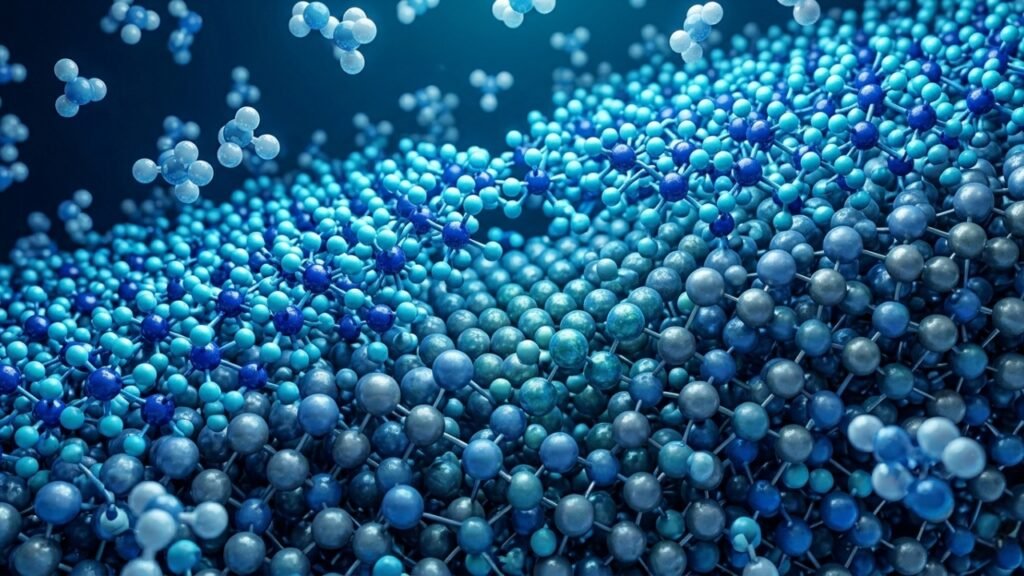
Very low ionic strength – The near-complete absence of dissolved ions makes RO water chemically aggressive in a way that higher-mineral water is not – a phenomenon known as the aggressive water effect that we will explain in detail in the next section.
Does 316 Stainless Steel Rust with RO Water?
Here is the direct answer:
Under normal, correctly designed, and properly maintained conditions – No. 316 stainless steel does not rust with RO water and is an entirely appropriate material for RO water storage and distribution systems.
However – under specific conditions that are more common than most people realise – Yes, 316 stainless steel can and does corrode in RO water systems. And when it does corrode, it is often more rapid and more localised than corrosion seen in systems handling lower-purity water.
This is the counterintuitive truth that the introduction referenced – and understanding why it happens requires understanding the specific mechanisms by which RO water can attack stainless steel under the wrong conditions.
Why Corrosion Happens – The Real Causes
Cause 1 – Aggressive Water Effect (Low Mineral Content)
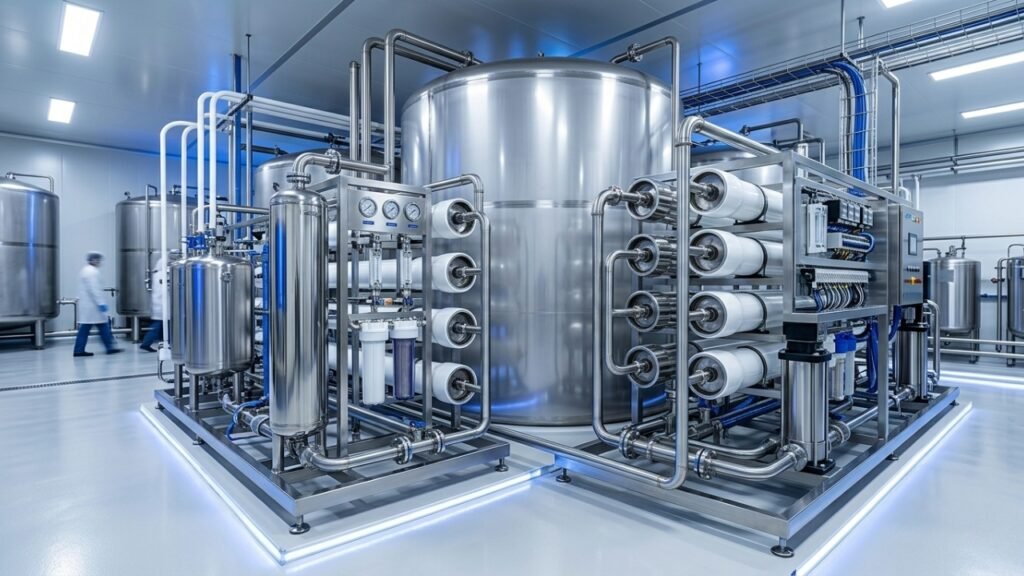
This is the most fundamental and most misunderstood cause of corrosion in RO water systems. High-purity, low-TDS water is thermodynamically “hungry” – because of its very low ionic concentration, it has a high driving force to dissolve ions from any surface it contacts. This is a well-documented phenomenon in water chemistry known as aggressive or corrosive water.
The Langelier Saturation Index (LSI) – a measure of water’s tendency to either deposit scale or dissolve minerals – is strongly negative for RO water, indicating highly aggressive, scale-dissolving characteristics. Where tap water with moderate hardness might have an LSI close to zero (balanced) or slightly positive (scale-forming), RO water with near-zero alkalinity and hardness has an LSI of -2.0 or lower – meaning it is actively trying to dissolve minerals from everything it contacts.
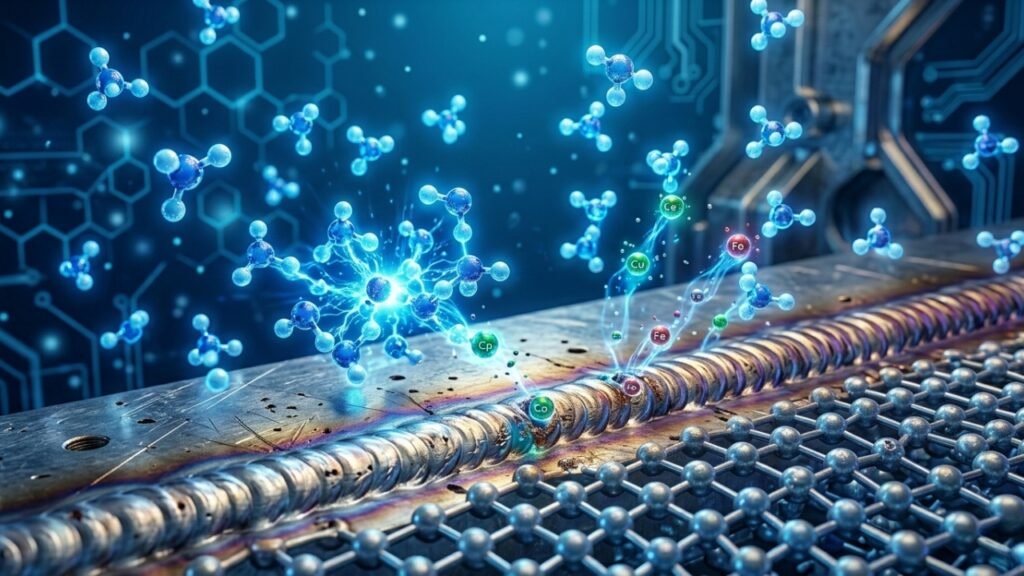
In a stainless steel system, this aggressive water effect means RO water is more likely to attack and dissolve the chromium oxide passive layer – particularly at any point where the layer is thin, damaged, or incompletely formed. Once a breach occurs in the passive layer, the aggressive water accelerates corrosion at that point rather than allowing the layer to self-repair in the way it would in a more benign water environment.
Cause 2 – Dissolved Oxygen
Dissolved oxygen in RO water plays a dual and paradoxical role in stainless steel corrosion.
On one hand, oxygen is essential for the formation and maintenance of the chromium oxide passive layer – without sufficient dissolved oxygen, the passive layer cannot form or reform after damage, leaving the underlying steel vulnerable.
On the other hand, in systems where the passive layer has already been locally breached – through aggressive water attack, surface defects, or chloride contamination – dissolved oxygen drives the electrochemical corrosion reaction at the breach point, accelerating metal dissolution and pit growth.
The challenge in 316 SS pitting corrosion RO water systems is that dissolved oxygen levels can vary significantly – particularly in systems with stagnant zones, dead legs, or inadequate recirculation – creating localised low-oxygen environments where passive layer maintenance is compromised while the aggressive water effect continues to attack the metal surface.
Cause 3 – Chloride Contamination
Chloride ions are the primary enemy of the stainless steel passive layer – and their presence in an RO water system, even at trace concentrations, significantly elevates corrosion risk.
Chlorides can enter an RO water system from several sources that are often overlooked:
Membrane breakthrough – If the RO membrane is degraded, incorrectly installed, or bypassed, chloride-containing feed water can pass through to the product water side – introducing chlorides into what should be a chloride-free system.
Sanitisation chemical residues – Some sanitisation protocols use hypochlorite (bleach) solutions. Incomplete rinsing after sanitisation can leave chloride residues in the system that subsequently contaminate the stored water.
Atmospheric contamination – In coastal environments like Karwar and Uttara Kannada, airborne salt particles can enter tanks through poorly sealed vents – introducing chlorides directly into RO water storage.
Cross-contamination from process chemicals – In pharmaceutical and industrial settings, process chemical spillage or incorrect valve operation can introduce chloride-containing substances into the water system.
Even trace chloride concentrations – at levels completely harmless from a water quality perspective – can be sufficient to initiate pitting corrosion on 316 SS surfaces, particularly at points where the passive layer is already compromised by aggressive water attack or surface defects.
Cause 4 – Poor Surface Finish
The condition of the stainless steel surface – its roughness, finish quality, and freedom from surface defects – has a major influence on its susceptibility to corrosion in RO water service.
Rough, unpolished, or mechanically damaged surfaces have microscopic peaks, valleys, crevices, and defects where the chromium oxide passive layer is thinner, less uniform, and more susceptible to aggressive water attack and chloride penetration. Standard electro-polished or mechanically polished surfaces (Ra ≤ 0.8 μm for pharmaceutical applications) maintain a more uniform, stable passive layer that is significantly more resistant to corrosion initiation.
Scratches from improper cleaning – using steel wool, abrasive pads, or wire brushes – are a common and entirely preventable source of surface damage that dramatically increases corrosion susceptibility. Even embedded iron particles from steel tooling used on the stainless steel surface can initiate rust formation by creating galvanic micro-cells on the surface.
Cause 5 – Welding Defects and Heat-Affected Zones
Welding is one of the most critical and most commonly problematic aspects of stainless steel fabrication for water system applications. The heat generated during welding creates several specific corrosion risks:
Carbide precipitation (sensitisation) – In standard 316 SS (not 316L), the heat of welding can cause carbon to migrate to grain boundaries and form chromium carbide – depleting chromium from the surrounding material and creating chromium-depleted zones that cannot form an adequate passive layer. This sensitised material is highly susceptible to intergranular corrosion.
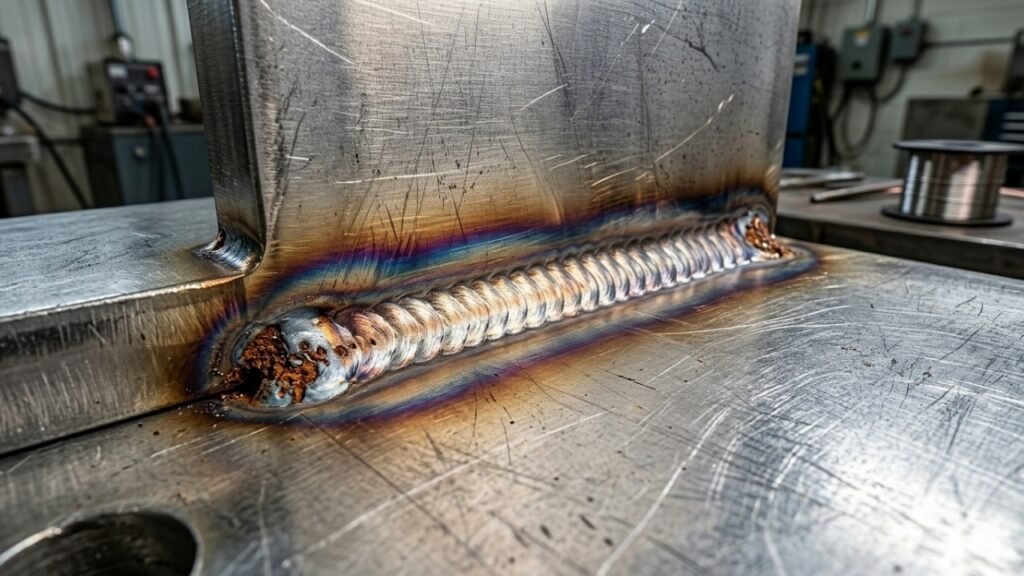
Heat tint and oxide scale – The coloured oxidation (heat tint) visible in the heat-affected zone around welds contains chromium-depleted oxide phases that are corrosion-susceptible. Heat tint must be removed by grinding, pickling, or passivation before the surface returns to full corrosion resistance.
Weld pool contamination – Weld contamination from atmospheric oxygen, moisture, or surface contamination introduces defects in the weld metal that can initiate corrosion.
Root side oxidation – In tube and pipe welds, the inner (root) surface of the weld is often not accessible for post-weld treatment – leaving heat-affected oxide scale in direct contact with the flowing water. Purge gas protection during welding is essential to prevent root-side oxidation in pharmaceutical and RO water pipework.
Types of Corrosion in 316 SS RO Water Systems
Understanding the specific types of corrosion that occur in RO water systems helps you identify them early – before they cause significant damage or water quality failures.
Pitting Corrosion
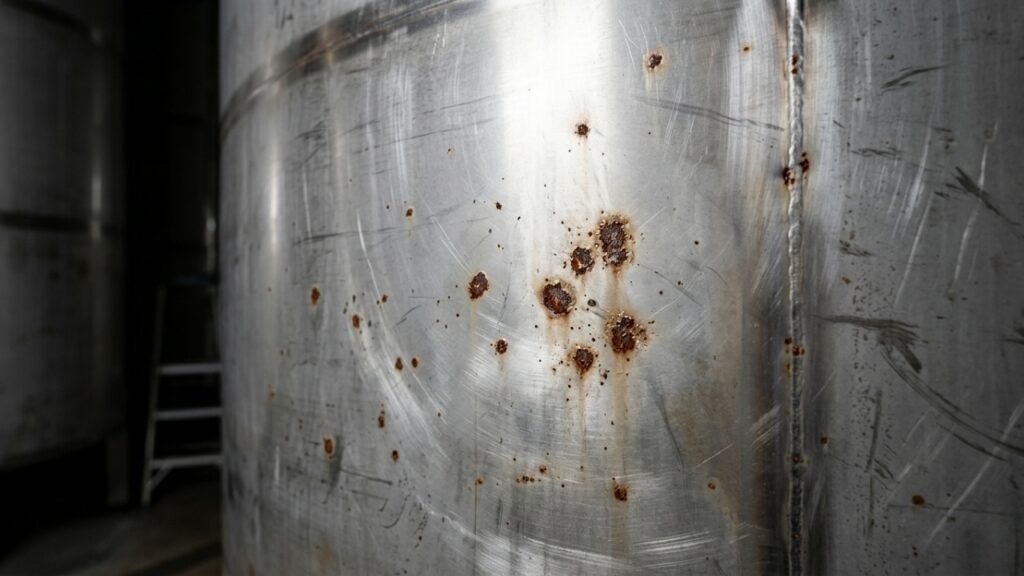
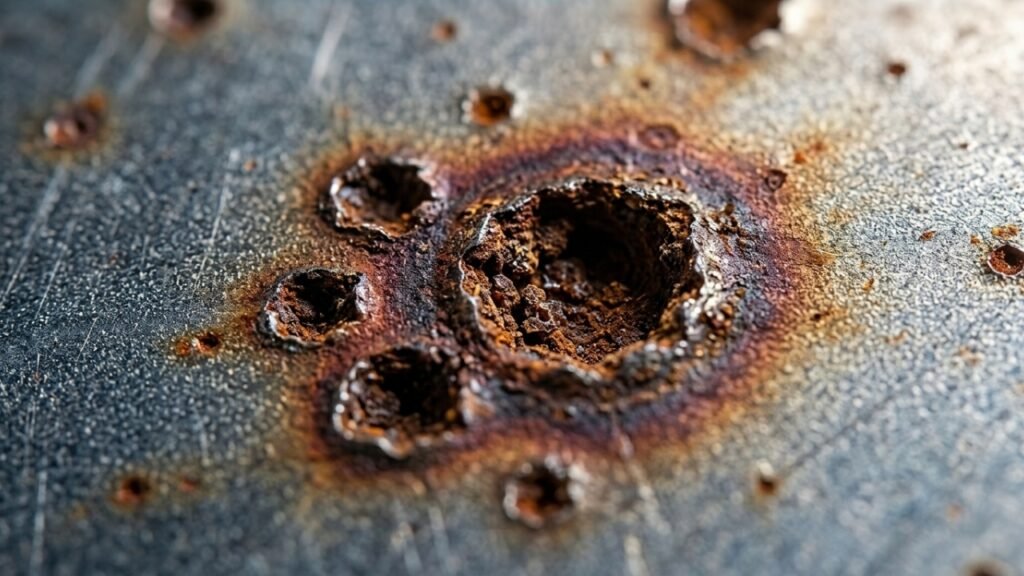
Pitting corrosion is the most common and most insidious form of corrosion in 316 SS RO water systems. It begins at a localised point on the stainless steel surface – typically where the passive layer has been breached by chloride attack, surface damage, or aggressive water dissolution – and progresses downward into the metal as a small, deep pit while the surrounding surface remains apparently intact.
Pitting is particularly dangerous because it is self-accelerating. The chemistry inside a growing pit – depleted in oxygen, enriched in metal ions and chlorides – creates a local environment that actively drives further dissolution. Meanwhile the surrounding metal surface remains passive and apparently undamaged, making pitting easy to miss in visual inspection until the pit is already deep.
In a storage tank or distribution pipe, undetected pitting eventually perforates the vessel or pipe wall – causing leaks that contaminate the surrounding environment and can introduce corrosion products into the water stream, causing batch failures or product contamination in pharmaceutical applications.
Visual indicators: Small, reddish-brown spots or stains on the stainless steel surface, often surrounded by a small zone of discoloration. The spots may appear minor on the surface while significant depth has developed beneath.
Crevice Corrosion
Crevice corrosion occurs at geometrical features that create narrow gaps or crevices where water can stagnate – under gaskets, at flange faces, between overlapping surfaces, at pipe support contact points, in threaded connections, and at any location where a tight space restricts water circulation and oxygen replenishment.
In a crevice, the stagnant water becomes depleted in oxygen over time – preventing passive layer maintenance – while remaining in contact with the metal surface. The aggressive character of RO water makes this depletion particularly rapid. As the passive layer breaks down in the oxygen-depleted crevice, corrosion initiates and accelerates – with the tight geometry of the crevice concentrating the corrosion products and creating an increasingly aggressive local chemistry.
Crevice corrosion is a design and fabrication issue as much as a materials issue – eliminating crevices from the design of RO water tanks and distribution systems is a fundamental corrosion prevention measure.
Common locations: Under saddle-type pipe supports, at flange face gasket edges, in threaded fittings, under improperly installed clamp connections, and at any surface overlap or contact point.
Stress Corrosion Cracking (SCC)
Stress corrosion cracking is the simultaneous action of tensile stress and a corrosive environment – producing brittle cracking in a material that would not crack under stress alone in a non-corrosive environment and would not corrode significantly without the stress.
Austenitic stainless steels including 316 SS are susceptible to stress corrosion cracking in chloride-containing environments – particularly at elevated temperatures. The combination of residual fabrication stresses (from forming, welding, or cold working), chloride contamination in the water, and temperature creates conditions where fine, branching cracks propagate through the material rapidly and without visible surface corrosion warning.
SCC is most commonly seen in heated sections of RO water distribution systems – hot water sanitisation loops, heat exchangers, and water for injection distribution systems operating at ≥ 80°C – where the combination of thermal stress, sensitisation from repeated heating cycles, and any chloride contamination creates SCC risk.
Visual indicators: Fine, branching crack patterns on the surface – often visible only under magnification until the crack propagates to failure. SCC failure typically appears sudden and catastrophic with minimal visible surface corrosion preceding it.
How to Prevent Rust in 316 SS RO Water Systems
Prevention 1 – Proper Passivation
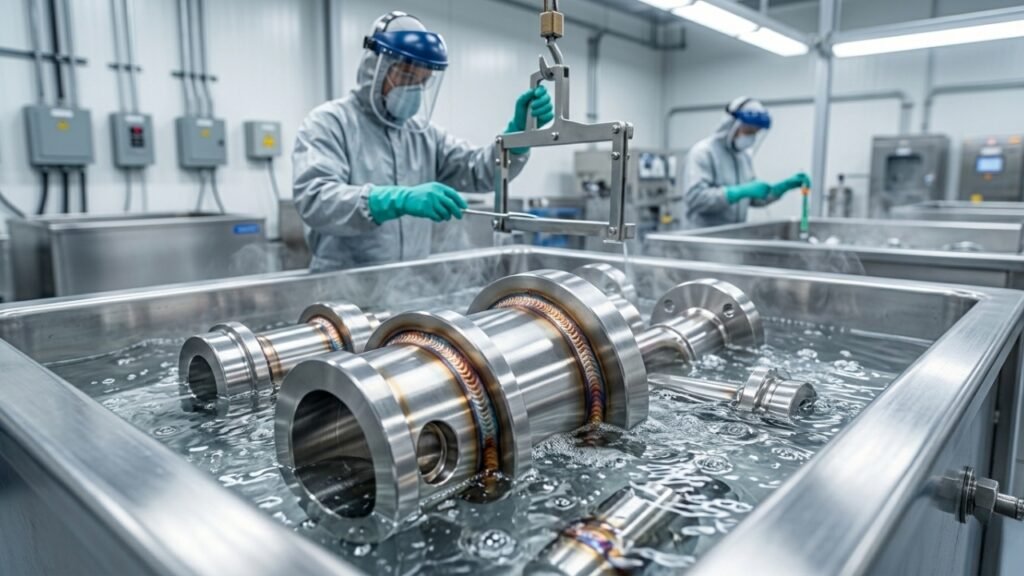
Passivation is the chemical treatment process that removes free iron, contamination, and heat tint from the stainless steel surface and promotes the formation of a thick, uniform, stable chromium oxide passive layer. It is a non-optional step in the commissioning of any new rust in 316 SS RO water system – and a periodic maintenance requirement throughout the system’s operational life.
Standard passivation procedure for 316 SS:
Cleaning – Remove all organic contamination, oils, and particulates from the surface using a suitable alkaline cleaner, followed by a thorough water rinse.
Pickling (if required) – For surfaces with heat tint, weld scale, or embedded iron contamination, acid pickling using a nitric acid / hydrofluoric acid solution or proprietary pickling paste removes the contaminated surface layer and exposes fresh, chromium-rich material.
Passivation treatment – Immersion or circulation of a nitric acid solution (typically 20–30% HNO₃ at 50–60°C for 30 minutes) or citric acid solution (an increasingly preferred alternative for safety and environmental reasons) dissolves free iron from the surface and promotes the formation of a thick, stable chromium oxide passive layer.
Rinse and verification – Thorough rinsing with high-purity water followed by verification testing – using ferroxyl test or ASTM A967 test methods – to confirm passive layer integrity before the system is placed in service.
For pharmaceutical water systems, passivation is a GMP requirement with documented procedures, acceptance criteria, and qualification records. For industrial and commercial RO water systems, passivation is an engineering best practice that significantly reduces corrosion risk and extends system life.
Prevention 2 – Maintain Appropriate pH
RO water with very low alkalinity has essentially no pH buffering – meaning it is susceptible to rapid pH drops as CO₂ from the atmosphere dissolves into it, producing carbonic acid and driving pH below 6.0. At low pH, the aggressive water attack on the passive layer accelerates significantly.
Maintaining pH in the range of 6.5–8.0 in RO water storage and distribution significantly reduces the corrosive aggressiveness of the water toward stainless steel. For pharmaceutical water systems, pH adjustment using degassing (CO₂ removal by membrane degasser or N₂ sparging) is the preferred approach – avoiding chemical addition that could affect water purity. For industrial and commercial systems, controlled alkali dosing can be considered.
Prevention 3 – Eliminate Chloride Contamination
Chloride control is the most critical ongoing operational measure for preventing pitting corrosion in 316 SS RO water systems. Key practices include:
Monitor RO membrane integrity continuously – Conductivity monitoring of RO permeate detects membrane breakthrough before chloride contamination of the product water reaches levels that initiate corrosion.
Use only chloride-free sanitisation chemicals – Peracetic acid is the preferred sanitisation agent for 316 SS pharmaceutical water systems – it is effective against biofilm and microorganisms without the chloride contamination risk of hypochlorite-based products. If hypochlorite is used, ensure rigorous flushing protocols with documented rinse water conductivity verification.
Seal all tank vents properly – In coastal environments, atmospheric salt contamination through unsealed or inadequately filtered tank vents is a significant chloride source that is easily eliminated with appropriate vent filtration.
Maintain system integrity – Prevent cross-contamination from process chemicals through correct valve tagging, line identification, and operational procedures.
Prevention 4 – Specify the Right Material Grade for Your Application
316L – not standard 316 – should be specified for all welded components in RO water systems. The low carbon content of 316L prevents carbide precipitation in heat-affected zones, eliminating sensitisation as a corrosion risk at welds.
For applications with particularly aggressive water chemistry – very high purity systems, elevated temperature service, or environments with unavoidable chloride exposure risk – consider upgrading to higher-alloyed materials:
Duplex Stainless Steel (e.g., 2205) – Approximately twice the yield strength of 316L with significantly better pitting and stress corrosion cracking resistance. A strong choice for high-temperature WFI distribution systems and marine-environment RO installations.
Super Austenitic Stainless Steel (e.g., 904L, 254 SMO) – Higher molybdenum content (4–6%) provides exceptional chloride and pitting resistance for the most demanding applications.
Electropolished 316L – Electropolishing removes the outermost layer of surface material to produce an ultra-smooth, chromium-enriched surface with superior passive layer quality – significantly more resistant to pitting initiation than mechanically polished surfaces. Electropolished 316L is the standard specification for pharmaceutical water system internal surfaces.
Prevention 5 – Correct Design – Eliminate Crevices and Dead Legs
The design of the RO water system itself is a corrosion prevention measure. Key design principles include:
Eliminate dead legs – Any section of pipework that does not circulate during normal system operation becomes a stagnation zone where oxygen depletion and biofilm development create localised corrosion conditions. The pharmaceutical industry standard limits dead leg length to 3× the pipe diameter (or 6× for hot water systems).
Use sanitary clamp connections instead of threaded or socket-weld fittings – Sanitary Tri-Clamp connections eliminate the crevices inherent in threaded fittings and reduce the risk of crevice corrosion at connection points.
Design for drainability – System slopes that ensure complete drainage prevent water stagnation on internal surfaces during shutdown periods.
Specify full-bore valves – Diaphragm valves or full-bore ball valves eliminate the internal crevices and turbulence-induced erosion that conventional globe valves and gate valves create.
Prevention 6 – Regular Inspection & Monitoring
Early detection of corrosion before it causes significant damage or water quality failures requires a structured inspection and monitoring programme:
Visual inspection – Regular visual inspection of accessible internal surfaces, weld zones, and connection points – ideally using an endoscope for tank internals – to detect pitting, staining, or surface deterioration at an early stage.
Corrosion coupon monitoring – Placing certified 316L corrosion coupons at strategic locations in the water system and periodically weighing them allows quantitative measurement of corrosion rates – providing early warning of aggressive water conditions before visible damage appears on system surfaces.
Water chemistry monitoring – Regular testing of pH, conductivity, chloride concentration, dissolved oxygen, and TOC in the water stream provides continuous assessment of corrosion risk conditions.
Ultrasonic thickness testing – Periodic ultrasonic measurement of pipe and tank wall thickness at high-risk locations detects metal loss from pitting or general corrosion before perforation occurs.
Best Practices for 316 SS RO Water Systems – Complete Summary
Material Selection
Always specify 316L (not standard 316) for all welded components – tanks, pipework, fittings, and vessels. Specify electropolished internal surfaces for pharmaceutical water systems (Ra ≤ 0.8 μm). Consider duplex SS for high-temperature WFI loops, marine environments, or systems with unavoidable chloride exposure risk. Verify material certification (mill certificates) for all SS components – counterfeit or substandard material is a documented problem in the Indian market.
Fabrication & Design Standards
Use ASME BPE (Bioprocessing Equipment) standard as the design and fabrication reference for pharmaceutical water systems. Require full weld documentation – weld maps, welder qualifications, weld inspection records. Specify inert gas purging (argon back-purging) for all tube and pipe welds to prevent root-side oxidation. Mandate post-weld pickling and passivation of all weld zones before system commissioning. Eliminate all dead legs, crevices, and stagnation zones by design.
Commissioning & Passivation
Conduct full system passivation before first use – documented procedure, acceptance criteria, and verification testing. Perform pre-commissioning flushing with high-purity water to remove construction debris, contamination, and passivation chemical residues. Conduct baseline water quality testing – conductivity, TOC, microbial counts, and metals – before releasing the system for production or operational use.
Operational Maintenance Schedule
| Maintenance Activity | Frequency |
| Visual internal inspection | Every 6 months |
| Corrosion coupon evaluation | Every 6 months |
| Full passivation treatment | Every 2–3 years or after major repairs |
| System sanitisation | Quarterly or per SOP |
| Ultrasonic thickness testing | Annually at high-risk points |
| Water chemistry full analysis | Monthly |
| Weld zone inspection (endoscope) | Annually |
| RO membrane integrity testing | Quarterly |
Common Myths About 316 SS and RO Water – Debunked
Myth 1 – “316 SS never rusts – it is stainless” False. The “stainless” designation refers to significantly improved corrosion resistance compared to plain carbon steel – not immunity to corrosion under all conditions. Under the specific conditions described in this article – aggressive water, chloride contamination, surface defects, or weld sensitisation – 316 SS absolutely can and does corrode.
Myth 2 – “Purer water is always safer for stainless steel” False – and this is the core counterintuitive reality of RO water corrosion. High-purity, low-mineral RO water is more aggressive toward stainless steel than moderate-hardness tap water under many conditions, because it lacks the mineral scale and buffering that provide passive protection in ordinary water systems.
Myth 3 – “If it looks shiny, the passive layer is intact” False. The chromium oxide passive layer is invisible – you cannot see it with the naked eye. A shiny surface may have significant passive layer compromise without any visible indication. Proper passivation verification requires chemical testing – not visual assessment.
Myth 4 – “316 and 316L are the same for welded applications” False. This distinction is critical. Standard 316 is susceptible to carbide precipitation and sensitisation in weld heat-affected zones – a serious corrosion risk in welded water system components. 316L’s low carbon content prevents this. Always specify 316L for welded RO water system components.
Myth 5 – “Once passivated, always passivated” False. Passivation is not a permanent treatment. Mechanical damage, chemical attack, heat tint from repairs, and prolonged aggressive water exposure all degrade the passive layer over time. Periodic re-passivation – typically every 2–3 years for pharmaceutical water systems, or after any major repair or modification – is a maintenance requirement, not a one-time commissioning activity.
Conclusion – The Truth About 316 SS and RO Water
The answer to the question in our title – does 316 stainless steel rust with RO water – is nuanced, and the nuance matters enormously for anyone designing, operating, or maintaining an RO water system.
316 stainless steel is an excellent material for RO water service – when it is correctly specified as 316L, correctly fabricated with proper weld practices, properly passivated at commissioning, correctly designed to eliminate crevices and dead legs, maintained free of chloride contamination, and subject to a regular inspection and maintenance programme.
Under those conditions, 316L SS will provide years of reliable, corrosion-free service in RO water applications – from pharmaceutical USP Purified Water systems to industrial RO storage tanks and community water plant distribution pipework.
But when any of those conditions are not met – when standard 316 is used instead of 316L for welded components, when passivation is skipped, when chloride contamination is not controlled, when the design includes crevices and dead legs, when inspection is neglected – corrosion will occur. And in the pure, aggressive water environment of an RO system, it will often progress faster and cause more damage than corrosion in a less pure water system would.
The lesson is not to distrust 316 SS in RO water applications. The lesson is to understand exactly what it needs to perform as specified – and to provide those conditions through correct material selection, proper fabrication, thorough passivation, disciplined operational practices, and consistent maintenance.
At Bangalore Aqua – Karnataka’s No. 1 water treatment company – we design, supply, install, and maintain RO water systems and stainless steel storage infrastructure for pharmaceutical manufacturers, hospitals, industrial facilities, and communities across Bangalore and Karnataka. Every system we deliver is specified, fabricated, and commissioned with full attention to the material and design requirements that ensure long-term, corrosion-free performance.
📞 Call / WhatsApp: +91 76763 93939 | +91 97387 04753
📧 Email: info@bangaloreaqua.com
🌐 Visit: bangaloreaqua.com
Karnataka’s No. 1 Water Treatment Company – delivering clean water solutions for pharmaceutical, industrial, commercial and community applications since 2021.