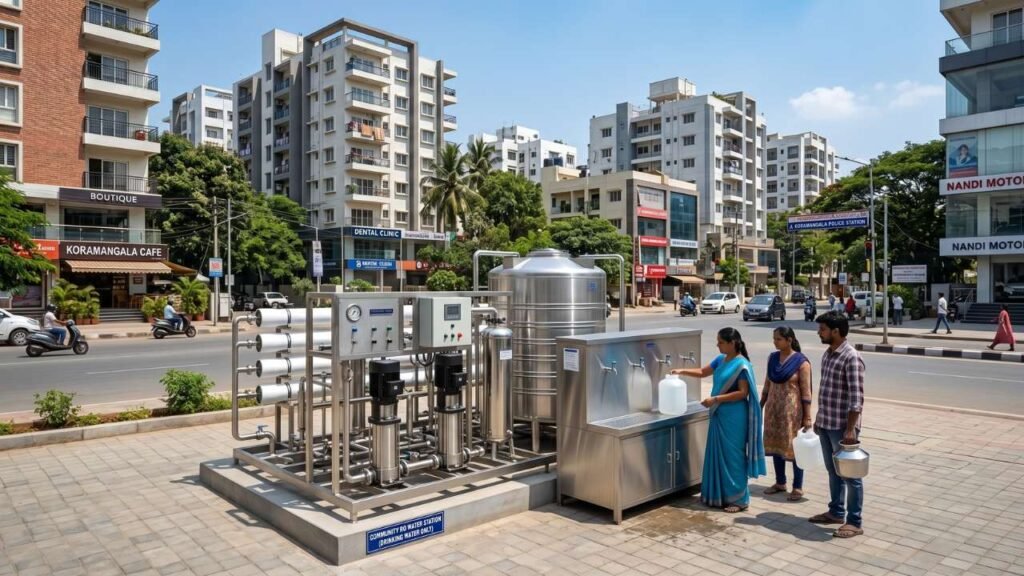
Koramangala Has a Water Problem That No One in the Neighbourhood Talks About Openly
Koramangala is one of the most aspirational neighbourhoods in India. Home to Bangalore’s densest concentration of startups, the country’s busiest food and beverage streets, hundreds of premium apartment complexes, and a resident population of educated, urban professionals who demand quality in every aspect of their lives – from the coffee they drink to the mattresses they sleep on.
And yet, when it comes to the water flowing through their taps, most Koramangala residents are flying blind.
Research on water quality in Bangalore’s south-central zone – which includes Koramangala and its surrounding neighbourhoods – found that TDS levels varied from 670 to 1,910 mg/L, with all water samples above the permissible limit and unfit for human consumption without treatment. That is not a minor deviation from acceptable standards. At 670 mg/L on the low end and nearly 2,000 mg/L on the high end, Koramangala’s groundwater is anywhere from moderately to severely contaminated with dissolved minerals.
The Bureau of Indian Standards‘ safe drinking water limit is 500 mg/L TDS. Koramangala’s borewell water does not just exceed this – it exceeds it by a factor of 1.3 to 3.8 times depending on the specific location and borewell depth.
Across major technology corridors such as Whitefield, Marathahalli, Koramangala, and HSR Layout, residents rely heavily on borewell water and ageing municipal infrastructure. As a result, many neighborhoods can experience TDS levels that exceed the Bureau of Indian Standards’ recommended limit of 500 mg/L for safe drinking water.
This is the real water situation in Koramangala. The neighbourhood deserves a real solution – and this guide tells you everything about what that solution looks like, who builds it right, and what it costs.
Koramangala’s Unique Water Challenge: Why It’s Different From the Rest of Bangalore
Koramangala is not just another Bangalore neighbourhood with standard water quality concerns. It has a specific combination of factors that makes its water treatment challenge distinctly complex and distinctly urgent.
The Koramangala-Chellaghatta Watershed
The Vrishabhavathi, Koramangala-Chellaghatta, and Hebbal-Nagavara are Bengaluru’s three main watersheds. Koramangala sits at the heart of one of the city’s primary watershed systems – which means it is also in the zone most affected by the cumulative impact of decades of urban runoff, sewage infiltration, and industrial contamination into the groundwater that feeds its borewells.
Urban development pressure in South Bangalore – the IT corridor, the Outer Ring Road technology parks, the dense residential development between Koramangala and HSR Layout – has created a compound problem. Borewells must be drilled deeper to find adequate yield, and deeper borewells draw from older geological strata with higher natural mineral content. Meanwhile, shallow aquifer contamination from urban runoff adds a biological dimension to the existing chemical challenge.
The result: Koramangala’s borewell water is not just hard and high in TDS. In some areas it also carries elevated iron, elevated nitrates from organic contamination, and bacteriological risks from pathogens entering cracked shallow borewell casings.
The Mixed Supply Reality
Unlike purely borewell-dependent areas of Bangalore, Koramangala receives a mix of BWSSB Cauvery supply and borewell water – with the ratio varying by block, building age, and seasonal availability. This creates a variable water quality situation that is harder to manage than a single consistent source.
During periods of adequate Cauvery supply, BWSSB-supplied water in Koramangala is generally lower in TDS but may carry residual chlorine, intermittent pressure variations, and the quality inconsistencies of ageing distribution infrastructure. During peak summer months when Cauvery allocation reduces, buildings fall back on borewells – and TDS can spike dramatically within the same week.
A water treatment system designed only for BWSSB supply will be overwhelmed when the borewell kicks in. A system designed only for borewell water may be unnecessarily intense during periods of clean Cauvery supply. The right solution is designed for the worst case – the highest TDS scenario – so that it handles every source scenario without compromise.
The Koramangala Commercial Ecosystem Needs More Than Domestic Solutions
Koramangala is one of the densest commercial food and beverage zones in South India. The neighbourhoods around 5th, 6th, 7th, and 8th Cross are packed with restaurants, cloud kitchens, cafes, microbreweries, bakeries, health food establishments, and QSR chains. Every single one of these businesses uses water in food and beverage preparation – and every single one is governed by FSSAI food safety regulations that mandate safe, potable water in food processing.
Beyond F&B, Koramangala hosts hundreds of co-working spaces, corporate offices, startup campuses, clinics, gyms, and hospitality establishments – all of which need reliable, high-quality water for employee consumption, equipment operation, and service delivery.
These commercial establishments are not well-served by domestic RO units designed for family kitchens. They need commercial-grade RO plants with the capacity, reliability, and water quality consistency to serve their operational demands without interruption.
Who Actually Needs an RO Plant in Koramangala? Every Type of Buyer
Residents of Apartment Complexes (Domestic and Community Scale)
Koramangala’s premium apartment sector – across 4th Block, 5th Block, 6th Block, 7th Block, and 8th Block – houses some of Bangalore’s highest-income, most water-aware residents. These are people who understand what they are consuming and who make considered purchasing decisions.
The typical Koramangala apartment resident currently uses either a branded domestic RO unit installed in their kitchen, or depends on 20-litre sealed water jars delivered weekly. Both are imperfect and expensive solutions.
A domestic RO system from a quality manufacturer, properly installed and maintained, solves the individual flat’s drinking water problem comprehensively. A community RO plant installed by the apartment association solves it at building scale – at lower per-litre cost, with better and more consistently maintained water quality.
Restaurants, Cafes, Breweries, and Cloud Kitchens
Water quality is a food quality issue. The flavour of a cup of filter coffee, the consistency of a pizza dough, the clarity of a craft beer, the texture of pasta, the safety of fresh salads – all are directly influenced by the mineral content and biological safety of the water used in preparation.
Nearly 72% of Bengaluru gets contaminated water. For a restaurant in Koramangala serving hundreds of customers daily, contaminated water is a food safety liability, a quality liability, and a FSSAI compliance liability – simultaneously.
A commercial RO plant sized 100–500 LPH, installed in the kitchen utility area, gives a Koramangala restaurant owner absolute confidence in the water going into every dish, every beverage, and every ice tray on the premises.
Corporate Offices and Startup Campuses
Koramangala’s startup ecosystem – along with the established corporate offices and co-working spaces in the area – houses thousands of employees who drink building-supplied water throughout their working day. High-TDS water that is technically “treated” through aging building filter systems or building-level UV units is not the same as properly RO-purified water.
Companies that take employee health seriously – and in Koramangala’s competitive employment market, employee wellness infrastructure matters – install commercial RO plants or water dispensing systems connected to central treatment units that deliver consistently safe water at every dispensing point.
Hotels, Guesthouses, and Service Apartments
Koramangala is a major hospitality hub serving business travellers, startup founders and investors passing through Bangalore, and long-stay guests in the city for work. Hotels and service apartments face water quality expectations from guests who have experienced international-standard water treatment – and who will immediately notice if the water at breakfast tastes off or smells of chlorine.
Industrial RO plants sized for hotel operations – covering drinking water, kitchen water, and laundry water – are standard requirements for competitive Koramangala hospitality establishments.
Clinics, Diagnostic Labs, and Healthcare Facilities
Koramangala has a significant concentration of clinics, dental practices, diagnostic laboratories, physiotherapy centres, and specialist medical practices. Many medical procedures and sterilisation processes require water of specific quality – and standard borewell or BWSSB water does not meet those requirements without treatment.
Medical and clinical RO systems in Koramangala must be specified with pharmaceutical-grade reliability and documentation – not the same as a restaurant system, and certainly not a domestic unit.
Small Manufacturers, Workshops, and Light Industrial Units
The back streets of Koramangala and its bordering industrial areas house small manufacturers, fabrication shops, garment units, and light engineering establishments. Their process water needs vary – some simply need safe drinking water for workers, others need demineralised water for equipment. Both require purpose-built solutions.
What Koramangala’s Water Looks Like Before Treatment
To understand why an RO plant is not optional but essential for serious water use in Koramangala, here is what the research tells us about actual source water quality in this zone.
TDS Levels Far Exceed Safe Limits
Studies on the south-central Bangalore zone that includes Koramangala found TDS ranging from 670 mg/L to 1,910 mg/L across borewell sources – with every single sample exceeding the BIS permissible limit of 500 mg/L. Research on Bangalore’s broader groundwater quality found TDS concentrations in Bangalore zones varying from 226 mg/L to 2,622 mg/L, 390 mg/L to 2,452 mg/L, and 240 mg/L to 3,484 mg/L respectively.
At Koramangala’s typical borewell TDS range of 670–1,910 mg/L, water consumed without treatment causes over time: gastrointestinal irritation, kidney stress, cardiovascular effects at very high TDS, and the familiar visible signs of hard water – scale on taps, dry skin, damaged appliances.
Hardness Is Severely Above Limits
According to a 2018 survey, 24% of Bengaluru households receive water from both borewells and Cauvery, with a hardness level above the prescribed limit of 200 milligrams per litre. In South Bangalore’s borewell-heavy zones including Koramangala, hardness levels in the 400–800 mg/L range are routinely documented – two to four times the permissible limit.
This level of hardness destroys RO membranes in domestic units without proper pre-treatment, clogs pipes with limescale within years, burns out geysers and washing machines prematurely, and leaves visible white deposits on every surface that water contacts.
Nitrates, Iron, and Heavy Metals Are Present
Borewell and Cauvery water in areas like Yeshwanthpur, Nayandahalli, and Bellandur showed high levels of nitrate, fluoride, and iron. Koramangala’s position within the broader South Bangalore zone means it shares these contamination risks – elevated nitrates from urban organic runoff, iron from borewell infrastructure corrosion, and trace heavy metals from decades of industrial and vehicular activity in the watershed.
Research on Bengaluru’s surface water bodies found that pH in 54% and TDS in 63% of water bodies exceed the WHO‘s permissible limits, with sources of metal pollution including industries in the city’s west and traffic in the city centre.
Bacterial Contamination Is Documented
Of water samples with high TDS levels, 61% was borewell and 17% was corporation water. Borewell water dominance in contamination statistics reflects a combination of geological mineral content and bacteriological infiltration through borewell casings – particularly in densely built urban areas where proximity of borewells to sewage infrastructure creates ongoing contamination risk.
A UV filter alone is insufficient for water with this contamination profile. UV addresses bacteriological risk but does nothing for dissolved minerals, heavy metals, nitrates, or hardness. Only a properly specified RO system with multi-stage pre-treatment addresses the full contamination picture.
The Full Range of RO Plant Solutions for Koramangala
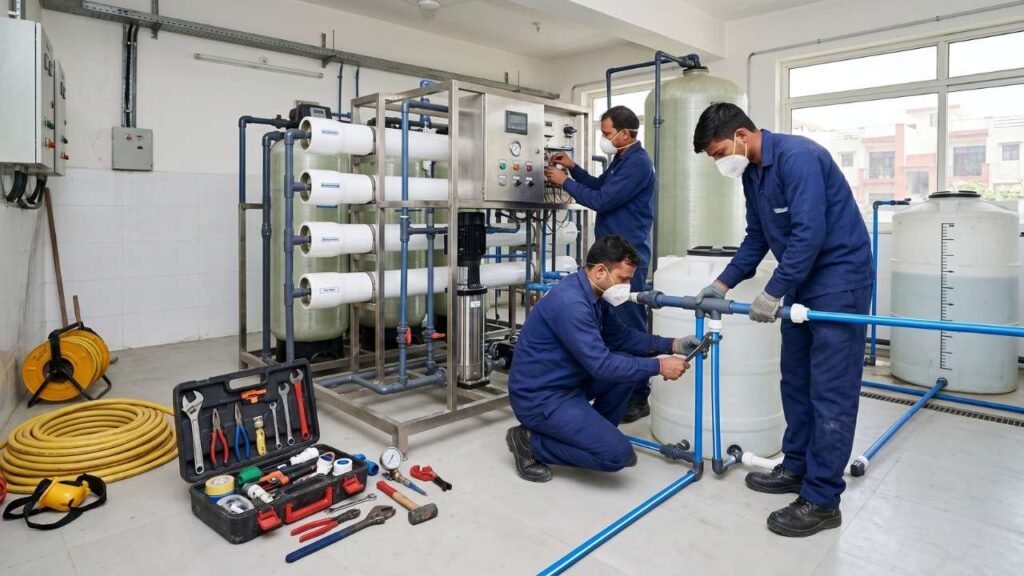
Bangalore Aqua and Energy Pvt. Ltd. manufactures, supplies, installs, and services the complete range of water treatment solutions required across Koramangala’s diverse buyer base.
Domestic RO Systems for Koramangala Homes and Flats
For individual flats and independent houses in Koramangala, Bangalore Aqua’s domestic RO systems are specifically configured for the area’s mixed BWSSB-plus-borewell supply reality.
Key design considerations for Koramangala domestic systems:
Variable TDS handling: The system is specified to handle Koramangala’s worst-case borewell TDS – ensuring performance consistency whether the building is on Cauvery supply (lower TDS) or borewell backup (higher TDS). Under-specification for the worst case means the system underperforms precisely when conditions are most challenging.
Hard water pre-treatment: For Koramangala’s high-hardness borewell water, an anti-scalant dosing unit or inline softener is incorporated upstream of the RO membrane. This protects membrane life and maintains output quality even when hardness spikes during borewell-dominant periods.
UV + RO combination: Given the documented bacteriological risk in South Bangalore borewell water, every Bangalore Aqua domestic system includes UV disinfection as a final kill step downstream of the membrane – not a substitute for the membrane, but an additional layer of biological safety.
Mineralisation post-treatment: Post-RO mineralisation cartridges restore a healthy pH and add controlled beneficial minerals – giving Koramangala residents water that is not just safe but genuinely pleasant to drink.
Product range for Koramangala domestic buyers:
- Under-counter compact RO systems (for flats with limited kitchen space – common in Koramangala’s dense apartment buildings)
- Wall-mounted kitchen RO units with TDS display
- Hot-cold-normal RO dispensers for home offices and living rooms
- High-recovery domestic systems for water-conscious households (reducing reject water waste)
Commercial RO Plants for Koramangala Restaurants, Cafes, and F&B Businesses
For Koramangala’s dense F&B sector, Bangalore Aqua’s commercial RO plants are the working backbone of water quality management across the neighbourhood’s kitchens and bars.
100 LPH Commercial RO Plant: Ideal for small cafes, cloud kitchens, QSR franchise outlets, and small restaurants. Produces 1,000 litres of purified water in a 10-hour operating day – sufficient for all food preparation, coffee machine, and staff drinking water needs of a small F&B establishment.
250 LPH Commercial RO Plant: For mid-size restaurants, large cafes, microbreweries, and bakeries with significant water consumption. 2,500 litres per day output comfortably covers peak service periods with storage headroom.
500 LPH Commercial RO Plant: For large restaurants, hotel F&B operations, large cloud kitchen facilities, and catering operations. The 5,000 litres per day output handles high-volume food preparation without supply interruption.
Features standard on all Bangalore Aqua commercial systems:
- Fully automatic operation with auto-flush cycles (prevents membrane fouling during off-peak periods)
- Online TDS display with audible alarm if output TDS exceeds set threshold
- FRP or SS pressure vessel construction for longevity in commercial kitchen environments (heat, steam, cleaning chemicals)
- Modular service design – cartridge and membrane replacement completed in under 30 minutes without tools by the AMC technician
- Compact skid-mounted footprint – critical for Koramangala’s premium-rent commercial premises where every square metre has financial value
Why FSSAI compliance matters for Koramangala’s F&B businesses: The Food Safety and Standards Authority of India requires that water used in food processing meets potable water standards. A Bangalore Aqua commercial RO system comes with water quality test certification at commissioning – directly usable as FSSAI compliance documentation. This protects your business during inspections and demonstrates genuine food safety commitment to your customers.
Community RO Plants for Koramangala Apartment Associations
Koramangala’s large apartment complexes – many with 100–400 flats – are natural candidates for centralised community water treatment. The economics, quality, and convenience case for community plants over individual household units is compelling at any scale above 50 flats.
For Koramangala apartment associations specifically, the community plant argument is reinforced by two local factors:
High resident transience: Koramangala is home to a highly mobile professional population – startup founders, early employees, consultants, and remote workers who may stay 12–24 months before moving. Individual household RO units are frequently left behind when tenants depart, repurchased at each new flat, or simply not maintained by transient occupants. A community plant managed by the association eliminates the individual maintenance variable entirely.
Premium building positioning: As Koramangala’s apartment market moves upmarket, building amenities increasingly determine rental and resale value. A centralised community water plant – with documented water quality certification – is a genuine building amenity that differentiates a property in a competitive market.
Community plant capacity guidance for Koramangala apartment buildings:
- 50–100 flats: 500 LPH community plant
- 100–200 flats: 1,000 LPH community plant
- 200–400 flats: 2,000 LPH community plant
- 400+ flats or large township: 5,000 LPH and above
Industrial and High-Capacity Commercial RO Plants
For Koramangala’s corporate campuses, large hospitality establishments, diagnostic laboratories, manufacturing units, and large co-working facilities, Bangalore Aqua’s industrial systems provide:
1,000–5,000+ LPH Industrial RO Plants: Engineered for continuous 18–24 hour daily operation, with multi-stage pre-treatment appropriate for Koramangala’s specific water chemistry. Industrial control panels with automated backwash, automatic flush, and low-pressure cutoff protect the system during supply interruptions – common in Koramangala during peak summer months when BWSSB supply reduces and borewells are under heavy draw.
Pharmaceutical-grade water systems for clinics and labs: Where medical or diagnostic water quality requirements demand near-zero TDS and confirmed bacterial absence, Bangalore Aqua designs multi-pass RO configurations with EDI (electrodeionisation) or mixed-bed polishing – producing water of the quality required for instrument sterilisation, reagent preparation, and critical clinical procedures.
Water Softeners for Koramangala
For properties where drinking water purification is handled separately but the hard water damage to appliances, plumbing, and skin and hair quality is a priority concern, Bangalore Aqua’s water softeners provide targeted hardness removal across the entire building’s water supply.
A whole-building softener installed on the incoming main supply protects:
- Geysers and water heaters throughout the building
- Washing machines and dishwashers in every flat
- The building’s entire plumbing infrastructure
- Swimming pools, cooling towers, and HVAC systems in the common areas
- Residents’ skin and hair quality across every shower and washbasin
For Koramangala’s premium apartment segment – where appliance quality, bathroom finish, and daily wellness are priorities – a building-level softener is increasingly standard infrastructure.
Water Dispensers and Coolers for Koramangala Offices
For co-working spaces, startup offices, corporate campuses, and clinics, Bangalore Aqua’s water dispensers and coolers provide temperature-controlled, purified water at point-of-use – connected to either individual under-sink RO units or the building’s community plant output.
Hot-cold-ambient dispensers delivering purified RO water replace the traditional 20-litre jar model entirely – eliminating the logistical burden of jar delivery, the plastic waste, the contamination risk of jar reuse, and the variable quality of third-party packaged water.
Why Bangalore Aqua Is Koramangala’s Best RO Plant Manufacturer
There are dozens of water treatment companies operating in Bangalore. Many of them service Koramangala with standard catalogue products and generic installation. Here is what makes Bangalore Aqua specifically the right partner for buyers in Koramangala.
They Know South Bangalore’s Water Chemistry
Bangalore Aqua’s service territory covers the full range of Bangalore’s diverse water chemistry environments. Their engineering team has tested, assessed, and designed systems for borewell and municipal supply sources across South Bangalore – including the specific mixed-supply, variable-quality reality of Koramangala, HSR Layout, BTM Layout, Jayanagar, Bannerghatta Road, and surrounding zones.
When Bangalore Aqua specifies a system for a Koramangala restaurant or apartment complex, they are not applying a national average template. They are applying direct field knowledge of how water in this specific zone behaves – seasonally variable TDS, hardness peaks during summer borewell periods, iron risk from certain deep borewells, and chlorine presence from BWSSB supply – and designing pre-treatment accordingly.
In-House Manufacturing – Quality You Can Verify
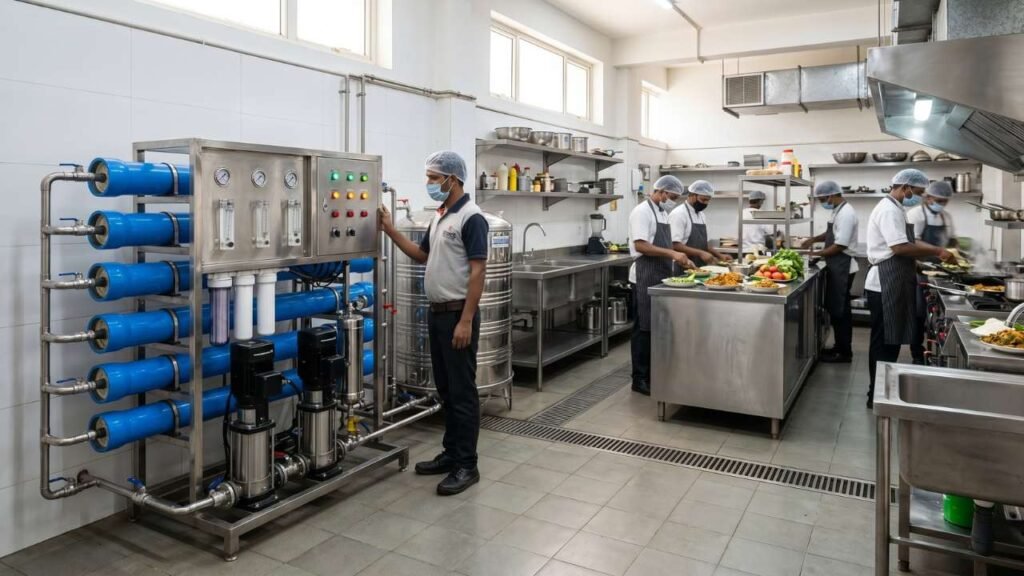
Bangalore Aqua manufactures its commercial, industrial, and community plants at its Bengaluru facility. Every system is assembled, tested, and quality-checked before it leaves the factory.
This is the critical differentiator from dealers and assemblers who source generic components from multiple manufacturers and assemble them on-site with variable quality control. When a Bangalore Aqua system is installed in your Koramangala property, every component – the high-pressure pump, the membrane housings, the control panel, the UV reactor, the SS tanks – has been tested as a complete system before arriving at your premises.
For commercial buyers who depend on their water system for daily business operations, this pre-delivery quality assurance is not a marketing claim – it is a fundamental reliability guarantee.
Manufacturer, Trader, and Service Provider – One Team
Bangalore Aqua operates as manufacturer, trader, and service provider simultaneously. For a Koramangala buyer, this means:
- The same team that specified your system installed it
- The same team that installed it services it under AMC
- Spare parts are sourced from the same manufacturer who assembled the original
- There is no dealer-manufacturer-service contractor triangle to navigate when something needs attention
One phone call. One point of accountability. One team that knows your specific system’s history.
Fast Response Times to Koramangala
Bangalore Aqua’s primary base in Kogilu Layout, Bengaluru provides straightforward access to South Bangalore via the Outer Ring Road and key arterial routes. Koramangala – at 15–25 km from the Bangalore Aqua base – is well within the same-day service zone.
For commercial buyers in Koramangala’s F&B sector, same-day service response is not a luxury – it is a business continuity requirement. A restaurant that loses its water treatment system on a Friday evening needs a response that day, not the following Monday. Bangalore Aqua’s AMC agreements for commercial installations specify response time commitments – and their local presence makes meeting those commitments realistic.
Transparent Pricing – No Hidden Costs
Koramangala’s commercial buyers are sophisticated and comparison-savvy. Bangalore Aqua’s quotation model matches that sophistication: fully itemised proposals covering every component of the system, civil requirements, installation labour, and AMC structure – with no hidden costs that emerge after the purchase decision.
The cost you see in the quote is the cost you pay. This transparency has built genuine loyalty among Bangalore Aqua’s growing Koramangala and South Bangalore customer base.
100+ Five-Star Reviews Across Karnataka
Bangalore Aqua’s verified Google and IndiaMart reviews – over 100 five-star ratings from real customers across Karnataka – are a reliable performance signal. Reviews specifically cite installation quality, service responsiveness, and the visible improvement in water quality that customers experience within days of commissioning. For a buyer in Koramangala deciding between multiple vendors, this independently verified track record is the most honest due diligence available.
Step-by-Step: Getting an RO Plant Installed in Koramangala
Here is exactly what the process looks like when you engage Bangalore Aqua for a Koramangala installation.
Step 1 – Initial Contact (Day 1) Call +91 76763 93939 or fill the enquiry form at bangaloreaqua.com. Describe your requirement: property type (apartment/restaurant/office/factory), approximate number of people, whether you have borewell, BWSSB, or mixed supply, and any existing water quality test data you have available.
Step 2 – Site Visit and Water Sampling (Day 2–3) A Bangalore Aqua technical representative visits your Koramangala property within 48 hours. They assess the water source, available space for the plant, electrical infrastructure, and – for commercial installations – your operational water demand profile. Water samples are collected from your tap or borewell for laboratory testing.
Step 3 – Water Quality Testing (Days 3–8) Samples go to an NABL-accredited laboratory for TDS, hardness, iron, fluoride, nitrate, bacterial count (total coliform and E. coli), pH, and turbidity. Results typically return within 3–5 working days. This test is the engineering foundation for everything that follows.
Step 4 – System Specification and Quote (Days 8–12) Based on test results and site data, Bangalore Aqua produces a complete, itemised proposal: pre-treatment train, membrane configuration, post-treatment, storage, reject water management, civil requirements, electrical specification, and AMC structure. The quote is transparent, detailed, and comes with a technical explanation so you can understand what you are buying and why each component is specified.
Step 5 – Review, Questions, and Order (Days 12–16) Bangalore Aqua welcomes questions, reference site visits, and comparison with other quotes. When you are ready to proceed, a purchase order and advance payment triggers manufacturing.
Step 6 – Manufacturing (Days 16–28) Standard domestic and small commercial systems are available from stock or complete within 5–8 working days. Custom commercial and industrial systems take 10–20 working days depending on capacity and specification.
Step 7 – Installation and Commissioning (Days 28–35) Bangalore Aqua’s installation team arrives with all equipment, materials, and tools. Domestic installations are completed in 2–4 hours. Commercial installations take 1–3 days. The system is flushed, started up, and performance-tested – with final outlet TDS and bacteriological safety verified before formal handover.
Step 8 – Handover and Training You and your designated operator receive a full walkthrough of the system: daily checks, TDS monitoring, when to call for service, and what maintenance you manage versus what the AMC covers.
Step 9 – AMC Live From Day One Your Annual Maintenance Contract activates from commissioning. Scheduled quarterly visits, consumable replacement, annual water quality testing, and priority emergency response are in force from day one – not from some future date after a trial period.
Costs: What to Expect for Koramangala Installations
Pricing is site-specific and depends on source water quality, system capacity, civil requirements, and distribution infrastructure. Here are realistic ranges for Koramangala buyers based on typical project profiles:
| System Type | Typical Application | Installed Cost Range | Monthly AMC (approx.) |
| Domestic RO (under-counter) | Single flat | ₹8,000–₹18,000 | ₹400–₹700 |
| Domestic RO with softener | Single flat, hard water | ₹18,000–₹35,000 | ₹600–₹900 |
| Commercial 100 LPH | Small cafe, QSR, cloud kitchen | ₹45,000–₹80,000 | ₹1,200–₹2,000 |
| Commercial 250 LPH | Mid-size restaurant, large cafe | ₹80,000–₹1,50,000 | ₹2,000–₹3,500 |
| Commercial 500 LPH | Large restaurant, brewery | ₹1,50,000–₹2,80,000 | ₹3,500–₹5,500 |
| Community 500 LPH | 50–100 flat apartment | ₹8,00,000–₹14,00,000 | ₹6,000–₹10,000/month |
| Community 1,000 LPH | 100–200 flat apartment | ₹14,00,000–₹22,00,000 | ₹10,000–₹15,000/month |
| Industrial 1,000 LPH | Corporate campus, hotel | ₹3,00,000–₹6,00,000 | ₹8,000–₹14,000/month |
| Water Softener (residential) | Single building | ₹20,000–₹60,000 | ₹800–₹1,500 |
All figures are approximate and indicative. Site-specific quotes from Bangalore Aqua are free and based on actual assessment.
Also Read On Bangaloreaqua Blag
Best Community RO Project Plants 2026
Best CSR Project RO Plants in India 2026
Best Water Softener for Bangalore 2026
Top 10 RO Plant Companies in India 2026
What Is a Domestic RO Water Purifier
The One Decision That Changes Everything About Your Water
Here is what it comes down to.
Koramangala’s water, without treatment, is not safe to drink consistently. The research is unambiguous on this. TDS levels from 670 to 1,910 mg/L, hardness above permissible limits in the majority of samples, documented bacterial contamination risk, and the presence of nitrates, iron, and heavy metals in portions of the groundwater – this is not a water quality situation that can be managed by boiling, UV filtering, or hoping the BWSSB supply is better today than yesterday.
The solution is an RO plant – correctly specified for your actual source water, professionally installed, and properly maintained.
The difference between a water treatment system that genuinely works and one that gives false confidence comes down almost entirely to two things: who manufactures and installs it, and whether the maintenance is structured and committed.
Bangalore Aqua and Energy Pvt. Ltd. delivers on both counts – with in-house manufacturing, local engineering expertise specific to South Bangalore’s water chemistry, professional installation, and a structured AMC programme that keeps your system performing at specification for years.
For Koramangala residents, restaurant owners, apartment associations, and business operators who want clean water they can trust – Bangalore Aqua is the manufacturer and service partner to call.
📞 +91 76763 93939 | +91 97387 04753
📧 info@bangaloreaqua.com
🌐 bangaloreaqua.com
📍 107/209 2nd Cross, 4th Main Kogilu Layout, Bengaluru – 560064, Karnataka
Serving Koramangala (all blocks), HSR Layout, BTM Layout, Jayanagar, JP Nagar, Bannerghatta Road, Electronic City, Bommanahalli, Bellandur, and all South Bangalore locations. Free site assessment. Same-day service response for AMC customers.
Related reads: Best Community RO Project Plants 2026 | Best CSR Project RO Plants in India 2026 | Best Water Softener for Bangalore 2026 | Top 10 RO Plant Companies in India 2026 | RO Plants for North Bangalore – Yelahanka, Devanahalli, Hoskote, Nelamangala, Doddaballapur