The Question Every Bangalore Homeowner Eventually Asks
You have noticed the white chalky deposits forming around your bathroom taps. Or your geyser started sounding like it is struggling to heat water half as efficiently as it did two years ago. Or your hair has been feeling dry and rough no matter what shampoo you use. Or – and this is the one that sends most people online searching at 11pm – you filled a glass of water from your kitchen tap, looked at it against the light, and thought: should I really be drinking this?
And so you start reading. And within about ten minutes, you are more confused than when you started.
Water softener. RO plant. UV purifier. TDS controller. Anti-scalant dosing. Membrane filtration. Ion exchange. The terminology is technical, the claims are contradictory, and every manufacturer’s website insists their product is the one solution you actually need.
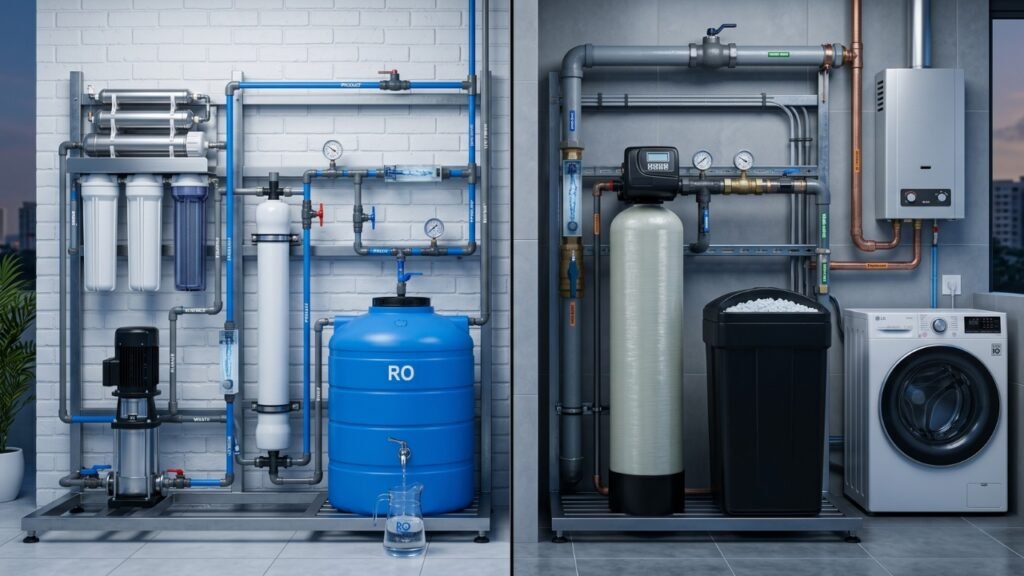
Here is the truth: an RO plant and a water softener are fundamentally different technologies that solve fundamentally different problems. One is not better than the other in any universal sense. What matters is your specific water, your specific problems, and your specific goals – and whether you need one, the other, or both.
This guide gives you that clarity – without jargon, without sales pressure, and with specific reference to Bangalore’s actual water quality challenges.
Before Anything Else: What Is Actually in Your Bangalore Water?
To understand which solution you need, you first need to understand what the problem is. And in Bangalore, the water problem is not one-dimensional.
Bangalore’s water supply is a mix – BWSSB Cauvery water in many older localities, borewell water in newer developments and as backup supply across the city, and in some areas a mixture of both that varies by season and municipal availability.
Research on Bangalore’s groundwater has found TDS concentrations varying from 226 mg/L to 3,484 mg/L across different zones – with the majority of borewell-sourced samples exceeding the Bureau of Indian Standards‘ safe limit of 500 mg/L. Studies on the south-central zone including areas like Koramangala and JP Nagar found TDS ranging from 670 mg/L to 1,910 mg/L, with all samples above permissible limits.
A 2018 survey found that 24% of Bengaluru households receive water with hardness levels above the prescribed limit of 200 mg/L – and that figure understates the problem in borewell-dependent areas, where hardness levels of 400–900 mg/L as CaCO₃ are frequently documented.
So Bangalore homes typically face two distinct but related water problems:
Problem 1 – High TDS: Excessive dissolved minerals, heavy metals, nitrates, fluoride, and other dissolved solids make the water unsafe or unpleasant to drink and cook with.
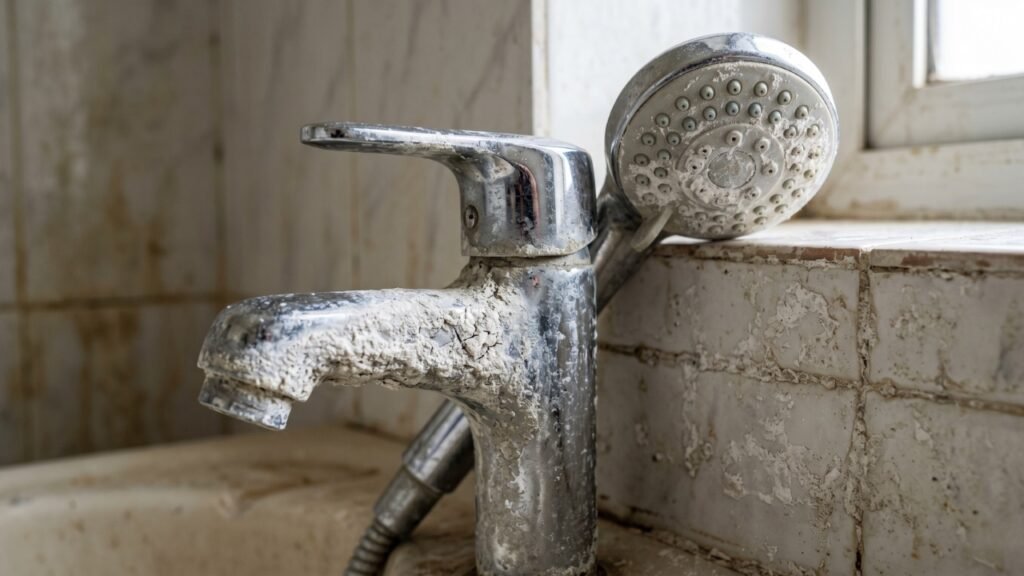
Problem 2 – High Hardness: Elevated calcium and magnesium concentrations damage appliances, block pipes, deposit scale on every surface water touches, and make skin, hair, and laundry feel rough and unclean.
These two problems can exist together or independently – and critically, each requires a different technology to fix.
Understanding this distinction is the entire foundation of making the right purchase decision.
What a Water Softener Actually Does – And What It Cannot Do
A water softener has one job and it does that job extremely well: it removes hardness from water.
Hardness is caused by dissolved calcium (Ca²⁺) and magnesium (Mg²⁺) ions – positively charged minerals that bond to heating elements, pipe interiors, skin, and fabric surfaces, causing all the visible and invisible damage of hard water.
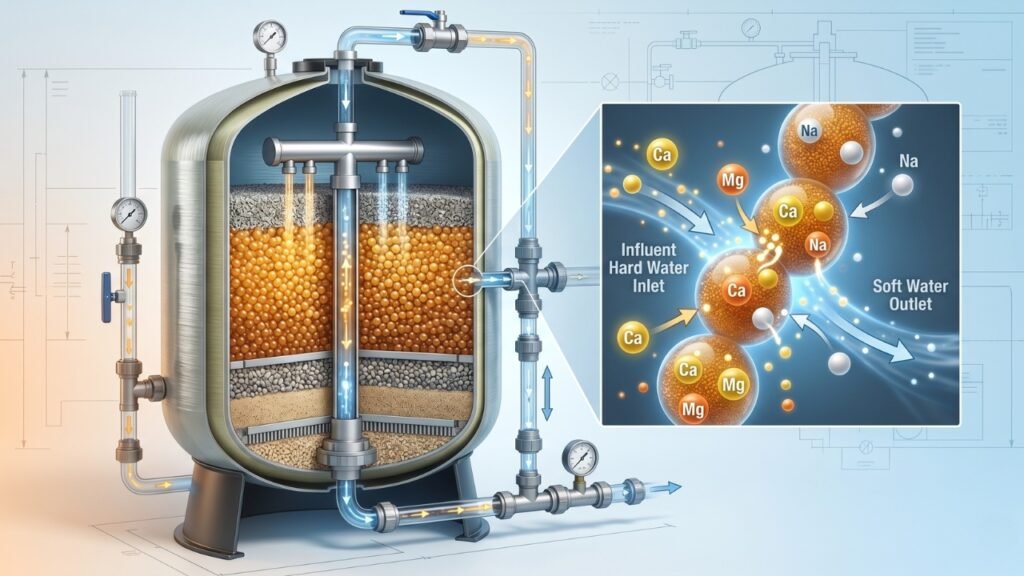
How Ion Exchange Works
Inside every water softener is a tank filled with resin beads – tiny spheres of polystyrene and divinylbenzene that carry a negative charge and are loaded with sodium ions. As hard water flows through the resin tank, a simple chemical exchange takes place: calcium and magnesium ions are attracted to the negatively charged beads, bond to them, and release sodium ions into the water in return.
The water that exits the softener has very low calcium and magnesium content. It is genuinely soft. The resin beads, over time, become saturated with calcium and magnesium and need to be regenerated – a process that flushes them with a brine (salt) solution, stripping off the accumulated minerals and reloading the beads with fresh sodium ions.
The Critical Thing a Softener Does NOT Do
Here is the single most important fact to understand about water softeners – and the one that confuses the most buyers.
A water softener does not reduce TDS.
This is not a small technical caveat. It is a fundamental limitation. If your raw water comes in at 1,200 mg/L TDS, it exits the softener at approximately 1,200 mg/L TDS. The calcium and magnesium that caused the hardness are replaced by sodium – so the water is no longer hard, but the dissolved solid load is essentially the same.
<cite>Water via softener can be used for all other purposes except drinking. This water cannot be used for consumption directly as a softener will only reduce hardness in water but will not change the existing TDS levels in the water.</cite>
This means: softened water is NOT safe to drink if your source water TDS is above safe limits. And in most Bangalore borewell sources, TDS is well above safe limits.
A softener also does not remove:
- Nitrates and nitrites
- Fluoride
- Heavy metals (arsenic, lead, chromium)
- Bacteria and viruses
- Chlorine and chloramines
- Organic compounds and pesticides
For all of these contaminants – which are present to varying degrees in Bangalore’s borewell water – a softener provides zero protection.
What a Softener Does Brilliantly
Within its specific domain – hardness removal – a water softener delivers remarkable, visible, and financially significant benefits:
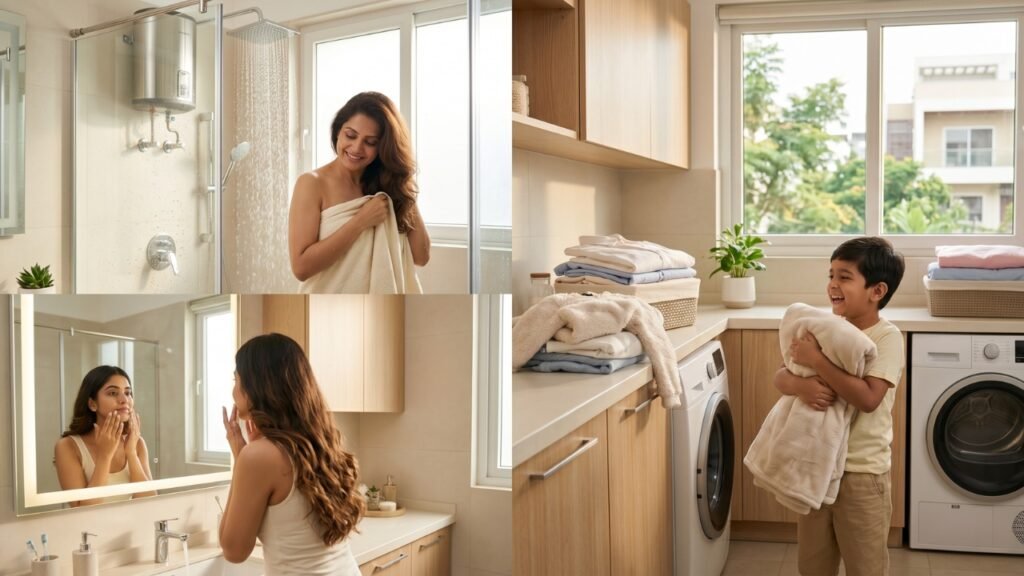
Appliance protection: A geyser coil with just 5mm of calcium scale loses roughly 8–10% of its heating efficiency – and scale accumulates continuously. A softener eliminates this entirely. Water heaters, geysers, washing machines, and dishwashers last significantly longer – often doubling their useful life in hard water areas. Soap and shampoo usage reduces by up to 75% because softened water lathers properly without reacting with hardness minerals.
Plumbing protection: Scale buildup inside pipes progressively narrows the internal diameter, reducing pressure and eventually causing blockage. In Bangalore apartment buildings with borewell dependence, pipe replacement due to scale is a recurring and expensive maintenance event. A building-level softener stops this entirely.
Skin and hair quality: Hard water reacts with soap to form soap scum – a sticky, insoluble residue that coats skin and hair rather than rinsing cleanly. The result is dry, itchy skin and brittle, dull hair. Softened water rinses cleanly, and the improvement in skin and hair quality is typically noticeable within the first week of installation.
Surface cleanliness: Bathrooms, kitchen surfaces, and tiles stay clean – without the white deposits that accumulate wherever hard water evaporates and leaves its mineral residue behind.
Cost savings across the household: Reduced soap and detergent use, lower electricity bills (geysers work efficiently), extended appliance life, and reduced plumbing maintenance add up to significant monthly savings. For a typical Bangalore family, the annual savings attributable to a water softener often exceed the annual running cost of the softener itself within 2–3 years.
What an RO Plant Actually Does – And What It Cannot Do
A Reverse Osmosis plant is a water purification system – fundamentally different in purpose and mechanism from a water softener.
Where a softener targets hardness only, an RO plant targets everything: it removes 95–99% of all total dissolved solids – including hardness minerals, heavy metals, nitrates, fluoride, pesticides, bacteria, viruses, and virtually every other dissolved contaminant.
How Reverse Osmosis Works
Pre-treated water is pressurised and forced through a semi-permeable membrane with pores 0.0001 microns in diameter – so small that only water molecules pass through. Dissolved ions, minerals, heavy metals, bacteria, and viruses are too large to pass through the membrane pores and are rejected into a concentrate stream that is discharged or repurposed.
The water that passes through the membrane – called the permeate – has had 95–99% of its dissolved solid load removed. A 1,200 mg/L TDS borewell source yields permeate at 20–80 mg/L TDS – well within the safe drinking range and then some.
Post-membrane stages add UV disinfection for biological kill assurance, activated carbon polishing for taste, and in well-designed systems, a mineralisation cartridge that restores a small, healthy quantity of calcium and magnesium to bring pH to a neutral level and improve palatability.
The Critical Things an RO Plant Does NOT Do Well Without Pre-Treatment
Here is the equally important flip side: an RO plant is not a standalone solution in Bangalore’s high-hardness water without proper pre-treatment – specifically without a softener or anti-scalant system upstream.
This is why the distinction between the two technologies matters so much, and why simply buying an RO plant without addressing hardness is a very expensive mistake in Bangalore’s borewell-dominated water environment.
When very hard water – above 300 mg/L hardness as CaCO₃, which is normal for Bangalore – is fed directly into an RO membrane without pre-treatment, calcium and magnesium carbonate precipitate on the membrane surface under the high pressure of the RO process. This precipitation is called scaling, and it:
- Reduces membrane output (less water produced per hour)
- Reduces rejection efficiency (more TDS passes through)
- Shortens membrane life from the expected 3–5 years to sometimes under 12 months
- Eventually destroys the membrane entirely, requiring expensive replacement
Hardness above 200 mg/L causes membrane scaling in most Indian groundwater conditions. Most Bangalore borewells are above 300 mg/L hardness. Many are above 600 mg/L. Without pre-treatment, you are buying a high-quality RO membrane and feeding it water that will destroy it prematurely.
This is precisely why Bangalore Aqua always includes either a softener stage or anti-scalant dosing as part of their RO plant specifications for high-hardness Bangalore borewell water – not as an upsell, but as an engineering necessity.
What an RO Plant Does Brilliantly
Within its domain – comprehensive water purification – an RO plant is the gold standard solution for Bangalore’s drinking water challenge:
Complete TDS reduction: From Bangalore borewell source water at 600–1,800 mg/L down to 30–80 mg/L in the purified output. Every dissolved contaminant is addressed simultaneously.
Safe drinking water – legally and medically: RO-treated water from a properly maintained system meets BIS 10500:2012 standards for safe drinking water. It removes fluoride (at 90–96% efficiency), nitrates (at 80–95% efficiency), heavy metals including arsenic and lead (at 95–99% efficiency), and eliminates bacterial and viral contamination.
Taste improvement: High TDS water – particularly water high in sulphates, chlorides, and other mineral salts – has a distinctly unpleasant taste. Many Bangalore borewell water sources taste noticeably bitter, salty, or metallic. RO-treated water tastes neutral, clean, and fresh.
Protection against seasonal TDS spikes: Bangalore’s borewell TDS rises significantly in summer as water tables drop and water is drawn from deeper, more mineralised strata. An RO system handles this variability consistently – maintaining safe output regardless of seasonal source water changes.
The Defining Comparison: Side by Side
| RO Plant | Water Softener | |
| Primary purpose | Purify water for safe drinking and cooking | Remove hardness to protect appliances, pipes, skin |
| Technology | Semi-permeable membrane filtration under pressure | Ion exchange resin |
| Removes TDS? | Yes – 95–99% reduction | No – TDS stays essentially the same |
| Removes hardness? | Yes – as part of overall TDS reduction | Yes – this is its sole function |
| Removes bacteria/viruses? | Yes – with UV stage included | No |
| Removes fluoride? | Yes – 90–96% | No |
| Removes nitrates? | Yes – 80–95% | No |
| Removes heavy metals? | Yes – 95–99% | No |
| Output safe to drink? | Yes | No – TDS unchanged |
| Protects appliances? | Partially (reduces hardness minerals in output) | Yes – completely eliminates scale-causing minerals |
| Protects all household plumbing? | Only for treated water line | Yes – for the entire building supply |
| Reduces soap/shampoo use? | Marginally | Yes – up to 75% reduction |
| Improves skin and hair? | Marginally | Yes – significantly |
| Produces reject water? | Yes – 30–50% of inlet volume | No reject water (only regeneration brine periodically) |
| Running cost | Filter and membrane replacement, electricity | Salt for regeneration |
| Output volume | Limited to plant capacity | Full building supply volume |
What Bangalore’s Specific Water Conditions Mean for Your Decision
Now that you understand what each system does, let us apply this to Bangalore’s actual water reality.
If Your Building Is on BWSSB Cauvery Supply (Predominantly)
BWSSB Cauvery water is significantly cleaner than Bangalore borewell water. It is treated before distribution and typically has TDS in the range of 150–350 mg/L – below or near the BIS limit. Hardness in BWSSB supply is moderate – typically 100–250 mg/L as CaCO₃.
For buildings predominantly on BWSSB supply with good delivery consistency:
- For drinking water: A quality domestic RO unit with UV stage is the right choice. TDS is low enough that the RO membrane life will be good, and you get pure, safe drinking water for cooking and consumption.
- For appliance and pipe protection: A water softener at the building level may or may not be needed depending on your actual hardness reading. Many BWSSB-supplied buildings in Bangalore manage fine without one – but if you are noticing scale deposits or appliance problems, a water test will confirm whether a softener is warranted.
If Your Building Uses Borewell Water (Predominantly or as Backup)
This is the majority situation across Bangalore – and the water quality profile is dramatically different from BWSSB supply.
Borewell TDS in Bangalore typically ranges from 600 mg/L to 2,000+ mg/L. Hardness is typically 300–900 mg/L as CaCO₃. Bacterial risk, iron, fluoride, and nitrates may also be present depending on your specific borewell depth and locality.
For buildings on borewell supply:
- For drinking water: An RO plant is not optional – it is essential. UV-only filtration does not address TDS, hardness, nitrates, fluoride, or heavy metals. Borewell water at 600–2,000 mg/L TDS is genuinely unsafe for regular consumption without RO treatment.
- For appliance and pipe protection: A water softener at the building supply level is strongly recommended. Without it, your RO membrane will scale and fail prematurely (hardness above 300 mg/L causes membrane fouling), your geysers and washing machines will suffer scale damage, and your building’s plumbing will accumulate limescale over years.
The practical recommendation for most borewell-dependent Bangalore homes: both systems, configured in combination.
If Your Building Has Mixed Supply (BWSSB + Borewell Alternating)
This is the most common and most challenging scenario in Bangalore. During monsoon and post-monsoon months, BWSSB supply is adequate and the building uses Cauvery water. During peak summer, supply drops and the building switches to borewell – sometimes within the same week.
A water treatment system designed for BWSSB quality will underperform during borewell periods. A system designed for worst-case borewell quality handles both effortlessly.
The right approach: specify for the worst case. Design and size your RO plant and water softener for peak borewell TDS and hardness – and let the system handle both source waters without compromise.
The Combination System: Why Many Bangalore Homes Need Both
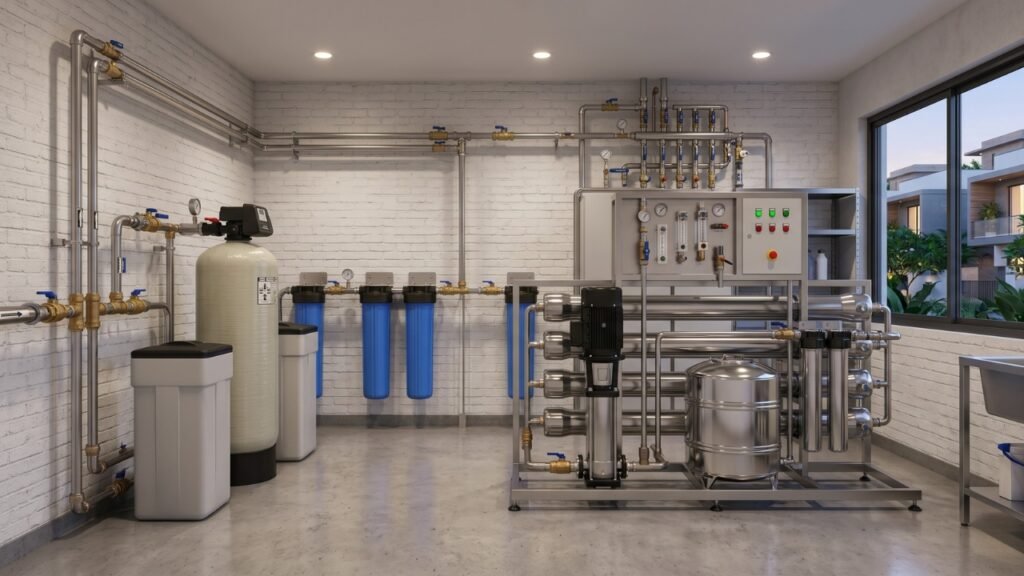
For housing societies, commercial kitchens, hotels, and industrial setups, both are often used together – a softener in the pre-treatment line, an RO system for final purification. This combined approach is standard practice in well-designed water treatment setups.
For Bangalore’s borewell-dependent homes and apartment buildings, a combined softener + RO system is the comprehensive answer because the two systems address different problem dimensions with zero overlap:
The softener handles:
- Removing hardness before it reaches the RO membrane (protecting the membrane)
- Protecting the entire building’s plumbing and all appliances from scale damage
- Improving skin, hair, and laundry quality across the entire building
- Reducing soap and detergent consumption for all residents
The RO plant handles:
- Purifying drinking and cooking water to safe, BIS-compliant quality
- Removing TDS, heavy metals, nitrates, fluoride, and bacteria
- Delivering consistently safe water regardless of seasonal borewell TDS variation
Together, these two systems give you something that neither delivers alone: completely protected household infrastructure and genuinely safe drinking water.
A key point to understand: a water softener is not effective for purification when TDS goes beyond 600 ppm. In such cases – which describes most Bangalore borewells – only an RO plant handles the purification process effectively. And conversely, an RO plant without upstream softening in a high-hardness environment will have its membranes scaled and shortened in life dramatically. They need each other in Bangalore’s water conditions.
Decision Framework: A Practical Guide for Bangalore Homeowners
Work through this step by step to find your answer.
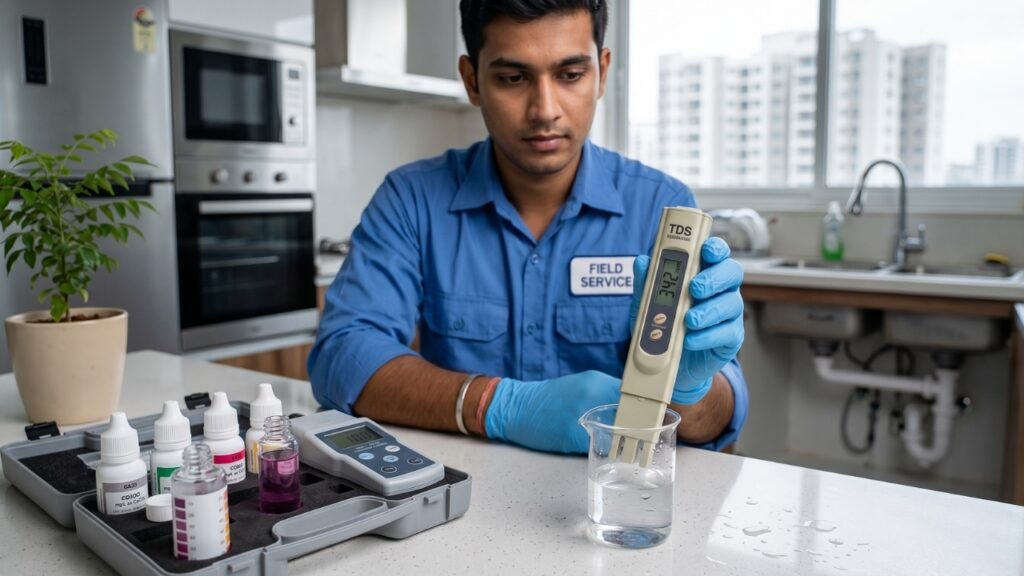
Step 1 – Get Your Water Tested
Everything starts here. Without a water test, you are guessing. A complete water quality test for your tap or borewell water should cover TDS, pH, total hardness (as CaCO₃), calcium hardness, iron, fluoride, nitrates, and bacteriological safety (total coliform and E. coli). Bangalore Aqua provides free water quality consultations and can arrange NABL-accredited testing.
Step 2 – Read Your TDS Number
- TDS below 300 mg/L: Your water is relatively clean. An RO plant may be appropriate for drinking water quality improvement, but it is not urgently necessary. Focus on hardness assessment (Step 3).
- TDS 300–600 mg/L: An RO plant is strongly recommended for drinking water. Your water is above or approaching the safe limit.
- TDS above 600 mg/L: An RO plant is non-negotiable for drinking water. This water is not safe for regular consumption without RO treatment.
Step 3 – Read Your Hardness Number
- Hardness below 150 mg/L as CaCO₃: Your water is moderately soft. A softener may not be necessary unless you are observing specific scale or appliance problems.
- Hardness 150–300 mg/L as CaCO₃: Moderate hardness. A softener is beneficial – particularly if you have a high-end geyser, expensive appliances, or sensitive skin. Upstream pre-treatment for your RO membrane is advised.
- Hardness above 300 mg/L as CaCO₃: A softener (or anti-scalant dosing system) is strongly recommended. Your RO membrane will scale without it. Your appliances and plumbing are at significant risk. This hardness range describes most Bangalore borewells.
- Hardness above 500 mg/L as CaCO₃: A water softener upstream of your RO system is essentially mandatory. Without it, membrane replacement will be frequent and expensive.
Step 4 – Apply Your Findings
| TDS | Hardness | Recommendation |
| Below 300 | Below 150 | RO optional; softener probably not needed; UV sufficient |
| Below 300 | Above 150 | Softener for appliance protection; RO optional for drinking |
| 300–600 | Below 200 | RO recommended for drinking water |
| 300–600 | Above 200 | RO + softener or anti-scalant pre-treatment |
| Above 600 | Any level | RO is mandatory; softener strongly recommended upstream |
| Above 600 | Above 300 | RO + dedicated softener – the full combination system |
For the majority of borewell-dependent Bangalore homes, the answer lands in the bottom two rows of this table.
Real Scenarios: What Bangalore Homeowners Actually Encounter
Scenario 1 – The Geyser That Dies Every 3 Years
A family in Sarjapur Road has replaced their geyser three times in nine years. Each time, the heating element has failed. The technician always says the same thing: scale damage. The family installs a water softener on their incoming supply line. The fourth geyser is now running efficiently at year 4, with no scale problems. The softener paid for itself in avoided replacement cost within the first 18 months.
What they needed: A water softener. Their BWSSB supply TDS was 280 mg/L – within safe limits for drinking – but hardness was 450 mg/L, causing severe appliance damage.
Scenario 2 – The Unpleasant-Tasting Kitchen Water
A family in Yelahanka notices their borewell water tastes bitter and slightly salty. Their TDS reading is 1,100 mg/L. They have been buying 20-litre water jars for ₹900 per month. A domestic RO unit is installed, bringing output TDS to 45 mg/L. The jar deliveries stop. The family saves ₹900 per month immediately. Within a year they have recovered the cost of the RO unit.
What they needed: An RO plant for drinking and cooking. Their hardness was 380 mg/L – Bangalore Aqua installed a pre-filter anti-scalant dosing system upstream to protect the membrane.
Scenario 3 – The Apartment Building With 150 Flats and Every Problem
A large gated community in Devanahalli has borewell water with TDS of 1,400 mg/L and hardness of 650 mg/L. Residents have scale deposits on all bathroom fixtures. Geysers across the building are failing prematurely. Individual RO units installed by residents are having membrane problems – the membranes are scaling up quickly without adequate pre-treatment. The RWA commissions a water quality assessment.
Solution: A building-level water softener on the incoming borewell supply line (protecting all plumbing, appliances, and skin/hair quality for all residents) combined with a 1,000 LPH community RO plant providing purified drinking water to all flats through a dedicated distribution line.
Outcome: Membrane problems resolved (softener pre-treatment protects the RO membranes). Geyser replacement calls drop sharply. Residents stop buying water jars. The per-flat monthly water cost drops from ₹800–1,200 (individual RO maintenance + water jars) to ₹120–160 (community plant levy).
What Each System Costs in Bangalore (2026)
Understanding costs clearly is essential for planning.
Water Softener Costs
| System Type | Capacity | Installed Cost | Monthly Running Cost |
| Domestic manual softener | 1 bathroom home | ₹15,000–₹25,000 | ₹300–₹600 (salt) |
| Domestic automatic softener | 2–4 bathroom home | ₹25,000–₹50,000 | ₹400–₹800 (salt) |
| Building softener (small apartment) | 20–50 flats | ₹80,000–₹1,80,000 | ₹1,500–₹3,000 |
| Building softener (large complex) | 100–200 flats | ₹2,00,000–₹4,50,000 | ₹3,000–₹7,000 |
Monthly running cost is primarily the cost of regeneration salt – sodium chloride pellets or crystals, widely available in Bangalore at ₹10–₹15/kg.
RO Plant Costs
| System Type | Capacity | Installed Cost | Monthly Running Cost |
| Domestic RO (under-counter) | Single flat | ₹8,000–₹18,000 | ₹350–₹700 |
| Domestic RO with pre-treatment | Single flat, high TDS | ₹15,000–₹30,000 | ₹500–₹900 |
| Community RO plant | 50–100 flats | ₹8,00,000–₹14,00,000 | ₹6,000–₹10,000 |
| Community RO plant | 100–200 flats | ₹14,00,000–₹22,00,000 | ₹10,000–₹16,000 |
The Combination System
For homes or buildings that need both: the combined system cost is not simply additive. The softener serves as pre-treatment for the RO, which means the RO system it protects will have longer membrane life, lower maintenance frequency, and lower total cost of ownership over 5 years. The combined investment typically recovers its total cost within 3–5 years through avoided membrane replacement, appliance longevity, and elimination of purchased water jars.
Common Mistakes Bangalore Buyers Make – And How to Avoid Them
Mistake 1 – Buying an RO Plant Without Addressing Hardness
The most expensive mistake in Bangalore’s water treatment market. Installing a quality RO unit in a home with borewell water at 600+ mg/L hardness without upstream pre-treatment is buying a premium product and setting it up to fail within 12–18 months. Bangalore Aqua always assesses hardness before specifying any RO system – and always includes appropriate pre-treatment in high-hardness scenarios.
Mistake 2 – Assuming a Softener Makes Water Safe to Drink
Soft water is not pure water. After a softener, TDS is essentially unchanged. If your borewell reads 1,200 mg/L TDS before the softener, it reads approximately 1,200 mg/L after. You still need an RO system for drinking water. Softened water is excellent for bathing, washing, cleaning, and appliance protection – not for drinking without further purification.
Mistake 3 – Choosing Based on Price Alone
A cheaper RO unit with poor-quality membranes and no anti-scalant pre-treatment in a high-hardness Bangalore borewell situation will need membrane replacement within a year. A quality system with proper pre-treatment costs more upfront but delivers 3–5 times the membrane life – making total cost of ownership dramatically lower. Always evaluate total cost over 5 years, not just the sticker price.
Mistake 4 – Skipping the Water Test
Every wrong purchase decision in Bangalore’s water treatment market starts with skipping the water test. Without knowing your actual TDS, hardness, iron, and bacteriological status, any recommendation is a guess. Bangalore Aqua provides free water quality consultations – use them before making any purchasing decision.
Mistake 5 – Installing Individual Household Units in a Borewell Building Without Building-Level Pre-Treatment
In a large apartment building on borewell water with very high hardness, 100 individual RO units without building-level softening pre-treatment are 100 individually scaling membranes. The building-level problem (hardness damaging membranes and appliances) requires a building-level solution (a softener on the incoming supply). Individual units downstream can then perform properly and reach their designed membrane life.
Mistake 6 – Ignoring Seasonal Water Variation
Bangalore’s borewell TDS peaks in summer. A system specified during the monsoon season, when TDS readings are at their seasonal low, may be undersized for summer conditions. Bangalore Aqua specifies systems for worst-case seasonal conditions, not average annual readings.
Why Bangalore Aqua Is the Right Partner for Both Systems
Bangalore Aqua and Energy Pvt. Ltd. is uniquely positioned as a manufacturer, trader, and service provider of both RO plants and water softeners – covering the full spectrum of water treatment solutions needed in Bangalore.
Deep Bangalore water knowledge: Bangalore Aqua’s engineers have tested and treated water from borewells across every Bangalore zone – Yelahanka, Devanahalli, Koramangala, Electronic City, Hoskote, Whitefield, HSR Layout, and beyond. They know which localities have fluoride risk, which have iron problems, which hit 1,500+ mg/L TDS in summer. This local knowledge directly informs system specification – you get a system designed for your water, not a generic catalogue product.
The only assessment that matters – testing your water first: Before recommending anything, Bangalore Aqua assesses your actual source water. This is not standard practice among all vendors. Many suppliers size and quote systems from assumptions. Bangalore Aqua tests, measures, and specifies from data.
Combination system expertise: Many vendors sell either RO systems or softeners – not both, and not the engineered combination of both. Bangalore Aqua designs and installs combination systems where both technologies work together as an integrated treatment train – with the softener correctly positioned upstream of the RO as pre-treatment, sized correctly relative to the RO’s inlet requirements, and both systems covered under a single AMC.
Single AMC, single point of accountability: Your RO plant and water softener both covered under one Annual Maintenance Contract. One team manages both. One call when anything needs attention. No finger-pointing between a softener supplier and an RO supplier. The team that installed both systems services both systems.
Transparent pricing: Itemised quotations covering every component, installation, and AMC commitment – before you sign anything. What you see is what you pay.
The Bottom Line
The question is not “RO plant or water softener?” The question is “what is actually in my water, and what do I need to solve my specific problems?”
For the majority of Bangalore homes on borewell water – which describes most of the city’s newer developments, peri-urban localities, and summer backup supply reality – the honest answer is: you likely need both, configured correctly and maintained properly.
The softener protects your building. The RO plant protects your family’s health. Together, they are a complete water solution for Bangalore’s challenging water environment.
Bangalore Aqua and Energy Pvt. Ltd. manufactures, installs, and services both – with deep local water knowledge, transparent pricing, and the committed after-sales support of a company that understands that clean water is not a luxury purchase. It is the most fundamental infrastructure investment your home can make.
Call Bangalore Aqua today for your free water test and consultation.
📞 +91 76763 93939 | +91 97387 04753
📧 info@bangaloreaqua.com
📍 107/209 2nd Cross, 4th Main Kogilu Layout, Bengaluru – 560064, KarnatakaFree site assessment. Free water quality consultation. NABL-accredited water testing arranged. Transparent, itemised quotations. No obligation.