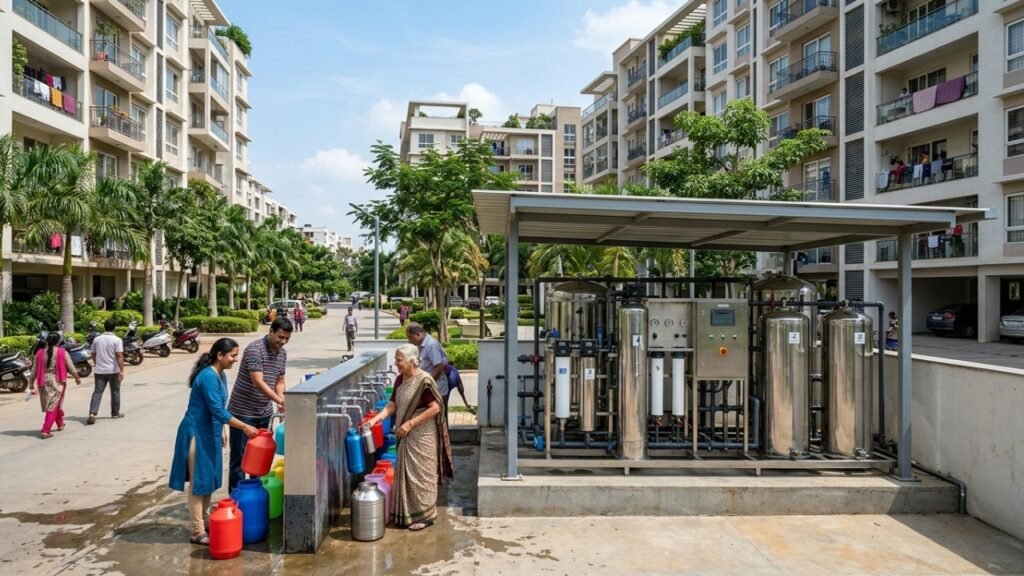
A Building With 300 Flats and 300 Different Water Problems
Walk into almost any large apartment complex in Bangalore today and ask residents about their drinking water. You will hear the same story told 300 different ways.
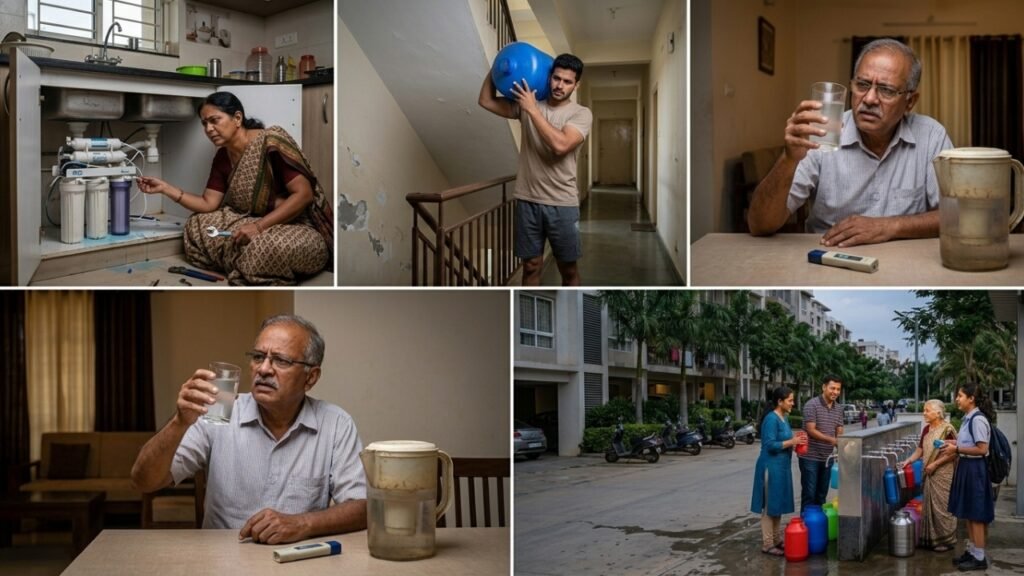
Flat 204 installed an under-counter RO unit two years ago and the TDS is back to 600 because they forgot to change the membrane. Flat 307 is still using the original system that came with the flat; the UV lamp burned out eight months ago and no one noticed. Flat 512 has given up on the building’s water entirely and spends ₹900 a month on 20-litre water jars. Flat 118 has four children under ten and the parents genuinely do not know whether the water they are drinking every day is safe.
This is the reality of individualised water management in a large residential building – and it is exactly the problem that a well-designed community RO project plants solves in one move.
A community RO plant is a single, centrally installed, professionally managed water purification system that serves every household in a building, society, or village from one plant. One maintenance contract. One quality standard. One monthly cost spread across every household. Clean, certified, consistently safe water delivered to every tap – without asking a single resident to manage a cartridge replacement schedule.
This is the concept. But the execution is where most community water projects either succeed brilliantly or fail completely – and the difference between those two outcomes is almost entirely about who installs it, how it is designed, and whether the maintenance structure is built in from day one.
This guide covers all of it – the technology, the types, the economics, the critical design decisions, and why Bangalore Aqua and Energy Pvt. Ltd. has become Karnataka’s most trusted partner for community RO projects.
Why Community RO Plants Are Now a Mainstream Infrastructure Choice
Five years ago, community RO plants were relatively rare in Bengaluru’s residential sector. Most apartment associations defaulted to individual household units, and the idea of centralised treatment felt like something for large institutions rather than residential buildings.
That has changed dramatically. Here is why:
Bangalore’s Borewell Water Is Getting Worse Every Year
The city’s explosive growth has depleted groundwater tables across every zone. As borewells are drilled deeper to compensate, the water they draw from older, more mineral-saturated geological strata is consistently harder and higher in TDS than before. Where a borewell in Yelahanka might have yielded 400 mg/L TDS water a decade ago, the same borewell today might produce 900–1,200 mg/L. In parts of Devanahalli, Hoskote, and Nelamangala, borewell TDS above 1,500 mg/L is now common.
This escalation makes individual household RO units increasingly inadequate. Most domestic units are designed for moderate TDS water. When source TDS climbs to 1,200+ mg/L, a domestic unit works far harder, membrane life drops sharply, and water quality becomes inconsistent. A community plant with properly sized industrial membranes and robust pre-treatment handles high TDS reliably – it is engineered for the actual water, not an average.
The Calculation Has Flipped in Favour of Centralisation
For years, community plants looked expensive compared to individual household units. That comparison has shifted. The cost of 300 individual household RO units across a large apartment complex – hardware, installation, annual filter replacement, membrane replacement, service calls – now substantially exceeds the capital and operational cost of a single well-designed community plant serving the same building.
More importantly, the quality delivered by a community plant is superior: consistent TDS, certified bacteriological safety, professionally monitored water quality, and zero maintenance burden on individual residents.
Resident Welfare Associations Are Taking Water Quality Seriously
A new generation of active, educated RWA leadership across Bengaluru, Mysuru, and other Karnataka cities is treating water quality as a core infrastructure responsibility – alongside lifts, generator backup, and security. These RWAs are commissioning water quality tests, comparing options seriously, and making informed investments in community water infrastructure. Community RO plants are the natural answer.
BBMP and BDA Layout Approvals Are Increasingly Requiring Water Treatment Plans
New large residential projects and layouts in Bengaluru now face regulatory expectations around water treatment and reject water management. Community plants, with their documented water quality output and reject water utilisation plans, satisfy these requirements in a way that individual household units cannot.
Understanding the Technology: What a Community RO Plant Actually Does
A community RO plant is not simply a large version of a household RO unit. It is an industrial-grade multi-stage water treatment system specifically engineered for continuous high-volume operation, with pre-treatment, core treatment, and post-treatment stages designed for the specific chemistry of the source water it processes.
Here is every stage in a well-designed community plant – explained in plain language:
Stage 1: Raw Water Collection and Primary Storage
Incoming water from the borewell, municipal supply line, or mixed source is collected in a raw water tank – typically a large underground sump or overhead tank. This primary storage serves two functions: it ensures a continuous supply buffer that can absorb variations in source water flow, and it allows gross suspended matter to settle before the treatment train begins.
In Bangalore’s typical borewell setup, the raw water tank may receive water intermittently from a submersible pump. The treatment plant draws from this tank on a continuous schedule, independent of the pump’s on/off cycles.
Stage 2: Multimedia Sand Filter
The first active treatment stage passes raw water through a media bed of graded sand, gravel, and anthracite coal. This multimedia filter removes turbidity, suspended solids, and colloidal particles – protecting the downstream cartridge filters and membranes from physical fouling.
For borewell water with high iron content (common in Yelahanka, Hoskote, and parts of Nelamangala), an iron removal stage may be incorporated here or immediately before – using either a green sand filter or an aeration-oxidation-filtration sequence. Iron above 0.3 mg/L causes irreversible fouling of RO membranes and must be removed upstream.
Stage 3: Activated Carbon Filter
A bed of granular activated carbon removes chlorine, chloramines, dissolved organic compounds, pesticide traces, and the taste and odour compounds that make water unpleasant to drink even when it is otherwise safe.
This stage is non-negotiable for any water with municipal supply input. Residual chlorine from BWSSB supply destroys RO membrane polymer through oxidative degradation – a process that happens silently and is irreversible. Carbon filtration before the RO membrane guarantees the membrane is protected.
Stage 4: Softening or Anti-Scalant Dosing
For Bangalore’s characteristically hard borewell water – typically 300–900 mg/L hardness as CaCO₃ – this stage is critical. Calcium and magnesium carbonates precipitate on RO membrane surfaces under pressure, forming scale deposits that reduce membrane output and ultimately cause failure.
Two approaches are used depending on the system:
Ion exchange softener: A tank of resin beads removes calcium and magnesium ions by ion exchange, replacing them with sodium. This fully eliminates hardness from the feed water before it reaches the membrane. Most reliable for very high hardness water (above 400 mg/L as CaCO₃).
Anti-scalant chemical dosing: A precisely metered chemical anti-scalant solution is dosed into the feed water before the high-pressure pump. The anti-scalant keeps calcium and magnesium in solution under pressure, preventing precipitation on membrane surfaces. Lower capital cost but requires chemical refills and dosing pump maintenance.
Bangalore Aqua’s engineers choose between these two approaches based on the specific hardness level and composition of your source water – not a default preference.
Stage 5: Fine Cartridge Pre-filtration (5 micron and 1 micron)
The final pre-treatment stages before the high-pressure pump are 5-micron and 1-micron polypropylene cartridge filters. These remove any remaining fine particles that passed through the multimedia filter, ensuring the feed water entering the membrane is clean enough to protect the membrane surface from abrasion-type fouling.
Cartridge filter replacement is the most routine maintenance task in a community plant – typically every 3–6 months depending on source water turbidity. Early replacement when differential pressure rises (monitored by pressure gauges across the cartridge housing) prevents membrane damage.
Stage 6: High-Pressure Pump
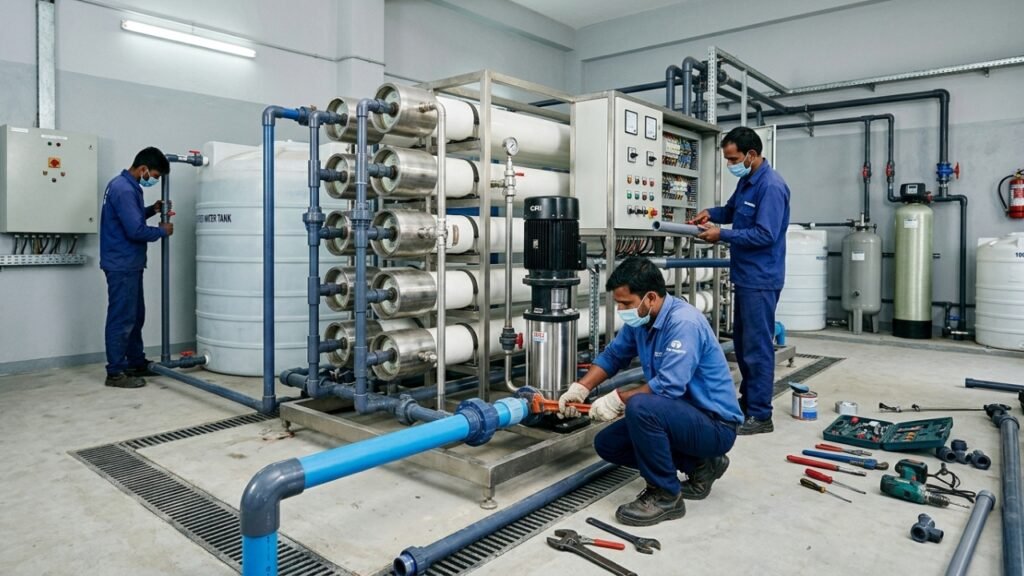
The heart of the drive system. A high-pressure pump, sized precisely for the plant’s design flow rate and the feed water’s osmotic pressure, pressurises the pre-treated water to 8–15 bar (120–220 psi). This pressure is what drives water molecules through the RO membrane’s 0.0001-micron pores while rejecting dissolved ions and micro-organisms.
The pump is the single highest-energy consumer in the plant and the mechanical component that most benefits from quality manufacturing. Industrial-grade pumps (Grundfos, Danfoss, Taro, and equivalent quality) deliver 50,000–80,000+ hours of operating life with proper maintenance. Cheap pumps – a common cost-cutting measure by low-quality assemblers – fail at 10,000–15,000 hours.
Stage 7: RO Membrane Array
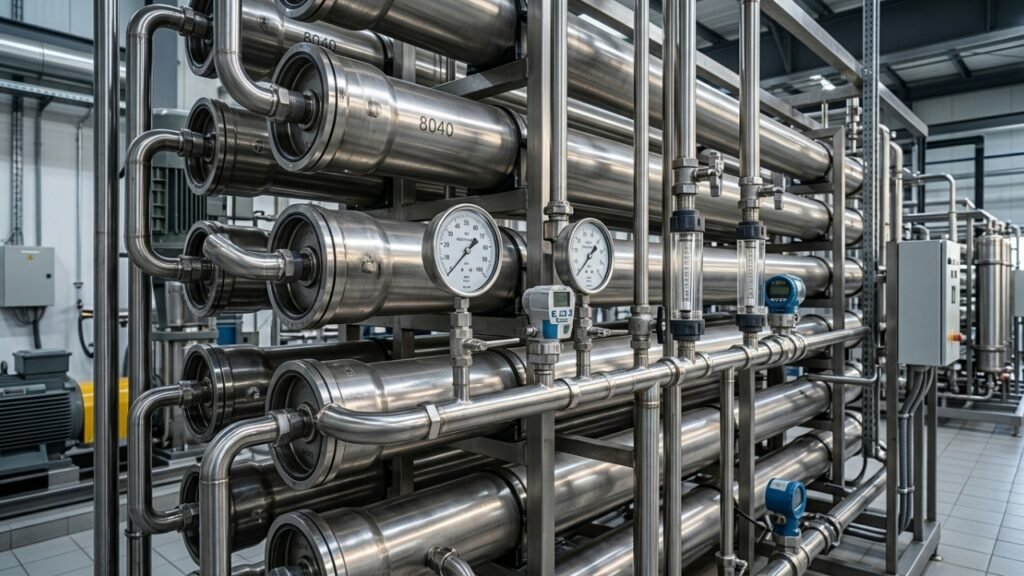
The technological core. A bank of spiral-wound RO membrane elements – typically 4040 (4-inch diameter, 40-inch length) or 8040 elements depending on plant size – rejects dissolved ions, salts, heavy metals, fluoride, nitrates, bacteria, viruses, and virtually all other dissolved contaminants at 95–99% efficiency.
Water exits the membrane array as two streams:
Permeate (purified water): The treated output – clean, low-TDS water that continues downstream to post-treatment. Typically 50–70% of the feed volume in a well-optimised community plant.
Concentrate (reject water): The remaining 30–50% of feed volume, carrying the rejected dissolved solids at 2–3x the original concentration. This stream requires management – productive use or controlled discharge. (See the dedicated section on reject water management.)
Membrane selection is critically important and often where cost-cutting by inferior suppliers causes long-term damage. Bangalore Aqua specifies Dow FilmTec, Toray, Hydranautics, or equivalent premium membranes for all community plant installations – not unbranded Indian or Chinese alternatives that may deliver adequate initial performance but degrade rapidly.
Stage 8: Post-RO Carbon Polishing
A granular activated carbon or carbon block polishing filter removes any residual taste or odour from the purified permeate. This stage also acts as a tertiary safety net against any trace organic compounds that may have passed the membrane.
Stage 9: UV Sterilisation
A high-intensity UV lamp at 254 nm provides the final biological kill step. Any micro-organisms – bacteria, viruses, Giardia cysts, Cryptosporidium oocysts – that may have passed through the membrane or entered post-membrane are exposed to UV light that destroys their DNA and prevents reproduction.
UV disinfection is the gold standard final treatment step for community plants because it leaves no chemical residue in the water, requires no contact time, and provides verifiable, near-100% disinfection efficacy when the lamp is maintained and replaced on schedule.
Stage 10: Mineralisation (Optional but Recommended)
Pure RO water, with TDS of 20–50 mg/L and pH of 5.5–6.5, is technically safe but tastes flat and is mildly acidic. A calcite or mineral cartridge adds controlled quantities of calcium, magnesium, and bicarbonate, raising TDS to 80–150 mg/L and pH to a healthy 7.0–7.5.
For community plants serving residential populations over years and decades, mineralisation is strongly recommended – the health and palatability benefits justify the small additional cost.
Stage 11: Purified Water Storage in SS Tanks
Treated water is stored in food-grade stainless steel tanks (SS304 or SS316) before distribution. Stainless steel is specified – not plastic or concrete – because it resists biofilm formation, is easy to inspect and clean, does not impart taste or odour, and does not crack or degrade over decades of use.
Storage tank sizing is calculated to meet the community’s peak demand periods without relying on the plant running continuously. Typically 1–1.5 times the community’s average daily drinking water consumption.
Community RO Plant Sizes and Who They Are Built For
Bangalore Aqua builds community plants across a wide capacity range. Here is how to match plant size to community type:
250 LPH Community Plant – Small Apartment Buildings and Compact Village Communities
Running 10 hours per day, a 250 LPH plant produces approximately 2,500 litres of purified water – enough to meet the drinking and cooking water needs of 30–50 households or 400–500 people, assuming 5 litres per person per day.
This is the right scale for small apartment buildings of 20–40 flats, compact residential layouts, small gram panchayat communities, or Anganwadi and school cluster installations. Compact footprint (typically 2.5m × 2.5m plant room), straightforward operation, and the most affordable AMC costs.
500 LPH Community Plant – Mid-Size Apartment Complexes and Medium Villages
The most commonly deployed community plant size in Bangalore’s residential sector. At 5,000 litres per day over 10 hours of operation, a 500 LPH plant serves 60–100 flats or 800–1,200 people with comfortable capacity headroom for peak demand.
This is the right scale for apartment complexes in the 50–100 flat range, gram panchayat community centres serving 1,000–1,500 people, construction project camps, or government school campus clusters.
1,000 LPH Community Plant – Large Apartment Complexes and Townships
At 10,000 litres per day, this is the workhorse of Bangalore’s apartment sector. Serving 150–200+ flats or 2,000–3,000 people comfortably, the 1,000 LPH plant is appropriate for large apartment complexes, gated communities with central clubhouse infrastructure, and peri-urban residential townships.
At this scale, a dedicated drinking water distribution network – pressurised piping delivering purified water to individual flats – becomes economically worthwhile and is increasingly expected by residents.
2,000 LPH Community Plant – Large Townships and Industrial Campuses
For very large gated townships, IT park employee communities, large industrial campuses with residential blocks, or government housing schemes, the 2,000 LPH configuration delivers 20,000 litres per day – serving 4,000–6,000 people.
5,000 LPH and Above – Peri-Urban Growth Corridors and Municipal Scale
At this capacity, the community plant functions as a small municipal water treatment facility. Modular multi-train membrane configurations, online monitoring systems, automated backwash cycles, and sophisticated control panels are standard. Solar integration is frequently incorporated.
The Economics That Every RWA Should See
One of the biggest obstacles to community plant adoption is the perception that the capital investment is large compared to “doing nothing.” Here is the real comparison – using a 200-flat apartment complex in Bangalore as the baseline.
Scenario A: Individual Household RO Units (Status Quo)
- Average quality household RO unit: ₹12,000 installed
- For 200 flats: ₹24,00,000 total capital outlay by residents individually
- Annual filter replacement per flat (sediment, carbon, UV lamp): ₹1,500
- Annual maintenance service per flat: ₹500–₹800
- Membrane replacement per flat (every 2–3 years): ₹2,500–₹4,000
- Annual cost across 200 flats: approximately ₹5,00,000–₹7,00,000 per year
- 5-year total (capital + running): ₹49,00,000–₹59,00,000
This is the invisible cost that apartment residents collectively bear in hundreds of small transactions that are never aggregated or examined as a building infrastructure expense.
Scenario B: Community RO Plant – 1,000 LPH
- Community plant installed (1,000 LPH, full pre and post treatment, SS tanks, distribution infrastructure): ₹18,00,000–₹25,00,000
- Annual operating cost (electricity, consumables, AMC): ₹1,20,000–₹1,80,000 per year
- Annual cost per flat: ₹600–₹900 per flat per year (charged as society maintenance)
- 5-year total: ₹24,00,000–₹34,00,000
The saving over 5 years: ₹15 lakh–₹25 lakh. Per flat, the community plant costs roughly ₹60–₹75 per month – compared to ₹200–₹400 per month that residents currently spend on household RO running costs and water jars.
And critically: the community plant delivers better water quality (industrial-grade membranes, professionally monitored, tested and certified), zero maintenance burden on individual residents, and a single point of accountability for water quality across the entire building.
The Water Jar Comparison
Many Bangalore residents have given up on their building’s water and spend ₹900–₹1,200 per month on 20-litre sealed water jars. Over a year that is ₹10,800–₹14,400 per flat. Over 5 years: ₹54,000–₹72,000 per flat.
A community plant providing unlimited safe drinking water costs ₹600–₹900 per flat per year – a saving of ₹10,000–₹13,500 per flat per year compared to buying jars. For a 200-flat building, that is a collective saving of ₹20,00,000–₹27,00,000 per year once the community plant is running.
The economic case is not close. Community plants win comprehensively on cost, quality, and convenience.
Reject Water: The Challenge Most Suppliers Don’t Talk About
Here is something that most community plant vendors skip in their sales presentations: RO plants produce reject water.
For every litre of purified permeate, a standard community plant produces 0.4–0.7 litres of reject water – the concentrate stream carrying the dissolved solids that the membrane rejected. For a 1,000 LPH plant running 10 hours per day, that is 4,000–7,000 litres of reject water per day.
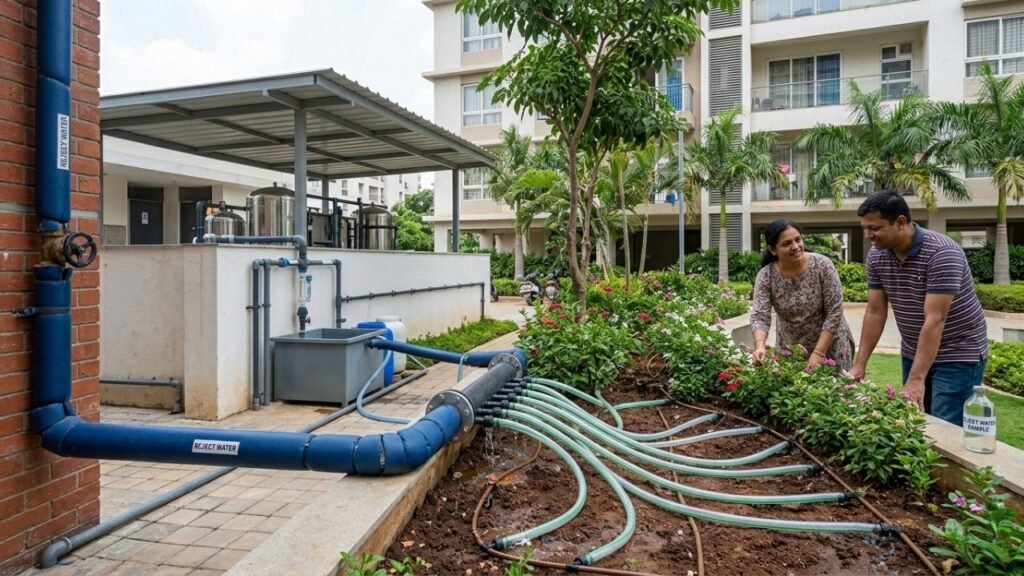
This reject water is not hazardous. It is simply your borewell water concentrated 2–3x in dissolved mineral content. But if it is simply discharged to drain, you are wasting 40–70% of the water your borewell pumped up. In Bangalore, where water scarcity is real and borewell depletion is a growing crisis, this waste is both an economic and ethical problem.
Bangalore Aqua designs a reject water utilisation plan into every community plant project. Here are the most effective productive uses:
Toilet flushing distribution: The highest-volume productive use. Reject water is piped directly into the building’s flushing water line. Toilet flushing requires no drinking-quality water – reject water at 1,500–2,500 mg/L TDS is entirely suitable. In a 200-flat building, toilet flushing consumes enormous volumes of water daily. Using reject water for this purpose effectively raises the overall water recovery of the system from 50–60% to 85–95% of total borewell input.
Garden and landscape irrigation: Reject water within acceptable TDS limits (below 2,000 mg/L for most ornamental plants, below 1,000 mg/L for vegetable gardens) is suitable for landscape irrigation. Bangalore Aqua advises on TDS thresholds for each project’s reject water chemistry.
Washing and cleaning: Vehicle washing bays, external walkway cleaning, and equipment washing areas can all be supplied from reject water, eliminating the use of potable borewell water for these applications.
Sump and fire tank make-up: Where reject water TDS is below acceptable limits, it can supplement building sump levels.
A well-planned reject water utilisation system effectively makes the community RO plant almost zero-waste – an increasingly important credential as BBMP and BDA regulatory frameworks evolve.
What Separates a Great Community Plant from a Failed One
This is the most important section in this guide, because community plant failures are real, documented, and almost always the result of the same predictable mistakes. Here is what differentiates the best community RO project plants from the ones that become expensive maintenance headaches:
Design Is Based on Actual Water Testing – Not Assumptions
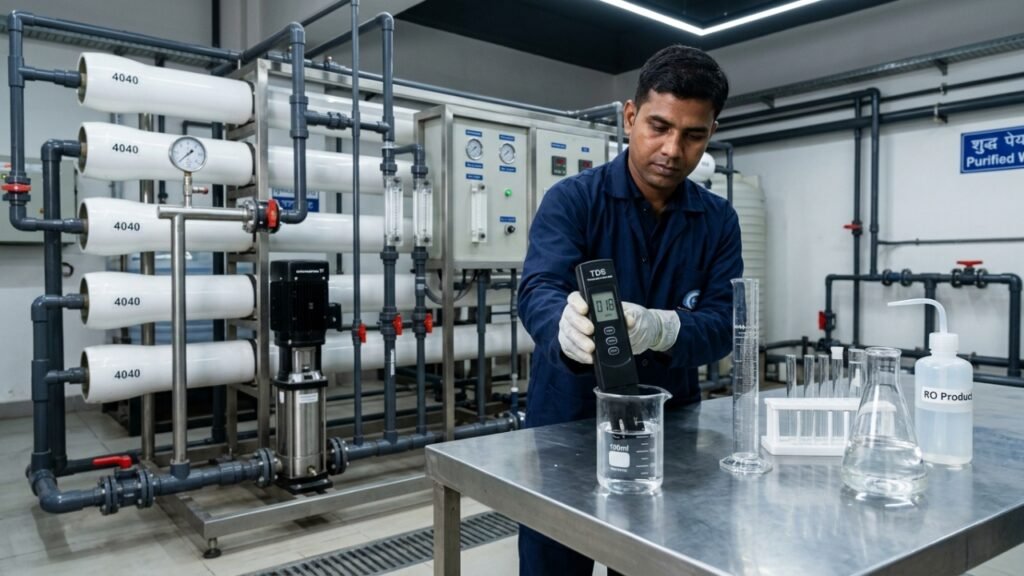
There is no substitute for a current, complete water quality test before specifying any system. Source water TDS, hardness, iron content, fluoride, nitrates, pH, and bacterial count all directly determine the pre-treatment requirements, membrane type, and post-treatment design.
A supplier who quotes without testing your water is guessing. That guess may result in under-specified pre-treatment (membranes foul prematurely), wrong membrane type (inadequate fluoride rejection), or over-specified capacity (plant runs at 30% utilisation and never reaches efficient operating conditions).
Bangalore Aqua conducts a free site assessment and coordinates source water testing before any system is specified.
Pre-Treatment Is Never Cut
The most common cost-cutting measure by inferior suppliers is reducing or eliminating pre-treatment stages. A quote that removes the multimedia sand filter, the carbon filter, or the softener to bring the headline price down is a quote that will cost the customer far more in membrane replacement costs over the first two years.
Good pre-treatment is the investment that protects the expensive investment. A quality RO membrane assembly costs ₹15,000–₹50,000+ depending on system size. A multimedia filter costs ₹5,000–₹15,000 to install. The arithmetic is not complicated.
Stainless Steel Storage – Not Plastic
Post-treatment storage in food-grade SS304 tanks is a non-negotiable quality marker. Plastic tanks – even food-grade HDPE – develop micro-surface cracks over time that harbour biofilm colonies. These biofilms can recontaminate purified water stored for more than a few hours. For a community plant storing 2,000–5,000 litres of purified water overnight, plastic storage is a genuine water safety risk.
Bangalore Aqua specifies SS304 food-grade tanks as standard.
The AMC is Funded and Structured Before Commissioning
A community plant without a funded maintenance contract is a community plant on a timer. The maintenance requirements are real and time-sensitive:
- Cartridge pre-filters: replace every 3–6 months
- UV lamp: replace annually (brightness fades below safe dosage – not visible to the eye)
- Carbon filter media: replace every 12 months
- Membrane flux monitoring: quarterly
- Water quality testing (NABL accredited): at least annually
- SS tank cleaning and sanitisation: annually
Miss these schedules consistently and the plant will gradually degrade – silently. Water quality slips below safe levels before most building managers notice. Children keep drinking it.
Bangalore Aqua structures AMC plans for every community plant at the time of sale – not as an afterthought. The quarterly maintenance visit schedule, consumable replacement calendar, and annual water quality test are part of the project deliverable.
Online TDS Monitoring Provides Constant Visibility
Every Bangalore Aqua community plant includes an inline TDS display on the purified water output line. Building managers or designated operators can verify water quality at any time with a glance. TDS above the plant’s rated output range immediately flags a membrane or pre-treatment issue requiring service attention.
For larger community plants (1,000 LPH and above), online monitoring with SMS or app-based alerts is available – notifying the building manager and Bangalore Aqua’s service team simultaneously if TDS rises above a set threshold.
How Bangalore Aqua Executes Community Plant Projects – Step by Step
Step 1 – Free Site Assessment (Day 1–3) Contact Bangalore Aqua. A technical team member visits your building or site within 48 hours, assesses the water source, existing infrastructure, available plant room space, electrical supply, and distribution requirements. Water samples are collected for laboratory analysis.
Step 2 – Water Quality Testing (Days 3–8) Samples are sent to an NABL-accredited laboratory for TDS, hardness, iron, fluoride, nitrate, coliform, E. coli, and pH analysis. Results typically return in 3–5 working days.
Step 3 – System Design and Quotation (Days 8–12) Based on test results and site data, Bangalore Aqua’s engineering team produces a complete system specification: pre-treatment train, membrane configuration, post-treatment, storage sizing, reject water management plan, civil requirements, and electrical specification. An itemised quotation is provided – no hidden costs.
Step 4 – RWA Approval and Order (Days 12–18) The technical proposal is presented to the RWA committee. Bangalore Aqua welcomes questions and site visits to reference installations. Once approved, manufacturing begins.
Step 5 – Manufacturing (Days 18–35) Standard community plants (250–1,000 LPH) are manufactured at Bangalore Aqua’s Bengaluru facility in 10–15 working days. Larger systems take 20–30 working days. Every system undergoes bench testing before dispatch.
Step 6 – Installation and Commissioning (Days 35–42) The installation team arrives on site with all equipment. Civil preparation (if required), equipment mounting, plumbing connections, electrical wiring, and SS tank installation are completed in 2–5 days depending on system size. The system is started up, flushed, and performance-tested. Final purified water TDS and bacterial count are verified before handover.
Step 7 – Operator Training and Handover The building’s designated operator receives 2–3 hours of hands-on training: daily startup and shutdown, reading TDS displays, checking pressure gauges, topping up chemical dosing tanks, monthly pre-filter inspection, and when to call for service. A laminated daily operations checklist is posted at the plant.
Step 8 – AMC Commencement The Annual Maintenance Contract activates from day of commissioning. Quarterly scheduled visits, consumable replacement, annual water quality testing, and priority emergency response are live from day one.
Community RO Plants in Specific North Bangalore Locations
Bangalore Aqua has extensive experience deploying community plants across North Bangalore’s rapidly growing residential and peri-urban landscape. Each zone has specific water chemistry characteristics that require tailored plant design:
Yelahanka
Yelahanka’s mix of older residential layouts and newer apartment projects creates varied water quality situations. Older borewells may show lower TDS but elevated bacterial risk. Newer, deeper borewells typically show higher TDS (700–1,100 mg/L) and hardness. The rapid apartment development along the Yelahanka–Doddaballapur Road and around Kogilu has created strong demand for community plant installations in new complexes.
Apartment associations in Yelahanka are among the most active community plant buyers in North Bangalore – driven by educated residents who understand water quality and active RWA leadership that has moved away from the individual household unit model.
Devanahalli
The airport ecosystem has created a remarkable density of residential supply near the KIA – staff housing, township projects, and independent layouts serving airport and aerospace park employees. These residents face some of North Bangalore’s highest TDS borewell water (900–2,000+ mg/L in some localities). Community plants in this zone must be designed for the high end of TDS range, with robust pre-treatment and premium membrane selection.
Bangalore Aqua has deployed community systems in Devanahalli that handle feed water TDS up to 1,800 mg/L reliably, delivering output consistently below 60 mg/L.
Nelamangala
Nelamangala’s large worker townships and industrial housing colonies represent a significant community plant market that is still underserved. High population density, high water consumption, and very hard source water (hardness often 500–700 mg/L as CaCO₃) make community plants the only practical solution at scale. Individual household units cannot handle the hardness levels consistently.
Doddaballapur and Hoskote
Rapidly urbanising areas with large worker populations, new residential layouts, and gram panchayat communities transitioning from rural to peri-urban status. Community plants here serve a mix of residential complexes and village-level installations. Gram panchayats in these areas are increasingly approaching Bangalore Aqua directly for community water plant installations – often with CSR funding from adjacent industrial companies.
Real Voices: What Apartment Associations and Community Leaders Say About Community Plants
The best evidence for any infrastructure investment is the testimony of those who have already made it.
Across Bangalore Aqua’s growing base of community plant installations, the feedback from building managers and RWA leaders is consistent and specific:
On cost savings: “We calculated that our 180 flats were collectively spending over ₹15 lakh a year on household RO maintenance, service calls, and water jars. After the community plant, our monthly water levy is ₹80 per flat. The building has saved money and the water is actually better.”
On resident satisfaction: “The complaints about water quality have essentially stopped. Before, the managing committee used to receive 15–20 calls a month about water. We now receive maybe one or two – and they are usually someone asking about the TDS reading on the display, not complaining.”
On the maintenance model: “What sold us was not just the plant – it was the AMC. Bangalore Aqua’s team comes every quarter without us having to chase them. The quarterly report they leave tells us exactly what was done, what was replaced, and what the current water quality reading is. That accountability was something we never had with individual units.”
On the installation experience: “The installation team was clean, professional, and finished on schedule. They explained every stage of the plant to our building manager in Kannada – which made the difference for daily operations.”
The Bottom Line: Community Water Plants Are Not a Luxury – They Are Responsible Infrastructure
Here is the simplest framing of the community RO plant case:
Every person in your building deserves to know that the water they and their children drink every day is safe. Not probably safe. Not safe unless someone forgot to change the cartridge three months ago. Definitely safe, tested, certified, and professionally managed.
That certainty does not come from 300 individual household units with 300 individual maintenance histories. It comes from one professionally designed, professionally installed, and professionally maintained community plant – with documented water quality output and a team that shows up every quarter to verify it.
The economics support it. The water quality supports it. The convenience supports it.
Bangalore Aqua and Energy Pvt. Ltd. has been delivering that certainty to apartments, societies, townships, and villages across Karnataka since 2021 – with 100+ five-star reviews, an established track record of successful community installations, and a service model built for the long term.
Take the first step today. Contact Bangalore Aqua for your free site assessment and water quality test.
📞 +91 76763 93939 | +91 97387 04753
📧 info@bangaloreaqua.com
🌐 bangaloreaqua.com
📍 107/209 2nd Cross, 4th Main Kogilu Layout, Bengaluru – 560064, Karnataka
Community RO plant installations across Bengaluru, Yelahanka, Devanahalli, Nelamangala, Doddaballapur, Hoskote, Mysuru, Mangaluru, Hubballi, Tumakuru, and all major Karnataka cities.
Related reads: Best CSR Project RO Plants in India 2026 | Best Water Softener for Bangalore 2026 | Top 10 RO Plant Companies in India 2026 | RO Plants for North Bangalore – Yelahanka, Devanahalli, Hoskote, Nelamangala, Doddaballapur