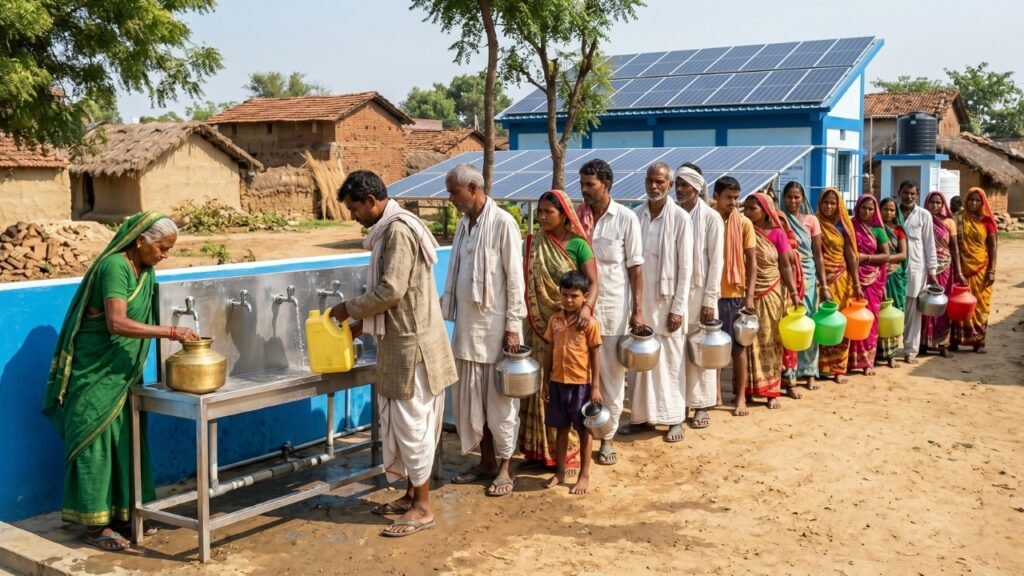
There Is a Village in Karnataka Whose Children Have Never Drunk Safe Water
This is not a figure of speech. This is a fact.
In fluoride-affected villages across Kolar and Chikkaballapur districts of Karnataka – just a two-hour drive from the gleaming glass towers of Bengaluru’s IT corridor – children have grown up drinking groundwater with fluoride concentrations that far exceed the Bureau of Indian Standards’ safe limit of 1.0 mg/L. The consequences are visible in their teeth and, in the most severe cases, in their bones. Dental fluorosis. Skeletal deformity. Pain that starts in childhood and does not leave.
This is not a failure of technology. The technology to remove fluoride from groundwater – Reverse Osmosis – has existed for decades. It is not a failure of engineering. An RO plant capable of serving an entire village can be manufactured, transported, installed, and commissioned within weeks. It is not a failure of cost economics. A 500 LPH community RO plant serving a village of 1,500 people can deliver safe water at a cost of less than ₹0.20 per litre – less than the price of a single grain of rice.
It is, most fundamentally, a failure of priority and investment – a failure that India’s corporate sector has both the obligation and the genuine opportunity to fix.
This is what CSR RO plant projects are about. Not a line item in a compliance spreadsheet. Not a photo opportunity for an annual report. The best CSR project RO plants are infrastructure investments that give communities something they have never had: the certainty that the water their children drink today will not hurt them tomorrow.
This guide is for every CSR head, sustainability manager, company director, and NGO programme officer who wants to understand what the best CSR RO plant projects look like, how to plan and execute them correctly, and who to partner with to ensure they deliver genuine, lasting impact.
The Legal Foundation: Why CSR Water Projects Are a Priority Under Indian Law
Before getting into the details of plant types, costs, and implementation, it is important to understand the legal framework – because for many companies, this is where the conversation begins.
Section 135 of the Companies Act, 2013
Under Section 135 of the Companies Act 2013, every company that meets any one of the following thresholds in the preceding financial year must constitute a CSR Committee and spend at least 2% of its average net profit over the preceding three financial years on CSR activities:
- Net worth of ₹500 crore or more, OR
- Turnover of ₹1,000 crore or more, OR
- Net profit of ₹5 crore or more
Failure to spend this amount – or, since the 2021 amendment, failure to transfer unspent funds to a designated PM-CARES or Schedule VII fund within prescribed timelines – is subject to penalties. The mandatory nature of this provision has created an enormous pool of CSR capital in India: estimated at over ₹25,000 crore per year and growing.
Schedule VII: Water Is Explicitly Listed
The activities eligible for CSR spending under Schedule VII include the following, directly relevant to RO plant projects:
“(i) Eradicating hunger, poverty and malnutrition, promoting health care including preventive health care and sanitation including contribution to the Swach Bharat Kosh set up by the Central Government for the promotion of sanitation and making available safe drinking water.”
Safe drinking water projects – including community RO plants, school water systems, village water kiosks, and solar-powered water plants – are explicitly and unambiguously eligible. There is no interpretive ambiguity. If your company installs an RO plant in a village, a school, or an underserved community, that spend qualifies under Schedule VII.
The 2021 Amendment: Unspent CSR Funds Must Be Used
The 2021 amendment to Section 135 added a critical provision: CSR funds that are committed to an ongoing project but not yet spent must be transferred to an Unspent CSR Account within 30 days of the financial year end, and then spent within three years. Funds committed to specified funds (like PM-CARES or Clean Ganga Fund) must be transferred within six months.
This amendment has created urgency around long-term projects like multi-year CSR water initiatives – which is exactly what a community RO plant with a 3–5 year AMC commitment represents. Companies are actively seeking partners who can structure multi-year projects with phased commitments that align with regulatory timelines.
Bangalore Aqua’s CSR project team is specifically experienced in structuring projects that satisfy these regulatory requirements, with phased payment and implementation milestones that map cleanly to CSR accounting timelines.
The Scale of India’s Drinking Water Crisis: Why This Is the Highest-Impact Category
To understand why CSR RO water projects matter more than almost any other category of corporate social responsibility spending, you need to understand the scale of the problem they are solving.
The Numbers Are Staggering
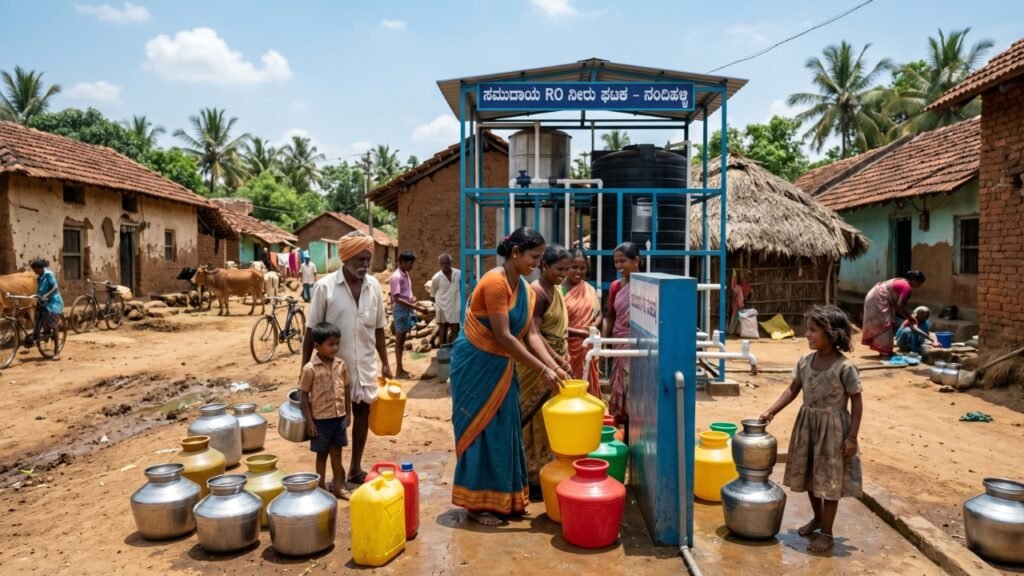
Six RO water purification plants set up by the Human Welfare Foundation have benefited 4 villages with approximately 500 households each – demonstrating the scale of impact achievable even with modest plant counts.
A single CSR initiative by a major bank has undertaken installation of RO plants for pure drinking water in 217 fluoride-affected villages across Kolar and Chikkaballapur districts in Karnataka – with installation completed in 156 villages and made operational.
One company and its foundation installed RO units in 15 Karnataka government schools, providing access to safe drinking water to over 750 students – while a community RO water plant in Srirampura village on the outskirts of Bengaluru is now benefiting over 2,000 residents.
A pharmaceutical company’s RO drinking water programme in Anekal Taluk, Bengaluru provides potable water to over 9,000 people under the administration of three panchayats.
These are not isolated cases. They are examples of what happens when a company decides to take clean water seriously as a CSR priority – and partners with the right implementation team to execute.
What Contaminated Water Is Actually Doing to Communities
Let us be specific about the health consequences that CSR RO plants are designed to prevent, because the numbers above mean nothing without understanding what they represent in human terms.
Fluorosis – caused by drinking water with fluoride above 1.5 mg/L over extended periods – affects an estimated 60–65 million people across India. Karnataka’s Kolar, Chikkaballapur, Chitradurga, and Tumakuru districts have documented endemic fluorosis. Children in affected villages develop mottled, discoloured teeth in the early stages. At higher doses or longer exposure, skeletal fluorosis causes joint pain, deformity, and eventual disability. There is no cure – only prevention. An RO plant removes fluoride at 90–96% efficiency. Prevention is entirely possible.
Nitrate contamination from agricultural fertiliser runoff affects shallow aquifers across rural Karnataka. Nitrate above 45 mg/L causes methemoglobinemia in infants under six months – a potentially fatal condition in which blood loses its ability to carry oxygen. RO membranes remove nitrates at 80–95% efficiency.
Bacterial contamination – E. coli, coliforms, and pathogenic bacteria – in unprotected wells and shallow borewells causes diarrhoea, typhoid, cholera, and hepatitis A. These diseases kill tens of thousands of Indian children annually. A well-maintained RO plant with UV disinfection eliminates bacterial risk from drinking water entirely.
High TDS and hardness from deep borewells – the dominant water source for most rural Karnataka communities – causes chronic kidney stress over years of consumption, contributes to kidney stones, and at very high TDS levels (1,500+ mg/L) is associated with cardiovascular effects.
A single CSR RO plant, costing as little as ₹3–5 lakh for a school installation, prevents all of these outcomes for hundreds of children for a decade or more. The return on that investment – measured in healthy childhoods, school attendance, reduced family medical expenditure, and long-term cognitive and physical development outcomes – is extraordinary.
What Makes a CSR RO Plant Project “The Best”? Six Defining Criteria
Not all CSR water projects are equal. The difference between a project that delivers lasting impact and one that becomes a rusting installation within eighteen months is almost entirely a function of implementation quality. Here are the six criteria that define the best CSR project RO plants:
1. Community Needs Were Properly Assessed Before Any Equipment Was Ordered
The single most common cause of CSR water project failure is the absence of a proper needs assessment. Companies – often under time pressure to deploy budget before the financial year end – order equipment based on rough estimates, without testing the source water, verifying community population, or assessing available infrastructure.
The result: a 500 LPH plant installed in a village with 3,000 people (a plant that can realistically serve 1,000–1,500). Or a plant installed with the wrong pre-treatment for the specific contamination profile of the local borewell – so fluoride or iron passes through the RO membrane and the water coming out of the plant is not actually safe.
The best CSR RO plants begin with a detailed, field-verified needs assessment covering source water quality testing (not estimated), accurate population count and daily water demand calculation, power supply reliability, available installation space, and community governance structure.
2. The Technology Is Correctly Matched to the Contamination Profile
This is a technical point that has profound real-world consequences.
Fluoride removal, nitrate removal, iron removal, and bacterial disinfection all require specific membrane types, pre-treatment stages, and operating parameters. A standard commercial RO plant configured for TDS reduction may not achieve adequate fluoride rejection if the wrong membrane is specified.
The best CSR RO projects involve genuine engineering specification – membranes selected for the specific contaminant profile of the source water, pre-treatment designed for the actual raw water chemistry, and final treatment (UV, ozone, or both) matched to the bacteriological risk.
Bangalore Aqua’s engineering team conducts source water testing and specifies membrane types, pre-treatment trains, and operating parameters specifically for each project site. This is not a standard template approach – it is site-specific engineering.
3. Community Ownership Is Built In From Day One
A water plant that a community does not feel ownership over is a plant on a countdown to abandonment. The best CSR RO projects are designed with community participation, not just community benefit.
This means involving local leaders (gram panchayat sarpanch, women’s self-help group leaders, school management committee members) in planning discussions. It means training local community members as operators – not just handing over a system and leaving a manual in Hindi or English that no one in the village can read.
It means designing the water delivery model to reflect community preferences: Is this a free access public good? A pay-per-litre kiosk that generates funds for consumable replacement? A school-specific installation managed by the school management committee? There is no one right answer – the right answer depends on the specific community’s governance culture, economic situation, and water use patterns.
The best CSR project partner – and this is exactly what Bangalore Aqua provides – conducts genuine community engagement before finalising any design, and trains local operators in their own language with hands-on, practical instruction.
4. The AMC Is Funded and Committed Upfront
This is the most critical governance decision in any CSR water project, and it is the one most often skipped.
A community RO plant requires:
- Filter cartridge replacement every 3–6 months
- UV lamp replacement annually
- Chemical dosing refill every 1–3 months
- RO membrane performance monitoring and membrane replacement at 3–5 years
- Periodic cleaning and sanitisation
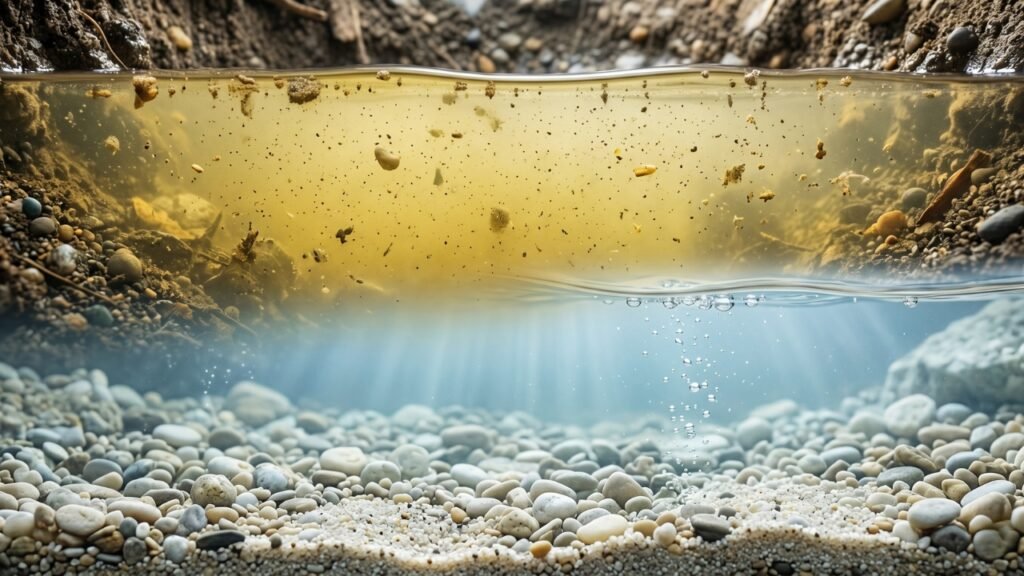
If no one is committed to funding these maintenance costs after the initial installation, the plant will degrade. Not dramatically and suddenly – but gradually, over 12–24 months, water quality will slip. Output will drop. Eventually the system will fail entirely.
The best CSR projects include an explicitly funded Annual Maintenance Contract – typically structured as a 3–5 year commitment – that covers all of the above. This AMC is treated as part of the total project cost, not an afterthought.
For companies using CSR funds: ongoing AMC costs for a plant that is producing social impact are legitimate ongoing CSR expenditures. This means you can budget the AMC as part of your multi-year CSR allocation.
5. Impact Is Documented Rigorously Throughout the Project Life
Your CSR Committee, Board, and auditors need to demonstrate that CSR funds produced real, verifiable impact. For water projects, this documentation should cover:
- Pre-installation water quality test reports (baseline – what people were drinking before)
- Post-installation water quality certification from an NABL-accredited laboratory
- Beneficiary count with demographic data
- Regular water production logs (litres per day)
- Annual community surveys capturing health outcome self-reporting
- Photographic and geo-tagged documentation
The best CSR project implementation partners provide all of this documentation as part of the project deliverables. Bangalore Aqua’s CSR documentation package is specifically structured to support BRSR (Business Responsibility and Sustainability Report) disclosure and MCA CSR annual reporting.
6. The Plant Is Designed for the Community’s Long-Term Future – Not Just Today’s Population
Communities grow. Schools get more students. Villages in peri-urban Karnataka are rapidly absorbing population as Bengaluru’s growth pushes outward. A plant correctly sized for today’s population may be inadequate in five years.
The best CSR projects include modular expansion capacity: plant room civil works and electrical infrastructure sized for a larger future installation, even if the initial plant is appropriately scaled to current demand. When the community grows, expanding capacity should be a matter of adding equipment to existing infrastructure – not building a whole new plant.
Bangalore Aqua designs all its CSR project plants with 3–5 year demand projections built into the civil and electrical specifications, ensuring the plant can scale without major reinvestment.
Types of CSR RO Plants: Which One Is Right for Your Project?
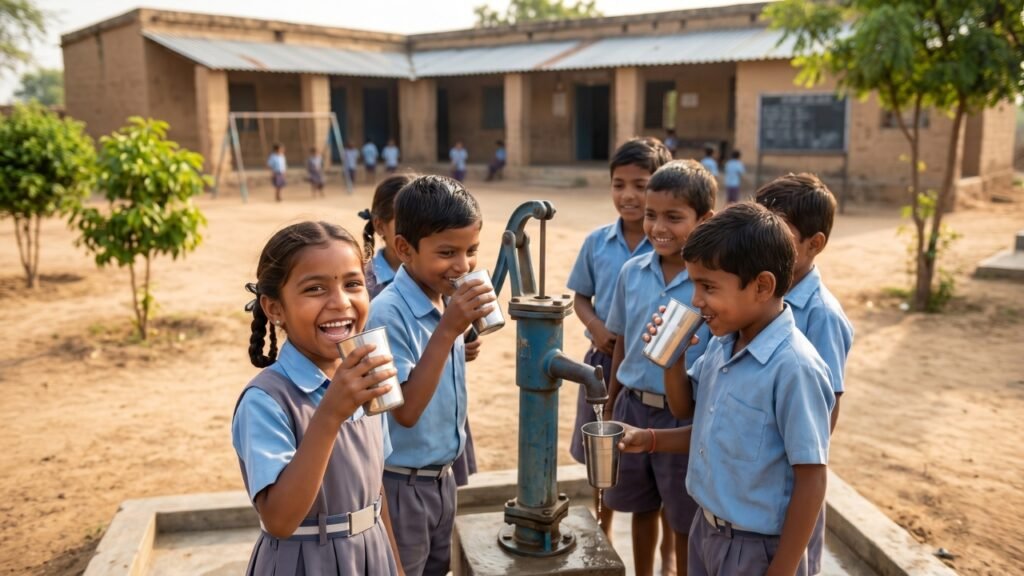
CSR drinking water projects take several forms depending on the target community, the available budget, the water source, and the governance model. Here is a comprehensive breakdown:
Type 1: Village Community Water Kiosk (500–1,000 LPH)
What it is: A standalone RO purification unit installed in a central village location – typically near the gram panchayat office, a community hall, or a prominent public space – producing clean drinking water for open community access.
How it works: Water is produced continuously or during fixed operating hours (typically 6–8 hours per day) and dispensed at a central dispensing point. Access may be free, or water may be dispensed through a coin or token mechanism at ₹1–₹5 per litre, generating a fund for consumable replacement.
Daily output: 5,000–10,000 litres (10-hour operation)
People served: 1,500–3,000 direct beneficiaries
Approximate capital cost: ₹5–₹12 lakh (including civil works, SS storage tanks, and dispensing system)
Best for: Villages with a clear central public space, strong panchayat governance, and 1,500–3,000 population
Sustainability model: For long-term sustainability, the nominal user fee model is recommended – even at ₹1 per litre, a plant producing 5,000 litres/day generates ₹5,000 per day, which over a month covers the cost of consumables and electricity. Bangalore Aqua advises on the optimal pricing model for each community based on its economic profile.
Type 2: School Drinking Water Plant (100–250 LPH)
What it is: A compact RO system installed at a government school, Anganwadi centre, or rural health sub-centre, providing clean drinking water for students, teachers, and staff throughout the school day.
How it works: The plant is sized to cover the school’s drinking water needs during school hours, with a storage tank large enough to ensure supply even if the plant is offline for part of the day. Water is delivered to drinking stations distributed across the campus.
Daily output: 1,000–2,500 litres (8–10 hours school day operation)
People served: 200–600 students and staff directly
Approximate capital cost: ₹2–₹6 lakh (including installation and storage)
Best for: Government primary and secondary schools, Anganwadi networks, and rural health centres
Social impact multiplier: School plants have a remarkable social impact multiplier beyond the direct health benefit. When children have access to safe drinking water at school, attendance improves – particularly for girls in communities where waterborne illness disproportionately affects younger children. Teachers perform better in environments where they are not anxious about water quality. The school becomes a model for the community – demonstrating what good water can look like.
Parijat Industries’ CSR initiative of installing an RO-integrated water cooler in a village community hall was specifically designed to ensure easy access to clean, cold, and healthy drinking water, especially during the summer – a timing consideration that demonstrates thoughtful needs-based project design.
Type 3: Large Panchayat Water Plant (1,000–5,000 LPH)
What it is: A high-capacity community RO plant designed to serve a large gram panchayat with multiple settlements or a dense rural-urban transitional community.
How it works: Water is produced at high volume and stored in large SS tanks (5,000–20,000 litre capacity). Distribution may happen through multiple dispensing points across the panchayat area, or through a dedicated distribution pipe network reaching individual habitations.
Daily output: 10,000–50,000 litres
People served: 3,000–15,000+ beneficiaries
Approximate capital cost: ₹15–₹60 lakh (depending on capacity, distribution infrastructure, and civil works)
Best for: Large panchayats, multi-village clusters, peri-urban growth communities on the edge of rapidly expanding Bengaluru
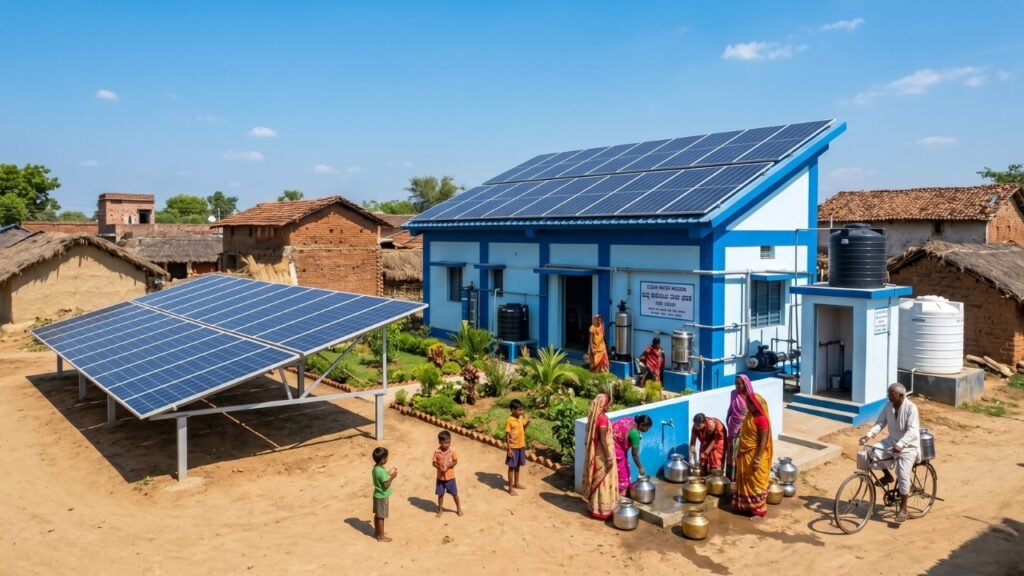
Type 4: Solar-Powered CSR Water Plant (100–2,000 LPH)
What it is: An RO purification plant powered entirely or predominantly by solar photovoltaic panels and battery storage, eliminating dependence on grid electricity.
How it works: A rooftop or ground-mounted solar array powers the RO pump, UV system, and control electronics through a battery bank. The system produces clean water during daylight hours and continues to operate into the evening on stored battery power. In areas with very poor grid reliability – common in many rural Karnataka districts – solar integration transforms a marginally functional plant into a reliably functioning one.
Daily output: Depends on system capacity (100 LPH to 2,000 LPH range)
People served: Varies by capacity
Approximate capital cost: Add ₹3–₹15 lakh to the base plant cost for solar integration
Best for: Villages in power-deficient areas; CSR projects with strong sustainability and carbon neutrality mandates; areas where the cost of diesel backup generators would otherwise be a significant ongoing expense
Why solar integration is increasingly the right choice for CSR projects: Karnataka’s solar irradiance is excellent – 5.0–5.5 peak sun hours per day across most of the state. A solar-powered water plant produces clean water using the sun – zero fuel costs, zero carbon emissions, and maximum operational reliability independent of the grid. For companies with net-zero or sustainability commitments, a solar-powered CSR water plant is a tangible, measurable contribution to both their water access and carbon reduction goals simultaneously.
Type 5: Water ATM Model (50–200 LPH)
What it is: A compact, automated water dispensing kiosk that integrates a small RO plant with an electronic payment system (coin slot, UPI, RFID card, or QR code). Community members pay a nominal amount – typically ₹1–₹5 per litre – to dispense measured quantities of purified water.
How it works: The Water ATM operates autonomously, requiring minimal human supervision. Transactions are logged electronically, providing the sponsoring company with real-time data on water dispensed and revenue generated. Revenue covers consumables and electricity, creating a self-sustaining model.
Daily output: 500–2,000 litres (depending on unit and operating hours)
People served: 200–800 people
Approximate capital cost: ₹3–₹8 lakh
Best for: Peri-urban communities, construction worker colonies, market areas, and bus stand clusters where people pass through rather than residing in a fixed location; also effective in communities with strong mobile payment adoption
The sustainability advantage: The Water ATM model is increasingly favoured by corporate CSR teams because it is inherently self-sustaining – the nominal user fee covers operating costs without requiring ongoing CSR budget. The initial capital expenditure is the primary CSR commitment. After year one, the plant pays for itself through user fees, with the company’s ongoing obligation being only the AMC contract.
Step-by-Step: How to Plan and Execute a Best-in-Class CSR RO Plant Project
This is a practical guide for CSR teams, programme officers, and implementation partners who want to execute a project that actually works.
Step 1: Define Your Impact Goal (Week 1)
Start with the why, not the what. Before specifying any equipment, your CSR committee should answer:
- What community are we targeting, and why?
- What is the specific water problem we are solving? (High TDS? Fluoride? Bacterial contamination? Simply no access to any purified source?)
- How many beneficiaries do we want to reach?
- What is our total budget – capital plus minimum 3-year AMC?
- Do we have an NGO implementation partner, or are we working directly with a technical supplier?
- What is our timeline – when does the plant need to be operational?
Clarity on these questions before engaging suppliers prevents misspecification and wasted time.
Step 2: Site Selection and Community Engagement (Weeks 2–3)
Work with your CSR field team, your NGO partner, or your district government contacts to identify 3–5 candidate sites. For each site, assess:
- Population size and water demand
- Current water source and quality (is there a borewell? Is it accessible? What is the approximate TDS and contaminant profile?)
- Community governance – is there a functional gram panchayat? A women’s SHG? A school management committee? Who will be responsible for the plant day-to-day?
- Physical space – where can the plant be installed? Is there an existing structure, or will civil works be needed?
- Electrical supply – is there a reliable grid connection, or is solar integration required?
- Community appetite – has anyone spoken to community members about the project? Do they want it? Are they willing to take operational responsibility?
This site visit typically takes one day per site. Bangalore Aqua can accompany your team on site visits to provide a technical assessment simultaneously with your community engagement activities.
Step 3: Water Quality Testing (Weeks 2–4)
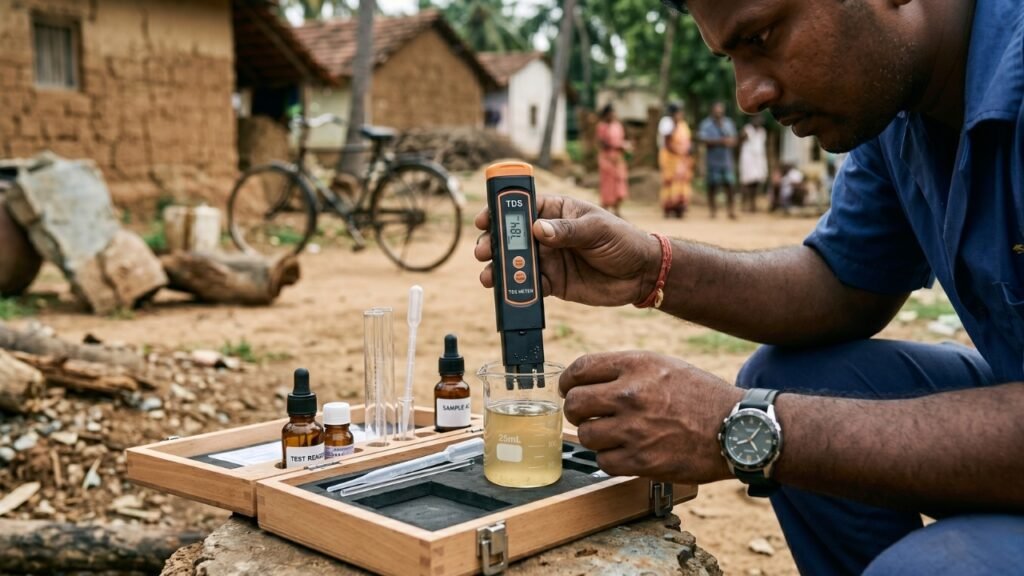
Collect water samples from the proposed source (borewell, municipal supply, or surface water) and have them tested by an NABL-accredited laboratory. The test should cover:
- TDS (Total Dissolved Solids)
- pH
- Total Hardness (as CaCO₃)
- Iron (total, ferrous, ferric)
- Manganese
- Fluoride
- Nitrate and Nitrite
- Arsenic (in certain regions)
- Total Coliform and E. coli count
- Turbidity
- Chlorides, Sulphates
This test takes 5–10 working days at an accredited laboratory. The results are the engineering foundation for everything that follows.
Bangalore Aqua can arrange accredited water quality testing as part of the project scoping process.
Step 4: Technical Specification and Quotation (Weeks 3–5)
Armed with site data and water quality test results, Bangalore Aqua’s engineering team prepares:
- System capacity specification (LPH, based on community population and daily demand)
- Pre-treatment train (sediment stages, carbon filtration, iron removal if needed, softener or anti-scalant dosing if needed)
- RO membrane specification (membrane type and count based on TDS and target contaminant removal)
- Post-treatment (mineralisation, pH correction, UV disinfection)
- Storage tank sizing (SS304 food-grade)
- Civil requirements (plant room dimensions, foundation requirements)
- Electrical specification (load, phases, or solar array sizing)
- Dispensing and distribution design
- Itemised Bill of Materials
- Full project cost breakdown (capital + installation + commissioning + 3-year AMC)
This proposal becomes your CSR Committee’s formal project document.
Step 5: CSR Committee Approval and Fund Release (Weeks 5–7)
Present the project to your CSR Committee with the full technical proposal, site assessment report, water quality baseline data, and expected impact metrics (beneficiary count, daily water production, contaminants addressed, health outcomes targeted). Obtain formal CSR Committee approval and arrange fund release per your company’s procurement policy.
Step 6: Manufacture and Installation (Weeks 7–13)
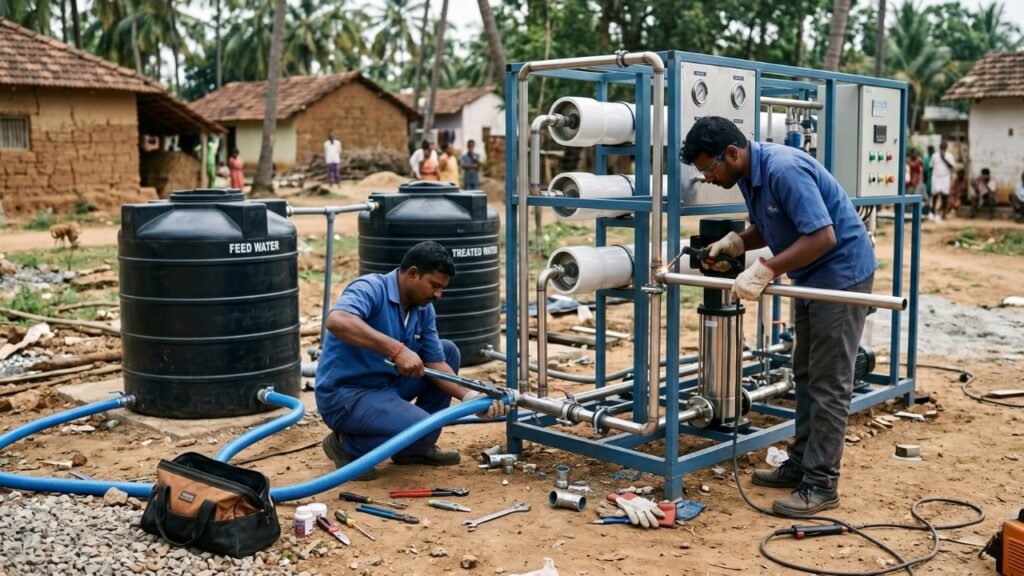
Bangalore Aqua’s manufacturing team produces the plant at the Bengaluru facility. Standard capacity plants (250–1,000 LPH) take 2–4 weeks to manufacture. Larger or custom configurations take 4–8 weeks.
Installation begins once the plant room civil works are complete (if required). A dedicated installation team handles:
- Equipment delivery and placement
- Borewell or inlet line connection
- Electrical connection or solar array installation
- Plumbing of all stages including reject water management
- Storage tank installation
- Control panel wiring and programming
- Initial system flush and startup
- Full performance test (inlet and outlet TDS, flow rate, UV intensity)
Step 7: Community Training and Formal Handover (Day of Commissioning)
On commissioning day, Bangalore Aqua conducts:
Operator training: 2–3 designated community operators (ideally drawn from the local women’s SHG or school staff) are trained for 2–3 hours in:
- Daily startup and shutdown procedure
- Reading TDS display and interpreting readings
- Checking UV lamp indicator
- Checking and refilling chemical dosing tanks
- Monthly filter inspection
- How to call for service support
Community launch event: The formal inauguration of the plant – with gram panchayat leaders, school principal, women’s SHG representatives, and community members present – marks the beginning of community ownership. Bangalore Aqua recommends the sponsoring company’s CSR team attend this event. The impact on community goodwill is significant.
Documentation package: Final water quality test certificate (post-commissioning), installation photographs (geo-tagged), beneficiary count documentation, and project completion report are delivered to the sponsoring company.
Step 8: Ongoing AMC and Annual Impact Reporting (Year 1–3+)
Bangalore Aqua’s AMC team:
- Visits the plant quarterly for scheduled maintenance (filter cartridge replacement, UV lamp check, pressure gauge calibration, membrane flux monitoring)
- Replaces UV lamp annually
- Conducts annual water quality testing at an accredited laboratory
- Responds to emergency service calls within 24–48 hours
- Provides an annual impact report summarising water produced, maintenance performed, and water quality results
The sponsoring company receives this documentation annually and uses it in their CSR Annual Report and BRSR disclosure.
The Real Human Impact: Stories From Karnataka CSR Water Projects
Numbers tell part of the story. The rest has to be told in human terms.
Kolar and Chikkaballapur’s Fluoride Crisis: An ambitious project has been undertaken to provide de-fluoridation RO plant facilities in fluoride-affected villages across Kolar and Chikkaballapur districts of Karnataka – a region where endemic fluorosis has been a documented health crisis for generations. For each village where an RO plant is made operational, the impact is immediate and measurable: children stop drinking fluoride-contaminated water. The progression of dental fluorosis stops. In communities where skeletal fluorosis is not yet clinically apparent, it never will be – because the exposure has ended.
Srirampura Village, Bengaluru Outskirts: A community RO water plant installed in Srirampura village, on the outskirts of Bengaluru, is now benefiting over 2,000 residents – people who live less than 30 kilometres from the city’s central business district but who, until the plant was installed, had no reliable access to purified drinking water. This is the paradox of peri-urban Karnataka: proximity to wealth does not guarantee access to the most basic necessities.
Anekal Taluk, Bengaluru Rural: A pharmaceutical company’s RO drinking water programme provides potable water to over 9,000 people across three panchayats in Anekal Taluk, Bengaluru – demonstrating that a single well-executed corporate CSR water programme can reach five-figure beneficiary numbers while remaining geographically focused on communities directly adjacent to the company’s manufacturing operations.
Karnataka School RO Programme: RO units installed in 15 Karnataka government schools are providing safe drinking water to over 750 students. 750 children who now have safe water at school. 750 families who worry less about their children’s health. 750 trajectories that are, in a small but real way, better than they would otherwise be.
These are not exceptional cases. They are what happens when the decision is made to invest in water access seriously, with proper implementation. They are replicable – in every direction, across every district of Karnataka and South India.
CSR RO Plant Costs: A Detailed Budget Guide for 2026
One of the most common questions CSR teams have is: how much does this actually cost? Here is a realistic, detailed budget guide for 2026.
Capital Costs by Plant Type
| Plant Type | Capacity | Capital Cost Range | Civil Works | Total Installed |
| School/Anganwadi Plant | 100–250 LPH | ₹2–₹4 lakh | ₹50K–₹1.5L | ₹2.5–₹5.5 lakh |
| Village Kiosk (small) | 250–500 LPH | ₹4–₹8 lakh | ₹1–₹2.5L | ₹5–₹10.5 lakh |
| Village Kiosk (medium) | 500–1,000 LPH | ₹8–₹15 lakh | ₹2–₹4L | ₹10–₹19 lakh |
| Large Panchayat Plant | 1,000–2,000 LPH | ₹15–₹30 lakh | ₹3–₹6L | ₹18–₹36 lakh |
| Very Large Plant | 2,000–5,000 LPH | ₹30–₹60 lakh | ₹5–₹12L | ₹35–₹72 lakh |
| Solar Integration (add-on) | Per system | ₹3–₹15 lakh | – | Varies by size |
| Water ATM Unit | 50–200 LPH | ₹3–₹8 lakh | ₹50K–₹1L | ₹3.5–₹9 lakh |
Costs are indicative for Karnataka/South India. Site-specific quotation from Bangalore Aqua provides accurate numbers.
Annual Maintenance Costs (AMC)
| Plant Type | Annual AMC Cost |
| School/Anganwadi Plant | ₹40,000–₹80,000/year |
| Village Kiosk 500 LPH | ₹60,000–₹1.2 lakh/year |
| Village Kiosk 1,000 LPH | ₹1–₹1.8 lakh/year |
| Large Panchayat Plant | ₹1.5–₹3 lakh/year |
| Solar-Integrated Systems | Add ₹20,000–₹60,000/year |
Indicative 5-Year Total Cost of Ownership
| Plant Type | Capital | 5-Year AMC | 5-Year Total | Beneficiaries | Cost/Beneficiary/Year |
| School Plant (250 LPH) | ₹5 lakh | ₹3 lakh | ₹8 lakh | 400 students | ₹400/student/year |
| Village Kiosk (500 LPH) | ₹10 lakh | ₹5 lakh | ₹15 lakh | 1,500 people | ₹200/person/year |
| Village Kiosk (1,000 LPH) | ₹18 lakh | ₹8 lakh | ₹26 lakh | 3,000 people | ₹173/person/year |
| Large Plant (2,000 LPH) | ₹36 lakh | ₹12 lakh | ₹48 lakh | 6,000 people | ₹160/person/year |
₹160–₹400 per person per year for safe drinking water – less than the cost of a single fever consultation at a private clinic. This is what CSR RO plant investment looks like when you calculate it per beneficiary.
Why Bangalore Aqua Is Karnataka’s Best CSR RO Plant Partner
There are several companies in Karnataka and South India that manufacture and install water treatment systems. There is, in the view of CSR teams and community programme managers who have worked with multiple suppliers, one that consistently stands apart for CSR project work specifically.
Built for Community Work – Not Just Industrial Sales
Many water treatment companies in India are primarily industrial suppliers – their engineering teams are optimised for factory installations with professional site teams, reliable power, and technically competent users. Community and CSR project installations are a different beast: the site conditions are variable, community engagement requires patience and cultural sensitivity, the operator will be a local community member with no engineering background, and the documentation requirements are unlike anything in an industrial project.
Bangalore Aqua has built its CSR project practice specifically around these realities. Their site teams are experienced in community contexts. Their operator training is conducted in Kannada and the local dialect. Their documentation packages are built for CSR reporting. Their AMC teams know how to engage with gram panchayat leaders and school principals, not just factory engineers.
Local Presence = Real Responsiveness
Bangalore Aqua is already recognised as one of the leading suppliers of commercial and industrial RO water plants in Bangalore and Karnataka, offering high-capacity, reliable water purification systems with expert installation and support.
Their base in Kogilu Layout, Yelahanka, Bengaluru places them within 30–45 minutes of most North Bangalore project sites and within 2–3 hours of the majority of Karnataka’s district headquarters. When a plant breaks down in a village near Devanahalli or Doddaballapur, a Bangalore Aqua service team can be there the same day. When a plant needs an urgent filter replacement in a school near Kolar, the consumable can be dispatched from Bengaluru and reach the site within 24 hours.
This local responsiveness is not something that a Delhi-based or Pune-based national supplier can replicate. For community-level CSR projects where plant downtime means real people not having safe water to drink, local service capability is not a nice-to-have – it is fundamental.
In-House Manufacturing = Quality Control Throughout
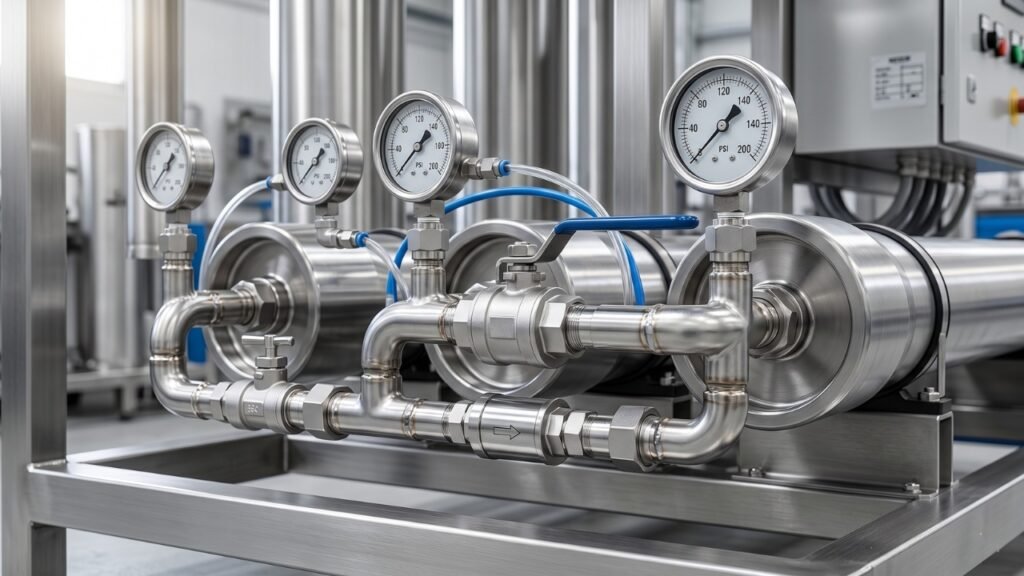
Bangalore Aqua manufactures its community plants in-house at its Bengaluru facility. Every component – the RO membrane housing, the pre-filter vessels, the high-pressure pump, the UV reactor, the control panel – is assembled and tested before dispatch. There are no subcontractors assembling unknown-origin components on site.
This manufacturing control matters enormously for CSR projects. A plant that fails within 18 months because a poor-quality valve or a substandard pump seal gave out is not just an engineering failure – it is an impact failure that leaves a community without safe water and a company with a difficult CSR reporting situation. Quality control at the manufacturing stage prevents this.
End-to-End Accountability
Bangalore Aqua takes responsibility for the entire project lifecycle:
- Needs assessment and site survey
- Water quality testing coordination
- System design and specification
- Manufacturing and quality testing
- Transport and installation
- Civil works coordination
- Community operator training
- Formal handover and documentation
- 3–5 year AMC with quarterly service visits
- Annual water quality certification
- Annual impact report for CSR documentation
There is one point of contact. One team that knows your project from beginning to end. One accountability structure. For a CSR programme officer managing multiple initiatives simultaneously, this single-point-of-accountability model is invaluable.
The Question Every CSR Head Should Ask
Here is the question every CSR head, sustainability manager, and company director should sit with for a moment:
In the communities near where your company operates, what are people drinking today?
Not abstractly. Specifically. What is the TDS of the borewell water in the villages nearest your factory? Does it contain fluoride above 1.0 mg/L? Nitrates above 45 mg/L? Is there a functioning water treatment system? Or are the children in those communities drinking the same groundwater their parents drank – water that the science says is harming them?
You probably don’t know the answer. Most companies don’t. The information requires a site visit and a water test – a few hours and a few thousand rupees.
But if you did know the answer, and the answer was that children two kilometres from your factory gate are drinking fluoride-contaminated water – would your company act?
That is what the best CSR project RO plants represent. Not a box to tick. Not a number to file. A decision that clean water is a right, not a privilege – and that your company has the means and the obligation to make it available to the people in your immediate community.
Start Your CSR Water Project Today – Partner With Bangalore Aqua
Bangalore Aqua and Energy Pvt. Ltd. is Karnataka’s most experienced and trusted partner for CSR community drinking water projects. Their end-to-end turnkey model covers everything from site assessment and water testing to in-house manufacturing, installation, community training, and long-term AMC.
Whether you are planning your first CSR water project or expanding an existing programme, Bangalore Aqua’s team will design a solution that maximises impact, satisfies regulatory requirements, and creates lasting benefit in the communities you serve.
📞 +91 76763 93939 | +91 97387 04753
📧 info@bangaloreaqua.com
🌐 bangaloreaqua.com
📍 107/209 2nd Cross, 4th Main Kogilu Layout, Bengaluru – 560064, Karnataka
CSR projects executed under Schedule VII of the Companies Act, 2013 – Safe Drinking Water category. Full documentation support for BRSR Annual Report and MCA CSR filing.
Related reads: Best Community RO Project Plants for Apartments and Villages | Best Water Softener for Bangalore | Top 10 RO Plant Companies in India | RO Plants for North Bangalore – Yelahanka, Devanahalli, Hoskote, Nelamangala, Doddaballapur