The Factory Manager Who Found His Answer in a Water Test
A production manager at an auto components factory in Hoskote had been trying to solve the same problem for two years. Output per worker was consistently lower in the second half of the shift – particularly during the summer months of March through May. Quality defect rates were higher in the afternoon. The workforce reported fatigue and headaches with unusual frequency. Labour turnover was running higher than the industry average.
He assumed it was the heat. He installed additional fans and cooling systems. It helped marginally. He introduced incentive schemes for afternoon productivity. They had limited effect. He adjusted shift timings. Still, the pattern persisted.
Then, as part of a facility audit, someone tested the water at the production floor drinking points. The borewell source read 1,100 mg/L TDS – more than twice the Bureau of Indian Standards’ safe limit of 500 mg/L. The water available to workers on the production floor was, by any regulatory definition, not safe for regular consumption. Workers were either avoiding it – becoming progressively dehydrated through their shift – or drinking it despite the taste and dealing with the digestive consequences.
Dehydration can lead to fatigue, headaches, and decreased concentration, impacting both individual performance and overall workplace productivity. 75 to 85% of the brain is water, making hydration essential for maintaining cognitive performance and the ability to learn new job skills.
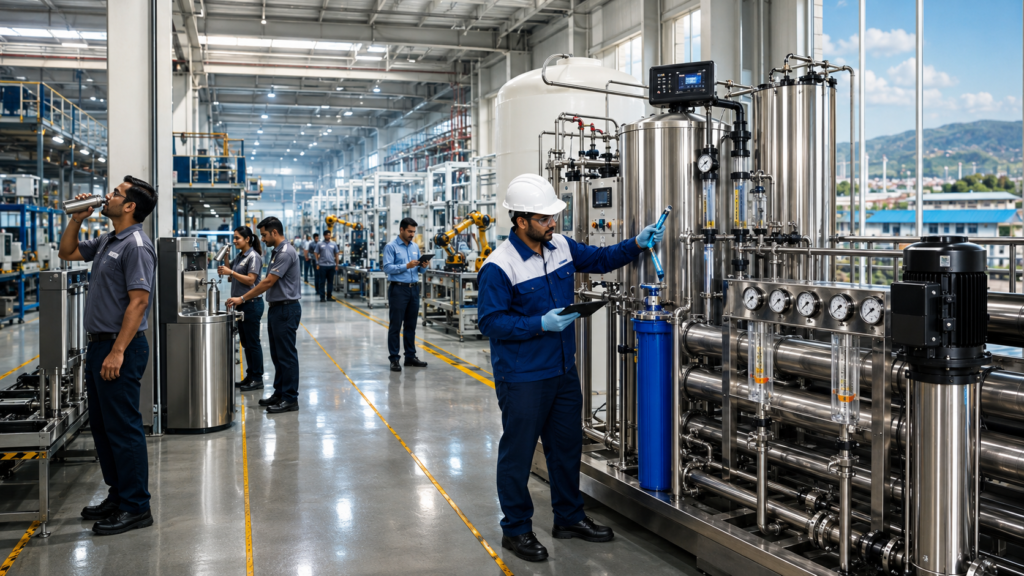
The facility installed a community RO water plant – a 1,500 LPH system serving the entire factory floor through dispensing points every 50 metres on the production line. Within three months, afternoon productivity metrics had improved measurably. Quality defect rates dropped. The pattern that had cost two years of investigation and countless management hours dissolved – because the root cause had been something as fundamental as the water workers were drinking.
This is not an unusual story in Karnataka’s industrial belt. It is, in varying forms, playing out in factories, IT parks, construction sites, industrial townships, and commercial campuses across Nelamangala, Hoskote, Doddaballapur, Whitefield, Electronic City, and every other major employment zone where Bangalore’s groundwater is high in TDS, high in hardness, and genuinely unsafe to drink without treatment.
And it is one of the core reasons why Indian industries are increasingly investing in community RO plants for employees as core infrastructure – not as welfare gestures, but as sound business decisions with measurable, documentable return on investment.
The Legal Foundation: What Indian Law Actually Requires From Employers
Before the business case, the compliance case. Because for many industries, the starting point for investing in employee water infrastructure is not a wellness strategy – it is a legal obligation they may not be fully aware they already carry.
The Factories Act, 1948 – Section 18 and Schedule
The Factories Act, 1948 is the primary legislation governing working conditions in Indian manufacturing establishments. Under the Act, employers have specific, mandatory obligations regarding drinking water.
Under the Factories Act, suitable shelters or rest rooms and lunchrooms with drinking water facilities are to be provided where 150 or more workmen are employed.
But the Act’s provisions go further than lunchrooms. Section 18 specifically mandates:
- Adequate supply of wholesome drinking water at convenient points in the factory
- Points to be marked “Drinking Water” in a language understood by most workers
- Water supply points to be at a distance of at least 6 metres from any latrine, urinal, or nuisance
- Where more than 250 workers are ordinarily employed, effective means of cooling drinking water during hot seasons must be provided
The critical word is wholesome. Borewell water at 800–1,500 mg/L TDS – which describes the typical source water in Hoskote, Nelamangala, Doddaballapur, and parts of Whitefield and Electronic City – is not wholesome in any legally meaningful sense. Providing access to this water without treatment does not fulfil the Section 18 obligation. A factory that is marking tap points “Drinking Water” while those taps deliver 1,200 mg/L TDS borewell water is technically in violation of its Factories Act obligations.
The Occupational Safety, Health and Working Conditions Code, 2020 (OSHWC Code)
The OSHWC Code, 2020 – which consolidates and replaces several older labour laws including relevant provisions of the Factories Act – maintains the employer’s obligation to provide wholesome drinking water to all workers. The Code applies to all establishments employing 10 or more workers, significantly expanding the scope of the drinking water obligation compared to the earlier Factories Act thresholds.
The OSHWC Code also explicitly requires employers to provide welfare facilities that protect the health of their workforce. Inadequate drinking water quality directly falls within this provision.
Labour Inspection and Compliance Risk
Labour inspectors assessing factory compliance under the Factories Act and OSHWC Code can, and increasingly do, include water quality at workforce drinking points in their compliance assessments. A factory that fails a water quality inspection faces notices, fines, and – in repeat violation scenarios – more serious regulatory consequences.
For industries in Karnataka already subject to KSPCB environmental compliance oversight, adding a labour compliance gap on employee water quality is a compounding risk that a community RO plant installation eliminates entirely.
Seven Business Reasons Industries Are Making This Investment
Beyond legal compliance, the business case for community RO plants in industrial settings is built on seven distinct and independently compelling drivers.
Reason 1 – Measurable Productivity Impact
The productivity impact of proper workforce hydration is not anecdotal. It is documented by multiple research studies and increasingly accepted as a quantifiable operational metric.
Installing water fountains and bottle filling stations in factories and warehouses benefits both employees and companies by helping workers stay hydrated and keeping productivity high. The improvements include enhanced cognitive performance – making it essential for workers to learn new job skills.
In industrial settings – where many workers perform repetitive, physically demanding tasks in hot environments – dehydration compounds the effects of heat stress. A worker who is even mildly dehydrated (1–2% of body weight in fluid loss) shows measurable declines in:
- Physical endurance (relevant for manual and semi-automated production tasks)
- Reaction time (relevant for quality control and machinery operation)
- Attention to detail (relevant for precision manufacturing, defect detection, and safety compliance)
- Short-term memory and cognitive flexibility (relevant for learning new processes and adapting to schedule changes)
For a factory in Hoskote or Nelamangala where borewell water is at 1,000+ mg/L TDS – and the taste is sufficiently off-putting that workers minimise consumption during shifts – the productivity loss from workforce dehydration is real, measurable, and entirely preventable.
Organizations that invest in proper water purification witness measurable improvements in employee wellness, reduced absenteeism, and enhanced reputation among clients and stakeholders. The return on investment extends beyond immediate health benefits to include long-term cost savings from eliminating bottled water purchases and reducing maintenance expenses associated with equipment corrosion caused by impure water.
A 1,000 LPH industrial RO plant for a 500-worker factory costs approximately ₹4–₹8 lakhs installed. If it reduces productivity loss from dehydration by even 1–2% across the workforce, the financial recovery from improved output easily justifies the capital investment within the first operating year.
Reason 2 – Reduced Employee Absenteeism from Waterborne Illness
Waterborne illness is the most immediate and most directly measurable consequence of inadequate workforce water quality. In industrial zones across Karnataka, borewell water with elevated TDS, high hardness, potential iron contamination, and bacteriological risk from shallow borewell casings creates a persistent background load of gastrointestinal illness that shows up in absenteeism data.
For a factory with 300 workers, a 1% absenteeism rate attributable to waterborne gastrointestinal illness represents approximately 750 worker-days lost per year – calculated at 5 days illness per episode, one episode per 50% of the workforce annually. At an average daily labour cost of ₹500–₹1,500 per worker, that is ₹3.75–₹11.25 lakhs in direct absenteeism cost per year, before accounting for production schedule disruption, overtime costs, and quality variability during understaffed production runs.
A community RO water plant with UV disinfection eliminates bacteriological risk from the workforce’s drinking water source entirely. Combined with the TDS reduction that makes the water palatable enough that workers actually drink adequate volumes, the impact on waterborne illness absenteeism is consistent and documented in facilities that have made this investment.
Reason 3 – Equipment Protection and Process Water Quality
In many industrial applications, the same water quality problems that affect workforce health also affect production equipment.
Cooling systems – particularly cooling towers and closed-loop heat exchangers in metal fabrication, plastics processing, and food manufacturing – scale rapidly when supplied with Bangalore’s high-hardness borewell water (typically 400–700 mg/L hardness as CaCO₃). High TDS water leads to scale deposits on heat exchangers and cooling towers, reducing heat transfer efficiency and increasing energy consumption and maintenance costs
Boilers in factories with medium-pressure steam requirements need feed water with very low TDS and near-zero hardness. Running medium-pressure boilers on untreated high-TDS borewell water causes rapid scale formation, dramatically reducing boiler efficiency and shortening equipment life – with the compounding risk of tube failure at elevated pressure.
Machinery that uses water in its process – washing, cooling, or as a direct ingredient – is similarly affected. A combined water softener plus RO treatment system that serves both workforce drinking water and process equipment makeup water delivers dual ROI: healthier workers and better-protected, longer-lived production equipment.
For industries in Nelamangala, Hoskote, and Doddaballapur – where borewell TDS and hardness levels are among the highest in the Bangalore industrial zone – the equipment protection argument alone often justifies the full capital cost of a water treatment investment, with the employee welfare benefit as a valuable additional return.
Reason 4 – ESG Compliance and Supply Chain Requirements
Eliminating plastic bottle waste by investing in a proper water purification system aligns with corporate sustainability goals increasingly valued by customers, investors, and regulatory bodies. Water quality consistency achievable through reverse osmosis technology surpasses alternatives like UV purification or activated carbon filtration alone.
In 2026, ESG (Environmental, Social, and Governance) reporting is not a niche concern of publicly listed multinational companies. It is increasingly a supply chain requirement that flows down to Tier 2 and Tier 3 suppliers in Karnataka’s manufacturing ecosystem.
For the auto components factory in Hoskote supplying a Tier 1 supplier to a European or Japanese OEM – the OEM’s supply chain audit may now include questions about worker welfare infrastructure, including access to safe drinking water. For the pharmaceutical company in Bommasandra supplying a global partner – that partner’s supplier code of conduct may specify worker welfare standards that include safe drinking water access.
A community RO plant with documented water quality testing and AMC – producing NABL-certified safe water for the workforce – is exactly the kind of evidence that satisfies supply chain ESG audits and sustainability questionnaires.
For industries pursuing voluntary ESG certifications (SA8000, ISO 14001, ISO 45001), employee access to safe drinking water at the workplace is frequently a scored element. A certified, documented water treatment system supports these certifications directly.
Reason 5 – Talent Attraction and Retention in Competitive Labour Markets
Karnataka’s industrial zones – Nelamangala, Hoskote, Whitefield, Electronic City, KIADB Aerospace Park in Devanahalli – compete for workers, not just customers. The manufacturing workforce is mobile, aware of comparative working conditions across facilities, and increasingly making employment choices that include welfare infrastructure alongside wage rates.
Clean drinking water at the workplace – delivered through visible, high-quality dispensing points connected to a properly maintained industrial RO system – is a tangible, immediately visible welfare investment that workers notice and value. It communicates to the workforce that the employer takes their health seriously. It is also the kind of facility improvement that workers mention in the community conversations that drive referral hiring.
In a labour market where skilled workers increasingly have choices, the marginal cost difference between facilities that provide safe drinking water and those that do not is a factor in recruitment and retention decisions. Given the replacement and retraining costs of employee turnover – typically 3–6 months of salary per departing skilled worker – a facility investment that measurably improves retention has direct, quantifiable financial return.
Reason 6 – CSR Compliance and Corporate Reputation
For companies meeting the thresholds that trigger mandatory CSR spending under Section 135 of the Companies Act, 2013 – net worth above ₹500 crore, turnover above ₹1,000 crore, or net profit above ₹5 crore – a community RO plant for the surrounding residential community or for the factory’s worker township qualifies as a legitimate CSR expenditure under Schedule VII’s healthcare and safe drinking water provision.
This creates an interesting dual-use scenario that many Karnataka industries are beginning to exploit intelligently. The community RO plant that serves both the factory’s workforce (operating expense/welfare investment) and the surrounding village (CSR expenditure) simultaneously addresses welfare obligations and CSR compliance – while generating strong community goodwill that reduces social tension and improves the company’s operating environment.
For industries in Karnataka’s peri-urban industrial zones – where the factory’s immediate neighbours are village communities whose relationship with the industry affects everything from land access to labour supply to local political relationships – a visible, well-maintained community water plant is one of the most cost-effective community relations investments available.
Bangalore Aqua has structured several CSR community development water projects in Karnataka’s industrial corridors – providing community RO plants that serve both factory workers and surrounding village communities under a single project framework that satisfies both welfare and CSR reporting obligations.
Reason 7 – Canteen and Food Service Compliance
Factories with more than a minimum number of workers are required to provide canteen facilities. Every canteen operation in a factory is subject to FSSAI (Food Safety and Standards Authority of India) food safety regulations – and FSSAI mandates that water used in food preparation must be potable and safe, meeting BIS 10500 standards.
A factory canteen using untreated high-TDS borewell water for cooking, tea preparation, and equipment washing is running a FSSAI compliance risk alongside the health risk to workers. During a FSSAI inspection, water quality failure at a factory canteen can result in closure notices, fines, and reputational damage.
A commercial RO plant supplying the canteen – or a single community plant serving both the production floor drinking points and the canteen kitchen – eliminates this compliance risk while improving canteen food quality and taste consistency. Workers notice when their dal, rice, and tea taste better. Food quality is a significant element of overall workforce satisfaction in large industrial facilities.
The Water Challenge Across Karnataka’s Major Industrial Zones
Understanding the specific water quality challenges that make community RO plants particularly compelling in Karnataka’s industrial geography is essential context for any facilities manager or industrial developer in the region.
Nelamangala – High TDS and Very High Hardness
Nelamangala’s industrial estate – anchored by the NH-48/Tumkur Road corridor with manufacturing, warehousing, pharmaceutical, and auto components facilities – draws water from borewells that typically register 700–1,500 mg/L TDS and 450–800 mg/L hardness as CaCO₃. These readings represent some of the most challenging source water in the Bangalore industrial region. Workers in Nelamangala facilities that rely on untreated borewell water are consuming water that significantly exceeds safe limits across multiple parameters.
For Nelamangala industries, a water softener pre-treatment stage upstream of an industrial RO plant is essential – both to protect the RO membrane from rapid scaling and to address the hardness that makes the water immediately unpleasant even before its high TDS content is measured.
Hoskote – Iron, High TDS, and Industrial Contamination Risk
Hoskote’s industrial estate houses leather tanneries, auto component manufacturers, and chemical processors – creating a complex water quality environment where borewell sources carry both natural geological contamination (high TDS, elevated iron and manganese) and the residual risk of shallow aquifer infiltration from industrial activity in the area.
Iron above 0.5 mg/L is common in Hoskote borewells – producing the characteristic orange discolouration that makes water visually unappealing even to workers who might otherwise drink it. Iron fouling also destroys RO membranes rapidly if not addressed in pre-treatment. For Hoskote, Bangalore Aqua’s standard specification includes iron removal as a dedicated pre-treatment stage before the softener and RO – see industrial RO spare parts and service for maintaining these systems over time.
Doddaballapur – Textile Industry Water Needs
Doddaballapur’s textile and apparel manufacturing sector has process water quality requirements that go beyond simple employee welfare. Reactive and disperse dyeing processes require water below 100–200 mg/L TDS with very low hardness to achieve consistent colour results.
A community RO plant in a Doddaballapur textile facility that serves the workforce’s drinking water needs simultaneously serves as a production water source – providing treated water for dye bath preparation that reduces chemical waste, improves shade consistency, and eliminates reject lots from water-quality-related colour variations.
Devanahalli and the KIA Ecosystem
The Kempegowda International Airport ecosystem – aerospace parks, logistics hubs, five-star hotels, large corporate campuses, and worker townships – presents a different profile. The airport zone’s large corporate employers have a sophisticated understanding of employee welfare and ESG obligations. The question for facilities managers in Devanahalli is typically not whether to invest in water treatment but which configuration best serves a large, diverse workforce across multiple building types.
For Devanahalli’s large campus employers, a combination of a building-level water softener on the incoming supply plus distributed commercial RO plants at canteen and break room locations is typically the most practical approach – supported by water dispensers and Blue Star water coolers at point-of-use.
Sizing a Community RO Plant for Your Industrial Workforce
Getting the right capacity for your facility’s community water plant is the critical engineering decision. Here is the practical framework Bangalore Aqua uses for industrial facilities across Karnataka.
Calculate Your Peak Drinking Water Demand
For industrial workers – particularly those performing physical labour in warm to hot environments – adequate hydration requires more water than standard office worker benchmarks suggest.
OSHA and NIOSH advise that workers in hot conditions drink about 1 cup (8 oz.) of cool water every 15 to 20 minutes during the work period.
For Indian industrial settings where production floor temperatures in summer can reach 35–42°C in poorly ventilated facilities, the water consumption benchmark for physical workers is realistically 5–8 litres per person per day during summer months – not the standard 3–4 litre office benchmark.
Apply your workforce count at the appropriate per-person figure, then add:
- Canteen and food preparation water: 10–15 litres per meal served
- Equipment cooling and process water (if the plant also serves process needs): calculated from the specific process
- A 20–25% peak demand buffer above your calculated average
Match Plant Size to Operating Hours
Your RO plant should produce sufficient purified water during its planned operating hours to cover the full shift’s demand. If your factory runs two 10-hour shifts, your plant needs to produce the day’s full demand in 10 hours of operation (with storage covering the other 10 hours) – or run continuously with production matched to ongoing demand.
Use the formula from Bangalore Aqua’s industrial capacity guide: Daily demand (litres) ÷ Operating hours = Minimum LPH capacity.
Add 20% for safety margin. This gives you the nameplate capacity to specify.
Consider Your Source Water TDS in the Sizing
Karnataka’s industrial zone borewell TDS is typically 700–1,800 mg/L. At higher TDS levels, the RO plant’s real-world permeate output is slightly lower than its rated capacity – because the higher osmotic pressure reduces membrane flux at a given feed pressure. Apply a 10–15% derating factor at TDS above 1,000 mg/L when calculating whether a given rated plant size meets your actual demand.
Reference Capacity Table for Karnataka Industrial Facilities
| Workforce Size | Typical Demand | Recommended Plant | Installed Cost Range |
| 50–150 workers (light production) | 500–1,200 LPD | 250 LPH | ₹1.5–₹3 lakh |
| 150–300 workers (medium production) | 1,200–2,500 LPD | 500 LPH | ₹2.5–₹5 lakh |
| 300–600 workers (heavy production) | 2,500–5,000 LPD | 1,000 LPH | ₹4–₹8 lakh |
| 600–1,500 workers (large factory) | 5,000–12,000 LPD | 2,000 LPH | ₹8–₹16 lakh |
| 1,500+ workers (large industrial campus) | 12,000+ LPD | 5,000 LPH+ | ₹20 lakh+ |
Above assumes physical workers in warm environments at 5–6 litres/person/day plus canteen. For office-based IT park employees, reduce to 3–4 litres/person/day. Contact Bangalore Aqua for a site-specific calculation and quotation.
The ROI Calculation: Community RO Plant vs Status Quo
Many industrial buyers approaching this investment want to see the numbers before committing. Here is an honest, structured ROI comparison for a representative Karnataka factory.
Scenario: Auto components factory, Hoskote, 400 workers, two shifts
Current Cost (Status Quo – No Treatment)
| Cost Category | Annual Cost |
| 20-litre water jars for workforce (₹60/jar × 20 jars/day) | ₹4,38,000 |
| Absenteeism from waterborne illness (5% of workforce × 4 days/year × ₹800/day) | ₹6,40,000 |
| Canteen equipment scale damage and repair | ₹1,50,000 |
| Increased soap and cleaning chemical use (hard water) | ₹80,000 |
| Production quality issues from dehydrated workforce (estimated 0.5% loss) | ₹8,00,000 |
| Total estimated annual cost of untreated water | ₹21,08,000 |
Community RO Plant (1,000 LPH with Softener Pre-treatment)
| Cost Category | Amount |
| Plant capital cost (installed, with softener) | ₹10,00,000 |
| Annual operating cost (electricity, consumables, AMC) | ₹1,80,000 |
| Annualised capital cost (5-year amortisation) | ₹2,00,000 |
| Total annual cost with community RO plant | ₹3,80,000 |
Annual saving: ₹17,28,000 Payback period: Under 7 months
These figures are illustrative and conservative. Facilities that have tracked pre- and post-installation data consistently report faster payback – particularly those where the productivity and absenteeism components are most accurately measured.
For a detailed, site-specific ROI calculation for your facility, contact Bangalore Aqua’s industrial project team.
What the Right Community RO Plant for Industrial Workers Looks Like
Not every RO system is appropriate for industrial workforce use. The community plant serving a factory’s workforce must meet specific requirements that differ from commercial or residential installations.
Continuous Duty Construction
Factory water plants typically need to run 10–16+ hours per day, day after day. The pump, membranes, and control system must be specified for industrial duty cycles – not commercial-grade components that assume 8 hours of operation. Bangalore Aqua’s industrial RO system products are specifically built for continuous industrial operation.
Point-of-Use Distribution
Purified water stored in a tank at the plant room is only useful if it reaches workers efficiently. For large factory floors, this means a distribution system – either a pressurised pipe network to dispenser points at regular intervals, or large-capacity dispensers positioned every 50–100 metres across the production floor.
50 LPH and 100 LPH water dispensers connected to the community plant’s purified water line bring clean, cold drinking water to within a short walk of every production station. Dispenser placement should follow the principle that no worker should have to walk more than 60 seconds from their workstation to access drinking water – a standard emerging from global industrial welfare frameworks.
Stainless Steel Storage Tanks
Purified water for a large workforce is stored in significant volumes overnight. As covered in Bangalore Aqua’s SS tank guide, plastic tanks develop micro-surface cracks over time that harbour biofilm. For a workforce drinking overnight-stored purified water, food-grade SS304 stainless steel tanks are the non-negotiable storage standard. Bangalore Aqua specifies SS storage as standard for all industrial community plants – see their SS tank supplier page for available sizes.
Structured AMC – Because Downtime Has a Cost
An industrial community water plant that goes offline during a production shift is an immediate welfare and productivity issue. Bangalore Aqua’s industrial and commercial AMC services provide quarterly scheduled maintenance, priority emergency response, and annual water quality certification – ensuring that the plant never becomes an invisible, degrading liability that workers simply learn to ignore.
Read Bangalore Aqua’s industrial RO plant maintenance checklist to understand the full maintenance scope that keeps a community plant performing at specification throughout its operational life.
Implementation Guide: From Decision to Operational Plant
For industrial buyers who have decided to invest in a community RO plant for their workforce, here is the practical implementation pathway with Bangalore Aqua.
Step 1 – Site Assessment and Water Testing Contact Bangalore Aqua at +91 76763 93939 or through the contact page. A technical team member visits your facility within 48 hours, assesses the water source, tests for TDS, hardness, iron, and bacterial contamination, evaluates existing infrastructure, and calculates your workforce’s daily water demand.
Step 2 – System Specification and Quote Based on the assessment, Bangalore Aqua produces a complete system specification – pre-treatment train, RO plant capacity, storage, distribution approach, dispenser placement – with a fully itemised quotation covering equipment, installation, and AMC structure. No hidden costs.
Step 3 – Manufacturing and Installation Industrial community plants are manufactured at Bangalore Aqua’s Bengaluru facility and installed by their dedicated project team. Standard industrial systems at 1,000–2,000 LPH take 3–5 working days to install. Larger systems take 5–10 working days.
Step 4 – Commissioning and Operator Training Following the commissioning process described in Bangalore Aqua’s commissioning guide, the system is started up, tested to confirmed output TDS, and formally handed over. Your designated facility operator receives hands-on training in daily monitoring, consumable level checks, and escalation protocols.
Step 5 – AMC Commencement Your Annual Maintenance Contract activates from commissioning day. Quarterly visits, consumable replacement, annual NABL water quality testing, and priority emergency response are all live from day one.
Frequently Asked Questions – Community RO Plants for Industrial Workers
Q: Is it a legal requirement for a factory to provide RO-purified water to workers? The Factories Act 1948 mandates provision of “wholesome” drinking water to workers. High-TDS borewell water – which describes most Karnataka industrial zone groundwater – does not meet the definition of wholesome under BIS 10500:2012. Installing a community RO plant is not just good welfare practice; in most Karnataka industrial zone contexts, it is the mechanism by which a factory actually fulfils its Section 18 obligation.
Q: What is the minimum capacity community RO plant for a factory with 200 workers? For 200 workers in a physical production environment in Karnataka’s warm climate, plan for approximately 5–6 litres per worker per shift day = 1,000–1,200 litres per shift. Add canteen demand. A 250–500 LPH plant running 6–8 hours covers this range. Contact Bangalore Aqua for a precise calculation based on your shift structure and canteen size.
Q: Can the same plant serve both workforce drinking water and process water requirements? Yes – and this is often the most economical approach for small to medium factories. A community RO plant producing purified water can supply both drinking dispenser points and process water inlets (boiler feed, cooling systems, product washing) from a single treatment train, with separate storage for each application if quality requirements differ. Bangalore Aqua’s industrial system designs routinely include dual-output configurations.
Q: Does a community RO plant for a factory qualify as a CSR expense? If the plant also serves the surrounding community (village workers’ housing, adjacent residential areas), the community-serving component qualifies as a CSR expense under Schedule VII of the Companies Act. The workforce-only component is a welfare/operating expense. Bangalore Aqua can help structure the project to maximise Schedule VII qualification. See CSR community development water projects for the full framework.
Q: What is the annual operating cost of a 1,000 LPH community RO plant in Hoskote? For a 1,000 LPH industrial community plant in Hoskote’s high-TDS borewell environment, annual operating costs including electricity, consumables (filter cartridges, UV lamp, chemicals), and AMC are typically ₹1.5–₹2.5 lakhs per year. This works out to approximately ₹1,250–₹2,100 per month per 100 workers – a fraction of the combined cost of water jars, absenteeism, and equipment damage that the plant replaces.
Q: Can Bangalore Aqua also handle the water softener if our borewell hardness is very high? Yes. Bangalore Aqua manufactures and installs both water softeners and industrial RO plants as integrated systems. For Hoskote and Nelamangala’s very high hardness borewell water, a softener upstream of the RO is not optional – it is essential to achieve the membrane life that makes the total investment economical. Bangalore Aqua delivers the complete combined system under a single project scope and AMC. Learn more at water softener for home and industry Bangalore.
Conclusion: Water Is Not a Welfare Optional – It Is an Operational Essential
The industries that are investing in community RO plants for their employees in 2026 are not doing so out of altruism alone. They are doing it because the evidence is clear: safe drinking water at the workplace is a measurable productivity input, a legal compliance requirement, an ESG reporting asset, a supply chain expectation, a talent retention factor, and – when the full ROI calculation is properly done – one of the most cost-effective infrastructure investments a Karnataka factory can make.
Modern businesses cannot afford to compromise on water quality, as it directly impacts employee health, customer satisfaction, and regulatory compliance. The right water purification system pays dividends through improved health outcomes, regulatory compliance, enhanced reputation, and potential cost savings.
Bangalore Aqua and Energy Pvt. Ltd. has designed, manufactured, installed, and maintained community and industrial water plants for factories, IT parks, industrial townships, and commercial campuses across Karnataka – from Nelamangala to Hoskote to Doddaballapur to Whitefield to Koramangala. Their engineering teams understand the specific water quality challenges of each Karnataka industrial zone, and their manufacturing capability means every system is built for the actual conditions at your facility – not a generic catalogue product.
Contact Bangalore Aqua today. Free site assessment. Honest ROI calculation. A team that knows your water.
📞 +91 76763 93939 | +91 97387 04753 📧 info@bangaloreaqua.com 🌐 bangaloreaqua.com 📍 107/209 2nd Cross, 4th Main Kogilu Layout, Bengaluru – 560064, Karnataka
Community and industrial RO plant solutions for factories, IT parks, and industrial estates across Bengaluru, Nelamangala, Hoskote, Whitefield, Mysuru, Hubballi, Mangaluru, Tumakuru, and all Karnataka locations.
Related Reads:
- Best Community RO Project Plants 2026
- Commercial RO Plant vs Industrial RO Plant: What’s the Difference?
- Industrial & Commercial RO Plant AMC Services
- How to Choose the Right Industrial RO Plant Capacity
- RO Plant Commissioning Process Explained
- CSR and Community Development Water Projects
- Top 10 RO Plant Companies in India