An Elderly Woman in Golur Haadi Asked a Question That Has No Good Answer
In HD Kote taluk of Mysuru district, deep within the forest fringe that borders the BRT Tiger Reserve, there is a tribal hamlet called Golur Haadi. The Soliga adivasis who have lived in and around this forest for generations are, by any measure, among the most ecologically rooted communities in Karnataka. They know this land – its trees, its rhythms, its waters – better than almost anyone.
And yet in 2026, the residents of Golur Haadi are digging small pits in the ground and collecting seeping water for daily use. They are drawing water from nearby streams with serious health and hygiene concerns. Children, pregnant women, and the elderly are consuming the same polluted sources.
<cite index=”27-1″>An elderly woman from the settlement said that children, pregnant women, and the elderly are all consuming the same polluted water. “We have no choice. If we fall sick, who will take responsibility?” she asked, expressing anguish over the lack of intervention.</cite>
That question – if we fall sick, who will take responsibility? – hangs over every tribal haadi in Karnataka that still lacks access to safe drinking water in 2026. Despite the Jal Jeevan Mission’s target of universal tap water coverage, despite constitutional protections for Scheduled Tribes, despite specific Tribal Sub-Plan (TSP) budget allocations for tribal welfare, the reality at the ground level for many Karnataka adivasi communities is: no safe water. No treatment. No accountability.
This is not a resource problem. It is an infrastructure and implementation problem. Community RO plants – designed, installed, and maintained by experienced regional partners – are the solution that works, has been proven to work, and is already being deployed in tribal areas across Karnataka by forward-thinking CSR partners and government agencies.
This guide is for every NGO, every district administration body, every CSR team, and every gram panchayat that serves a tribal area and wants to understand what a community RO plant for tribal communities looks like, how to fund it, how to implement it, and how to ensure it runs for a decade rather than becoming another defunct installation in a village that has already been promised too much and received too little.
The Scale of the Crisis: Karnataka’s Tribal Water Reality in 2026
Karnataka has a significant Scheduled Tribe population concentrated in the state’s forest zones, hill regions, and semi-arid districts. Understanding the specific water quality challenges faced by these communities requires understanding three distinct geographic contexts.
The Forest Fringe Tribal Communities – Western Ghats Zone
The Western Ghats corridor – spanning Kodagu, Uttara Kannada, Shivamogga, Dakshina Kannada, Udupi, Chikkamagaluru, and Hassan districts – is home to significant tribal populations including the Soliga, Jenu Kuruba, Kadu Kuruba, Hakki Pikki, and coastal tribal communities.
These communities live in forest fringes, reserve forest areas, and protected area buffer zones – geographic positions that create a specific set of water access challenges. Municipal water supply infrastructure barely reaches them. Borewell drilling in forest areas is often restricted. Seasonal streams and springs – traditional water sources – are increasingly unreliable due to forest degradation and changing rainfall patterns.
Where boreholes do exist, the water quality varies dramatically by season and micro-location. During the monsoon, shallow borewells often show elevated turbidity and bacteriological contamination from surface runoff. During the dry season, yields drop and mineral concentrations rise.
<cite index=”25-1″>Residents in the Asthana tribal haadi (tribal hamlet) in Virajpet taluk of Kodagu are facing a drinking water crisis</cite> – a report that represents dozens of similar tribal hamlets across the Western Ghats corridor that face the same combination of infrastructure neglect and geographic isolation.
The Semi-Arid North Karnataka Tribal Communities
The districts of Raichur, Kalaburagi, Bidar, Vijayapura, Yadgir, and Chitradurga contain significant ST populations alongside the well-documented fluoride and nitrate contamination of groundwater that affects these regions.
<cite index=”25-2″>High fluoride contamination affects 31 districts of Karnataka, and arsenic affects 3 districts – with the water crisis in North Karnataka compounded by hundreds of RO plants remaining defunct because operating and maintaining them has become a challenge for gram panchayats.</cite>
<cite index=”28-1″>In 22 villages in Karnataka’s Vijayapura district, fluoride concentrations in groundwater exceeded permissible limits – with clinical symptoms including gastrointestinal discomfort, arthritis, joint aches, and lower limb abnormalities found in people with high urine fluoride content.</cite>
For tribal communities in these districts – often more geographically isolated and with less political voice than dominant community villages – the fluoride problem is acute. Children in fluoride-affected tribal villages develop dental fluorosis before they reach primary school age. Adult community members show skeletal fluorosis symptoms that impair their ability to work in agriculture and forest-based livelihoods.
<cite index=”28-2″>In Vijayanagar’s Makarabbi village, six villagers died within ten days of the first person falling ill after consuming contaminated borewell water. More than 150 people fell sick. The 2,000-strong village has four borewells, three of which have been deemed unsafe for human consumption.</cite>
<cite index=”32-1″>Karnataka’s state government itself has acknowledged that approximately 50% of the 10 lakh people in fluoride-affected taluks – including Pavagad, Challakere, Molakalmuru, and Kudligi – belong to SC/ST communities, warranting ₹704 crore in dedicated Tribal Sub-Plan (TSP) funding for the drinking water project.</cite>
This is not a small or disputed number. Half the people most severely affected by fluoride contamination in Karnataka are from Scheduled Tribe and Scheduled Caste communities.
The SC/ST Communities on the Edges of Rapid Urbanisation
In districts surrounding Bengaluru – Bengaluru Rural, Ramnagar, Tumakuru, Kolar, and Chikkaballapur – tribal and SC communities occupy the peri-urban fringe: close enough to feel the effects of urbanisation (rising land prices, depleted groundwater, increased cost of living), but far enough from urban infrastructure that they receive few of its benefits.
Groundwater in these zones is rapidly deteriorating. Borewell depths have increased from 200 feet to 700–800 feet in a single generation as water tables plunge. <cite index=”24-1″>As of March 2026, nearly 1,800 Karnataka villages are consuming contaminated water – with nitrate contamination affecting the most villages, alongside fluoride and bacterial contamination.</cite>
For tribal and SC communities in these districts, the combination of deteriorating water quality and weak political representation in water infrastructure allocation means they are often the last to receive improvements under government water programmes.
Why Tribal Communities Face Uniquely Severe Water Access Challenges
The water access problem in tribal areas is not simply a version of the rural water access problem. It has specific characteristics – structural, geographic, and institutional – that require tailored approaches.
Geographic Isolation Limits Infrastructure Reach
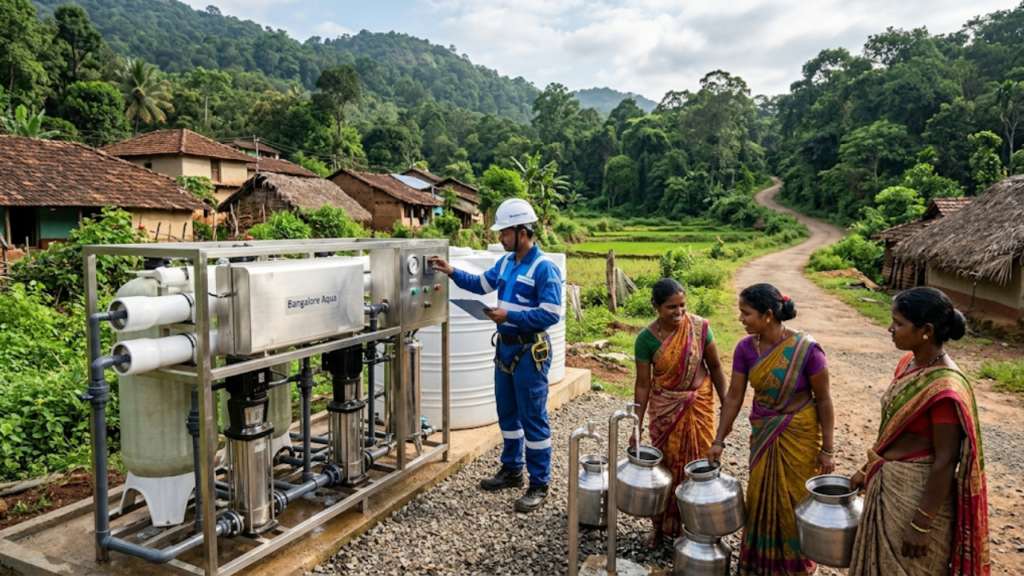
Many tribal haadis in Karnataka’s forest districts are not connected by all-weather roads. During the monsoon, they may be completely inaccessible by vehicle for days or weeks at a time. Government water infrastructure – pipes, pumps, overhead tanks – is expensive to build in these locations and even more expensive to maintain when service vehicles cannot reach the site.
This geographic isolation also means that when government-installed infrastructure (handpumps, gravity schemes, UV systems) fails, it often stays failed for months – because the response chain from breakdown to repair takes far longer than in accessible villages.
Solar-powered community RO plants specifically designed for remote deployment – with minimal electrical infrastructure requirements, IoT-based remote monitoring, and service schedules designed for periodic vehicle access – are the appropriate technology response to this geographic reality.
Language and Literacy Barriers Affect Operation and Maintenance
Standard government water plant operator training materials are in Kannada, and sometimes in English. Many tribal haadi residents – particularly older community members – speak a local dialect or tribal language as their primary language, with limited Kannada literacy.
When a government-installed RO plant has a maintenance manual that no one in the village can read, and an operator training programme that was conducted in Kannada by a government engineer who visited once, the probability of proper operation is very low. When the UV lamp fails – silently, invisibly – no one will know. When the pre-filter becomes blocked, the symptom (reduced flow) may be interpreted as a water table problem rather than a maintenance issue.
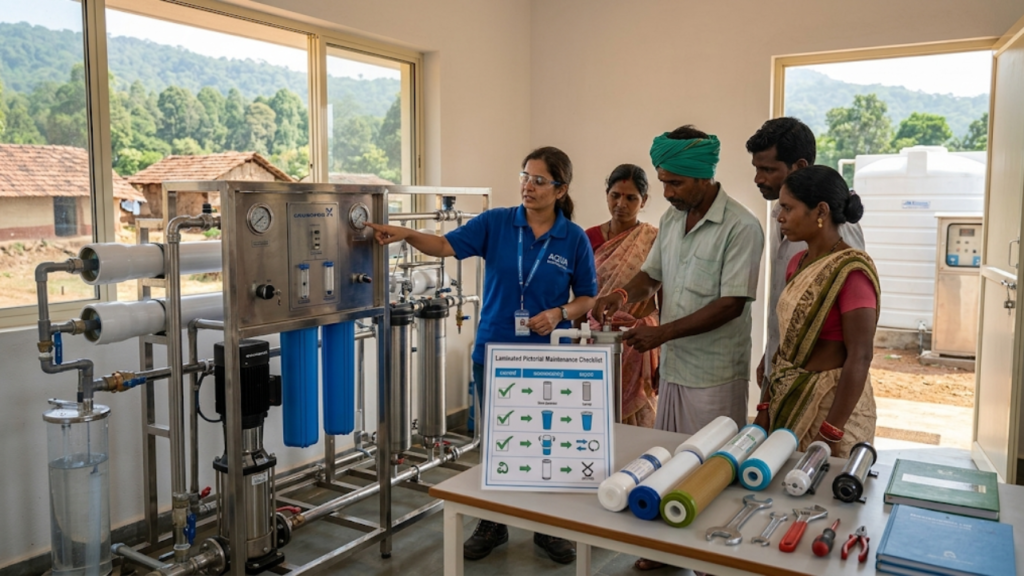
Bangalore Aqua’s operator training approach for tribal area installations uses:
- Illustrated, pictorial checklists that communicate maintenance tasks without requiring text literacy
- Training conducted with community interpreters where the primary language is not Kannada
- Hands-on demonstration with community members actually performing each task under supervision – not just watching
- Follow-up visits within 30 days of installation to reinforce training and address any operational questions
Political Marginalisation Reduces Access to Government Schemes
The allocation of government water infrastructure – JJM connections, government RO plants, borewell drilling – is not a purely technical or needs-based process. It involves district administration, elected representatives, and gram panchayat leadership. In districts where tribal communities have historically had limited political representation, the allocation of resources has correspondingly been limited.
<cite index=”20-1″>A large number of residents rely only on borewells for their drinking water since operating and maintaining RO plants has become a challenge for gram panchayats</cite> – but this challenge is most acute in tribal haadis where gram panchayats may be dominated by non-tribal community members who do not prioritise the haadi’s specific needs.
This political marginalisation means that tribal water access improvements often require dedicated funding mechanisms – Tribal Sub-Plan (TSP), Scheduled Tribe Component Plan (STCP), DMF funds – rather than general JJM allocations. Understanding and accessing these dedicated mechanisms is essential for effective tribal water project implementation.
Ecosystem and Source Water Variability
Tribal communities living in forest fringe areas often depend on surface water sources – streams, springs, seasonal rivers – that the surrounding agricultural and urban population treats as drainage channels. Upstream land use changes, including agricultural runoff, pesticide application, and loss of forest cover, directly affect the quality of surface water that tribal communities use for drinking.
This ecosystem-mediated contamination creates a water quality challenge that is highly seasonal and highly variable – different from the consistent mineral contamination of deep borewells. Community RO plants for tribal areas must be designed to handle this variability, including bacterial contamination from surface water and turbidity spikes during and immediately after the monsoon.
Types of Community RO Plants for Tribal Areas
The geographic and social diversity of Karnataka’s tribal communities means that no single plant type or size is universally appropriate. Here is how different community configurations map to different plant types.
Type 1: Small Tribal Haadi Plant (100–250 LPH) – For Isolated Forest Communities
Who it serves: Small tribal haadis of 50–300 people, typically accessible only by forest tracks. Often dependent on surface water sources (springs, seasonal streams) rather than borewells.
Technical characteristics for tribal haadi context:
- Compact skid-mounted design that can be transported by small vehicle or even in sections by foot through forest tracks
- Multi-source capability – designed to handle surface water (higher turbidity and bacterial load) as well as borewell water
- Enhanced pre-treatment for turbidity – additional coagulation/flocculation stage or multimedia filter with coarser media for heavy sediment loads
- UV disinfection at higher dose than standard – 40+ mJ/cm² rather than the standard 30 mJ/cm² – to account for the higher biological load of surface water sources
- Solar power integration – critical for communities without reliable grid connection
Daily output: 1,000–2,500 litres per day (10-hour operation) People served: 200–500 people at 5 litres per person per day
Installed cost range: ₹2.5–₹6 lakh (solar version ₹5–₹10 lakh)
This scale of installation is exactly what Mukul Madhav Foundation, Toyota Kirloskar Motor, and Canara Bank’s CSR initiatives have been deploying across tribal and rural Karnataka. <cite index=”16-1″>Toyota Kirloskar Motor has committed to installing 500 LPH RO water purification units across six rural locations in Tumakuru district, Karnataka – with the explicit commitment that “clean drinking water should never be a privilege; it is a basic necessity that every family deserves.”</cite>
Type 2: Multi-Haadi Community Plant (500 LPH) – For Cluster Deployments
Who it serves: A cluster of 3–5 tribal haadis sharing a central water point, or a medium-sized panchayat village with significant ST population. Typically serves 1,000–2,500 people.
Technical characteristics:
- Central installation at a panchayat building, community hall, or school
- Distribution by collection point (beneficiaries bring containers) rather than piped connection – appropriate where inter-haadi pipe network is not feasible
- User-fee dispensing system (₹1–₹5 per litre via UPI/QR code or token) to generate funds for consumable replacement
- Water ATM integration option for 24-hour autonomous operation
Daily output: 4,000–6,000 litres per day People served: 800–2,000 direct beneficiaries
Installed cost range: ₹5–₹12 lakh
Type 3: Tribal Panchayat Water Centre (1,000 LPH) – For Larger Tribal Settlements
Who it serves: Larger ST-dominant villages, tribal blocks with concentrated population, panchayats designated as PVTG (Particularly Vulnerable Tribal Group) habitations that receive priority under government welfare schemes.
Technical characteristics:
- Full industrial-grade construction with continuous-duty pump specification
- Enclosed plant room with provision for community operator residence nearby
- Online TDS monitoring with remote alert capability
- Piped distribution to multiple dispensing points across the settlement
- Full government tender compliance documentation
Daily output: 8,000–12,000 litres per day People served: 2,000–4,000 direct beneficiaries
Installed cost range: ₹12–₹22 lakh
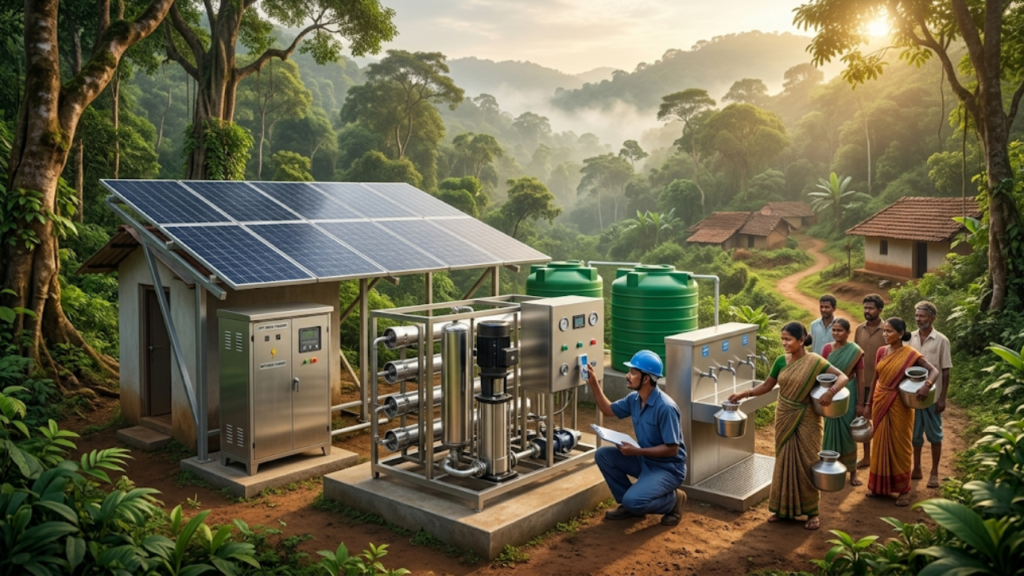
Type 4: Solar-Powered Off-Grid Tribal Water Plant – The Critical Technology for Remote Areas
For tribal communities in Karnataka’s forest districts – Kodagu, Uttara Kannada, Shivamogga, Chikkamagaluru – where grid electricity is unreliable or entirely absent, solar-powered community RO plants are not an optional upgrade. They are the only viable model for sustained operation.
A solar-powered tribal water plant designed by Bangalore Aqua includes:
Solar array: Sized for the plant’s energy consumption during peak operating hours, with battery storage for overcast days and reduced-sunshine periods. Karnataka’s Western Ghats districts receive excellent solar irradiance (4.5–5.5 peak sun hours/day) even accounting for the cloud cover of the monsoon season.
Battery backup: Lithium iron phosphate (LiFePO₄) battery bank providing 4–8 hours of autonomous operation during cloudy periods or at dawn and dusk, extending daily production time beyond the peak solar window.
IoT monitoring: GSM/4G-connected monitoring module transmitting real-time plant status – operating vs. offline, TDS readings, solar production, battery state of charge – to a remote dashboard. This allows Bangalore Aqua’s AMC team to identify performance issues and dispatch service before the community experiences a water supply failure.
Installed cost premium for solar integration: ₹3–₹8 lakh above base plant cost, depending on system size and battery capacity.
Operational saving: Zero electricity cost – critical for tribal gram panchayats and VWSCs with limited revenue for ongoing operating expenses. The combination of zero electricity cost and solar reliability addresses the two most common causes of tribal area water plant failure: inability to pay electricity bills and grid power cuts that shut down the plant during peak demand periods.
Funding Sources for Tribal Area Community RO Plants
Funding for community RO plants in tribal areas is available through multiple channels. Understanding each – and which is most accessible for your specific project – is the key to moving from concept to implementation.
1. Tribal Sub-Plan (TSP) and Scheduled Tribe Component (STC) Fund
The Tribal Sub-Plan (TSP) – now called the Scheduled Tribe Component Plan in some states – is a dedicated budget allocation under which a proportion of state and central government plan funds must be spent specifically on the welfare of Scheduled Tribes. Under Karnataka’s TSP framework, drinking water projects in ST-dominated habitations are a priority eligible category.
For projects in Karnataka districts with significant ST populations – Kodagu, Mysuru, Uttara Kannada, Shivamogga, Hassan, Dakshina Kannada, Raichur, Kalaburagi, Bidar – TSP funds are administered through the Karnataka Scheduled Tribes Welfare Department. The process involves project proposal submission to the district welfare office, technical verification, and approval by the District Tribal Welfare Committee.
<cite index=”32-1″>Karnataka’s state government allocated ₹704 crore under the Special Component Plan (SCP) and Tribal Sub-Plan (TSP) specifically for a drinking water project serving a population of 10 lakh in fluoride-affected districts, half of whom belong to SC/ST communities – demonstrating the scale of TSP funding available for tribal water access.</cite>
2. District Mineral Foundation (DMF) Funds – For Mining-Adjacent Tribal Areas
Karnataka’s mining districts – Bellary, Chitradurga, Tumakuru, Kolar – have significant DMF balances generated by mining royalty contributions. Communities affected by mining – which frequently include tribal communities living near mining areas – are priority beneficiaries under the Pradhan Mantri Khanij Kshetra Kalyan Yojana (PMKKKY) that governs DMF use.
Drinking water infrastructure is explicitly listed as a Tier 1 priority under PMKKKY – meaning DMF funds can be used for community RO plants in tribal areas within mining districts without complex eligibility justification.
The process: project proposal to the district DMF Trust, chaired by the district collector. For community water plants serving tribal communities adjacent to or affected by mining, approval is typically achievable within a single DMF Trust meeting cycle.
3. Corporate CSR Under Schedule VII – The Most Flexible Funding Source
Under Section 135 of the Companies Act 2013, Schedule VII category (i) explicitly includes “making available safe drinking water” as a qualifying CSR activity. For tribal area water projects, this CSR funding pathway is particularly relevant for companies with operations in Karnataka whose surrounding communities include tribal habitations.
<cite index=”19-1″>Since 2013, the Mukul Madhav Foundation has provided 90 RO units across villages in Maharashtra, Gujarat, Karnataka and Rajasthan – providing safe drinking water to drought-affected villagers and fishermen communities, and working with tribal communities across India to improve access to safe water and reduce the burden on women and children who often travel long distances to fetch water.</cite>
For Karnataka companies looking to direct CSR funds to tribal area water projects, Bangalore Aqua offers a turnkey implementation model that handles everything from needs assessment and government permissions through to installation, community training, and multi-year AMC – allowing the corporate CSR team to focus on governance and reporting rather than operational project management.
See Bangalore Aqua’s CSR community development water projects framework and best CSR project RO plants guide for the complete CSR project implementation approach.
4. Jal Jeevan Mission 2.0 – Tribal Haabi Priority Provisions
JJM 2.0’s guidelines specifically mandate priority coverage for Scheduled Tribe habitations – tribal haadis, gudda haadis, and other ST settlements that may have been excluded from earlier JJM phase coverage.
For tribal haadis that have JJM pipe connections but where source water quality is poor (fluoride, high TDS, bacterial contamination), JJM’s water quality component can fund RO treatment plants as part of the habitation’s water supply scheme. The district JJM Programme Management Unit (DPMU) is the implementing agency for these projects.
The key documentation requirement: a water quality test from an NABL-accredited laboratory confirming contamination above BIS 10500 limits, justifying the RO treatment investment. Bangalore Aqua arranges NABL-accredited testing as part of every project scoping exercise.
5. National Rural Livelihood Mission (NRLM) and Women’s SHG Water Enterprises
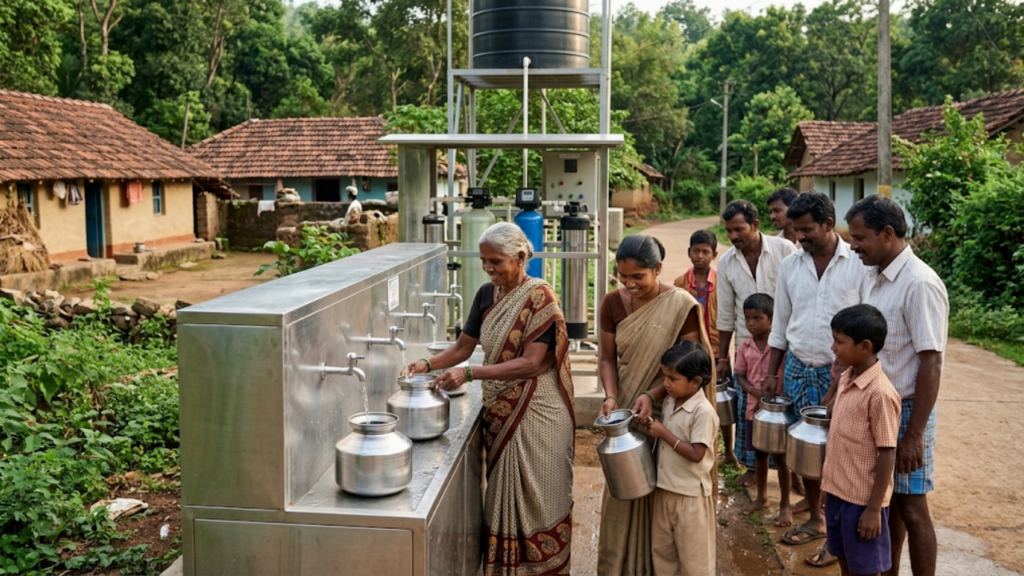
An emerging and promising model for tribal area water plants is the community enterprise model – where women’s Self-Help Groups (SHGs) affiliated with the National Rural Livelihood Mission (NRLM) own and operate a community RO plant as a micro-enterprise.
Under this model:
- A women’s SHG in the tribal haadi takes ownership of the water plant
- The plant is funded through a combination of NRLM infrastructure grant, bank loan at subsidised rate, and community contribution
- Water is dispensed at ₹1–₹3 per litre
- Revenue from water sales covers loan repayment, consumable costs, and a small operating surplus for the SHG
- The SHG operators are trained by Bangalore Aqua in both plant operation and basic business management
This model builds long-term sustainability into the community water plant in a way that purely grant-funded installations often do not – because the SHG has a financial stake in keeping the plant running. It also creates income for tribal women, building economic agency within the community.
The Maintenance Problem: Why So Many Tribal Area Water Plants Are Defunct
This section must be addressed directly, because it is the most important and most uncomfortable fact about government-installed water plants in tribal areas.
<cite index=”20-1″>Hundreds of RO plants in North Karnataka remain defunct – not because the technology failed, but because operating and maintaining them has become a challenge for gram panchayats.</cite>
The deficit is not equipment. India has installed tens of thousands of community water plants in rural and tribal areas over the past two decades. Many are working. Many more are not. The failure mode is almost always the same: a plant was installed, commissioned, and handed over – and then no one was responsible for maintaining it, no one had the budget to replace filter cartridges, no one replaced the UV lamp when it failed, no one called a technician when the pump made an unusual sound.
For tribal areas specifically, the maintenance gap is wider than in general rural areas:
- Local operators have less exposure to the technology and less confidence in troubleshooting
- Service technicians are less willing to travel to remote tribal haadis
- Spare parts are harder to source locally
- Communication infrastructure (mobile networks, internet) may be limited, making remote support harder
- The local governance structure (gram panchayat, VWSC) may have less organisational capacity
Bangalore Aqua’s approach to this problem in tribal area installations is comprehensive and deliberately different from the standard government installation model:
Pictorial operator manuals – laminated, illustrated, language-neutral daily operation checklists that communicate what to check and what to do without requiring Kannada literacy.
Trained local operators from within the community – Bangalore Aqua insists on training 2–3 operators per installation from within the tribal community, not the gram panchayat’s general operator pool. These operators have a community stake in the plant’s function.
30-day post-installation follow-up visit – a Bangalore Aqua technician returns one month after installation to assess how the community operators are managing, address any operational questions, and reinforce training. This visit is included as standard, not as a chargeable service.
IoT-based remote monitoring (for solar systems and larger plants) – allows Bangalore Aqua’s service team to monitor plant status remotely and identify issues before the community reports a failure. When the dashboard shows TDS rising above the threshold, Bangalore Aqua can contact the community operator proactively – before the water becomes non-compliant.
Annual Maintenance Contract with guaranteed response – Bangalore Aqua’s AMC programme covers quarterly site visits, consumable replacement, annual NABL water quality testing, and priority emergency response. For tribal area installations, the AMC is structured with the understanding that service mobilisation takes longer and is planned accordingly – more comprehensive consumable stock kept on site, more thorough quarterly visits to reduce the frequency of between-visit interventions.
Pre-positioned consumable stock at the installation site – every tribal area installation includes a 6-month stock of filter cartridges, UV lamp, and chemical dosing consumables stored at the plant site. This eliminates the most common failure mode – the filter that needs replacement but no one knows where to source the replacement.
Real Karnataka Tribal Area Water Projects: What Has Worked
The landscape of tribal area water projects in Karnataka includes both sobering failures and genuinely inspiring successes. Understanding what differentiates them is the most practical guide to effective implementation.
What Worked: CSR-Funded RO Plants with Dedicated AMC
Corporate CSR-funded community RO plants in Karnataka’s tribal districts – where the funding company also committed to a 3–5 year AMC – have consistently outperformed government-installed plants in operational longevity. The AMC commitment forces a maintenance relationship that the government one-time installation model cannot guarantee.
<cite index=”19-1″>Mukul Madhav Foundation has provided 90 RO units across villages in Maharashtra, Gujarat, Karnataka and Rajasthan since 2013 – specifically targeting tribal communities and drought-affected rural populations, with water purification systems at schools, hospitals, and public spaces.</cite>
The foundation’s model – continuous engagement through both installation and ongoing support – is the template that works.
What Worked: Women’s SHG Water Enterprise in HD Kote
In tribal panchayats in the HD Kote area of Mysuru district – the same region where Golur Haadi’s residents are digging pits for water – some gram panchayats with stronger NRLM SHG networks have successfully established women-operated community water plants that have run without interruption for multiple years. The SHG financial stake and social accountability create the operational continuity that government operator arrangements frequently cannot.
What Failed: Single-Installation, No AMC, No Community Training
The pattern of failure is depressingly consistent: a government agency or CSR programme installs an RO plant, conducts a brief commissioning, hands over a manual no one can read, and leaves. Within 6–18 months, a filter has not been replaced, the UV lamp has silently ceased to be effective, and the plant is technically running but not producing safe water. Within 2–3 years, a pump failure or membrane blockage puts the plant completely offline – and it stays offline.
<cite index=”20-1″>In North Karnataka, hundreds of RO plants remain defunct due to maintenance challenges at the gram panchayat level – a cautionary reminder that infrastructure investment without operational support is infrastructure investment wasted.</cite>
How to Plan a Community RO Plant Project for a Tribal Area
Step 1 – Community Engagement First, Technology Second
In tribal communities, the sequence matters enormously. A water plant imposed on a community without their understanding and buy-in will not be maintained or sustained by that community. Before any system is specified or funded, Bangalore Aqua recommends a community engagement session – ideally through an NGO partner with existing community relationships – to:
- Explain what an RO plant is and what it does, in the community’s own language
- Understand the community’s current water collection practices and what problems they most want solved
- Identify 2–3 community members (ideally women, ideally from the SHG if one exists) who will be the designated operators
- Agree on the governance model: who is responsible for the plant, how access will be managed, whether a user fee will be collected
Step 2 – Source Water Testing
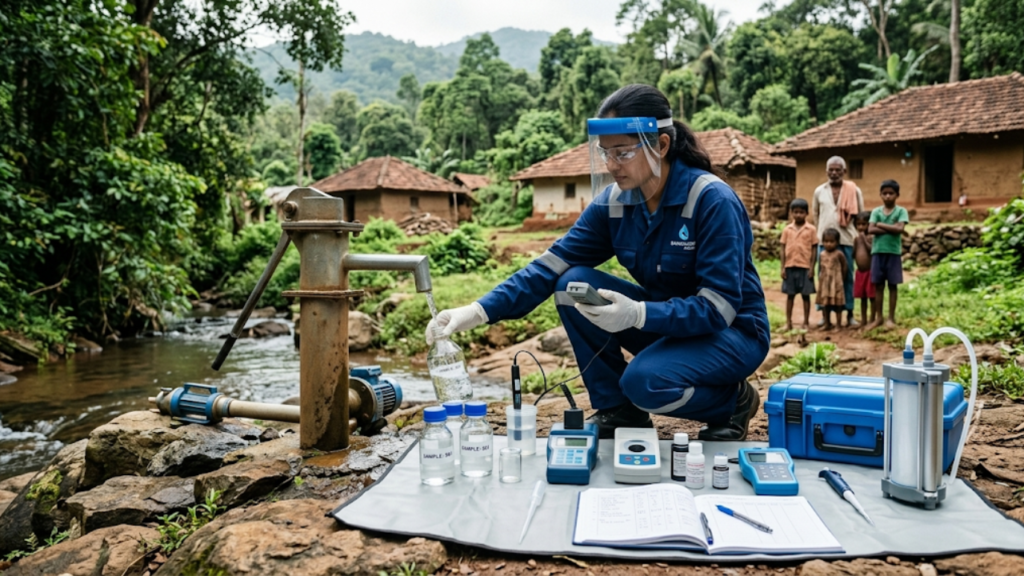
Collect water samples from the existing source – spring, stream, borewell, or government pipe – and have them tested at an NABL-accredited laboratory. Bangalore Aqua arranges this testing as part of project scoping.
For tribal area surface water sources, the panel should include: TDS, pH, turbidity, total hardness, iron, manganese, fluoride, nitrate, total coliform, E. coli, and total dissolved organic carbon. For forest-adjacent sources, pesticide residues may also be appropriate to test.
Step 3 – Select the Right Plant Type and Size
Based on community population, water source type (surface vs. borewell), contamination profile, grid electricity availability, and geographic accessibility, Bangalore Aqua’s engineering team specifies:
- Plant capacity (LPH)
- Pre-treatment configuration
- Solar integration requirement
- Distribution approach (piped vs. central kiosk)
- Storage tank size
Step 4 – Identify and Secure Funding
Match the project to the most appropriate funding mechanism from the options above – TSP, DMF, CSR, JJM water quality component, or NRLM enterprise model. Bangalore Aqua’s project team can assist with:
- Technical content for DMF and TSP project proposals
- DPR preparation for JJM water quality sub-projects
- CSR project documentation for Schedule VII compliance
Step 5 – Installation with Community Integration
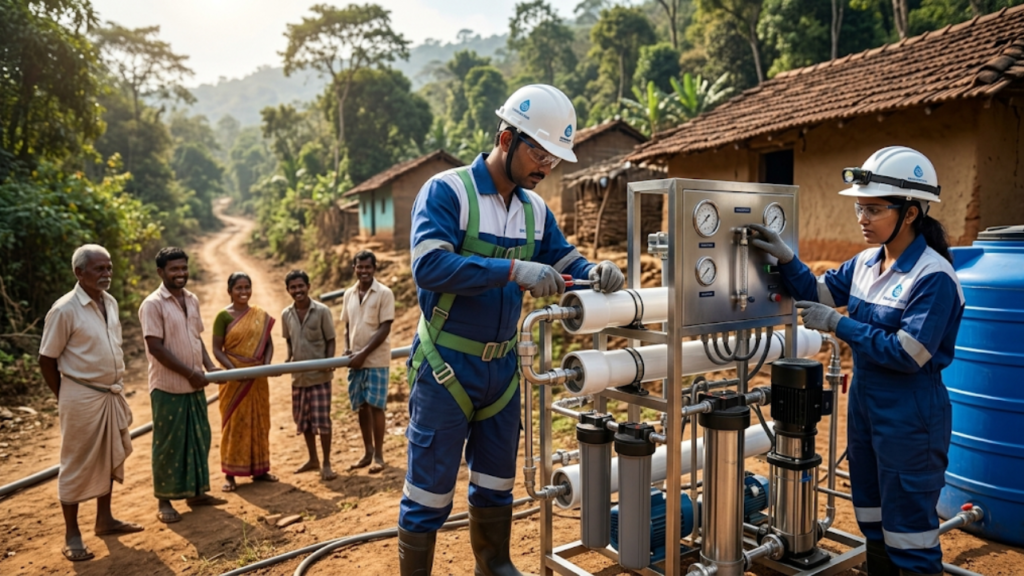
Bangalore Aqua’s installation team installs the plant with community members present and participating – not as spectators but as active participants in the installation. The designated operators handle specific installation tasks under Bangalore Aqua technician supervision, beginning to build their understanding of the system’s components and function from day one.
Step 6 – Training, Handover, and AMC Commencement
See the full commissioning process for detailed steps. For tribal area installations, the training session is extended and conducted with a community interpreter where needed. The 30-day follow-up visit is scheduled before the installation team leaves. The AMC activates from commissioning day.
Location-Specific Notes: Karnataka’s Key Tribal Districts
Bangalore Aqua serves tribal communities across Karnataka’s key tribal districts. Here are the specific service pages for the districts with the most significant tribal water access challenges:
- Mysuru district – HD Kote, Hunsur, Piriyapatna taluks have significant Soliga and Jenu Kuruba tribal populations
- Chamarajanagar – Soliga tribal communities in Biligirirangana Hills
- Uttara Kannada / Karwar – coastal and forest tribal communities
- Shivamogga – tribal hamlets in Sorab, Sagar, and Hosanagara taluks
- Chikkamagaluru – coffee estate adjacent tribal communities
- Raichur – fluoride-affected ST communities
- Chitradurga – Pavagad and Molakalmuru areas with documented ST water crisis
- Kalaburagi – North Karnataka ST habitations with fluoride contamination
- Bidar – North Karnataka tribal water access gaps
- Yadgir – severely water-stressed district with significant ST population
- Chikballapur – fluoride-affected areas including tribal villages
Frequently Asked Questions – Community RO Plants for Tribal Areas
Q: Can a gram panchayat use JJM funds specifically for a tribal haadi RO plant even if the haadi already has a tap connection? Yes – if the tap connection delivers water that fails BIS 10500 water quality standards (which is the case in fluoride and high-TDS zones), a water quality improvement sub-project under JJM is eligible. A documented NABL water quality test confirming contamination above safe limits is the key justification. Bangalore Aqua arranges this testing and supports the DPR preparation. Contact Bangalore Aqua’s project team through the contact page.
Q: How do we handle the UV lamp replacement in a remote tribal haadi where we cannot get a technician there quickly? Bangalore Aqua’s tribal area installations include a 12-month consumable pre-stock at the installation site – including at least one spare UV lamp. The community operator is trained to recognise the UV lamp failure indicator (a sensor alarm or indicator light) and to swap the lamp following a pictorial step-by-step guide. The failed lamp can be held for proper disposal during the next quarterly AMC visit.
Q: Is there a special government scheme specifically for PVTG (Particularly Vulnerable Tribal Groups) water access? Yes. India’s 75 PVTGs (18 of which are in Karnataka) receive priority under the PM PVTG Development Mission launched in 2023, which includes provision for basic amenities including safe drinking water. District welfare officers for PVTGs can access dedicated PVTG mission funding for water infrastructure in PVTG settlements. Bangalore Aqua has experience implementing water plants in PVTG areas and can provide technical documentation in the format required for PVTG mission project approvals.
Q: What is the minimum community size for a community RO plant installation to be viable? Bangalore Aqua has installed community plants for tribal haadis as small as 80–100 people. At this scale, a 100 LPH plant producing 800–1,000 litres per day serves the community’s basic drinking water needs. For very small haadis, the primary consideration is not economic viability but operational sustainability – whether there are enough community members to sustain operator training, user fees, and basic maintenance. Bangalore Aqua advises on the minimum viable community engagement structure for each project during the needs assessment.
Q: Our NGO is implementing a tribal water project in Kodagu. How does Bangalore Aqua’s partnership model work for NGO-led projects? Bangalore Aqua works regularly with NGOs as the technology and implementation partner in a three-party model: NGO (community engagement and governance), funding agency (CSR, DMF, or TSP), and Bangalore Aqua (technical implementation and AMC). The NGO selects Bangalore Aqua as their water plant supplier and manages the community and funding relationship. Bangalore Aqua handles the technical scope end-to-end. For tribal area projects specifically, Bangalore Aqua’s team includes professionals experienced with the specific sensitivities of community engagement in tribal contexts. Contact the project team to discuss your Kodagu project.
Q: Does Bangalore Aqua provide the mineral RO plant option for tribal communities where the source water may have too-low TDS after treatment? Yes. In some high-altitude forest springs in Karnataka’s Western Ghats, natural source water TDS may actually be low (below 100 mg/L) – and further RO treatment would produce water below the minimum mineral threshold recommended by WHO. For these sources, Bangalore Aqua recommends a UV disinfection plus mineralisation system rather than full RO – appropriately matched to the contamination profile of the specific source. Source water testing before system specification is the foundation of every Bangalore Aqua project, precisely to avoid over-treating water that needs less intervention.
Conclusion: The Question Deserves an Answer
The elderly woman in Golur Haadi asked: “If we fall sick, who will take responsibility?”
In 2026, that question still does not have a clear institutional answer. But it has a clear technological answer. A community RO plant – correctly sized, correctly specified for the local water chemistry, correctly installed with community operator training, and correctly maintained through a structured AMC – gives the Golur Haadi community water that will not make them sick. Safe water. Every day. For a decade.
The responsibility for bringing that plant to Golur Haadi and to every other tribal haadi in Karnataka that still lacks safe drinking water belongs to all of us – government through its TSP and JJM mechanisms, corporations through their CSR obligations, NGOs through their community development mandates, and implementation partners like Bangalore Aqua through their technical capability and commitment to making it work.
The water treatment services that Bangalore Aqua delivers across Karnataka are not limited to cities and industrial zones. They extend to wherever in Karnataka’s diverse geography there are people who deserve clean water – including the forest communities, the tribal haadis, the ST villages in fluoride-affected districts, and the adivasi communities on the margins of a rapidly growing state.
Contact Bangalore Aqua today to discuss your tribal area water project.
📞 +91 76763 93939 | +91 97387 04753 📧 info@bangaloreaqua.com 🌐 bangaloreaqua.com 📍 107/209 2nd Cross, 4th Main Kogilu Layout, Bengaluru – 560064, Karnataka
Community RO plant projects for tribal areas across Karnataka – TSP-funded, DMF-funded, CSR-funded, and NRLM enterprise model. Full turnkey implementation including community engagement, NABL water testing, solar integration, pictorial operator training, and structured AMC. Serving tribal communities across Mysuru, Kodagu, Chamarajanagar, Uttara Kannada, Shivamogga, Chikkamagaluru, Raichur, Chitradurga, Kalaburagi, Bidar, Yadgir, and all Karnataka districts.
Related Reads: