
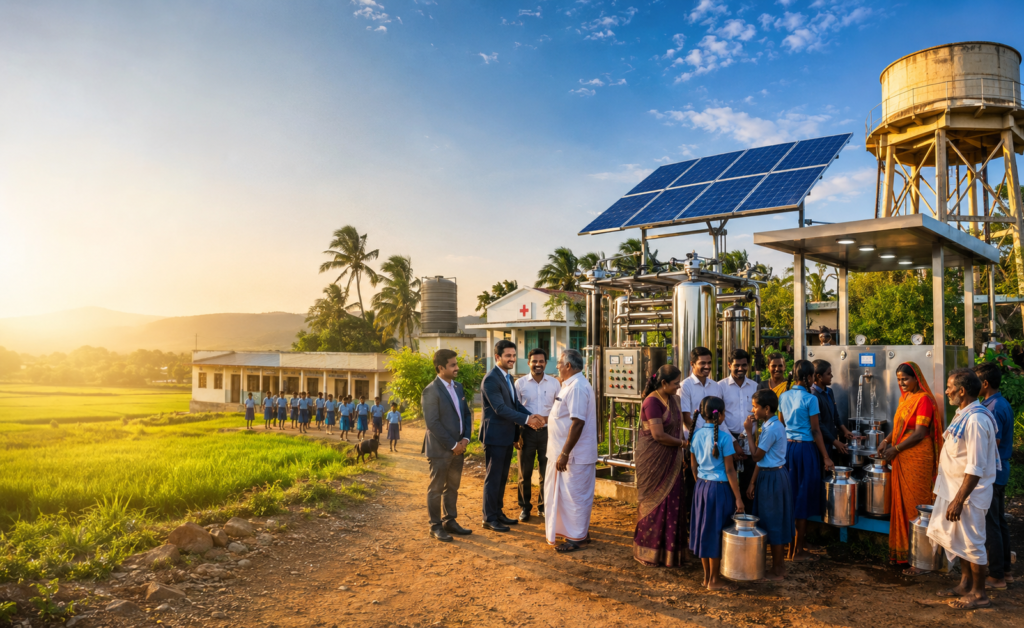
Water Is the First Infrastructure. Everything Else Comes After.
Before a school can educate, children need to be healthy enough to attend. Before a hospital can heal, the community needs water that does not make people sick in the first place. Before a rural economy can grow, families need to stop spending hours each day fetching water from distant and often contaminated sources.
Water is not one infrastructure priority among many. It is the foundational one — the intervention that unlocks every other form of human development that governments, corporations, foundations, and communities are trying to achieve.
This is why community development water projects occupy a unique position in both the government policy landscape and the private sector CSR framework. They are not optional or aspirational — in the most literal sense, they are survival infrastructure. And in India in 2026, despite remarkable progress in both government and private investment, the gap between the water quality that communities actually receive and the water quality that safe, healthy human life requires remains wide enough to demand urgent, sustained action.
This complete guide is for every government body, corporate CSR team, NGO programme officer, gram panchayat leader, housing society, and industrial company looking to understand how community water development projects work — from the legal framework that governs private sector investment to the technology that makes safe water achievable, from the government schemes that provide the infrastructure backbone to the CSR implementation models that complement and extend their reach.
And it is a guide to why Bangalore Aqua and Energy Pvt. Ltd. is the implementation partner that both government-linked and privately funded community water projects in Karnataka and South India are increasingly choosing.
The Current Landscape: Where India Stands on Community Water Access in 2026
Understanding the current state of play is essential context for any organisation planning a community water investment.
Jal Jeevan Mission: India’s Most Ambitious Water Programme
When the Jal Jeevan Mission (JJM) was launched in August 2019, only 16.7% of India’s 193.5 million rural households had tap water connections. The mission set out to achieve 100% household tap water coverage by 2024 — the most ambitious rural water infrastructure programme in the country’s history.
<cite index=”35-1″>By March 2026, coverage has risen to 81.6%, adding 125.5 million new connections in under seven years — resulting in savings of 55 million hours of daily water-fetching time and 277,000 villages being certified as Har Ghar Jal.</cite>
<cite index=”33-1″>Approved by the Union Cabinet in March 2026, Jal Jeevan Mission 2.0 has expanded the total outlay to Rs 8.69 lakh crore, with central assistance of Rs 3.59 lakh crore, shifting from an infrastructure-centric model to a service delivery framework ensuring reliable, safe, and sustainable rural water supply.</cite>
In Karnataka specifically, <cite index=”34-1″>66 lakh households have been provided with tap water connections under the Jal Jeevan Mission.</cite>
The Gap That Government Schemes Alone Cannot Fill
This progress is remarkable. But the numbers also reveal a persistent challenge that government infrastructure alone cannot address:
<cite index=”35-1″>A 2024 Functionality Assessment covering 19,812 certified Har Ghar Jal villages found that while 98% of households had tap connections, only three in four households received water that met Mission standards of quantity, quality, and regularity.</cite>
A tap connection and safe drinking water are not the same thing. A connection to a contaminated source is still a contaminated source. Infrastructure investment without water quality treatment investment leaves the fundamental health problem unsolved.
This is the critical gap where private sector CSR investment, community RO plants, and professional water treatment implementation partners like Bangalore Aqua provide the solution that government infrastructure programmes, by design and scale, cannot deliver at the household and community level.
<cite index=”35-1″>A Comptroller and Auditor General of India audit of Karnataka (2024) found procurement gaps in single-bid contracts and tender premiums of 5 to 61 per cent above estimates</cite> — underscoring that the quality and accountability of implementation partners is as important as the policy framework that enables water projects.
Karnataka’s Specific Water Quality Challenge
Karnataka is not a water-uniform state. The southern districts have Cauvery basin access. The northern districts — Kolar, Chikkaballapur, Raichur, Bidar, Chitradurga — face endemic groundwater contamination including fluoride, nitrates, and high TDS from geological mineral content that no pipe connection can address without treatment.
<cite index=”30-1″>An ambitious CSR project has undertaken de-fluoridation RO plant installation in fluoride-affected 217 villages of Kolar and Chikkaballapur districts, Karnataka, with installation completed in 156 villages and made operational.</cite>
<cite index=”27-1″>The AMRUTHVARSHINI project promotes ground water replenishment in Raichur and Gulbarga in North Karnataka</cite> — demonstrating the multi-dimensional nature of the water challenge in Karnataka’s northern districts.
Rapidly urbanising East and South Bangalore — Whitefield, Bellandur, Electronic City, Sarjapur, Koramangala — faces a different but equally severe problem: explosive population growth, groundwater depletion, borewell TDS levels of 600–1,900+ mg/L, and the infrastructure lag that comes with areas urbanising faster than municipal supply can reach them.
The solution landscape spans this entire spectrum — from village fluoride removal plants in Kolar to community RO systems in Whitefield apartment complexes. What every solution in this landscape requires is the right technology, correctly specified, professionally installed, and consistently maintained.
The Two Pathways to Community Water Investment: Government and Private Sector Frameworks
Community water projects in India flow through two distinct frameworks — each with its own legal basis, funding mechanisms, accountability structures, and implementation requirements. Most effective community water development today uses both, with private sector CSR investment complementing and extending government infrastructure programmes.
Pathway 1: Government Schemes and Programmes
Jal Jeevan Mission 2.0 (2026–2028)
The continuation of India’s flagship rural water programme, with a total outlay of Rs 8.69 lakh crore and a specific focus in this phase on water quality — ensuring that connections deliver safe water, not just any water. The 2026 extension specifically prioritises contamination treatment for fluoride, arsenic, and nitrates in identified districts.
For gram panchayats, Village Water and Sanitation Committees (VWSCs), and state government bodies in Karnataka, JJM 2.0 provides the funding framework for large-scale water infrastructure. Implementation partners — including commercial manufacturers and service providers like Bangalore Aqua — can engage with JJM-funded projects as technology and service suppliers.
Swachh Bharat Mission (Urban and Rural)
The urban stream of Swachh Bharat Mission includes water quality and sanitation infrastructure as eligible spending categories for urban local bodies. Municipal corporations and urban development authorities in Karnataka can use Swachh Bharat Mission funding to install community water treatment infrastructure in underserved urban wards and peri-urban growth areas.
AMRUT 2.0 (Atal Mission for Rejuvenation and Urban Transformation)
AMRUT 2.0 targets universal water supply coverage in all cities. For Karnataka’s growing secondary cities — Mysuru, Hubballi, Mangaluru, Belagavi, Tumakuru, Kalaburagi — AMRUT 2.0 provides funding for water infrastructure investments including treatment plants. Urban local bodies in these cities can leverage AMRUT 2.0 for community water system upgrades.
PM Gati Shakti and Industrial Corridor Development
New industrial corridor and infrastructure development projects under PM Gati Shakti create new communities — worker townships, new residential zones adjacent to industrial estates — that require water infrastructure from day one. Bangalore Aqua has experience supplying and installing water treatment systems for new industrial corridor communities in Karnataka.
District Mineral Foundation (DMF) Funds
In districts with mining operations, DMF funds are specifically designated for community development in mining-affected areas. Water infrastructure is a top priority DMF spending category. In Karnataka’s mining districts, these funds represent a significant source of community water investment that local bodies and implementation partners can access.
Pathway 2: Private Sector CSR Under Schedule VII
For private sector companies, the mandatory CSR framework under Section 135 of the Companies Act 2013 is the primary vehicle for community water investment.
The Legal Obligation
Companies meeting any of these thresholds must spend 2% of their average net profit over the preceding three financial years on qualifying CSR activities:
- Net worth of ₹500 crore or more
- Turnover of ₹1,000 crore or more
- Net profit of ₹5 crore or more
Schedule VII Eligibility for Water Projects
Under Schedule VII (i), CSR spending on “making available safe drinking water” and “health care including preventive health care and sanitation” is explicitly eligible. This makes community RO plants, school water systems, village water kiosks, solar-powered community water plants, and water quality improvement programmes unambiguously eligible for Schedule VII CSR classification.
The 2026 CSR Compliance Context
Total mandatory CSR spending in India now exceeds ₹25,000 crore annually. Water, sanitation, and hygiene (WASH) consistently ranks among the top five CSR categories by spend. The BRSR (Business Responsibility and Sustainability Report) — now mandatory for the top 1,000 listed companies — requires disclosure of water-related activities and impacts, creating an additional reporting driver for water project investment.
Multi-Year Project Structuring
Since the 2021 amendment to Section 135, CSR funds committed to ongoing multi-year projects must be transferred to an Unspent CSR Account within 30 days of the financial year end and spent within three years. This regulatory structure actually favours multi-year community water projects — a 3-year capital-plus-AMC commitment maps cleanly to the regulatory framework and provides the sustained operational support that makes community water systems work long-term.
Types of Community Water Development Projects: A Technology Guide
The right project type depends on the community’s specific needs, the source water quality, the available infrastructure, and the funding source. Here is a comprehensive guide to every category of community water development project that Bangalore Aqua designs and implements.
Category 1: Village Fluoride Removal and De-contamination Plants (250–2,000 LPH)
The most urgent category in Karnataka’s identified contaminated groundwater districts. Kolar, Chikkaballapur, Chitradurga, Tumakuru, and parts of North Karnataka have documented endemic fluoride levels above the safe limit of 1.0 mg/L in groundwater.
RO technology removes fluoride at 90–96% efficiency — making it the gold standard solution for fluoride-affected communities. A properly designed and maintained fluoride removal RO plant is not just a convenience infrastructure: it is life-changing medical infrastructure that prevents dental and skeletal fluorosis in every child who drinks from it.
These plants are typically government or CSR funded, installed in a central community location — gram panchayat office, community hall, or school grounds — and produce safe water dispensed through a central kiosk point. Canara Bank’s 217-village project in Kolar and Chikkaballapur is the benchmark for this category in Karnataka.
Bangalore Aqua’s role: Full turnkey — site assessment, source water testing for fluoride and related parameters, system design with fluoride-specific membrane selection, installation, community operator training, and 3–5 year AMC.
Category 2: Gram Panchayat Community Water Centres (500–1,000 LPH)
For villages without specific chemical contamination but with high TDS (500–1,500+ mg/L) from mineral-rich groundwater, a gram panchayat community water centre provides centralised treatment and distribution of safe drinking water.
These plants are sized to serve the entire panchayat population — typically 2,000–5,000 people — from a single professionally managed facility. Water is produced during operational hours and dispensed at a central point, either free of charge (in fully externally funded projects) or at ₹1–₹5 per litre (in user-fee sustainability models).
Both government JJM funding and private sector CSR funding can support this category. In practice, JJM often funds the distribution infrastructure (pipes to individual households) while CSR funding covers the treatment plant that ensures the water delivered through those pipes is safe.
Sustainability note: The combination of JJM-funded last-mile distribution with CSR-funded treatment plants represents the most effective and sustainable model for rural water access in contaminated groundwater areas.
Category 3: School and Anganwadi Water Systems (100–250 LPH)
Government schools and Anganwadi centres across rural Karnataka are specifically targeted under JJM, which mandates that all schools and Anganwadis receive tap water supply with functional drinking water. However, having a tap connection does not guarantee safe water quality.
CSR-funded RO systems at government schools ensure that the water children drink at school meets safe standards — even where the underlying municipal or borewell supply does not. This category has one of the most powerful impact-per-rupee ratios of any community water investment: a ₹3–6 lakh school water plant provides 400–600 children with safe drinking water throughout their school years.
<cite index=”25-1″>Maruti Suzuki’s CSR initiative set up 24 water ATMs in 23 villages across Gujarat, Haryana, and Karnataka, providing over 24 million litres of drinking water at affordable prices — demonstrating the scale achievable when corporate CSR investment is applied consistently to community water access.</cite>
Category 4: Urban Community Plants for Apartment Societies (500–5,000 LPH)
For Bangalore’s rapidly growing apartment sector — across East Bangalore (Whitefield, Marathahalli), South Bangalore (Koramangala, Electronic City, HSR Layout), and North Bangalore (Yelahanka, Devanahalli) — community RO plants serve the urban equivalent of the rural village water centre function.
These plants are funded by apartment associations through collective maintenance levies — not government or corporate CSR money in most cases, but the community development model is identical: one professional system, serving many households, with documented quality output and structured maintenance.
For companies whose employees predominantly live in specific apartment clusters, funding a community RO plant as an employee welfare CSR investment is an innovative and highly impactful model that directly benefits their workforce while qualifying under Schedule VII.
Category 5: Solar-Powered Community Water Plants for Off-Grid Communities
In rural areas with unreliable or absent grid electricity — common in North Karnataka’s agricultural districts and in remote habitations across the Western Ghats — solar-powered RO plants provide clean water without grid dependence.
<cite index=”23-1″>Wipro’s Karnataka State Water Network (KSWN) convenes industry, government, and citizens to address water challenges in identified Bengaluru clusters</cite> — an example of the public-private partnership model that works best for complex, multi-stakeholder water challenges.
Solar-integrated community water plants represent the most sustainable and lowest-operating-cost model for off-grid communities. Once the capital investment is made and the system is commissioned, ongoing operating cost is essentially zero for electricity — with only consumable replacement and AMC as recurring expenses.
Category 6: Water ATM Networks for Peri-Urban Communities
Water ATMs — automated dispensing kiosks with integrated RO treatment and electronic payment systems — are the most scalable and financially sustainable community water model for rapidly urbanising peri-urban areas around Bangalore, Mysuru, Hubballi, and other Karnataka cities.
A network of Water ATMs in a peri-urban community cluster can serve 10,000–50,000 people across multiple habitations. User fees at ₹1–₹5 per litre generate revenue that covers electricity and consumable costs, creating a self-sustaining model after the initial capital investment.
Corporate CSR investment can fund the capital installation cost; the user fee model then sustains operations indefinitely — making the initial CSR spend an investment with indefinite impact duration rather than a time-limited intervention.
Category 7: Industrial Community Water Systems for Worker Townships
Industries established in Karnataka’s industrial estates — Nelamangala, Hoskote, Doddaballapur, Devanahalli, Dharwad, Hubli, Belgaum — have both a CSR obligation and a direct operational interest in providing safe drinking water to their worker populations.
Worker health is an operational imperative. Waterborne illness in a factory workforce means absenteeism, reduced productivity, and increased healthcare costs. An industrial community water system serving a 2,000-worker township is simultaneously a CSR project (providing safe water to employees and their families) and a business continuity investment.
Bangalore Aqua’s industrial and community plant range serves this sector with large-capacity systems (1,000–10,000 LPH) designed for the high-TDS borewell water common across Karnataka’s industrial estate zones.
Government–Private Sector Partnership Models That Work
The most effective community water development projects in India are not purely government or purely private — they are partnerships that combine the scale and reach of government programmes with the speed, accountability, and quality focus of private sector implementation.
Model 1: JJM Infrastructure + CSR Treatment
Government funds the distribution infrastructure (pipes, pumps, overhead tanks, last-mile connections) through JJM. Corporate CSR funds the water treatment plant — the RO system that ensures water flowing through those government-funded pipes is actually safe. Both investments are essential; neither is effective without the other.
This model is increasingly adopted by Karnataka-based companies with operations in fluoride-affected districts. The company’s CSR investment is modest relative to the government’s infrastructure investment, but it transforms the government investment from pipe-delivery-of-contaminated-water to pipe-delivery-of-safe-water.
Model 2: District Administration + Corporate Partnership
District administrations — collectors’ offices and gram panchayat federations — identify communities with the most acute safe water gaps. Corporate CSR partners co-fund the water treatment infrastructure. Gram panchayats take governance responsibility for the plant. The corporate partner funds AMC for 3–5 years.
This model works particularly well in Karnataka’s district headquarters towns, where the collector’s office has good data on village-level water quality and strong panchayat governance networks. Bangalore Aqua has experience working in this tripartite model — coordinating with district administration, the corporate CSR team, and the gram panchayat to ensure all stakeholders are aligned on implementation, governance, and maintenance.
Model 3: Industrial Estate Developer + Worker Community CSR
Industrial estate developers — KIADB, private industrial park developers — fund community water infrastructure for the communities surrounding their estates as both a social licence investment and a direct CSR contribution under Schedule VII.
The logic is straightforward: an industrial estate that improves access to safe water in its surrounding villages builds stronger community relations, reduces conflict over shared resources, and creates a visible, tangible demonstration of corporate citizenship. Bangalore Aqua has implemented community water plants in villages surrounding Karnataka’s major industrial zones under this model.
Model 4: Technology Company Employee Catchment Area CSR
For Bengaluru’s major IT employers — companies with 5,000–50,000 employees across Whitefield, Electronic City, and the Outer Ring Road corridor — the employee catchment area includes millions of Bangalore residents who are not employees but who live in the same communities.
Some forward-thinking companies are investing CSR funds in community water infrastructure in the residential areas surrounding their campuses — improving the quality of life of their employees’ neighbours, reducing the waterborne disease burden in the communities their employees come home to, and creating tangible community benefit that goes well beyond their immediate employee population.
Model 5: Multi-Company CSR Consortium Projects
For villages adjacent to large industrial clusters where multiple companies operate, a consortium CSR model — where 5–10 companies collectively fund a large community water plant — distributes the cost across multiple CSR budgets while creating an infrastructure investment that none of the individual companies could fund alone.
Bangalore Aqua has experience structuring multi-company consortium water projects in coordination with CII (Confederation of Indian Industry) and ASSOCHAM Karnataka chapter networks. If your company is interested in participating in a consortium water project, contact Bangalore Aqua’s CSR team to discuss current Karnataka consortium opportunities.
What Makes a Community Water Project Succeed Long-Term
The difference between a community water project that delivers safe water for 15 years and one that is offline within 18 months comes down to a handful of critical decisions made before the first pipe is laid.
Decision 1: Technology Matched to Contamination Profile
Water quality testing before system specification is not optional — it is the foundation of every effective community water project. Fluoride removal requires different membrane selection from simple TDS reduction. Iron removal requires a specific upstream pre-treatment stage. High hardness requires softener pre-treatment to protect the RO membrane. Bacterial contamination requires UV disinfection as a final kill step.
A generic RO plant specified without source water testing will either under-treat (failing to address the specific contaminant) or over-treat (wasting capital on unnecessary stages). Either way, the community is not well served.
Bangalore Aqua conducts NABL-accredited source water testing as the mandatory first step of every community water project — before any system is specified or any budget is committed.
Decision 2: Community Ownership Built In From Planning
A water plant that the community does not feel ownership over is a plant on a countdown to abandonment. The most successful community water projects involve community leaders — gram panchayat sarpanch, ASHA workers, women’s SHG leaders, school management committee members — in the planning process, not just the launch ceremony.
Bangalore Aqua’s community engagement approach involves a formal community meeting before plant design is finalised — establishing the governance model (who manages daily operations), the access model (free or user-fee), the maintenance responsibility structure, and the community’s commitments to plant stewardship.
Decision 3: Local Operator Training in Local Language
The operator of a community water plant in rural Karnataka is typically a locally engaged community member with no technical background. Their ability to monitor the plant daily, identify early warning signs of performance degradation, and contact service support appropriately is the critical link between professional installation and sustained performance.
Bangalore Aqua provides operator training in Kannada — with laminated, illustrated daily operation checklists designed for operators with no technical background. This is not a standard practice across the industry. It is, in Bangalore Aqua’s experience, the single most impactful thing an implementation partner can do to prevent the slow operational degradation that silently affects under-trained community plant operators.
Decision 4: AMC Funded and Contracted Before Commissioning
No AMC means no sustained performance. This is not an opinion — it is the observable outcome of every community water project that was commissioned without a funded maintenance commitment. Bangalore Aqua structures every community project proposal to include a 3-year minimum AMC as a non-negotiable component of the project budget.
For CSR-funded projects, the AMC is included in the total project cost and treated as ongoing CSR expenditure — valid under Schedule VII for every year the plant is producing safe water for the community. For government-funded projects, Bangalore Aqua proposes AMC as a separate contract line that can be funded from JJM operational grants or from district DMF funds.
Decision 5: Annual Impact Documentation for Reporting
For private sector CSR projects, annual impact documentation is both a governance requirement (BRSR disclosure) and an accountability mechanism. Bangalore Aqua provides annual project reports including water quality test certificates from NABL-accredited laboratories, water production logs, beneficiary count updates, and photographic documentation — the complete package for CSR committee reporting and MCA annual filing.
Bangalore Aqua’s Community Development Project Portfolio in Karnataka
Bangalore Aqua and Energy Pvt. Ltd. has built a growing portfolio of community water development projects across Karnataka — serving both government-adjacent and private CSR-funded implementations. Their project categories include:
Village RO Water Plants (Kolar, Chikkaballapur, Tumakuru districts): Community drinking water systems for fluoride and high-TDS groundwater zones, serving gram panchayat communities of 500–3,000 people. Multiple installations operational with 3-year AMC coverage.
School Drinking Water Systems (Yelahanka, Devanahalli, Doddaballapur zones): Compact RO systems installed at government schools in the North Bangalore corridor, providing safe drinking water to student populations of 200–600. Several installations funded through corporate CSR by industrial companies in the adjacent industrial estates.
Urban Apartment Community Plants (Bengaluru — multiple zones): Community RO plants for apartment associations across Yelahanka, Koramangala, Whitefield, Electronic City, and HSR Layout. These installations range from 500 LPH for smaller complexes to 2,000+ LPH for large townships.
Industrial Worker Township Systems (Nelamangala, Hoskote, Doddaballapur): High-capacity community water plants for worker colonies adjacent to manufacturing and industrial facilities, often funded through the company’s CSR budget as an employee welfare investment.
Solar-Integrated CSR Plants (North Karnataka pilot locations): Solar-powered community RO plants for off-grid and power-deficient villages, combining clean energy and clean water in a single CSR investment vehicle that aligns with both water access and environmental sustainability goals.
The Business Case for Government Bodies and Private Companies
For Government Bodies and Urban Local Bodies
Community water development projects with professional private sector implementation partners offer government bodies something they urgently need: reliable, quality-verified delivery that government procurement processes struggle to ensure at scale.
<cite index=”35-1″>A CAG audit of Karnataka’s JJM implementation found single-bid contracts and tender premiums of 5 to 61 per cent above estimates.</cite> Working with pre-qualified, experience-verified implementation partners — rather than lowest-bid open tenders — consistently delivers better quality outcomes at comparable or lower total cost of ownership.
Bangalore Aqua’s willingness to engage with government implementation frameworks — DPR preparation support, technical specification for procurement documents, installation and commissioning under government project timelines, and AMC support for government-funded community plants — makes them a practical partner for gram panchayats, urban local bodies, and district administrations managing water infrastructure projects.
For Private Sector Companies Planning CSR Investment
Financial returns are real: A community RO plant funded through CSR qualifies as tax-deductible expenditure under Section 135 — reducing the after-tax cost of the investment. When the AMC is structured as annual recurring CSR expenditure, the financial benefit continues year on year.
BRSR disclosure value is significant: Water access projects produce some of the most compelling, quantifiable BRSR disclosures available. Litres of safe water produced. Beneficiaries served. Water quality before and after. These are numbers that make ESG investors and sustainability raters pay attention.
Social licence benefit is substantial: For companies operating in Karnataka’s industrial corridor — Nelamangala, Hoskote, Doddaballapur, Devanahalli — community water infrastructure in surrounding villages is the most visible, most tangible demonstration of social responsibility available. It is an investment that communities remember and value far longer than any awareness campaign or event sponsorship.
Employee engagement is genuine: Companies that invest in community water infrastructure in the areas where their employees live — or in visible proximity to their operations — consistently report stronger employee identification with company values and higher engagement scores on CSR awareness metrics.
How to Start Your Community Water Development Project With Bangalore Aqua
Whether you are a gram panchayat looking to improve your village’s water quality, a corporate CSR team planning your Schedule VII spend, an industrial developer seeking an implementation partner for township water infrastructure, or an apartment association considering a community plant — the process with Bangalore Aqua is straightforward.
Step 1 — Define Scope and Funding Source How many beneficiaries? What geography? What budget envelope? What funding mechanism (government scheme, CSR, association levy, consortium)? Clarity on these points allows Bangalore Aqua to immediately map the right project type and scale.
Step 2 — Site Assessment and Water Testing Bangalore Aqua visits the proposed site or sites, assesses infrastructure conditions, and arranges NABL-accredited source water testing. This is the non-negotiable technical foundation of every project.
Step 3 — Community Engagement For village and peri-urban projects, a community engagement session with gram panchayat leadership, women’s SHG members, and other community stakeholders establishes governance, access model, and community commitment.
Step 4 — Technical Proposal and Project Budget A complete project proposal is prepared — system design, BoM, civil requirements, installation plan, operator training plan, and 3–5 year AMC structure — with full itemised budgeting transparent to all stakeholders.
Step 5 — Approval and Implementation For CSR projects: CSR Committee approval and fund release. For government projects: procurement process completion. Bangalore Aqua then manages manufacturing, logistics, installation, commissioning, and training.
Step 6 — Handover and Long-Term AMC Partnership The community plant is formally commissioned and handed over, with operators trained and operational documentation in place. AMC begins from day one of commissioning.
Frequently Asked Questions
Q: Can a gram panchayat partner directly with Bangalore Aqua for a community water plant funded through JJM or DMF? Yes. Bangalore Aqua works with gram panchayats as a technology and service supplier under government-funded project frameworks. They can assist with DPR preparation, provide technical specifications for procurement, and execute installation and AMC under panchayat or district administration contracts. Contact the Bangalore Aqua team to discuss your panchayat’s specific situation.
Q: Can a company fund water plants across multiple Karnataka districts under a single CSR project? Yes — and this is increasingly the model for companies with larger CSR budgets and operations across multiple Karnataka locations. Bangalore Aqua has multi-site project management capability and can execute simultaneous installations across different districts under a coordinated project plan. A single project document, phased implementation schedule, and consolidated impact reporting package covers all sites.
Q: What is the minimum CSR budget for a meaningful community water project? A school water plant installation starts from approximately ₹2.5 lakh. A village kiosk for a 500-person community starts from approximately ₹5 lakh. Including a 3-year AMC, a meaningful, well-executed school project with documented impact can be delivered for ₹4–₹7 lakh. This is accessible for a wide range of qualifying companies, not just the largest corporates.
Q: How do government bodies ensure quality when procurement goes through tender processes? Specifying minimum technical requirements carefully in the tender document is the most effective quality assurance mechanism. Require NABL-accredited source water testing before commissioning. Require post-commissioning water quality certification. Require a minimum AMC period as part of the contract scope. Bangalore Aqua can assist government bodies in drafting technically sound tender specifications for community water plant procurement.
Q: Can CSR funds be used for the ongoing AMC after the plant is installed? Yes. Ongoing maintenance of a community water plant that is actively producing safe water for the community is a continuing CSR expenditure under Schedule VII — the social benefit (safe drinking water) continues, qualifying the maintenance as an ongoing contribution to that benefit. Your company’s legal and CSR team should confirm the specific structuring, but the general principle is well-established.
Q: How do we ensure that a solar-powered community water plant in a remote village is maintained properly? Solar-integrated systems from Bangalore Aqua are designed for low-maintenance autonomous operation — the photovoltaic system requires virtually no mechanical maintenance for 20+ years. The RO system requires standard quarterly consumable replacement. Bangalore Aqua’s AMC teams service remote locations on quarterly visit schedules. IoT-based monitoring with GSM connectivity is available for plants in areas with mobile network coverage, allowing remote performance monitoring without requiring in-person visits for routine status checks.
Also Read on Bangaloreaqua Blog
https://bangaloreaqua.com/ro-plant-vs-water-softener-bangalore/
https://bangaloreaqua.com/best-ro-plant-manufacturer-koramangala-bangalore/
https://bangaloreaqua.com/best-community-ro-project-plants/
https://bangaloreaqua.com/domestic-ro-water-purifier-flow-diagram/
https://bangaloreaqua.com/best-csr-project-ro-plants/
Conclusion: The Water Investment That Pays Forward for Decades
Every rupee invested in a community water development project — whether it comes from a government scheme, a corporate CSR budget, a gram panchayat levy, or an apartment association maintenance fund — produces returns that compound over time.
The child who does not develop fluorosis because their school has a safe water system grows up healthier, attends school more consistently, and achieves educational outcomes that change the trajectory of their life and their family’s. The woman who no longer spends three hours daily fetching water from a distant well reclaims that time for economic activity, education, and family care. The factory worker who drinks safe water at the company township does not miss days to waterborne illness. The apartment resident who has certified purified water at their tap stops worrying about something that should not require worry.
These are not abstract outcomes. They are the documented, measurable human returns on a water infrastructure investment — returns that compound forward across generations.
Bangalore Aqua and Energy Pvt. Ltd. has been delivering these returns for communities across Karnataka since 2021 — through village RO plants, school water systems, apartment community plants, industrial worker township systems, and CSR implementation partnerships with companies across South India’s corporate landscape.
The technology works. The economics work. The legal framework supports it. What makes the difference between a project that works and one that does not is the implementation partner — and Bangalore Aqua has built its entire model around being the partner that makes community water projects work, for the long term.
Ready to start your community water development project?
📞 +91 76763 93939 | +91 97387 04753 📧 info@bangaloreaqua.com 🌐 bangaloreaqua.com 📍 107/209 2nd Cross, 4th Main Kogilu Layout, Bengaluru – 560064, Karnataka
Community water development projects across Karnataka and South India — for gram panchayats, urban local bodies, corporate CSR teams, industrial developers, apartment associations, NGOs, and foundations. Turnkey implementation. NABL-accredited water testing. BRSR-compatible impact documentation. 3–5 year AMC.