A Tap Connection and Safe Water Are Not the Same Thing
On paper, India has achieved something extraordinary.
Under the Jal Jeevan Mission (JJM), rural tap water coverage has risen to 82.09% in 2026 – from just 16.71% when the programme launched in August 2019. This represents an addition of over 12 crore tap water connections in six years, making JJM one of the largest infrastructure delivery programmes in human history.</cite>
This is a genuine achievement. The engineering effort, the political will, and the sheer logistical complexity of laying water supply infrastructure to hundreds of thousands of villages across India’s geographic and demographic diversity cannot be understated.
But here is the gap that the data also reveals – and it is a gap that represents one of the most significant opportunities for community RO plant suppliers, NGOs, CSR partners, and district-level implementation agencies in India today.
While JJM focused on laying physical water supply infrastructure, JJM 2.0 – approved by the Union Cabinet in March 2026 – represents a strategic shift towards guaranteeing quality, regularity, and sustainability of tap water service. The new phase emphasises not just building pipelines but ensuring these systems operate efficiently and serve villagers consistently.</cite>
The gap between coverage and quality is real and documented. A Functionality Assessment of Har Ghar Jal villages found that while connections existed, only three in four households received water meeting Mission standards of quantity, quality, and regularity. The pipes are there. The water is reaching homes. But in contaminated groundwater areas – fluoride-affected districts, high-TDS borewell zones, nitrate-contaminated agricultural regions – a pipe carrying contaminated water to a household tap is not the same as safe drinking water reaching that household.
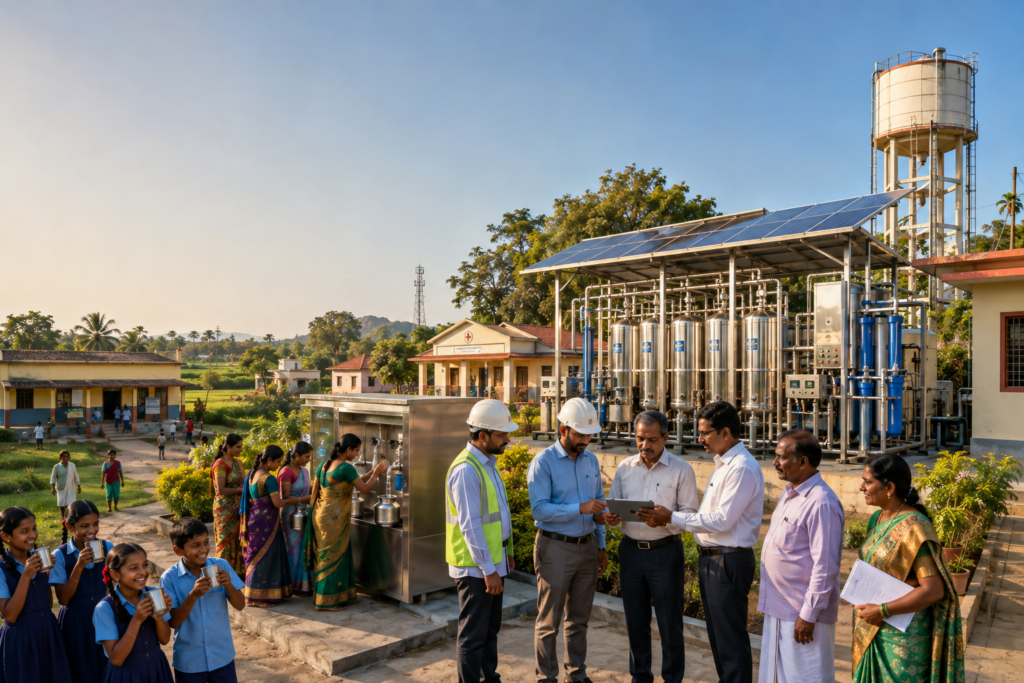
This is precisely where community RO plants fit. They are the treatment layer that transforms infrastructure access into actual safe water – the technology that bridges the gap between JJM’s connection mandate and the genuine drinking water safety that rural India deserves.
This guide is the complete resource for understanding India’s government drinking water schemes, the specific opportunities they create for community RO plant deployment, and how Bangalore Aqua and Energy Pvt. Ltd. partners with government bodies, NGOs, CSR teams, and gram panchayats to convert government water infrastructure into genuinely safe drinking water for communities across Karnataka and South India.
India’s Government Drinking Water Landscape: Every Major Scheme Explained
Understanding the government landscape is essential for any organisation – manufacturer, NGO, CSR team, or contractor – that wants to participate in publicly funded community water projects.
Jal Jeevan Mission 2.0 (2026–2028): India’s Flagship Rural Water Programme
What it is: The Jal Jeevan Mission (JJM), launched on 15 August 2019, is the Government of India’s flagship scheme for providing Functional Household Tap Connections (FHTC) delivering at least 55 litres per capita per day (lpcd) of potable water meeting BIS 10500 standards to every rural household.
The Union Cabinet approved JJM 2.0 in March 2026, extending the mission to December 2028 with a significantly enhanced total outlay of ₹8.69 lakh crore – with central assistance of ₹3.59 lakh crore. The expansion includes the transfer of rural water supply schemes to Gram Panchayats (GPs) and Village Water and Sanitation Committees (VWSCs), necessitating robust institutional and financial mechanisms for sustainable operation and maintenance.</cite>
The JJM 2.0 shift – from pipes to quality:
JJM 2.0’s Sujalam Bharat digital framework assigns every village a unique Sujal Gaon ID to digitally map rural drinking water supply chains from source to household taps – improving monitoring, accountability, and transparency. JJM 2.0 places stronger emphasis on community participation and decentralised governance, with Jal Arpan initiatives empowering Gram Panchayats and VWSCs to verify and commission projects.</cite>
What this means for community RO plant opportunities:
JJM 2.0’s quality focus creates a specific and substantial opportunity. The mission’s BIS 10500 water quality mandate means that in contaminated groundwater areas – which include significant portions of Karnataka (fluoride-affected Kolar, Chikkaballapur, Chitradurga), North Karnataka’s nitrate-contaminated zones, and deep borewell areas with TDS above 500 mg/L – JJM tap connections cannot deliver compliant water without treatment.
This compliance gap drives demand for community RO treatment plants as the treatment layer upstream of the JJM distribution network. Gram panchayats, district administrations, and state government bodies implementing JJM 2.0 in contaminated zones are actively seeking:
- Technology suppliers who can design and supply community RO plants matched to local water quality challenges
- Installation partners with on-the-ground capacity in rural Karnataka
- O&M (Operation and Maintenance) partners who can train local operators and maintain plants over the long term
- Documentation partners who can support the Sujalam Bharat digital reporting requirements
Bangalore Aqua’s full-cycle capability – from source water testing through design, manufacture, installation, operator training, and AMC – positions them as an ideal JJM 2.0 implementation partner across Karnataka.
Scale of the opportunity in Karnataka:
Karnataka’s JJM implementation covers approximately 10.7 lakh rural households as targets across multiple phases. Of these, the districts with documented groundwater contamination – Kolar, Chikkaballapur, Chitradurga, Tumakuru, Raichur, Bidar, Bagalkot, and others – represent the high-priority zones for community RO treatment plant deployment.
<cite index=”29-1″>JJM specifically mandates that women constitute at least 50% of the GPWSC/Paani Samiti members. Women trained as village water testers, Paani Samiti members, and O&M contractors are central to JJM 2.0’s sustainability model.</cite>
This women-in-governance mandate aligns perfectly with Bangalore Aqua’s community operator training model – which specifically targets women’s self-help group members as the preferred operators for community water plants, building local ownership and income-generation opportunities simultaneously.
AMRUT 2.0 (Atal Mission for Rejuvenation and Urban Transformation): Urban Water Quality
What it is: AMRUT 2.0, launched in 2021 and continuing through 2026, targets universal water supply coverage in all statutory urban towns across India. The second phase specifically focuses on water security for all urban households – including peri-urban areas that have been left out of earlier urban infrastructure programmes.
Scope: AMRUT 2.0 covers 500 AMRUT cities and all statutory towns across India. In Karnataka, this includes Bengaluru (BBMP), Mysuru, Hubballi-Dharwad, Mangaluru, Belagavi, Kalaburagi, and dozens of smaller urban local bodies (ULBs).
Funding structure: Central share of 33–50% (depending on city size), with state government and ULB contributions making up the balance. Total AMRUT 2.0 allocation nationally is approximately ₹2.77 lakh crore over 5 years.
Community RO plant opportunity under AMRUT 2.0:
AMRUT 2.0 funds water supply infrastructure in urban and peri-urban areas. For peri-urban zones of Karnataka’s secondary cities – particularly those with borewell-dependent supply due to inadequate municipal connection reach – community RO treatment plants are an eligible infrastructure investment.
ULBs in Karnataka implementing AMRUT 2.0 projects in areas with poor source water quality are potential clients for:
- Community water treatment plants serving peri-urban wards
- Institutional RO plants for government school and hospital buildings within the ULB area
- Water quality monitoring and testing infrastructure
- O&M service contracts for ULB-owned water treatment infrastructure
National Rural Drinking Water Programme (NRDWP): Legacy Infrastructure Maintenance
The predecessor to JJM, NRDWP created water supply infrastructure across rural India over several decades. Much of this infrastructure is now more than 10–20 years old. The transition to JJM has transferred O&M responsibility to Gram Panchayats and VWSCs – bodies that often lack technical capacity and maintenance budgets.
This legacy infrastructure – pumps, overhead tanks, distribution systems, and water quality treatment units – represents a maintenance and upgrade opportunity that community RO plant suppliers can address. Many NRDWP-era community water treatment plants (gravity-based or UV-only systems) are no longer adequate for current water quality standards and need replacement or upgrade to RO-based technology.
District Mineral Foundation (DMF) Funds: Water Projects in Mining Districts
What it is: The District Mineral Foundation (DMF) is a mandatory fund established under the Mines and Minerals (Development and Regulation) Amendment Act 2015. Mining companies in India contribute a percentage of royalties to the DMF of the district where they mine. DMF funds are specifically earmarked for the welfare of communities affected by mining – and drinking water infrastructure is among the highest-priority eligible uses.
Scale: Total DMF collections nationally exceed ₹50,000 crore. Mining-significant Karnataka districts – Bellary, Chitradurga, Tumakuru, Kolar, and others – have significant DMF balances specifically available for community welfare projects including drinking water.
Community RO plant opportunity under DMF:
DMF funds represent one of the most accessible and flexible funding sources for community water projects in mining-affected Karnataka districts. District collectors (who chair the DMF Trust) and district-level planning bodies can approve community RO plant projects relatively quickly – without the more complex central government procurement processes that JJM projects sometimes involve.
The contaminated groundwater in many Karnataka mining districts – where decades of mining activity have affected both surface and groundwater quality, and where geological formations naturally produce fluoride and other contaminants – creates a genuine need for RO-based treatment rather than simpler purification methods.
Organisations and companies seeking to implement community water projects in Karnataka’s mining districts should engage with district DMF cells directly, and are well-served by partnering with a community water plant supplier (like Bangalore Aqua) who can provide complete technical documentation, impact projections, and cost-benefit analysis in the format that DMF project approvals require.
Samagra Shiksha Abhiyan: School Drinking Water Infrastructure
What it is: Samagra Shiksha Abhiyan (formerly Sarva Shiksha Abhiyan and Rashtriya Madhyamik Shiksha Abhiyan) is the central government’s integrated school education programme, which includes provision for basic school infrastructure – including safe drinking water facilities.
Under the Samagra Shiksha framework and NIPUN Bharat, government schools are expected to have functional, safe drinking water at the point of use. This policy mandate – combined with the well-documented reality that many Karnataka government school buildings lack modern water purification infrastructure – creates a substantial opportunity for school-scale RO plant installations.
Scale in Karnataka: Karnataka has approximately 57,000 government and government-aided schools. Studies on school water quality across India consistently find that a significant proportion of government schools either have non-functional water supply infrastructure or have water that does not meet BIS 10500 standards.
The Karnataka government’s own programmes – including Nali Kali and other school quality initiatives – incorporate water quality as a component of school readiness metrics.
Community RO plant opportunity in schools:
School-scale RO plants (100–250 LPH) are the most cost-effective and impactful category of community water project available:
- Low capital cost: ₹2.5–₹6 lakhs per school installation
- High impact: 300–600 students receiving safe drinking water every school day for 10–15 years
- Samagra Shiksha funding: School infrastructure funding can be channelled to water treatment under the basic infrastructure provision
- CSR complement: Many corporate CSR programmes specifically target school water projects – CSR funds can complement Samagra Shiksha allocations for faster and broader implementation
- Easy compliance documentation: School management committees maintain records; water quality testing can be tied to existing school quality reporting frameworks
Bangalore Aqua has installed school water plants across government schools in Yelahanka, Devanahalli, Doddaballapur, and adjacent North Bangalore corridors – with experience in navigating the documentation and procurement requirements for government school installations.
Swachh Bharat Mission (SBM) Urban and Rural: WASH Infrastructure
What it is: Swachh Bharat Mission covers water, sanitation, and hygiene (WASH) infrastructure. While the mission’s primary focus has been on toilet construction (rural SBM) and solid waste management (urban SBM), water quality infrastructure is an eligible use within the WASH framework.
For gram panchayats implementing total sanitation village (ODF+) certification requirements, water quality at public facilities – including schools, anganwadis, health sub-centres, and gram panchayat buildings – is assessed as part of ODF+ status. Community water treatment plants at these public facilities directly support ODF+ compliance.
Opportunity: ODF+ certification processes across Karnataka create a specific demand for water quality infrastructure at government-owned public facilities. Community RO plants at panchayat buildings, anganwadis, and public health centres are eligible under SBM WASH categories.
NABARD Rural Infrastructure Development Fund (RIDF): Panchayat Water Projects
What it is: NABARD‘s Rural Infrastructure Development Fund (RIDF) provides concessional loans to state governments for rural infrastructure projects, including water supply. State governments – including Karnataka – use RIDF loans to finance rural infrastructure at the panchayat level.
Karnataka State Government has used NABARD RIDF for water supply projects in rural areas. Gram panchayats whose water projects are funded through RIDF can access capital for community water infrastructure, including treatment plants in areas where source water quality requires it.
Opportunity: Gram panchayats in Karnataka with RIDF-funded or RIDF-eligible water supply projects can include community RO treatment plants as components of those projects.
National Health Mission (NHM): Healthcare Facility Water Quality
What it is: The National Health Mission funds primary healthcare infrastructure including Primary Health Centres (PHCs), Community Health Centres (CHCs), and Sub-Centres across rural India. Water quality at healthcare facilities is explicitly within the NHM’s scope of quality improvement.
PHCs and CHCs in Karnataka’s rural districts frequently operate with inadequate water quality for clinical use. NHM quality improvement grants can fund RO treatment systems at these facilities – providing safe water for patient care, wound irrigation, and instrument cleaning.
Opportunity: Karnataka’s 2,200+ PHCs and 350+ CHCs are potential sites for NHM-funded healthcare water treatment installations. Bangalore Aqua’s experience with healthcare water systems (including NABH-compatible documentation) makes them a qualified supplier for NHM healthcare facility water projects.
The Three Models for Community RO Plant Implementation in Government Projects
Government-funded community water projects can be structured and implemented through three distinct models, each with different procurement, governance, and sustainability characteristics.
Model 1: Direct Government Procurement (for Gram Panchayats and Urban Local Bodies)
In this model, the government body – gram panchayat, ULB, district administration – directly procures the community RO plant through a tender process and takes ownership and O&M responsibility.
Process:
- Government body identifies need and prepares a Detailed Project Report (DPR)
- Tender is floated through the government e-procurement portal (GeM or state-specific)
- Suppliers (including Bangalore Aqua) bid against the technical and financial specifications
- Contract is awarded and the supplier installs and commissions the plant
- O&M is either handled by trained local operators (with AMC support from the supplier) or through a separate O&M contract
Bangalore Aqua’s role: Technology supplier and implementation partner. Bangalore Aqua can assist gram panchayats and district administration bodies in DPR preparation – providing technical specifications, capacity calculations, water quality testing support, and budget estimates that meet government procurement documentation requirements. They then bid on the tender and, if awarded, execute the full installation.
Procurement note: Government tenders for community water plants are increasingly listed on the GeM (Government e-Marketplace) portal. Bangalore Aqua’s GeM registration enables them to participate in government procurement efficiently.
Model 2: NGO / Foundation Implementation Partner Model
In this model, an NGO or CSR foundation identifies the community need and accesses government funding (through DMF, JJM VWSC grants, or state government channels), or combines government funding with philanthropic or CSR contributions.
The NGO acts as the implementation agency – coordinating between the funding body, the community, and the technology supplier.
Process:
- NGO identifies target community and documents need
- NGO applies for government funding or CSR grants
- NGO procures community RO plant from a qualified supplier (Bangalore Aqua)
- NGO manages community engagement, operator training, and governance setup
- Technology supplier (Bangalore Aqua) handles technical installation and AMC
Bangalore Aqua’s role: Technology supplier and technical implementation partner to the NGO. Bangalore Aqua provides the complete technical solution – water testing, plant design, manufacture, installation, commissioning, operator training, and long-term AMC.
This model is particularly common in Karnataka’s CSR-funded community water projects – where companies with CSR obligations partner with reputable NGOs and community foundations for project implementation.
Model 3: BOOT (Build-Own-Operate-Transfer) or PPP Model
In larger-scale community water projects, particularly for peri-urban communities and larger village clusters, a BOOT or PPP structure may be appropriate – where a private operator builds, owns, and operates the treatment plant for a defined period, recovering costs through user fees, before transferring ownership to the community or government body.
Process:
- Government body (gram panchayat, ULB) issues a concession agreement
- Private operator (e.g., Bangalore Aqua as part of a consortium) designs, finances, builds, and operates the plant for 5–15 years
- User fees – typically ₹1–₹5 per litre for dispensed water – recover capital and operating costs
- Plant is transferred to the gram panchayat or ULB at the end of the concession period, fully paid-off and with trained local operators
Bangalore Aqua’s role: Technology partner and potential operating partner in BOOT/PPP arrangements. For smaller BOOT arrangements (village-level water ATMs, for example), Bangalore Aqua can provide both the technology and the operational support infrastructure.
The Quality Gap: Where Community RO Plants Are Most Urgently Needed in Karnataka
Understanding which Karnataka districts and which types of communities have the most acute need for community RO treatment plants is essential for prioritising project development.
Fluoride-Affected Districts
Karnataka has documented endemic fluoride contamination in groundwater across several districts. Communities in these areas are drinking water with fluoride above the BIS safe limit of 1.0 mg/L – causing dental and skeletal fluorosis in children and adults.
Priority fluoride districts in Karnataka:
- Kolar and Chikkaballapur: The most extensively documented fluoride-affected districts in Karnataka, with ongoing community RO plant programmes funded through CSR and government channels
- Chitradurga: Elevated fluoride in borewell water across several taluks
- Tumakuru: Parts of the district have fluoride above safe levels in borewell water
- Bidar and Raichur (North Karnataka): Elevated fluoride in some groundwater zones
RO membranes reject fluoride at 90–96% efficiency – making community RO plants the definitive solution for fluoride-affected communities. Gravity-based filters, UV systems, and activated alumina defluoridation (common in older government schemes) do not achieve the consistent, high-efficiency fluoride removal that RO provides.
High-TDS Borewell Zones
Karnataka’s rapidly urbanising districts – including Bengaluru Rural, Ramnagar, Mysuru, and the peri-urban zones surrounding Bengaluru city – have borewell water with TDS consistently above 500 mg/L and often above 1,000 mg/L. These areas fall between the rural-urban divide in government water programmes – not sufficiently rural for full JJM coverage, but not sufficiently urban for BWSSB connections.
Community RO plants – funded through a combination of gram panchayat O&M budgets, user fees, and AMRUT 2.0 or DMF grants – are the appropriate solution for these peri-urban growth communities.
Industrial Area Worker Communities
The communities surrounding Karnataka’s major industrial estates – Nelamangala, Hoskote, Doddaballapur, Devanahalli, Hubli-Dharwad industrial areas – are inhabited by industrial workers, their families, and supporting service populations. These communities have a double water burden: hard, high-TDS groundwater from borewells, combined with potential groundwater contamination from industrial activity.
Industries with CSR obligations have a natural incentive to invest in community water infrastructure in the villages surrounding their operations – and community RO plants are the standard solution. Government DMF funds (in districts with mining) and industry CSR funds can both be channelled to this need.
Drought-Prone Areas of North Karnataka
Districts in the Hyderabad-Karnataka region – Bidar, Kalaburagi, Yadgir, Raichur, Vijayapura – are water-scarce, drought-prone, and dependent on groundwater that in many areas carries elevated TDS, fluoride, and nitrate levels. JJM 2.0 prioritises these regions, but the source water quality challenges mean that pipe connections without treatment deliver compliance on paper while failing on actual water quality.
Community RO plants in these districts – particularly solar-powered systems given the reliable solar irradiance and unreliable grid electricity in rural North Karnataka – represent both a public health investment and a significant opportunity for equipped community water plant suppliers.
What Government Agencies, NGOs, and CSR Teams Need From Implementation Partners
Whether you are a district collector, a gram panchayat sarpanch, an NGO programme manager, or a corporate CSR head, the requirements you have from a community water plant implementation partner are similar – and understanding them from Bangalore Aqua’s perspective is important.
Technical Capability
You need a supplier who can test your source water, design a system appropriate for your specific contamination profile (fluoride? high TDS? iron? bacteria?), manufacture quality equipment, install it correctly, and commission it to produce water that actually meets BIS 10500 standards. Not catalogue equipment – engineered solutions for your specific water.
Documentation Support
Government procurement and funding processes require specific documentation: technical specifications for tender preparation, DPR (Detailed Project Report) support, installation and commissioning certificates, water quality test certificates from NABL-accredited laboratories, and impact documentation for reporting to funding bodies.
CSR projects require: pre-installation baseline water quality reports, post-installation compliance certificates, beneficiary count documentation, photographic documentation, and annual impact reports for BRSR disclosure.
Bangalore Aqua provides all of these documentation packages as standard – because supporting their clients’ reporting obligations is part of their service commitment, not an optional extra.
Community Training and Capacity Building
The most technically excellent community water plant fails if the local operator does not know how to run it. Bangalore Aqua provides hands-on operator training in Kannada (and local dialect where applicable), with laminated daily operation checklists designed for operators with no technical background. For JJM 2.0 projects, Bangalore Aqua’s training approach aligns with the VWSC empowerment model that the mission promotes.
Long-Term Maintenance Commitment
A community water plant that is not maintained becomes a statistic in the “infrastructure gap” data rather than a sustained public health asset. Bangalore Aqua’s structured AMC – quarterly visits, scheduled consumable replacement, annual water quality testing, and emergency response – is the maintenance commitment that transforms a one-time installation into a decade-long public health investment.
Transparent Pricing for Government Procurement
Government procurement requires transparent, itemised, and competitive pricing. Bangalore Aqua’s direct manufacturing model – no middleman, no intermediary markup – provides genuinely competitive pricing for government tenders while maintaining the quality of in-house manufactured equipment.
How to Access Government Funding for Community RO Plants: A Step-by-Step Guide
For gram panchayats, NGOs, and CSR teams looking to access government funding for community water projects, here is a practical pathway:
Step 1 – Identify the Right Funding Source
Start by determining which government programme is most appropriate for your community and project type:
- Rural village, JJM-covered area: Approach your district’s JJM district programme management unit (DPMU). If the village is in a water quality-affected zone (fluoride, high TDS), the water quality component can be funded as a JJM sub-project.
- Mining district: Contact the district collector’s office regarding DMF funds and the eligibility of community water infrastructure.
- Urban/peri-urban area: Contact the relevant ULB’s AMRUT 2.0 nodal officer.
- Government schools: Contact the Block Education Officer regarding Samagra Shiksha water infrastructure provisions.
- Government health facilities (PHC/CHC): Contact the District Health Officer regarding NHM infrastructure improvement grants.
- Industrial area community: Approach the nearby industry’s CSR committee – this may be the fastest and most flexible funding path.
Step 2 – Prepare a Project Concept Note
Before formal DPR preparation, a short project concept note (3–5 pages) describing the community’s water quality problem, the proposed solution, the number of beneficiaries, and the estimated cost helps assess funding eligibility quickly. Bangalore Aqua can support concept note preparation with technical content – source water quality data, plant type recommendation, capacity estimate, and rough cost range.
Step 3 – Commission a Water Quality Assessment
NABL-accredited water quality testing is required for most government funding applications for water quality projects. The test results justify the need for treatment and inform the system specification. Bangalore Aqua arranges and coordinates NABL-accredited testing as part of their project scoping services.
Step 4 – Prepare the Detailed Project Report (DPR)
For JJM projects and most government-funded infrastructure projects, a DPR is the formal project approval document. It includes: problem statement, water quality baseline data, beneficiary profile, proposed system design (with technical specifications), civil works requirements, implementation timeline, O&M plan and budget, and total project cost. Bangalore Aqua assists implementing agencies in DPR preparation for community water projects.
Step 5 – Tender or Direct Procurement
For JJM and most government projects, procurement goes through a competitive tender. For smaller projects (below state-specified threshold values), direct procurement or quotation-based procurement may be allowed. For CSR-funded projects, implementing agencies typically follow their own procurement policies.
Step 6 – Implementation, Commissioning, and Handover
Bangalore Aqua handles full implementation – manufacturing, logistics, civil coordination, installation, commissioning, operator training, and handover documentation.
Step 7 – Annual Monitoring and O&M
AMC provides ongoing maintenance. JJM 2.0’s Sujalam Bharat digital reporting requires water quality data upload – Bangalore Aqua’s quarterly water quality testing results are provided in formats compatible with government monitoring requirements.
The Karnataka State Specific Opportunity: Jal Jeevan Mission Implementation Gaps
Karnataka’s JJM implementation has progressed well on connection count but faces documented quality challenges in specific areas. The state government’s Department of Rural Development and Panchayat Raj (RDPR) – which implements JJM in Karnataka – has identified several categories of habitations that need water quality treatment infrastructure alongside or in addition to distribution connections.
These include:
- Habitations in fluoride-contaminated zones (primarily Kolar, Chikkaballapur, Chitradurga districts)
- Habitations dependent on borewell sources with TDS above 500 mg/L
- Habitations where the quality of piped supply is seasonally variable due to surface water source mixing
For each of these categories, the Karnataka RDPR and district DPMUs are potential project development and procurement partners. Bangalore Aqua’s Karnataka-specific experience – including their track record of community water plant installations across North and South Bangalore rural districts – makes them a credible and relevant implementation partner for Karnataka JJM quality improvement projects.
Solar-Powered Community RO Plants: The Government Scheme Perfect Fit
For government-funded community water projects in rural Karnataka – particularly in North Karnataka districts where grid electricity is unreliable and the solar resource is excellent – solar-powered community RO plants represent the ideal technology choice.
Why solar-powered community water plants are particularly well-suited to government schemes:
Energy independence: Rural villages with unreliable grid electricity see their water plants frequently offline during power cuts. Solar-powered systems with battery backup produce clean water throughout the day – even during the grid outages that are common in summer and during monsoon thunderstorm events.
Zero electricity cost: After capital investment, the energy cost of a solar-powered water plant is essentially zero. This dramatically reduces the O&M burden on gram panchayats and VWSCs, whose capacity to collect and manage user fees for ongoing operating costs is often limited.
Sustainability alignment: JJM 2.0 and most government sustainability frameworks specifically value solar-integrated rural infrastructure. Solar water plants align with national solar energy targets and can be classified under multiple government funding categories simultaneously (Jal Shakti + MNRE solar programmes).
MNRE (Ministry of New and Renewable Energy) synergy: Solar water pumping and solar-powered water treatment plants can sometimes access MNRE subsidy schemes alongside Jal Shakti Ministry water quality funds – creating a double-funding opportunity that reduces project capital cost.
Bangalore Aqua designs and installs solar-integrated community RO plants from 250 LPH to 2,000 LPH – appropriate for village populations from 500 to 5,000+ beneficiaries.
Community RO Plants Under Government Projects: Frequently Asked Questions
Q: Can a gram panchayat directly purchase a community RO plant from Bangalore Aqua using JJM funds? Yes, subject to the specific JJM project approval process in Karnataka. Gram panchayats implementing JJM water quality sub-projects can procure community RO plants through the standard government procurement process – either through GeM (Government e-Marketplace) or through competitive tender. Bangalore Aqua is registered on GeM and can support gram panchayats in the procurement documentation process.
Q: What documentation does Bangalore Aqua provide for government project reporting? Bangalore Aqua provides: NABL-accredited water quality test certificates (pre-installation baseline and post-installation compliance), installation completion certificate, commissioning performance data, operator training attendance records, and annual water quality and maintenance reports. For JJM projects, reports are formatted to be compatible with the Sujalam Bharat digital monitoring framework.
Q: What is the minimum project size for Bangalore Aqua to engage with government community water projects? There is no formal minimum. Bangalore Aqua has installed school water plants at approximately ₹3 lakh and village community plants at ₹5–₹8 lakh – both of which are well within typical gram panchayat or DMF grant approval thresholds. Contact Bangalore Aqua’s project team to discuss your specific project scope.
Q: How does Bangalore Aqua handle the O&M of community plants in remote rural locations? Bangalore Aqua’s AMC teams service rural locations across Karnataka on quarterly schedules. For very remote locations in districts like Bidar, Raichur, or Chitradurga, service visit schedules are coordinated during field trips that combine multiple village plant visits efficiently. Emergency response for remote locations is coordinated through the district-level contact point established during project handover. IoT-based remote monitoring with GSM connectivity is available for plants in areas with mobile network coverage.
Q: Can DMF funds be used for community RO plants in Karnataka’s mining districts? Yes. Safe drinking water is one of the highest-priority categories for DMF spending under the Pradhan Mantri Khanij Kshetra Kalyan Yojana (PMKKKY) guidelines. The district DMF Trust – chaired by the District Collector – approves DMF project proposals. Bangalore Aqua has experience preparing DMF project proposals for water quality projects in Karnataka’s mineral districts. Contact Bangalore Aqua to discuss a specific DMF project in your district.
Q: Is there a government subsidy available for community RO plants? There is no universal direct subsidy specifically for community RO plants as a standalone product. However, community RO plants can be fully funded through JJM (water quality component), DMF (welfare of mining-affected communities), AMRUT 2.0 (peri-urban water quality), Samagra Shiksha (school water infrastructure), NHM (healthcare facility infrastructure), or CSR (Schedule VII). The plant itself is the deliverable; the funding comes from the applicable government or CSR scheme. Bangalore Aqua’s project team can help identify the most appropriate funding channel for your specific project.
Why Bangalore Aqua Is Karnataka’s Most Qualified Government Water Project Partner
Track Record of Government-Adjacent Implementations
Bangalore Aqua has an established portfolio of community water plant installations across Karnataka – including village-level installations in Kolar district’s fluoride-affected zone, school water plants in North Bangalore’s government school network, and community plants in gram panchayats in Devanahalli, Doddaballapur, and Hoskote taluks. This track record demonstrates the practical capability to navigate rural Karnataka’s diverse implementation environments.
Full DPR and Documentation Support
Bangalore Aqua’s project team can support gram panchayats, NGOs, and district administration bodies in preparing the technical content for JJM sub-project DPRs, DMF project proposals, Samagra Shiksha applications, and AMRUT 2.0 project documents. This support – which is provided as part of Bangalore Aqua’s project development engagement – significantly reduces the burden on implementing agencies who may lack in-house technical capacity.
NABL-Accredited Testing Partnership
Every community water project that Bangalore Aqua executes includes NABL-accredited source water testing at the outset and post-commissioning compliance testing. These test certificates – which confirm both the problem (contaminated source water) and the solution (compliant purified water from the plant) – are the core evidentiary requirement for government project approvals and reporting.
Community Training in Kannada
Bangalore Aqua’s operator training is conducted in Kannada, with training materials designed for operators with no technical background. This localised training approach is directly aligned with JJM 2.0’s emphasis on community capacity building and women’s empowerment in water governance.
Proven AMC Infrastructure Across Karnataka
A community water plant without sustained maintenance eventually fails. Bangalore Aqua’s structured AMC programme – with quarterly site visits, scheduled consumable replacement, annual water quality certification, and emergency breakdown response – is the O&M infrastructure that government project evaluators and funding agencies need to see before committing long-term funds to community water infrastructure.
Also Read on NikahNamah Blog
- https://bangaloreaqua.com/ro-plant-commissioning-process/
- https://bangaloreaqua.com/industrial-ro-plant-maintenance-checklist/
- https://bangaloreaqua.com/industrial-commercial-ro-plant-amc-services/
- https://bangaloreaqua.com/csr-community-development-water-projects-india/
- https://bangaloreaqua.com/ro-plant-vs-water-softener-bangalore/
Conclusion: The Infrastructure Is Being Built – Now It Needs the Treatment Layer
India’s JJM achievement is remarkable – from 17% to 82% rural tap water coverage in six years. But the mission’s own quality data tells us that connection coverage is not the same as safe water delivery, particularly in Karnataka’s contaminated groundwater zones.
JJM 2.0’s explicit shift toward quality and sustainability – with its Sujalam Bharat digital monitoring, its VWSC empowerment model, and its BIS 10500 compliance mandate – is the policy signal that the infrastructure investment phase is being complemented by a quality delivery phase.
Community RO plants are the treatment layer that this quality delivery phase requires. They are the technology that transforms a JJM tap connection in a fluoride-affected Kolar village from a pipe carrying contaminated water to a source of genuinely safe drinking water. They are the intervention that converts government infrastructure investment into measurable public health outcomes.
Bangalore Aqua and Energy Pvt. Ltd. is Karnataka’s most experienced and most locally present community RO plant manufacturer and implementation partner – with the technical capability, the documentation support, the community training model, and the long-term AMC commitment that government water projects require.
Contact Bangalore Aqua’s project team today to discuss your government or NGO community water project.
📞 +91 76763 93939 | +91 97387 04753 📧 info@bangaloreaqua.com 🌐 bangaloreaqua.com 📍 107/209 2nd Cross, 4th Main Kogilu Layout, Bengaluru – 560064, Karnataka
Community RO plant projects under JJM, DMF, AMRUT, Samagra Shiksha, NHM, and CSR Schedule VII – across Bengaluru, Kolar, Chikkaballapur, Devanahalli, Doddaballapur, Hoskote, Chitradurga, Tumakuru, Raichur, Bidar, Mysuru, Hubballi, and all Karnataka districts.
Related reads: Best CSR Project RO Plants in India 2026 | CSR and Community Development Projects for Government and Private Sectors 2026 | Best Community RO Project Plants 2026 | Understanding TDS Levels for Different Industries 2026 | Top 10 RO Plant Companies in India 2026