The Acronym Confusion That Has Cost Hundreds of Indian Businesses Their KSPCB Consent
Imagine spending ₹15–40 lakhs on a wastewater treatment plant. The plant is installed, commissioned, and handed over. The team signs off. The facility starts operating.
Six months later, an inspector from the Karnataka State Pollution Control Board arrives for a consent verification visit. She takes samples from your discharge point. She reviews your treatment plant records. And then she delivers the news that every facility manager dreads: your discharge is non-compliant. Your plant is not treating the wastewater you are producing. Your KSPCB consent is at risk.
What went wrong? In many cases, the answer is devastatingly simple: the wrong type of plant was installed. A sewage treatment plant (STP) was installed in a facility producing industrial effluent. Or an effluent treatment plant (ETP) was specified for a residential development where only domestic sewage is generated. Or – most commonly in mixed-use industrial facilities – both types of wastewater were present but combined into a single stream that can be treated by neither plant effectively.
<cite index=”24-2″>A domestic sewage plant dropped in front of an industrial waste stream will simply fail: the microbes die, the discharge stays illegal, and the regulator does not accept “we built a plant” as compliance.</cite>
<cite index=”30-1″>Many project owners mistakenly install the wrong system, leading to compliance failure and operational issues.</cite>
STP and ETP are not interchangeable acronyms for “wastewater treatment plant.” They are fundamentally different technologies, designed for fundamentally different waste streams, governed by different regulatory frameworks, and sized and specified through completely different engineering processes.
This guide is the complete explanation of what separates them – and the practical tool for determining which one your facility, business, industrial unit, or residential development actually needs.
The One-Sentence Distinction That Changes Everything
Before all the technical detail, here is the core distinction in plain language:
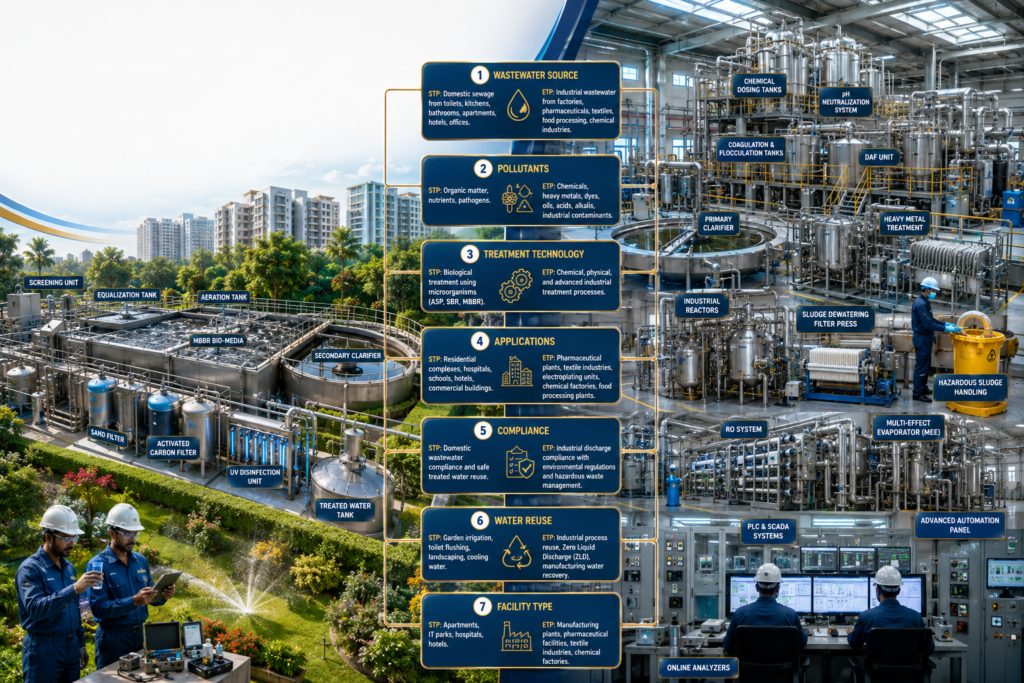
An STP (Sewage Treatment Plant) treats domestic sewage – the wastewater generated by human beings living and working in a building: toilet waste, kitchen waste, shower and bathroom wastewater.
An ETP (Effluent Treatment Plant) treats industrial effluent – the wastewater generated by industrial and manufacturing processes: chemicals, dyes, heavy metals, oils, acids, alkalis, and other process-specific pollutants.
<cite index=”23-2″>An ETP treats industrial process effluent containing chemicals, heavy metals, and industrial pollutants. An STP treats domestic sewage from toilets, bathrooms, and kitchens. ETPs require specialised treatment processes tailored to specific industrial effluent characteristics. STPs use standard biological treatment for domestic sewage.</cite>
This distinction matters because the treatment technologies are fundamentally different. STPs work primarily through biological processes – using microorganisms (bacteria) to break down organic matter. ETPs work primarily through chemical and physical processes – neutralising acids and alkalis, precipitating heavy metals, removing non-biodegradable compounds that bacteria cannot digest.
Put bacteria-based STP technology in front of a chemical-laden industrial waste stream, and the bacteria die. The system fails. The discharge remains illegal.
Put ETP chemical treatment in front of domestic sewage that just needs biological digestion, and you waste enormous amounts of chemical reagents treating something that a far cheaper biological system would handle easily – while generating unnecessary chemical sludge that requires expensive disposal.
What an STP (Sewage Treatment Plant) Is – Explained Completely
What It Treats
An STP is designed to receive and treat sewage – the mixed wastewater from:
- Toilet flush water containing human excreta and urine (the most significant component by BOD load)
- Kitchen wastewater containing food particles, vegetable peels, oils, and cleaning agent residues
- Bathroom and shower wastewater containing soap, shampoo, skin cells, and hair
- Laundry wastewater containing detergent residues and suspended solids
- Floor wash and general cleaning wastewater
This domestic sewage is characterised primarily by organic matter (measured as BOD – Biochemical Oxygen Demand, and COD – Chemical Oxygen Demand), suspended solids, nutrients (nitrogen and phosphorus from urine and food), and pathogens (bacteria, viruses, and parasites from faecal matter).
The critical characteristic of domestic sewage is that its primary pollutants – organic matter and nutrients – are biodegradable. Microorganisms can break them down. This is the biological process that STPs are designed to exploit.
Who Needs an STP
Residential apartment complexes: Under the Environment (Protection) Act and the Karnataka Environment (Protection) Act, residential buildings above a certain size – typically above 50 apartments or 500 square metres of built-up area under BBMP regulations – are required to install and operate an STP. This is one of the most common STP applications across Bengaluru’s expanding apartment sector.
Hotels and resorts: The hospitality sector generates large volumes of domestic sewage from guest rooms, kitchens, laundries, and common areas. Standalone wastewater treatment is increasingly a licensing requirement and a prerequisite for star-category rating.
Corporate offices and IT parks: Large office campuses with thousands of daily occupants generate significant sewage volumes. BBMP building plan approvals for large commercial developments increasingly require a dedicated STP.
Hospitals and healthcare institutions: Hospital sewage – which includes clinical wastewater – is treated in a dedicated STP (sometimes with additional disinfection stages for pathogen management) before discharge or reuse.
Educational institutions: Colleges, universities, and large schools with significant residential or catering facilities require STPs above a certain campus population threshold.
Government buildings and municipal bodies: Large government complexes and BBMP itself operate STP infrastructure for civic sewage management.
How an STP Works: The Treatment Stages
Stage 1 – Screening and Grit Removal (Preliminary Treatment) Incoming sewage passes through coarse and fine screens to remove large solids – rags, plastic, sanitary waste, large food scraps – that would otherwise clog pumps and damage equipment. After screening, grit (sand, gravel, fine particles from kitchen drains) is settled in a grit chamber and removed. This preliminary treatment prepares the sewage for biological processing.
Stage 2 – Equalisation Sewage flow to a treatment plant is highly variable – peak flow during morning hours (7–9am) can be 3–5 times the overnight minimum flow. An equalisation tank collects incoming sewage and releases it to the treatment train at a steady, controlled rate. This smooths out flow and concentration variations, protecting the biological treatment stages from hydraulic shock loads.
Stage 3 – Primary Clarification (Primary Treatment) Sewage is held in a primary settling tank (clarifier) for 1–3 hours, allowing settleable solids to sink to the bottom as primary sludge. Floating materials (oils and greases) are skimmed from the surface. This stage removes approximately 50–70% of suspended solids and 25–40% of BOD before the biological treatment begins.
Stage 4 – Biological Treatment (Secondary Treatment – the heart of the STP) This is where STPs work their fundamental magic. The partially clarified sewage is introduced to a biological reactor where a diverse community of aerobic (oxygen-loving) microorganisms – primarily bacteria – oxidise and consume the dissolved and suspended organic matter. These bacteria use the organic compounds in sewage as their food source, converting them to carbon dioxide, water, and new bacterial biomass.
Multiple biological treatment technologies are used depending on the scale of the STP, the available footprint, and the effluent quality target:
Activated Sludge Process (ASP): The most widely used STP technology in India. Sewage is mixed with a dense culture of bacteria (activated sludge) in an aeration tank where compressed air is continuously supplied to maintain aerobic conditions. The bacteria degrade organic matter over a retention time of 4–8 hours. The treated water and bacteria mixture then flows to a secondary clarifier where the bacteria settle out, are partly recycled back to the aeration tank (maintaining high bacterial concentration), and the clarified effluent flows forward.
Sequential Batch Reactor (SBR): A time-based variation of the activated sludge process where the same tank cycles through fill, aeration, settling, and decant phases. SBR systems are compact, produce good quality effluent, and are well-suited for the space-constrained plot areas common in Bengaluru apartment developments.
Moving Bed Biofilm Reactor (MBBR): Plastic carrier media provide surface area for biofilm growth – bacteria attach to the carriers and treat sewage as it flows through the reactor. MBBR systems are compact, robust to flow variation, and require less sludge handling than conventional ASP.
Extended Aeration: A variant of ASP with very long aeration times (24+ hours) that reduces sludge production – beneficial for facilities where sludge handling is a constraint.
Stage 5 – Secondary Clarification The biologically treated mixed liquor (water + bacteria biomass) flows to a secondary clarifier where the bacterial biomass settles, the clear supernatant overflows to tertiary treatment, and a portion of the settled sludge is recycled to the biological reactor.
Stage 6 – Tertiary Treatment and Disinfection The secondary effluent – which has already had BOD and TSS removed to low levels – receives final polishing:
- Sand filtration: Removes residual suspended solids and turbidity
- Activated carbon filtration: Removes residual COD, colour, and odour
- UV disinfection or chlorination: Eliminates pathogens – bacteria, viruses, and parasites – to achieve safe reuse standards
- Reverse Osmosis (for high-quality reuse): For residential buildings that want to recycle STP-treated water for toilet flushing, garden irrigation, or even (with appropriate additional treatment) drinking water
Stage 7 – Sludge Management Every STP generates sludge – the concentrated biomass removed in primary and secondary clarification. This sludge requires thickening, dewatering (filter press or centrifuge), and disposal. Dewatered sludge cake can be used as compost or sent to landfill.
STP Effluent Standards in India
The treated effluent from an STP must meet discharge standards set by the CPCB (Central Pollution Control Board) and enforced by state PCBs (KSPCB in Karnataka). For land/surface water discharge from an institutional or residential STP, key standards include:
| Parameter | CPCB Inland Surface Water Discharge Limit |
| pH | 6.5–8.5 |
| BOD (5 days, 20°C) | Below 30 mg/L |
| Total Suspended Solids (TSS) | Below 100 mg/L |
| Total Nitrogen | Below 10 mg/L (some notifications) |
| Total Coliform | Below 10,000 MPN/100 mL |
For reuse in toilet flushing or garden irrigation, the relevant standard is CPCB’s Treated Sewage Reuse Standards – which specify that reused STP water must have BOD below 10 mg/L, TSS below 20 mg/L, and coliform below 200 MPN/100 mL.
What an ETP (Effluent Treatment Plant) Is – Explained Completely
What It Treats
An ETP is designed to receive and treat industrial effluent – wastewater generated by manufacturing and industrial processes. Unlike domestic sewage, industrial effluent is highly variable in its composition depending on the specific industry and process. What is common across all industrial effluents is that they typically contain contaminants that:
- Are often chemically complex or toxic
- May not be biodegradable (cannot be broken down by bacteria)
- May be inhibitory or fatal to the bacteria used in biological treatment at even modest concentrations
- Often require specific chemical, physical, or advanced treatment processes tailored to the specific industry
<cite index=”28-2″>An ETP handles toxic chemicals, oils, acids, alkalis, metals, dyes, and non-biodegradable materials. It requires highly customized and complex processes tailored to industry-specific contaminants.</cite>
Who Needs an ETP
<cite index=”23-3″>All industries generating industrial effluent are required to install ETPs under India’s Environment (Protection) Act, 1986. Key industries include: pharmaceutical and bulk drug, textile dyeing and processing, chemical and petrochemical, food and beverage processing, leather and tannery, sugar mills and distilleries, paper and pulp, automotive and metal finishing.</cite>
In Karnataka, this regulatory requirement is enforced by the KSPCB (Karnataka State Pollution Control Board) through the consent-to-establish and consent-to-operate framework. Industries in the Red and Orange categories of CPCB’s industrial categorisation – which includes most manufacturing and processing industries – must have an operating ETP as a condition of their Consent to Operate.
Industry-Specific Effluent Challenges
The range of contaminants across different industries makes ETP design inherently site-specific. Here is an overview of the specific challenges across Karnataka’s major industrial sectors:
Textile and Dyeing (Doddaballapur, Ramanagara, Bellary): Textile dyeing effluent contains reactive and acid dyes – complex aromatic compounds that are highly coloured and resistant to biodegradation. High pH (from alkali scouring), high TDS from dyeing salts, and COD from the dye molecules and auxiliary chemicals. Colour removal is the defining treatment challenge – biological processes alone are insufficient; chemical coagulation and advanced oxidation are required.
Pharmaceutical and Bulk Drug Manufacturing: Pharmaceutical effluent contains active pharmaceutical ingredients (APIs), organic solvents, reaction by-products, and antibiotics. Antibiotic-containing effluent is particularly challenging because antibiotics inhibit or kill the bacteria in biological treatment systems. Advanced biological systems (MBR – Membrane Bioreactor) or pre-treatment to remove antibiotics before biological treatment is required.
Food and Beverage Processing: Food processing effluent has high BOD and COD from food solids, oils, and carbohydrates. It is primarily biodegradable – unlike pharmaceutical or textile effluent – but the organic load is so high (COD of 2,000–20,000 mg/L versus domestic sewage at 200–500 mg/L) that the biological system must be designed for the much higher load. Anaerobic pre-treatment (generating biogas from the high-strength effluent) followed by aerobic polishing is often the most economical approach.
Auto Components and Metal Finishing (Hoskote, Peenya, Bommasandra): Metal finishing effluent contains heavy metals (chromium, nickel, zinc, copper, lead), acids (sulphuric, hydrochloric), and alkalis. Hexavalent chromium (Cr⁶⁺) – used in chrome plating – is a carcinogen that requires specific chemical reduction to Cr³⁺ before precipitation. Heavy metals must be chemically precipitated and separated as metal hydroxide sludge – biological processes cannot remove them.
Leather and Tannery: Tannery effluent contains chromium from chrome-tanning processes, sulphide from hide processing, and extremely high TDS. Karnataka’s Hoskote area has significant leather industry presence. Tannery effluent is among the most challenging in India – typically requiring a CETP arrangement given the small scale of individual tannery operations.
Chemical Manufacturing: Highly variable depending on the specific chemicals produced. May include volatile organic compounds (VOCs), chlorinated compounds, reactive chemicals, and specific toxicants. Requires detailed effluent characterisation before any ETP can be designed.
How an ETP Works: The Treatment Stages
ETP treatment sequences vary significantly based on the specific industry. A generic ETP for mixed industrial effluent typically includes:
Stage 1 – Collection and Equalisation Industrial effluent flows vary significantly – batch discharge at the end of a processing cycle, continuous discharge, or variable production schedules. Equalisation tanks collect and homogenise the effluent before treatment, smoothing out flow rate and concentration variations that would otherwise shock downstream treatment units.
Stage 2 – Pre-Treatment (Industry-Specific) This is where ETPs diverge most sharply from STPs – each industry has specific pre-treatment requirements:
- pH Neutralisation: Acidic or alkaline effluent must be neutralised (pH brought to 6.5–8.5) before biological or chemical treatment. Acid effluent from metal finishing is dosed with alkali; alkaline effluent from dyeing is acidified. Without pH correction, downstream treatment systems cannot function.
- Heavy Metal Precipitation: Dissolved heavy metals (chromium, nickel, zinc, lead) are precipitated as metal hydroxides by raising pH, then settled and removed.
- Oil and Grease Removal: Dissolved air flotation (DAF) or oil interceptors remove free and emulsified oils before biological treatment – oils at high concentrations inhibit biological activity.
- Cyanide Destruction: Where cyanide is present (metal finishing operations), alkaline chlorination or other specific destruction processes are applied.
- Chromium Reduction: Hexavalent chromium (Cr⁶⁺) is reduced to trivalent form (Cr³⁺) with sodium metabisulphite or sulphur dioxide under acidic conditions before precipitation.
Stage 3 – Coagulation and Flocculation (Primary Treatment) Coagulant chemicals (aluminium sulphate, ferric chloride, or PAC – Polyaluminium Chloride) are added to the effluent under rapid mixing, destabilising suspended and colloidal particles and causing them to aggregate. Flocculant polymer is then added under gentle mixing, causing the aggregated particles to form larger, settleable floc. This chemical primary treatment achieves 60–80% removal of suspended solids and significant colour removal.
Stage 4 – Primary Sedimentation (Clarification) The flocculated effluent is settled in a primary clarifier, removing the chemical sludge (coagulant-pollutant complexes) from the liquid stream. The clarified liquid proceeds to biological treatment; the primary sludge requires separate handling and disposal.
Stage 5 – Biological Treatment (for biodegradable components) Where the effluent has a biodegradable organic component after primary treatment – food processing, pharmaceutical, some chemical effluents – a biological secondary treatment stage (typically ASP, SBR, or anaerobic reactor + aerobic polishing) degrades the remaining organic load. For effluents where the organic fraction is non-biodegradable (textile dyes, certain chemicals), this stage may be modified or replaced with advanced oxidation.
Stage 6 – Advanced Treatment (Tertiary) Depending on the discharge standard required and the effluent’s specific characteristics:
- Reverse Osmosis: For very high TDS industrial effluents where TDS reduction is required for discharge compliance or for water recovery and reuse (zero liquid discharge approaches)
- Multi-Effect Evaporation (MEE): For highly concentrated reject streams from RO – evaporating water to recover salts in solid form
- Advanced Oxidation Processes (AOP): Ozone, UV-hydrogen peroxide, or Fenton’s reagent for non-biodegradable organic compound destruction (pharmaceutical APIs, textile dyes)
- Activated Carbon Adsorption: For trace organics removal and colour polishing
Stage 7 – Sludge Management ETP sludge is often hazardous – containing precipitated heavy metals, chemical coagulant residues, or concentrated biological sludge from high-strength effluent treatment. Hazardous sludge from ETPs must be disposed of at KSPCB-authorised TSDF (Treatment, Storage, and Disposal Facility) sites. Non-hazardous ETP sludge may be sent to landfill or, where composition permits, used as compost.
ETP Effluent Standards – More Stringent, Industry-Specific
CPCB discharge standards for industrial effluent are both more stringent and more specific than STP standards. Key parameters that are typically tighter for ETPs:
| Parameter | STP (Inland Surface) | ETP (Inland Surface – General) |
| pH | 6.5–8.5 | 6.5–8.5 |
| BOD | Below 30 mg/L | Below 30 mg/L |
| TSS | Below 100 mg/L | Below 100 mg/L |
| TDS | No specific limit (surface) | Below 2,100 mg/L |
| Chromium (total) | Not applicable | Below 2.0 mg/L |
| Lead | Not applicable | Below 0.1 mg/L |
| Phenolics | Not applicable | Below 1.0 mg/L |
| Cyanide | Not applicable | Below 0.2 mg/L |
| Colour | Not specified | No visible colour change |
For specific industries (textile, pharmaceutical, tannery, electroplating), CPCB has issued sector-specific standards that are even more stringent than the general ETP discharge standards.
The Critical Third Category: When You Need Both
<cite index=”24-3″>Industrial facilities with worker canteens and welfare facilities need both – an ETP for process effluent and an STP for domestic sewage. The canteen, toilets, and washrooms produce domestic sewage that goes to an STP; the production floor produces trade effluent that goes to a separate ETP.</cite>
<cite index=”24-4″>Mixing the two streams is poor practice: it dilutes the effluent (making it harder to treat efficiently and sometimes breaching “no dilution” rules) and contaminates otherwise easy sewage. Keep them separate, treat them separately.</cite>
This is the most important practical point for industrial facility managers in Karnataka. Most factories, manufacturing units, and industrial campuses generate BOTH types of wastewater:
Domestic sewage from the workforce – the toilets, bathrooms, canteen kitchen, canteen dining area, and administrative office areas. This is exactly the same domestic sewage produced by any residential building and is correctly treated in a biological STP.
Industrial effluent from the production floor – the process drains, equipment wash water, chemical reaction by-products, rinse water, and cooling water blow-down. This is industrial trade effluent and must go to a dedicated ETP.
Why must they stay separate?
Mixing industrial effluent into the domestic sewage stream dilutes the industrial effluent – but this is not a solution. The “no dilution” principle in CPCB guidelines explicitly states that dilution with less contaminated water streams cannot substitute for proper treatment. The KSPCB inspector is checking the concentration of pollutants at the discharge point against the standard limits – if those limits are only met by dilution with domestic sewage, it is still non-compliance.
More importantly, industrial chemicals – solvents, heavy metals, pH-extreme liquids, biocidal compounds – can destroy the biological system in an STP at even low concentrations. A slug discharge of chrome plating rinse water into an STP’s biological reactor can kill the entire activated sludge culture, putting the STP offline for weeks until the biological system recovers.
The correct design for an industrial facility: two completely separate drainage systems from the building design stage, two separate collection points, two separate treatment plants (STP and ETP), and two separate discharge points with separate monitoring.
For facilities that are already built with combined drainage, retrofitting separation is expensive but often necessary to achieve KSPCB compliance.
CETP: The Solution for Small Industries That Can’t Afford Their Own ETP
<cite index=”24-5″>Not every small industrial unit can afford, staff, and run its own ETP – and a poorly run in-house ETP is worse than none. India’s pollution-control framework promotes the CETP – Common Effluent Treatment Plant: a shared ETP serving a whole industrial estate or cluster, usually of small and medium units.</cite>
In Karnataka, CETP facilities operate in several major industrial clusters – including the Peenya Industrial Area (Bangalore), KIADB industrial estates in Doddaballapur, Hoskote, and Nelamangala, and various district-level industrial estates.
Under the CETP model, member industries pre-treat their effluent to preliminary or primary level standards (neutralising extreme pH, removing free oils and gross solids) before discharging to the common collection system. The CETP then provides secondary and tertiary treatment for the combined flow. The cost of the treatment plant, its operation, and its compliance management are shared across all member units.
For SMEs in Karnataka’s industrial estates – particularly those in the textile, metal finishing, food processing, and small chemical sectors – CETP membership is often the most practical and most economical path to KSPCB compliance. The conditions: the member industry’s effluent must be compatible with the CETP’s treatment process (checked during admission), and the pre-treatment standards must be met before discharge to the common system.
Side-by-Side Comparison: STP vs ETP
| Dimension | STP (Sewage Treatment Plant) | ETP (Effluent Treatment Plant) |
| What it treats | Domestic sewage – toilets, kitchen, bathroom | Industrial process effluent |
| Primary pollutants | Organic matter, nutrients, pathogens | Chemicals, heavy metals, dyes, oils, acids, non-biodegradables |
| Core technology | Biological (microorganisms) | Chemical + physical (+ biological for biodegradable components) |
| Design specificity | Standardised – similar for all domestic sources | Highly industry-specific – different for every sector |
| Regulatory authority | KSPCB / BBMP (for apartments) | KSPCB / CPCB under Environment Protection Act |
| Typical industries | Apartments, hotels, hospitals, offices, schools | Factories, manufacturing units, processing facilities |
| BOD of inlet | 150–500 mg/L typically | 500–50,000+ mg/L (highly variable) |
| Sludge type | Biological sludge – non-hazardous, composting possible | May be hazardous – TSDF disposal required for heavy metal sludge |
| Water recovery for reuse | Yes – toilet flushing, irrigation | Yes – but requires advanced treatment for most reuse applications |
| Typical capital cost | ₹5–₹50 lakhs (residential/institutional scale) | ₹15 lakhs–₹5 crores+ (varies enormously by industry and scale) |
| Operating complexity | Moderate – biological system needs consistent management | High – process chemistry must be managed precisely |
| Mixing with other stream | Contaminated by industrial effluent | Dilution is non-compliance; keep separate from domestic sewage |
How to Determine Which System Your Facility Needs
Decision Framework
Step 1 – Characterise your wastewater streams
List every wastewater source in your facility separately: toilets, bathrooms, kitchen drains, process drains, equipment wash drains, cooling water discharge, product rinse water.
Step 2 – Classify each stream
Is each stream domestic sewage (from human activity) or industrial trade effluent (from production or process activity)? Any stream containing process chemicals, industrial solvents, metal ions, dyes, or other non-domestic pollutants is industrial trade effluent – regardless of how diluted it appears.
Step 3 – Check quantities
Estimate the daily volume of each stream. This determines the treatment plant capacity required.
Step 4 – Check applicable regulations
Contact KSPCB or consult a licensed environmental consultant to confirm:
- Is your facility categorised Red, Orange, or Green under CPCB’s colour-coded industrial categorisation?
- What are the applicable KSPCB discharge standards for your effluent category?
- Does your building plan approval or BBMP sanction include an STP requirement?
- Are you within a CETP service zone?
Step 5 – Engage a technically qualified treatment plant designer
An ETP must be designed for your specific effluent chemistry – not selected from a catalogue. A responsible supplier will test your actual effluent before recommending any treatment process. The same principle applies to STP sizing and technology selection for large institutional facilities.
The Answer in Common Scenarios
| Scenario | What You Need |
| Apartment building (50+ flats) | STP |
| Small restaurant or café | STP (may be covered by municipal sewage network) |
| Hotel or resort | STP |
| Hospital or nursing home | STP (with additional disinfection) |
| Office building | STP (usually connected to municipal network in cities) |
| Textile dyeing unit | ETP |
| Pharmaceutical manufacturing | ETP |
| Electroplating / metal finishing | ETP |
| Food processing factory | ETP (high-BOD, but biodegradable – specific design needed) |
| Auto components factory | STP (domestic) + ETP (process) |
| Small factory in industrial estate with CETP | STP (domestic) + CETP connection (process) |
| Large manufacturing campus | STP (for domestic) + ETP (for process) – separate |
| Mixed-use industrial facility | Both – separated from the drain design stage |
Common Mistakes and How to Avoid Them
Mistake 1: Installing One System for Both Streams in a Mixed Facility
The most expensive and most consequential mistake. An auto components factory that runs all its wastewater – toilet drains AND coolant/cutting oil washdown – through a single biological STP will find that the biological system is consistently inhibited by the metalworking fluids and the discharge never meets KSPCB standards.
How to avoid it: Design your drain network from the start with separation of domestic and industrial streams. If your facility is already built with combined drainage, engage a drainage consultant to evaluate the retrofit cost of separation versus the compliance risk of continued operation with a combined system.
Mistake 2: Buying a Generic ETP Without Effluent Characterisation
ETPs are not off-the-shelf products. A pharmaceutical ETP is completely different from a textile ETP. A food processing ETP is completely different from a metal finishing ETP. A supplier who quotes you an ETP for your textile dyeing unit without first testing samples of your actual dyeing effluent is not doing their job – and the system they deliver may not achieve KSPCB compliance.
How to avoid it: Require a raw effluent characterisation report before accepting any ETP design or quotation. The report should include: BOD, COD, TSS, pH, TDS, colour (for textile/food), heavy metals (for metal finishing), and any sector-specific parameters. All process chemistry and sizing should be based on this measured data.
Mistake 3: Underestimating Sludge Management Costs
Every STP and ETP generates sludge. Many buyers focus exclusively on the capital cost of the treatment plant and discover during operation that sludge disposal is a significant ongoing expense.
For STPs: biological sludge from residential STPs can typically be composted or sent to municipal landfill. The volume is modest and the cost is manageable.
For ETPs in heavy metal or pharmaceutical sectors: sludge may be classified as hazardous waste under the Hazardous Waste Management Rules. Hazardous sludge must be sent to a KSPCB-authorised TSDF – at costs of ₹5,000–₹25,000 per tonne. Underestimating sludge volume and composition in the ETP design phase leads to ongoing operating cost surprises.
How to avoid it: Ask your treatment plant designer to include a sludge generation estimate and disposal cost estimate in the project proposal.
Mistake 4: Ignoring Treated Water Reuse Opportunities
Both STP and ETP treated water can be reused productively – reducing the facility’s overall water consumption and cost. STP-treated water at tertiary quality can be reused for toilet flushing, garden irrigation, cooling tower makeup, and (with additional RO treatment) for industrial process applications.
Many facilities pay for municipal or borewell water for toilet flushing while simultaneously discharging tertiary-quality STP treated water to drain. This is both economically and environmentally wasteful.
How to avoid it: Design the STP with a treated water reuse circuit from the start. In most apartment STP installations, a dedicated reuse pump, a small treated water storage tank, and reuse piping to toilet flush tanks adds ₹1–₹3 lakhs to the installation but saves ₹2,000–₹8,000 per month in borewell water costs for flushing – recovering the investment in 1–2 years.
Regulatory Framework: KSPCB and CPCB Compliance in Karnataka
For STPs
BBMP / local body approval: Residential and commercial buildings above threshold sizes in Bengaluru must obtain building plan approval that includes an approved STP design. The building’s occupancy certificate is contingent on the STP being installed and operational.
KSPCB consent: For institutional STPs in hotels, hospitals, and large commercial buildings, a KSPCB Consent to Operate (CTO) is required for the wastewater treatment plant.
Ongoing monitoring: KSPCB requires regular self-monitoring (monthly or quarterly) of STP effluent quality at the discharge point, with results submitted to KSPCB.
For ETPs
KSPCB Consent to Establish (CTE) and Consent to Operate (CTO): Any industry with an ETP must obtain CTE before construction and CTO before operation. The ETP design, capacity, and treatment process are reviewed and approved as part of the consent application.
Environmental Statement: Industries with ETPs are required to file an annual Environmental Statement with KSPCB, covering effluent volumes treated, discharge quality, and sludge quantities generated and disposed.
Self-monitoring and KSPCB inspection: Regular self-monitoring at the ETP discharge point, with results uploaded to KSPCB’s online monitoring portal. KSPCB field inspectors conduct periodic surprise inspections and can seal non-compliant ETPs.
Closure orders and penalties: Persistent non-compliance with ETP discharge standards can result in closure orders, legal notices under the Environment Protection Act, and substantial financial penalties. The KSPCB has the power to seal premises and suspend operations for ETP compliance failure.
Cost Reference: What STPs and ETPs Cost in 2026
STP Costs (Karnataka, 2026)
| STP Capacity | Typical Application | Technology | Installed Cost |
| 20–50 KLD | Small apartment (30–80 flats) | SBR or MBBR | ₹8–₹20 lakhs |
| 50–100 KLD | Medium apartment (80–150 flats), small hotel | SBR or ASP | ₹18–₹40 lakhs |
| 100–250 KLD | Large apartment, mid-size hotel, hospital | SBR or ASP | ₹35–₹80 lakhs |
| 250–500 KLD | Township, large hospital, IT campus | ASP or MBR | ₹70 lakhs–₹1.5 crore |
| Above 500 KLD | Large township, municipality | ASP/MBR/UASB | ₹1.5 crore+ |
(KLD = kilolitres per day; 1 KLD = 1,000 litres per day)
ETP Costs (Karnataka, 2026)
ETP costs are highly variable because every system is industry-specific. These are indicative ranges:
| ETP Type | Industry Example | Capacity Range | Indicative Cost |
| Simple biological ETP | Food processing, dairy | 50–200 KLD | ₹20–₹60 lakhs |
| Physical-chemical ETP | Metal finishing, electroplating | 20–100 KLD | ₹25–₹80 lakhs |
| Combined physico-biological ETP | Auto components, mixed industrial | 50–300 KLD | ₹40–₹1.5 crore |
| Complex chemical-biological ETP | Pharmaceutical, textile dyeing | 100–500 KLD | ₹80 lakhs–₹5 crore |
| Zero Liquid Discharge (ZLD) system | Textile, pharma, high-compliance | 50–500 KLD | ₹1.5–₹10 crore+ |
ZLD (Zero Liquid Discharge) systems – which use RO and multi-effect evaporation to achieve virtually zero effluent discharge – are required for certain industries in water-stressed zones and by specific KSPCB conditions for high-TDS industrial sectors.
Frequently Asked Questions
Q: Can an STP and ETP be combined into a single treatment plant? In principle, streams could be combined if the industrial effluent has been pre-treated to the level where it is compatible with biological treatment, and if mixing does not violate “no dilution” norms. In practice, combining domestic and industrial streams in a single plant is poor practice that the KSPCB increasingly disfavours. The correct approach is separate treatment of each stream. Contact Bangalore Aqua for an assessment of your specific wastewater streams.
Q: Our factory only has 50 workers. Do we really need both an STP and an ETP? Yes, if your production process generates industrial trade effluent – regardless of how small your workforce is. The STP requirement is driven by the quantity of domestic sewage (which correlates with workforce size – a 50-person factory would need a small STP of perhaps 5–8 KLD). The ETP requirement is driven by the nature of your production process – even a small metal finishing unit generating 1–2 KLD of plating rinse water needs an ETP for that specific stream.
Q: We are a large apartment with 200 flats. Do we need an ETP? A pure residential apartment without any industrial tenants or activities does not need an ETP. You need an STP for the domestic sewage generated by residents. However, if your complex includes a commercial or retail component – a restaurant, a dry cleaner, a commercial laundry – those tenants’ trade effluent needs to be assessed separately to determine whether their wastewater should go to your STP or requires separate ETP treatment.
Q: What is a ZLD plant and when is it required? ZLD (Zero Liquid Discharge) is a wastewater management approach where effluent is treated until there is zero liquid discharge from the facility – all water is either reused in the process or released as solid salts. ZLD is mandated by CPCB for specific industries in water-stressed areas or where the discharge would significantly impact receiving water bodies. In Karnataka, ZLD is applicable to sectors including textile processing units in certain notified zones and pharmaceutical bulk drug manufacturers. ZLD systems are the most capital and energy intensive wastewater treatment approach – costs typically range from ₹1.5 crore to ₹10+ crore depending on capacity and effluent complexity.
Q: How does Bangalore Aqua help with STP and ETP projects? Bangalore Aqua provides water supply treatment systems (RO plants, water softeners) that are often integral to the water management infrastructure of the same industrial and institutional facilities that also need STP or ETP solutions. Bangalore Aqua can advise on water balance optimisation – connecting fresh water treatment (RO plant) and wastewater treatment (STP/ETP) into a coherent water management framework that minimises total water consumption and maximises treated water reuse. For specific STP and ETP design and installation, Bangalore Aqua works with qualified partner environmental engineering firms and can facilitate introductions based on your specific Karnataka location and industry type.
Also Read on NikahNamah Blog
https://bangaloreaqua.com/ro-plant-commissioning-process/
https://bangaloreaqua.com/industrial-ro-plant-maintenance-checklist/
https://bangaloreaqua.com/water-treatment-solutions-for-hospitals/
https://bangaloreaqua.com/industrial-commercial-ro-plant-amc-services/
https://bangaloreaqua.com/commercial-ro-plant-vs-industrial-ro-plant/
Conclusion: Right System, Right Stream – The Only Path to Compliance
India generates over 72,000 million litres of wastewater daily. <cite index=”30-2″>Untreated sewage can contaminate groundwater, spread diseases like cholera, or choke rivers. Industrial waste, laced with dyes or metals, poses even tougher risks.</cite>
The infrastructure that addresses this challenge – STPs and ETPs – is only effective when it is correctly matched to the wastewater stream it treats. An STP treating domestic sewage achieves compliance and enables safe water reuse. An ETP correctly designed for specific industrial effluent achieves KSPCB discharge standards and protects the environment from the complex pollutants of industrial activity.
Getting the choice wrong – installing an STP in front of an industrial waste stream, or combining streams that must be separated – produces facilities that spend money on treatment infrastructure but never achieve compliance. The KSPCB does not grant credit for a plant that exists but does not work. The inspector checks the discharge quality. If the discharge does not meet standards, the consent is at risk – regardless of what treatment equipment is installed upstream.
The path to compliance starts with correctly understanding what type of wastewater your facility produces – domestic sewage, industrial trade effluent, or both – and then specifying the right treatment system for each stream.
Bangalore Aqua and Energy Pvt. Ltd. provides water treatment consultation across Karnataka – including water supply systems (RO plants, water softeners) that integrate with facility water management, and guidance on STP and ETP project development for industrial and institutional clients.
Contact Bangalore Aqua today for your facility’s water treatment assessment.
📞 +91 76763 93939 | +91 97387 04753 📧 info@bangaloreaqua.com 🌐 bangaloreaqua.com 📍 107/209 2nd Cross, 4th Main Kogilu Layout, Bengaluru – 560064, Karnataka
Water treatment solutions across Bengaluru, Nelamangala, Hoskote, Doddaballapur, Devanahalli, Whitefield, Koramangala, Electronic City, Mysuru, Hubballi, Mangaluru, Tumakuru, and all Karnataka locations.