
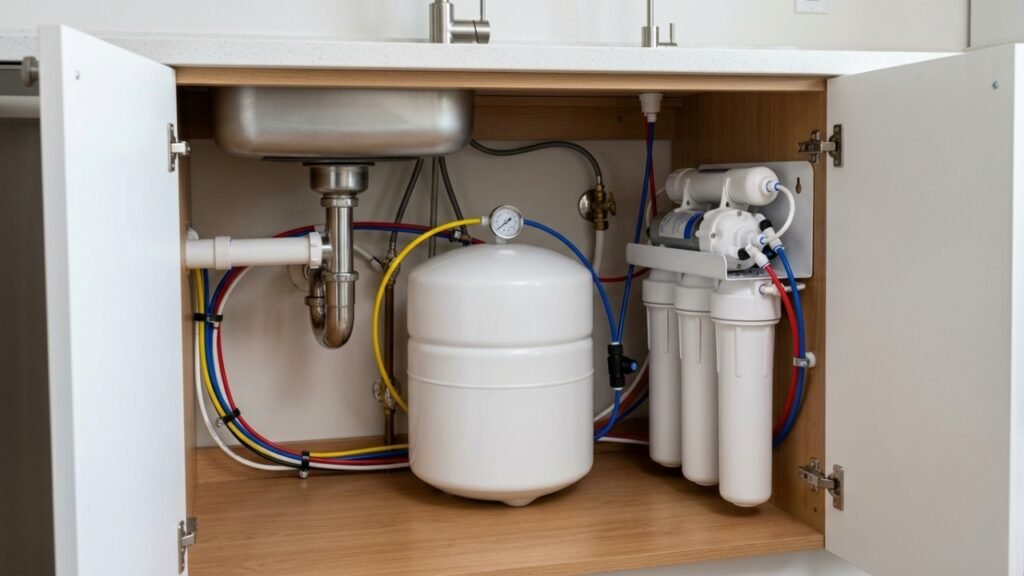
You press the tap on your RO water purifier. Water flows out instantly – cold, clean, and ready to drink. You fill a glass, a bottle, a cooking pot. No waiting. No delay.
That instant availability is something most people take completely for granted. And almost nobody stops to wonder – how does an RO system deliver water immediately, when the purification process itself is slow and continuous?
The answer is the RO water storage tank. It is one of the most important and most overlooked components in any RO water purification system – quietly doing its job behind the scenes, ensuring that purified water is always available on demand regardless of how fast or slow the RO membrane produces it.
Understanding your RO water tank – what it is, how it works, what types are available, what size you need, and how to maintain it properly – is essential for anyone who owns or is planning to buy an RO water purification system. Because a poorly chosen, incorrectly sized, or inadequately maintained storage tank undermines the performance of even the best RO system – resulting in slow water flow, low pressure, water shortages, bad taste, and bacterial contamination that defeats the entire purpose of purifying your water in the first place.
This complete guide by Bangalore Aqua covers everything you need to know about RO water tanks – from basic concepts to practical buying advice, troubleshooting, and maintenance – so you can make the right choice and get the best possible performance from your RO system.
Why Does an RO System Need a Storage Tank?
Before explaining what an best RO water tank is, it helps to understand why it exists – because the reason is rooted in a fundamental characteristic of RO purification technology.
An RO membrane purifies water slowly. A typical domestic RO membrane produces purified water at a rate of roughly 50–200 millilitres per minute – meaning it takes between 25 and 100 minutes to produce just one litre of purified water. This is the inherent nature of the reverse osmosis process – water must be forced through a semi-permeable membrane under pressure, and this cannot be rushed beyond the membrane’s rated flux without compromising rejection performance or damaging the membrane.
Now consider how water is actually used. When you open a tap to fill a glass, you expect 250 ml of water in about 5 seconds. When you fill a cooking pot, you need 2–3 litres in under a minute. This instantaneous demand – hundreds of millilitres per second at the tap – is completely incompatible with the slow, steady production rate of an RO membrane.
The solution is the storage tank. The RO system runs continuously – or runs automatically whenever the tank is below full – purifying water slowly and storing it in the tank. When you open the tap, you are not drawing water directly from the membrane. You are drawing from the pre-purified water stored in the tank – getting immediate, full-pressure water flow whenever you need it, while the system works quietly to refill the tank in the background.
Without a storage tank, an RO system would deliver a very slow trickle of water at the tap – completely impractical for real household or commercial use. The storage tank is what makes an RO system genuinely usable.
What Is an RO Water Tank?
An RO water tank – also called an RO storage tank or RO pressure tank in domestic systems – is a sealed vessel that stores purified water produced by the RO membrane, making it available for immediate on-demand dispensing at full flow rate and appropriate pressure.
In a domestic under-sink or countertop RO system, the storage tank is typically a pressurised vessel – pre-charged with air pressure – that uses a rubber bladder or diaphragm internally to separate the air charge from the stored water, allowing the pressurised air to push water out of the tank and through the tap at adequate flow rate and pressure when the tap is opened.
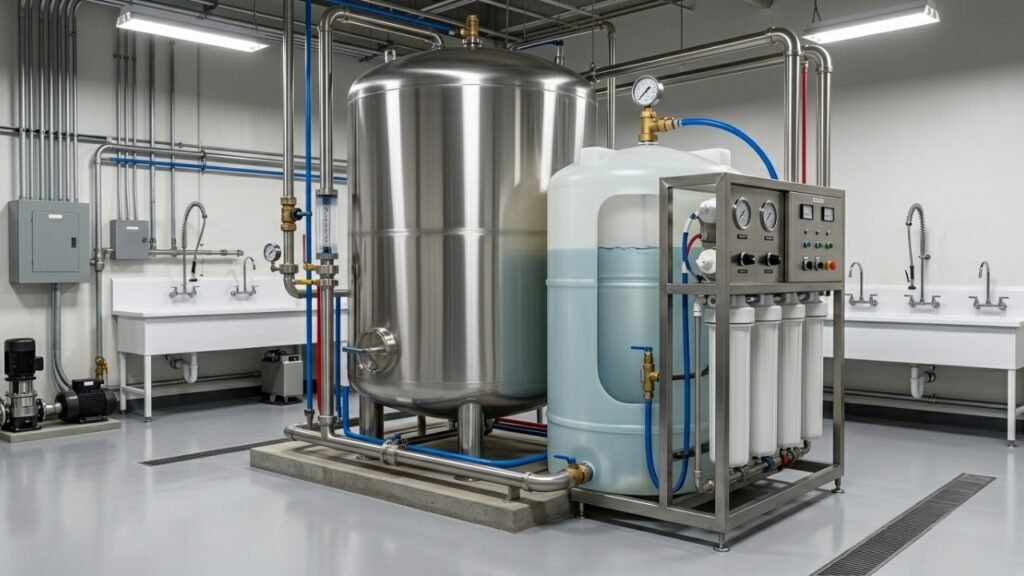
In commercial, institutional, and industrial RO systems, the storage tank is typically a larger, non-pressurised stainless steel or food-grade plastic overhead or ground-level tank – from which water is either gravity-fed or pump-fed to the distribution points as required.
The storage tank is not just a passive container. In pressurised domestic systems especially, it plays an active role in the hydraulic performance of the entire RO system – its pre-charge pressure, its bladder integrity, and its current fill level all directly affect the flow rate and pressure at the tap, and the frequency with which the RO system’s automatic shut-off valve cycles the membrane on and off.
Types of RO Water Tanks
There are two fundamental types of RO water storage tanks – pressurised tanks and non-pressurised tanks – and understanding the difference between them is essential for choosing the right solution for your application.

Type 1 – Pressurised RO Storage Tank
The pressurised RO storage tank is the standard storage solution for domestic and small commercial under-sink RO systems. It is a compact, sealed vessel – typically round or cylindrical in shape – that contains an internal rubber bladder or diaphragm that divides the tank into two chambers.
How the Internal Bladder Works
The upper or outer chamber of the tank is pre-charged with air at a specific pressure – typically 6–8 PSI (pounds per square inch) for a standard domestic tank. This air charge is introduced through a standard Schrader valve (similar to a bicycle tyre valve) on the tank’s exterior. The inner chamber – separated from the air charge by the rubber bladder – is where the purified RO water is stored.
As the RO system produces purified water, it is pushed into the inner bladder chamber under the membrane’s operating pressure – compressing the rubber bladder against the pre-charged air, which compresses as the water fills the tank. The stored water is now under pressure from the compressed air on the other side of the bladder.
When you open the RO tap, the compressed air in the outer chamber pushes against the bladder – which pushes the stored water out through the outlet port, through the post-filter, and out of the tap at good flow rate and pressure.
As water leaves the tank, the air pressure behind the bladder decreases – and when it drops to a certain level, the system’s automatic shut-off valve opens, allowing the RO membrane to resume producing and refilling the tank.
Key Characteristics of Pressurised Tanks
Fast, consistent water flow at the tap – the pressurised air delivery ensures good flow rate even as the tank approaches empty
Compact size – most domestic pressurised tanks hold 3–12 litres of usable water and fit neatly in the under-sink cabinet alongside the RO unit
Sealed, hygienic storage – the closed bladder design prevents any air contact with the stored water, protecting water quality between uses
Requires correct pre-charge pressure maintenance – if the air pre-charge pressure is too low or the bladder fails, flow rate and tank capacity are significantly compromised
Common Pressurised Tank Sizes in India
| Tank Size | Actual Usable Water | Typical Application |
| 3.2 Litre | 1.5 – 2 Litres | Very compact systems, low-use households |
| 6 Litre | 3 – 3.5 Litres | Standard domestic RO systems |
| 12 Litre | 6 – 7 Litres | High-use households, small offices |
| 20 Litre | 10 – 12 Litres | Small commercial, high-demand households |
Note that the rated size of a pressurised tank is the total internal volume – not the usable water capacity. Because the air pre-charge occupies approximately half the internal volume, a 6-litre rated tank typically delivers only 3–3.5 litres of usable water before the pressure drops too low for adequate tap flow. This is a crucial detail that many buyers overlook when selecting tank size.
Type 2 – Non-Pressurised RO Storage Tank
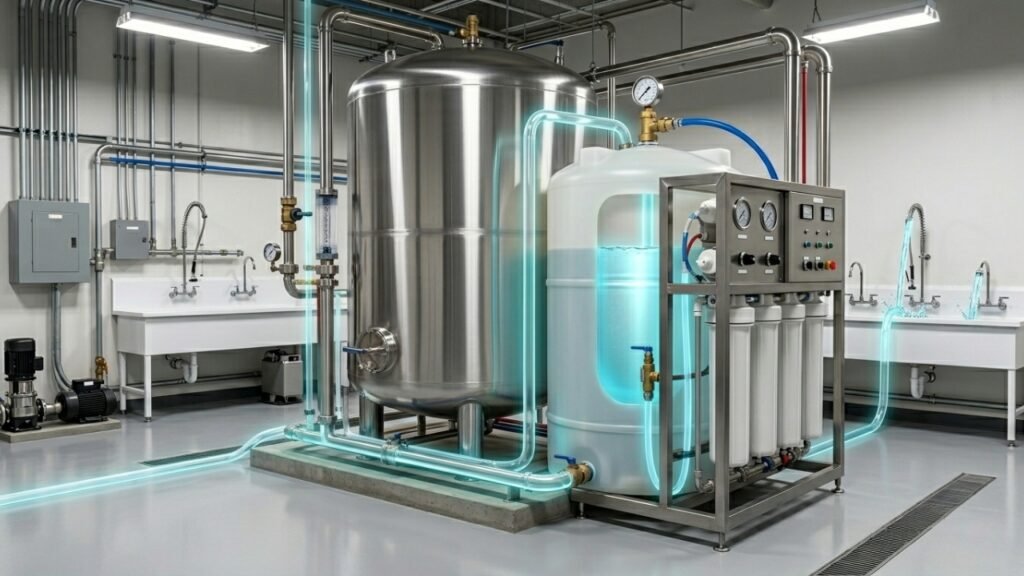
The non-pressurised Best RO storage tank is a straightforward, open-style storage vessel – typically made from food-grade polypropylene plastic or stainless steel – that stores purified water from the RO system without any internal pressure mechanism. Water flows into the tank by gravity or pump pressure from the RO unit, is stored at atmospheric pressure, and is dispensed either by gravity (in overhead installations) or through a booster pump.
How Non-Pressurised Tanks Work
In a non-pressurised system, the RO membrane produces purified water continuously and fills the storage tank. A float valve or electronic level sensor typically controls when the RO system runs – stopping production when the tank is full and resuming when water is drawn down to a certain level. Water is dispensed from the tank either by gravity feed (for tanks installed above the point of use) or through a dedicated dispensing pump that pressurises the water on demand.
Key Characteristics of Non-Pressurised Tanks
Available in large capacities – from 20 litres to several thousand litres, non-pressurised tanks can store much larger volumes of purified water than pressurised tanks – making them the practical choice for commercial, institutional, and industrial applications
Lower cost per litre of storage capacity – the simple construction of a non-pressurised tank makes larger storage volumes significantly more affordable than equivalent pressurised tank capacity
Food-grade SS or plastic construction – stainless steel tanks provide excellent hygiene and durability for larger commercial applications
Requires a booster pump for pressure dispensing – if gravity feed is not possible or adequate, a separate pump is required for distribution
Wider opening allows for easier cleaning – periodic manual cleaning of non-pressurised tanks is more straightforward than cleaning the sealed bladder of a pressurised tank
Common Applications for Non-Pressurised Tanks
Commercial water dispensers and water cooler systems, office water distribution, community water plants, hospitals and schools, industrial process water storage, and apartment complex centralised water treatment systems.
RO Storage Tank vs Overhead Tank – Key Differences
| Feature | RO Pressurised Storage Tank | Overhead / Non-Pressurised Tank |
| Pressure Mechanism | Internal pre-charged air bladder | Gravity or external pump |
| Typical Capacity | 3 – 20 litres | 20 litres – several thousand litres |
| Application | Domestic & small commercial under-sink systems | Commercial, industrial & community systems |
| Construction | Steel with rubber bladder | Food-grade plastic or stainless steel |
| Installation | Under-sink, compact | Overhead, ground level or dedicated room |
| Maintenance | Air pre-charge check, bladder inspection | Periodic manual cleaning |
| Cost | ₹500 – ₹3,000 (domestic sizes) | ₹3,000 – ₹50,000+ (depending on capacity) |
How an RO Water Tank Works – The Complete Process
Understanding the complete working process of a pressurised domestic RO storage tank gives you the context to diagnose problems, maintain the system correctly, and understand why proper pre-charge pressure matters so much.
Stage 1 – Filtration
Source water – from your tap, borewell, or municipal supply – first passes through the RO system’s pre-filtration stages: a sediment filter that removes suspended solids and a carbon filter that removes chlorine, chloramines, and organic compounds that would damage the RO membrane.
Stage 2 – RO Membrane Purification
Pre-treated water is pressurised by the system’s feed water pressure (or a booster pump in low-pressure systems) and forced through the RO membrane. The membrane rejects 95–99% of dissolved solids, heavy metals, bacteria, and viruses – allowing only pure water molecules through as permeate. The rejected contaminants are flushed away as a waste (reject) stream to drain.
Stage 3 – Storage in the Tank
The purified permeate water flows through the system’s check valve into the RO storage tank – entering the inner bladder chamber and compressing it against the pre-charged air in the outer chamber. The tank fills slowly – the RO membrane may take 2–4 hours to completely fill a 6-litre tank depending on the membrane’s production rate and the feed water pressure.
When the tank reaches approximately 2/3 of its capacity, the back-pressure from the compressed air inside the tank reaches a level that triggers the automatic shut-off valve (ASO valve) to close – cutting off feed water flow to the membrane and stopping the purification process until water is drawn from the tank.
Stage 4 – Dispensing
When you open the RO tap, the pressurised air in the outer chamber of the storage tank pushes against the rubber bladder – forcing stored purified water out through the tank’s outlet port, through the post-filter (typically an activated carbon polishing filter that improves taste), and out through the tap at good flow rate.
As water leaves and the air pressure behind the bladder drops, the ASO valve reopens and the RO system begins producing again – refilling the tank. In normal household use, the system cycles automatically throughout the day – producing water whenever the tank is below full, storing it, and making it instantly available at the tap whenever needed.
Benefits of an RO Storage Tank
Instant Water Availability at the Tap
Without a storage tank, an RO system would deliver a slow trickle at the tap – 50–200 ml per minute, far too slow for practical use. The storage tank makes instant, full-flow water delivery possible regardless of the membrane’s slow production rate. You get immediate water whenever you need it.
Maintains Consistent Water Pressure
The pre-charged air in a pressurised storage tank ensures that water is dispensed at consistent, adequate pressure throughout the dispensing cycle – giving you a good, steady flow from the first glass to the last before the tank needs to refill.
Reliable Backup Storage
The storage tank provides a buffer of purified water that remains available even if the water supply to your home is temporarily interrupted, the feed water pressure drops, or the RO system is temporarily switched off for maintenance. In Bangalore where water supply interruptions are common, having 3–10 litres of purified water stored and ready is a meaningful practical benefit.
Protects the RO Membrane
By allowing the RO system to run in longer, less frequent cycles – filling the tank completely rather than running continuously in response to every small water draw – the storage tank reduces the number of startup and shutdown cycles the membrane undergoes, extending its operational life.
Enables Automation
The storage tank is the enabling component for the automatic shut-off valve that makes modern RO systems self-managing. Without a storage tank creating the back-pressure that triggers the ASO valve, the system would run continuously – wasting water and wearing out the membrane unnecessarily.
Ideal RO Tank Size – Choosing the Right Capacity
Choosing the right tank size is one of the most practically important decisions in setting up your RO system. A tank that is too small means you frequently run out of purified water and have to wait for the system to refill. A tank that is excessively large means water sits in the tank for too long – increasing the risk of bacterial growth and stale taste.
| Use Type | Recommended Tank Size | Notes |
| Small Household (1–2 people) | 3 – 5 Litres | Compact, fits most under-sink spaces |
| Standard Household (3–5 people) | 6 – 10 Litres | Most common domestic choice |
| Large Household (6+ people) | 10 – 15 Litres | Ensures adequate supply during peak morning use |
| Small Office (10–20 people) | 20 – 50 Litres | Non-pressurised tank with booster pump |
| Medium Office / School | 50 – 100 Litres | Centralised storage with distribution |
| Large Commercial / Industrial | 100 Litres – several thousand Litres | Stainless steel tanks, dedicated pump system |
Important reminder: For pressurised tanks, the usable water capacity is approximately 40–50% of the rated tank size. A 6-litre rated tank delivers around 3 litres of usable water. Always factor this into your capacity calculations when selecting a domestic pressurised tank.
General Rule of Thumb for Households
Plan for approximately 2–3 litres of usable tank capacity per person in the household for comfortable daily use – accounting for peak morning demand when multiple people need water for drinking, cooking, and preparing beverages within a short window.
Common RO Water Tank Problems – And What Causes Them
Problem 1 – RO Tank Not Filling
This is one of the most frequently reported RO storage tank problems – and it has several possible causes:
Low feed water pressure – RO systems require a minimum feed water pressure (typically 40–80 PSI) to push water through the membrane and into the tank against the tank’s back-pressure. If your municipal or borewell supply pressure is low, the system cannot fill the tank effectively. Solution: Install a booster pump upstream of the RO unit.
Clogged pre-filters – Sediment and carbon pre-filters that are overdue for replacement reduce water flow through the system, slowing tank filling significantly. Solution: Replace pre-filters on schedule – typically every 3–6 months depending on water quality.
Faulty automatic shut-off valve (ASO valve) – If the ASO valve fails in the closed position, it prevents water from reaching the membrane regardless of tank fill level. Solution: Test and replace the ASO valve.
Degraded RO membrane – An old or fouled RO membrane with significantly reduced flux produces water very slowly – making the tank take an impractically long time to fill. Solution: Replace the membrane – typically every 1–2 years depending on water quality and usage.
Incorrect pre-charge pressure – If the air pre-charge pressure in the tank is too high – above the recommended 6–8 PSI – it creates excessive back-pressure that makes the ASO valve trigger prematurely, shutting off the system before the tank is actually full. Solution: Check and correct the pre-charge pressure with a tyre pressure gauge.
Problem 2 – Low Water Pressure at the Tap
Weak, slow water flow at the RO tap despite the tank appearing to have water in it is almost always a pre-charge pressure problem.
Low or zero pre-charge pressure – If the air pre-charge in the outer chamber of the pressurised tank has leaked out – through a faulty Schrader valve or a pinhole in the tank shell – there is no air pressure to push water out of the bladder. The tank may be full of water but delivers it at virtually no pressure. Solution: Check the Schrader valve, inflate to the correct pre-charge pressure (6–8 PSI with an empty tank), and recheck. If pressure will not hold, the valve or tank shell needs replacement.
Failed or punctured rubber bladder – If the internal rubber bladder has developed a tear or puncture, water and air mix inside the tank – eliminating the pressurisation mechanism. A key indicator is water coming out of the Schrader valve when you press it with the tank connected. Solution: Replace the tank – bladder replacement is generally not practical for standard domestic tanks.
Clogged post-filter – An overdue activated carbon post-filter significantly restricts water flow at the tap even if tank pressure is normal. Solution: Replace the post-filter – typically every 6–12 months.
Problem 3 – Bad Smell or Taste in RO Water
Unpleasant smell or taste in purified water stored in the RO tank is almost always caused by one of three things:
Bacterial contamination in the tank – If the tank has not been sanitised periodically, bacteria can colonise the rubber bladder and tank interior – producing biofilm and off-odours that contaminate the stored water. This is particularly common in systems that are left unused for extended periods. Solution: Sanitise the complete RO system including the storage tank – see the maintenance section below.
Overdue post-filter – An activated carbon post-filter that has exceeded its service life stops removing taste and odour compounds and can actually begin releasing accumulated organic material back into the water. Solution: Replace the post-filter immediately.
New tank smell – New rubber bladder tanks sometimes impart a slight rubber or plastic taste to the first few tank-fulls of water. Solution: Flush the system completely 2–3 times before drinking the water from a newly installed or replaced tank.
RO Water Tank Maintenance – Complete Guide
Proper maintenance of your RO storage tank is essential for water quality, system performance, and the longevity of your RO system. Here is everything you need to do and how often:
Regular Tank Cleaning – Every 6–12 Months
Why it matters: Even with an RO system producing high-purity water, the interior of the storage tank can accumulate bacterial biofilm over time – particularly if water sits in the tank for extended periods without regular turnover. Periodic sanitisation prevents bacterial contamination and maintains the taste quality of your purified water.
How to clean a pressurised RO storage tank:
Step 1 – Turn off the feed water supply to the RO system and open the RO tap to drain all water from the tank completely.
Step 2 – Close the RO tap once the tank is empty. Disconnect the tank from the system by removing the fitting on the tank’s water port.
Step 3 – Prepare a sanitising solution – mix 1 teaspoon of food-grade hydrogen peroxide (3% concentration) or unscented household bleach in approximately 500 ml of clean water.
Step 4 – Inject the sanitising solution into the water port of the tank using a small funnel or syringe. Shake the tank gently to coat the interior bladder surface.
Step 5 – Leave the solution in the tank for 30 minutes to 1 hour.
Step 6 – Drain the sanitising solution completely, reconnect the tank, restore feed water supply, and allow the system to fill the tank completely.
Step 7 – Flush the first full tank of water to drain – do not drink it. The second tank-fill is safe for consumption.
Air Pre-Charge Pressure Check – Every 6 Months
Checking and maintaining the correct air pre-charge pressure in your pressurised storage tank is the single most impactful maintenance action for preserving good water flow and tank performance – and it takes less than five minutes.
How to check pre-charge pressure:
Step 1 – Turn off the feed water supply and open the RO tap to drain all water from the tank completely. It is essential that the tank is empty of water before checking pre-charge pressure – otherwise the water pressure in the bladder will give you a false reading.
Step 2 – Locate the Schrader valve on the tank – typically on the side or bottom, protected by a small plastic cap.
Step 3 – Use a standard tyre pressure gauge to check the pre-charge pressure. The correct pre-charge pressure for most domestic pressurised RO tanks is 6–8 PSI.
Step 4 – If the pressure is below 6 PSI, inflate the tank using a bicycle pump or compressor to bring it to 7 PSI. Do not over-inflate above 8 PSI.
Step 5 – Restore feed water supply and allow the system to refill normally.
Pre-Filter and Post-Filter Replacement – Every 3–6 Months
Your RO system’s pre-filters (sediment and carbon) and post-filter (carbon polishing filter) directly affect both water quality and system performance – including tank filling speed. Overdue filters restrict flow, stress the membrane, and compromise the taste and safety of your purified water.
Replacement schedule for Bangalore water conditions:
Sediment pre-filter – every 3 months (Bangalore borewell water is particularly heavy on sediment)
Activated carbon pre-filter – every 3–6 months
Post-carbon polishing filter – every 6–12 months
RO membrane – every 1–2 years depending on feed water TDS and usage volume
Regular water purifier maintenance on schedule is the most cost-effective way to maintain water quality, preserve membrane life, and avoid the far more expensive repairs that neglected systems eventually require.

Complete System Sanitisation After Extended Non-Use
If your RO system has been switched off or unused for more than 2–3 weeks – during travel, seasonal closure, or any extended absence – sanitise the complete system including the storage tank before resuming use. Stagnant water in an unused system provides ideal conditions for bacterial growth, and the first water drawn after extended non-use should always be flushed to drain rather than consumed.
RO Water Tank Price in India – What to Expect
| Tank Type | Capacity | Price Range | Notes |
| Pressurised RO Tank (Plastic) | 3.2 Litre | ₹400 – ₹800 | Standard domestic entry level |
| Pressurised RO Tank (Steel) | 6 Litre | ₹700 – ₹1,500 | Most common domestic size |
| Pressurised RO Tank (Steel) | 12 Litre | ₹1,200 – ₹2,500 | High-demand household |
| Pressurised RO Tank (Steel) | 20 Litre | ₹2,000 – ₹4,000 | Small office / high-use home |
| Non-Pressurised Food-Grade Plastic | 20 – 50 Litre | ₹1,500 – ₹5,000 | Commercial use |
| Stainless Steel Storage Tank | 100 – 500 Litre | ₹8,000 – ₹30,000+ | Commercial / industrial |
| Stainless Steel Storage Tank | 1000 Litre+ | ₹20,000 – ₹80,000+ | Industrial / community |
Prices vary based on material quality, brand, and supplier. Always purchase from a reputable supplier – low-cost tanks with poor-quality rubber bladders or non-food-grade materials compromise water quality and fail prematurely.
How to Choose the Right RO Water Tank – Buying Checklist
Choosing the right RO storage tank involves matching several key parameters to your specific application. Here is a practical checklist:
Determine your daily purified water consumption – Count the number of people in your household or workplace and estimate daily drinking water usage (approximately 3–5 litres per person per day for drinking and cooking).
Choose the right capacity – Select a tank size that provides at least your peak demand volume as usable capacity – remembering that usable capacity in a pressurised tank is approximately half the rated volume.
Match the tank to your RO system type – Domestic under-sink RO systems use pressurised tanks. Commercial and industrial systems use non-pressurised tanks with pumped distribution.
Choose appropriate material – Steel-bodied pressurised tanks are more durable and longer-lasting than plastic-bodied versions. For larger commercial storage, food-grade stainless steel is the premium choice.
Check the tank’s rated working pressure – Ensure the tank’s rated working pressure is compatible with your RO system’s operating pressure.
Verify food-grade certification – All water contact materials – including the rubber bladder in pressurised tanks – should be food-grade and certified safe for potable water storage.
Buy from a reputable supplier with after-sales support – A tank that fails within a year is not a saving. Choose a supplier who stands behind the products they sell and provides maintenance support.
Conclusion – Your RO Tank Is More Important Than You Think
The RO water storage tank is not a passive accessory – it is an active, critical component of your entire water purification system. It is the component that transforms a slow, continuous purification process into an instant, on-demand water supply. It is the component that maintains the pressure that makes your RO tap usable. And it is the component that, when neglected, becomes the weakest link that undermines your water quality regardless of how good the rest of your system is.
Choosing the right tank for your application – the right type, the right capacity, the right material – is as important as choosing the right RO system. And maintaining it correctly – regular cleaning, air pressure checks, timely filter replacement – is as important as the initial purchase decision.
Whether you are setting up a new RO system for your home, upgrading your office water supply, or designing a large-scale commercial water treatment solution, Bangalore Aqua has the expertise, the product range, and the after-sales support to help you choose, install, and maintain the right solution – including the right storage tank – for your specific needs across Bangalore and Karnataka.
📞 Call / WhatsApp: +91 76763 93939 | +91 97387 04753
📧 Email: info@bangaloreaqua.com
🌐 Visit: bangaloreaqua.com
Karnataka’s No. 1 Water Treatment Company – supplying, installing and maintaining RO systems, storage tanks and complete water treatment solutions for homes, offices, industries and communities since 2021.