The 2am Emergency That Every Restaurant Owner in Bangalore Has Faced
The dinner service has just wrapped. It is 10:30 on a Friday night. The chef is doing the final clean-down of the kitchen. And then the catering manager notices that the commercial RO plant’s output TDS display – normally reading a steady 55 mg/L – is now showing 340 mg/L.
The UV lamp failure indicator is also on. Has been on, probably, for the past few days. No one checked.
Tomorrow morning at 7am, the restaurant opens for breakfast. The wedding event they have been booked for starts at noon. Four hundred people. And right now, the water purification system that every element of Saturday’s service depends on is effectively offline – producing water that is neither safe nor fit for the high-standard cooking the restaurant is known for.
The catering manager starts calling the original RO plant installer. No answer. Calls the nearest water purifier service shop listed on Google Maps. Closed. Calls another. Closed. Eventually finds one that opens at 9am.
By 9am Saturday, the restaurant has already received its first delivery of 20-litre water jars – at ₹70 per jar, with a dozen required just for the morning – and the chef has had to modify the cooking plan for the wedding lunch around the water supply gap.
The UV lamp that caused this crisis? It costs ₹400–₹800. It needed replacing approximately ten months ago. The cartridge pre-filter that should have been replaced three months earlier – which allowed turbidity to build up on the membrane, causing the TDS spike – costs ₹120–₹200.
This scenario plays out, with variations, in restaurants, hotels, corporate offices, clinics, and commercial facilities across Bengaluru every week. The equipment is not faulty. The solution is not complicated. The problem is simple: the right spare parts were not available, were not replaced on schedule, and there was no reliable local supplier to call when it mattered.
This guide is the complete resource for every commercial RO plant owner in Bangalore – restaurant operator, hotel facilities manager, office building manager, school principal, clinic administrator – who wants to understand every spare part their system needs, when to replace it, which brands to specify, and where in Bangalore to source genuine parts fast when you need them.
Why Commercial RO Spare Parts Management Is Different From Domestic
A domestic RO unit in a family kitchen serves 4–6 people, runs 2–3 hours a day, and produces 40–80 litres of purified water. When it needs a filter replacement, the family drinks bottled water for a day or two.
A commercial RO plant – serving a restaurant, a hotel kitchen, a corporate office canteen, a clinic, or a school – is a different beast entirely. It might produce 500–2,000 litres of water per day. It may run 8–12 hours continuously. It serves 100–500 people who depend on its output for cooking, drinking, equipment operation, and in some cases regulatory compliance.
<cite index=”35-1″>Commercial RO plant spare parts are manufactured and supplied in stringent compliance with industrial quality standards. The sediment pre-filter removes suspended particles and protects the RO membrane from clogging. The activated carbon filter adsorbs chlorine, organic compounds, bad taste, and odour. The RO membrane is the core component that filters dissolved salts, heavy metals, bacteria, and viruses – and requires regular replacement to maintain water quality and efficiency.</cite>
When a commercial RO plant’s key components fail unexpectedly – because replacement was deferred or sourced from unreliable channels – the consequences are not a household inconvenience. They are a business continuity event. And in Bengaluru’s competitive commercial landscape, a business continuity event caused by a ₹500 filter cartridge is an entirely avoidable failure.
The Complete Commercial RO Plant Spare Parts Catalogue
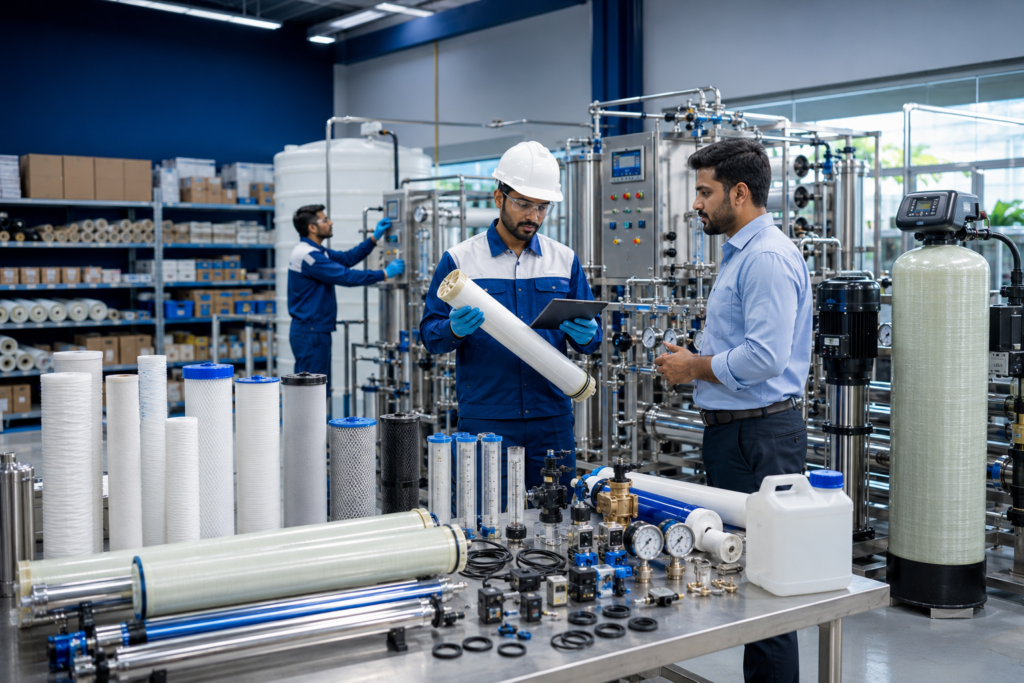
Every commercial RO plant – from a 100 LPH system in a small cafe to a 2,000 LPH system in a large hotel – uses the same fundamental components. Here is every spare part you need to know about, organised by replacement priority.
Tier 1: High-Frequency Consumables (Replace Every 3–6 Months)
These are the parts that need the most regular attention. Neglecting them does not just reduce water quality – it accelerates damage to the more expensive components downstream.
Sediment Pre-Filter Cartridges (5 Micron and 1 Micron)
What they do: The 5-micron cartridge is the first line of defence – it traps sand, silt, rust flakes, suspended solids, and physical particulate matter above 5 micrometres. The finer 1-micron cartridge downstream catches colloidal particles and very fine silt that passed the 5-micron stage.
Why they matter: These cartridges protect the activated carbon filter media and – critically – the RO membrane from physical fouling. A blocked 5-micron cartridge starves the system of feed water, forcing the high-pressure pump to work harder against resistance. A 1-micron cartridge that is not replaced causes colloidal fouling of the membrane surface – one of the most common causes of premature membrane performance decline.
Replacement interval: Every 3–4 months for commercial plants in Bengaluru’s borewell water context (higher turbidity borewell sources may require 2-month cycles). Monitor differential pressure across the cartridge housing – replace when dP exceeds 0.5 bar above baseline.
Specifications for commercial plants:
- Size: 10-inch or 20-inch length (20-inch preferred for commercial plants – higher capacity)
- Material: Polypropylene spun fibre (PP Spun) – avoid cellulose fibre for borewell water
- Rating: 5 micron nominal (pre-filter) and 1 micron nominal (post-sediment)
- Housing: Transparent filter housing (for visual inspection of cartridge loading) or opaque FRP housing
Price range in Bangalore (2026):
- Standard 10-inch PP spun cartridge: ₹80–₹150 each
- 20-inch PP spun cartridge (commercial): ₹150–₹280 each
- Pleated polyester cartridge (longer life, higher flow): ₹250–₹500 each
Activated Carbon Filter Cartridges / Media
What they do: Activated carbon adsorbs chlorine, chloramines, dissolved organic compounds, pesticide traces, taste compounds, and odour-causing substances. For BWSSB-connected commercial properties in Bangalore, chlorine removal is the critical function – residual chlorine from municipal treatment destroys RO membrane polymer through oxidative degradation.
Why they matter: A failed or exhausted carbon filter allows chlorine to reach the RO membrane – causing irreversible degradation of the membrane’s thin-film composite layer within weeks. The carbon filter is the cheapest protection for the most expensive component. Never defer carbon replacement.
Replacement interval: Every 6–12 months depending on source water chlorine concentration and daily run time. If your source includes BWSSB supply (which carries residual chlorine), lean toward 6-month replacement cycles.
Specifications for commercial plants:
- Granular Activated Carbon (GAC) block: 20-inch carbon block preferred for commercial – provides longer contact time than GAC loose media
- Iodine number: Minimum 900 mg/g (indicator of carbon activity) – verify specification with supplier
- Coconut shell carbon: Superior adsorption performance vs coal-based carbon
Price range in Bangalore (2026):
- 10-inch carbon block cartridge: ₹150–₹300
- 20-inch carbon block (commercial): ₹280–₹600
- Granular carbon media (per kg, for bulk carbon filter housings): ₹80–₹150/kg
Tier 2: Annual Replacement Components
These components have longer service lives but require annual replacement to maintain system performance and safety.
UV Lamp (Ultra-Violet Germicidal Lamp)
What it does: The UV lamp emits radiation at 254 nm wavelength – the germicidal wavelength that destroys the DNA of bacteria, viruses, and other microorganisms, preventing their reproduction and rendering them biologically inactive.
The critical misconception: UV lamps do not simply stop working when they are exhausted. They dim gradually – and they continue to produce visible light long after their germicidal intensity has fallen below the effective threshold. A UV lamp that looks bright and appears to be functioning may be delivering UV doses too low to achieve effective disinfection.
Most commercial UV lamps are rated for 8,000–9,000 hours of effective germicidal output. At 10 hours of daily operation, this equals approximately 800–900 days – or about 2.5 years. However, lamp degradation is not linear – intensity drops more steeply in the second half of lamp life. Annual replacement is strongly recommended regardless of apparent lamp function.
<cite index=”39-1″>UV lamps are used in UV-based water purifiers to kill harmful microorganisms, including bacteria and viruses. The lamp must be replaced on schedule regardless of visual appearance – a lamp that looks bright may no longer be producing effective germicidal doses.</cite>
Replacement interval: Every 12 months – annual replacement is the standard for all commercial and industrial water treatment installations.
Specifications:
- Wavelength: 254 nm (germicidal UV-C)
- Power: 11W (small commercial), 25W, 55W, 75W (larger commercial)
- Common brands available in Bangalore: Philips (most widely available, high quality), Starlite, Elga, Trojan (premium commercial)
- Connector type: Must match existing UV reactor (2-pin, 4-pin, or single-pin configuration – verify before ordering)
Price range in Bangalore (2026):
- 11W UV lamp (residential/light commercial): ₹350–₹600
- 25W commercial UV lamp: ₹700–₹1,200
- 55W commercial UV lamp: ₹1,200–₹2,000
- 75W industrial UV lamp: ₹1,800–₹3,000
Bangalore Aqua stocks UV lamps for all common commercial configurations. Visit the RO water plant service Bangalore page or contact Bangalore Aqua directly for same-day supply of UV lamps for your specific reactor configuration.
Post-Carbon Polish Cartridge / Mineralisation Cartridge
What they do: The post-carbon polishing filter removes any residual taste or organic compounds from the purified permeate – improving palatability. The mineralisation cartridge (calcite or mineral blend) restores a small quantity of calcium, magnesium, and bicarbonate minerals to the RO-treated water, raising pH from the naturally acidic 5.5–6.5 of pure RO output back to a healthy 7.0–7.5.
Replacement interval: Every 12 months for post-carbon polish. Every 6–12 months for mineralisation cartridge depending on daily production volume.
Price range in Bangalore (2026):
- Post-carbon 10-inch block: ₹150–₹300
- Mineralisation cartridge: ₹250–₹600
Tier 3: Medium-Cycle Replacement Parts (2–3 Years)
RO Membrane Elements – The Most Critical and Most Expensive Spare Part
What they do: The RO membrane is the technological heart of your purification system. A spiral-wound semi-permeable membrane with 0.0001-micron pores rejects dissolved solids – TDS, heavy metals, fluoride, nitrates, bacteria, viruses – at 95–99% efficiency while allowing water molecules to pass.
Why this is the most important spare part decision you make:
<cite index=”38-1″>Investing in the right RO membrane is crucial for maintaining the efficiency and longevity of your reverse osmosis system. Premium membranes from established manufacturers deliver significantly higher and more consistent rejection rates than unbranded alternatives. Every component matters.</cite>
In Bangalore’s high-TDS borewell water environment – with source water typically ranging from 600–1,500 mg/L – the RO membrane works harder than in lower-TDS regions. Combined with Bangalore’s very high hardness (which causes scaling without proper pre-treatment), membrane life can be dramatically shorter than the manufacturer’s rated 3–5 years if the system is not properly maintained.
When to replace the membrane:
- Permeate TDS rises above specification (typically more than 20% above baseline commissioning reading)
- Normalised permeate flow has dropped more than 15% from commissioning baseline
- Salt rejection has declined below 90% (calculated from inlet TDS and permeate TDS)
- The system requires increasingly high feed pressure to maintain output flow
Membrane brands and specifications for commercial plants:
4040 Membranes (4-inch diameter, 40-inch length): Standard configuration for commercial plants producing 100–2,000 LPH depending on the number of elements in series and parallel.
| Brand | Permeate Flow | Salt Rejection | Bangalore Price Range |
| Dow FilmTec BW30-4040 | 9.1 m³/day | 99.5% | ₹8,000–₹12,000 |
| Toray TMH10-D | 9.1 m³/day | 99.5% | ₹7,500–₹11,000 |
| Hydranautics ESPA2-4040 | 8.5 m³/day | 99.3% | ₹7,000–₹10,500 |
| Koch/Nitto | 9.0 m³/day | 99.3% | ₹7,500–₹11,000 |
8040 Membranes (8-inch diameter, 40-inch length): For larger commercial plants producing 500 LPH or more per membrane element, or industrial systems. Significantly higher output per element but requires matched high-pressure pumping.
Important caution on unbranded membranes: The Bangalore spare parts market includes membranes from unbranded Chinese manufacturers at significantly lower prices (₹3,000–₹5,000 per element). These may deliver adequate performance initially but typically show 30–40% faster degradation in rejection efficiency. For a commercial food service or healthcare application, using unbranded membranes creates a regulatory compliance risk and a customer health risk. Bangalore Aqua supplies and recommends only membranes from verified global manufacturers.
Contact Bangalore Aqua’s commercial RO parts dealers service for membrane sourcing and supply.
High-Pressure Pump Components and Spare Parts
What they do: The high-pressure pump creates the pressure (typically 8–15 bar for commercial brackish water applications) needed to force pre-treated water through the RO membrane. It is the highest-energy, highest-mechanical-stress component in the system.
Common failure modes and their spare parts:
Mechanical seal failure: The most common commercial pump failure. The mechanical seal prevents water from leaking along the pump shaft. When it wears, water escapes at the shaft – visible as leaking at the pump body. Early symptoms: slight wetness around pump shaft. Late symptom: significant leakage and pressure loss.
Mechanical seal replacement is a skilled task requiring disassembly of the pump front plate. Bangalore Aqua’s service team provides this as part of their AMC services.
Price range: ₹500–₹2,500 depending on pump model and seal specification.
Impeller wear: Over years of operation, the pump impeller wears at vane edges, reducing efficiency. Symptom: rising power consumption at the same flow rate. Usually addressed during pump overhaul or at pump end-of-life.
Pump brands commonly used in Bangalore commercial plants:
- CRI (Coimbatore, India) – most widely used in Bangalore commercial systems; excellent spare parts availability locally
- Grundfos CM/CR series – premium European quality; spare parts available through Grundfos network
- Taro (India) – competitive pricing, reasonable quality for light commercial duty
- Kirloskar – industrial brand with good Bangalore presence
Bearing replacement: Pump motor bearings typically last 15,000–20,000+ hours with proper lubrication. In continuous-duty commercial applications, bearing inspection and replacement is typically a 3–5 year activity.
Bangalore Aqua’s industrial RO spare parts Bangalore page covers industrial-scale pump components for larger systems.
FRP Pressure Vessels (Membrane Housings)
What they do: The FRP (Fibre Reinforced Plastic) pressure vessel is the tube that houses the RO membrane element under operating pressure (typically 8–15 bar for commercial applications). The vessel is designed to contain the pressurised feed water and physically support the membrane element while separating feed, permeate, and reject streams.
When to replace: FRP pressure vessels are designed to last the life of the system – 10–15 years – under normal operating conditions. Early replacement is required when:
- Visible fibre delamination or cracking on the vessel exterior
- Internal corrosion or blistering (rare with quality vessels, more common with cheap alternatives exposed to aggressive feed chemistry)
- End cap thread damage that prevents reliable sealing
- Physical impact damage
<cite index=”34-1″>FRP pressure vessels are available in multiple diameters – 4-inch and 12-inch configurations for different membrane element sizes. They are manufactured for use in both residential and industrial RO applications and should be sourced from quality manufacturers to ensure rated pressure tolerance.</cite>
Specifications for Bangalore commercial plants:
- 4040 configuration (4-inch diameter): For standard commercial plants with 4040 membrane elements
- 8040 configuration (8-inch diameter): For larger commercial and industrial plants
- Pressure rating: Minimum 300 psi (21 bar) for commercial applications – provides adequate safety margin above typical operating pressure of 120–200 psi
Price range in Bangalore (2026):
- 4-inch FRP single-element vessel: ₹2,500–₹5,000
- 4-inch FRP multi-element vessel (2–3 elements): ₹5,000–₹10,000
- 8-inch FRP vessel: ₹15,000–₹35,000
Tier 4: On-Condition Replacement Parts
These components are replaced when inspection or measured performance indicates need – not on a fixed schedule.
O-Rings and Gaskets
What they do: O-rings are the seals between membrane elements within a pressure vessel, between membrane housing end caps and the vessel body, between filter housing bowls and heads, and at all other fluid connections in the system. They prevent bypass of feed water around the membrane and leakage at connection points.
Why they matter for performance: An O-ring bypass between membrane elements is a major water quality failure mode that is not immediately visible. If the interconnector O-ring between two membrane elements fails, feed water bypasses the membrane and mixes directly with permeate – causing permeate TDS to spike dramatically. This can mimic a membrane failure and lead to unnecessary membrane replacement if not properly diagnosed.
When to replace: During any membrane replacement (interconnector and brine seal O-rings should always be replaced whenever membranes are changed). At any filter housing maintenance event. During annual service inspection when O-rings show visible wear, cracking, or deformation.
Material: EPDM (Ethylene Propylene Diene Monomer) for most commercial water applications. Buna-N (nitrile) where oil contamination is a risk. Silicone for high-temperature applications.
Price range in Bangalore: ₹20–₹200 per O-ring depending on size and material.
Solenoid Valves
What they do: Solenoid valves control automatic flow in the RO system – the feed inlet valve that opens when the system starts and closes on tank-full or low-pressure shutdown, the flush valve that initiates automatic membrane flushing cycles, and in some configurations the product water shut-off valve.
Failure modes: Solenoid coil burnout (electrical failure – valve stays open or closed regardless of signal), valve body wear (internal leak allowing flow without signal), solenoid plunger sticking (valve fails to open or close).
Price range in Bangalore (2026):
- 24V DC solenoid valve (most common for commercial RO): ₹400–₹1,200 depending on diameter and quality
- 230V AC solenoid valve: ₹600–₹1,500
Pressure Gauges
What they do: Pressure gauges at the inlet, inter-stage (between pre-treatment and membrane), and outlet positions allow the operator to verify that the system is operating at the correct pressure and to identify developing problems. A rising inter-stage pressure indicates pre-filter blockage. A falling feed pressure indicates pump wear or supply issues.
Replacement: When a pressure gauge shows erratic or clearly incorrect readings, or when the gauge face is water-damaged, cracked, or unreadable.
Price range in Bangalore: ₹200–₹600 per gauge (glycerine-filled gauges are preferred for commercial applications – they absorb vibration and extend gauge life).
Flow Restrictors and Flow Meters
What they do: The flow restrictor on the reject water outlet controls the system’s recovery ratio – the proportion of feed water converted to purified permeate. A blocked or incorrectly sized flow restrictor causes either too-high recovery (elevated permeate TDS) or too-low recovery (wasted water). Flow meters on the permeate outlet confirm daily production volumes.
Replacement: Flow restrictors should be inspected at every AMC visit and replaced if blocked or corroded. Flow meter calibration should be verified annually.
Price range in Bangalore:
- Flow restrictor (capillary type): ₹150–₹400
- In-line flow meter: ₹500–₹2,000
Anti-Scalant Chemicals: The Consumable Everyone Forgets
Anti-scalant chemical is one of the most important consumables in a commercial RO plant – and one of the most frequently neglected. The anti-scalant dosing system injects a small, precisely metered quantity of scale-inhibiting chemical into the feed water before the high-pressure pump.
In Bangalore’s high-hardness borewell water environment – where hardness can reach 400–700 mg/L as CaCO₃ in many commercial properties – anti-scalant is the first line of defence against carbonate scaling on the RO membrane. When the dosing tank runs dry, scaling begins within days. When scaling is allowed to continue for weeks, the membrane requires aggressive chemical cleaning – and may be permanently damaged.
What to look for:
- SHMP (Sodium Hexametaphosphate) – the most basic anti-scalant, effective for moderate hardness
- Polymer-based anti-scalants (polyacrylic acid, polymaleic acid blends) – more effective for very high hardness and for silica-containing waters (present in some Bangalore area borewells)
- Ensure the anti-scalant is compatible with your source water chemistry – wrong anti-scalant chemistry can accelerate fouling rather than prevent it
Price range in Bangalore: ₹500–₹1,500 per litre (concentration determines actual cost per volume treated – follow manufacturer dosing instructions).
Bangalore Aqua supplies anti-scalant chemicals suitable for Bangalore’s specific borewell water chemistry as part of their commercial RO parts and AMC service portfolio.
TDS Meters and Monitoring Equipment
An inline TDS meter or conductivity probe at the permeate outlet is the most important process monitoring tool in a commercial RO plant. It provides instant, continuous verification that the membrane is performing within specification.
Types available:
Inline TDS display units: Permanently mounted probe in the permeate line with digital display on the control panel. Provides continuous reading. Essential for any commercial plant. Price range in Bangalore: ₹500–₹2,000 for the display unit; ₹200–₹600 for replacement probes.
Handheld TDS meters: For spot-checking at multiple points in the system – inlet, permeate, reject. Essential for the facility manager’s monthly monitoring. Price range: ₹200–₹800 for a quality meter (HM Digital and similar brands).
Two-point TDS display systems: Simultaneously display inlet and permeate TDS, calculating rejection percentage in real time. Most useful for high-throughput commercial systems where water quality consistency is a priority.
Calibration: TDS meters should be calibrated against a known standard solution annually and whenever readings appear inconsistent with the system’s expected performance.
Water Softener Spare Parts for Pre-Treatment Systems
Many Bangalore commercial RO plants include a water softener in the pre-treatment train – essential in a high-hardness borewell environment. The softener has its own spare parts requirements.
Softener Resin
The ion exchange resin is the functional heart of the water softener. Quality resin from reputable manufacturers (Purolite, Dowex, Thermax) has a typical lifespan of 7–10 years with proper maintenance. However, resin can be permanently damaged by:
- Iron fouling (iron from borewell water irreversibly coats resin beads)
- Chlorine oxidation (chlorine degrades the resin polymer – confirm carbon filter is working before it reaches the softener if BWSSB supply is involved)
- Silica fouling (high silica in some Karnataka groundwater)
Signs of resin exhaustion or fouling: Hardness in the treated water even immediately after regeneration. Declining softening capacity (more frequent regeneration cycles required at the same flow rate).
Price range in Bangalore: Quality resin: ₹800–₹2,000 per litre (typical commercial softener requires 30–100 litres of resin). Contact Bangalore Aqua for resin sourcing – they can verify resin specification against your softener’s design.
Softener Control Valve
Automatic water softeners use a multi-port control valve to cycle through service, backwash, brine draw, slow rinse, and fast rinse phases. Valve failure is the most common cause of softener malfunction.
Common brands in Bangalore: Fleck (US), Clack (US), Runxin (China – widely available at lower price). Fleck and Clack valves have significantly better longevity and spare parts availability for repair versus Runxin.
Price range in Bangalore: Fleck 5600 series valve assembly: ₹5,000–₹12,000. Runxin equivalent: ₹2,000–₹5,000.
Brine Tank Components
The brine (salt) tank that holds the regeneration salt requires occasional maintenance: an injector and venturi assembly that draws brine from the tank into the resin vessel during regeneration. These small components are frequently the cause of softener regeneration failures.
Price range in Bangalore: Injector/venturi assembly: ₹300–₹800. Float valve for brine tank water level control: ₹200–₹600.
Why Buying Genuine Spare Parts Matters More for Commercial Plants
The temptation in the commercial spare parts market is to optimise on price – buying the cheapest cartridge, the unbranded membrane, the lowest-cost UV lamp. For a domestic system, this is a manageable risk. For a commercial system, it is a false economy with real consequences.
The membrane false economy: An unbranded 4040 membrane at ₹3,500 versus a Dow FilmTec at ₹10,000 seems like a straightforward saving. But if the unbranded membrane degrades to below 90% rejection in 18 months rather than maintaining 99%+ rejection for 36–48 months, the effective membrane cost per litre of compliant purified water is higher – not lower – with the cheaper option. Plus the compliance risk during the period when the membrane is delivering non-compliant output.
The UV lamp false economy: A generic UV lamp at ₹200 versus a Philips lamp at ₹600 again appears to be a saving. But if the generic lamp reaches sub-germicidal intensity at 5 months rather than the rated 12 months, or if the wavelength peak is not accurately at 254 nm, the lamp is not providing the biological safety it is supposed to provide – while the indicator light continues to show it as “working.”
For food service businesses subject to FSSAI inspection, healthcare facilities subject to NABH standards, and pharmaceutical or food manufacturing operations – the quality of spare parts in their water treatment system is a regulatory compliance question, not just a performance question. Using verified, branded components is the only defensible position in a compliance inspection.
Common Spare Parts Failures and Their Warning Signs
Understanding the early warning signs of component failure allows commercial plant operators to replace parts at the scheduled time – rather than in the emergency that follows failure.
| Component | Early Warning Sign | Consequence of Ignoring |
| Sediment cartridge | Rising differential pressure across housing | Membrane fouling, pump cavitation |
| Carbon filter | Chlorine smell in water; shorter membrane life | Membrane polymer oxidation, premature failure |
| UV lamp | UV indicator alarm; membrane-passed bacteria | Bacteriological non-compliance |
| RO membrane | Rising permeate TDS; falling flow rate | Non-compliant water quality |
| Pump mechanical seal | Visible water dripping at pump shaft | Pump failure, flooding |
| Solenoid valve | Valve stuck open or closed; abnormal system cycling | System cannot auto-start or auto-stop |
| Anti-scalant dosing | Empty chemical tank; rising feed pressure | Membrane scaling, rejection loss |
| O-ring (membrane) | Sudden TDS spike without other explanation | Feed water bypass into permeate |
| Flow restrictor | Recovery rate deviation; permeate TDS change | Over-recovery (TDS rise) or water waste |
| Pressure gauge | Erratic or zero reading | No visibility on system pressure; safety risk |
Spare Parts Stocking Guide: What to Keep On Site
Every commercial RO plant operator should maintain a minimum on-site stock of high-frequency consumables – the parts that are most likely to be needed between scheduled service visits and that cannot be sourced immediately from a local supplier on a Sunday afternoon.
Minimum on-site stock for a commercial plant (100–500 LPH):
| Part | Stock Quantity | Rationale |
| 5-micron PP spun cartridge | 2–4 units | Replace every 3–4 months; have one cycle ahead |
| 1-micron PP spun cartridge | 2–4 units | Same replacement cycle as 5-micron |
| Carbon block cartridge | 1–2 units | Replace every 6–12 months |
| UV lamp (correct model for your reactor) | 1 spare | Annual replacement; critical for emergency swap |
| O-rings (interconnector, housing) | Assorted set | Replace at every membrane service |
| Anti-scalant chemical | Minimum 2-litre spare | Refill dosing tank before it runs dry |
| TDS meter calibration solution | 1 bottle | Annual calibration |
Bangalore Aqua’s commercial RO parts dealers Bangalore service can supply all of the above as a packaged commercial spare parts kit – reducing the number of individual sourcing decisions the facility manager needs to make.
Where to Source Commercial RO Plant Spare Parts in Bangalore
Bangalore has a distributed spare parts market for water treatment components. Here is how to navigate it.
The Problem With Buying From Generic Water Purifier Shops
Bangalore has hundreds of small water purifier service shops – particularly concentrated in areas like Rajajinagar, Peenya, Jalahalli, and Marathahalli. These shops are appropriate for domestic RO unit filter cartridges and basic domestic-scale UV lamps.
For commercial RO plant spare parts, these shops frequently have limitations:
- Limited stock of commercial-scale components (20-inch cartridges, commercial UV lamps, 4040 membranes)
- Unverified brand authenticity – particularly for membranes, where counterfeiting is documented
- No technical knowledge of commercial plant specifications to ensure compatibility
- No ability to advise on whether the part you are buying is the right specification for your system
The Bangalore Aqua Advantage for Commercial Spare Parts
As a commercial RO plant manufacturer and service provider, Bangalore Aqua maintains comprehensive local stock of commercial RO spare parts – for the specific reason that their AMC customers need prompt, verified parts supply.
What Bangalore Aqua provides as a spare parts supplier:
Verified brand authenticity: Every membrane Bangalore Aqua supplies comes from its authorised distribution channel – Dow FilmTec, Toray, Hydranautics, or equivalent verified brands. The serial number can be verified with the manufacturer.
Correct specification matching: Bangalore Aqua’s technical team verifies compatibility before supplying any spare part – membrane element configuration, UV lamp pin configuration, O-ring material and size, control valve model. No guesswork.
Same-day supply for stocked items: Sediment cartridges, carbon cartridges, UV lamps for common commercial configurations, O-ring sets, pressure gauges, solenoid valves – available from local Bengaluru stock for same-day collection or next-day delivery.
Complete spare parts service for both commercial and industrial systems:
- Commercial RO parts dealers Bangalore – for commercial systems (100–2,000 LPH)
- Industrial RO spare parts Bangalore – for industrial systems (1,000 LPH+)
Technical support with every part supply: When you call Bangalore Aqua for a spare part, you are speaking with a team that has engineering knowledge of your system type. If you are unsure whether you need a 5600 or 5800 Fleck valve assembly, whether you need a BW30 or XLE30 membrane for your source water TDS, or what UV lamp wattage your reactor requires – Bangalore Aqua can advise accurately before you purchase.
AMC customer priority: AMC customers receive priority access to Bangalore Aqua’s spare parts stock – ensuring that scheduled AMC maintenance is never delayed by parts availability. For non-AMC customers, emergency supply is available, but AMC customers receive same-day priority.
Commercial RO Spare Parts: 2026 Bangalore Price Reference
| Part | Specification | Bangalore Price Range (2026) |
| PP Spun cartridge (5 micron, 10-inch) | Commercial grade | ₹80–₹150 |
| PP Spun cartridge (1 micron, 20-inch) | Commercial grade | ₹150–₹280 |
| Carbon block cartridge (10-inch) | Coconut shell | ₹150–₹300 |
| Carbon block cartridge (20-inch) | Commercial | ₹280–₹600 |
| UV lamp (11W) | Philips or equivalent | ₹350–₹600 |
| UV lamp (25W) | Commercial | ₹700–₹1,200 |
| UV lamp (55W) | Large commercial | ₹1,200–₹2,000 |
| Mineralisation cartridge | Standard | ₹250–₹600 |
| 4040 RO membrane (Dow FilmTec) | BW30-4040 | ₹8,000–₹12,000 |
| 4040 RO membrane (Toray) | TMH10-D | ₹7,500–₹11,000 |
| 4040 RO membrane (Hydranautics) | ESPA2 | ₹7,000–₹10,500 |
| FRP pressure vessel (4-inch, single element) | 300 psi rated | ₹2,500–₹5,000 |
| High-pressure pump mechanical seal (CRI) | Model-specific | ₹500–₹2,500 |
| O-ring set (membrane housing) | EPDM | ₹200–₹600/set |
| Solenoid valve (24V DC, 1/2-inch) | Commercial duty | ₹400–₹1,200 |
| Pressure gauge (glycerine-filled) | 0–10 bar | ₹200–₹600 |
| TDS inline display unit | With probe | ₹500–₹2,000 |
| Handheld TDS meter | HM Digital or equivalent | ₹200–₹800 |
| Anti-scalant chemical | Polymer-based | ₹500–₹1,500/litre |
| Softener control valve (Fleck) | 5600/5800 series | ₹5,000–₹12,000 |
| Ion exchange resin (quality) | Purolite/Dowex | ₹800–₹2,000/litre |
Prices are indicative for Bangalore market, 2026. Contact Bangalore Aqua for exact pricing on specific models and quantities.
The Case for an AMC: Parts Supply Plus Service in One Agreement
The most reliable way to ensure your commercial RO plant always has the right spare parts, replaced at the right time, with no emergency scramble – is a structured Annual Maintenance Contract with a supplier who stocks the parts you need.
Bangalore Aqua’s AMC for commercial and industrial RO plants includes:
- All Tier 1 consumables (sediment cartridges, carbon filters) replaced on schedule at quarterly visits
- UV lamp replaced annually (included in AMC)
- Membrane performance monitoring – so you have advance notice when replacement is approaching
- Anti-scalant chemical supply and dosing system check at every quarterly visit
- Emergency breakdown response with priority access to spare parts from Bangalore Aqua’s stock
- Annual water quality testing from an NABL-accredited laboratory – confirming your plant is actually producing compliant water
The AMC eliminates every scenario described in the opening paragraph of this blog. The filter that failed at 2am on a Friday? It was replaced three months earlier at the scheduled quarterly visit. The UV lamp that was silently sub-germicidal? It was replaced at the last annual service. The TDS spike? Caught at the monthly monitoring and investigated before it became a problem.
See the complete industrial RO plant maintenance checklist to understand the full maintenance scope that an AMC covers.
Frequently Asked Questions – Commercial RO Spare Parts in Bangalore
Q: How do I know which membrane to buy as a replacement for my commercial RO plant? You need three specifications: the element size (4040 or 8040), the membrane type (brackish water standard, low-pressure, or high-rejection for your TDS range), and the manufacturer model that fits your pressure vessel configuration. If you have a copy of your plant’s original commissioning document, the membrane specification is listed there. If not, contact Bangalore Aqua with your current permeate TDS and inlet TDS – they can recommend the appropriate membrane specification for Bangalore’s typical borewell source water.
Q: Can I replace just one membrane element in a multi-element array, or do I need to replace all of them? You can replace individual elements – if only one element is performing poorly (identifiable by element-level performance testing during an AMC visit), replacing just that element is acceptable. However, if your membrane array has been in service for 3+ years and one element is showing significant decline, the others are likely not far behind. Replacing the full array at one service event is typically more economical than sequential individual replacements.
Q: My RO plant is producing water at 280 mg/L TDS from a 900 mg/L source – is the membrane failing? At 900 mg/L inlet and 280 mg/L permeate, you are achieving approximately 69% rejection – well below the expected 95%+ for a functioning membrane. This is a serious performance deficit. First, check for O-ring bypass (improper interconnector seating between membrane elements) – this is a common cause of apparent membrane failure that is resolved without membrane replacement. If O-rings are correct and properly seated, the membrane has degraded and requires replacement. Contact Bangalore Aqua’s service team for an emergency assessment.
Q: Where can I buy genuine Dow FilmTec membranes in Bangalore? Bangalore Aqua sources and supplies genuine Dow FilmTec membranes through verified distribution channels. Contact them through commercial RO parts dealers Bangalore or call +91 76763 93939 for same-day enquiry and supply.
Q: How much does it cost to replace the membranes in a 500 LPH commercial RO plant? A 500 LPH commercial plant typically uses 2–4 membrane elements in a 4040 configuration. At ₹8,000–₹12,000 per Dow FilmTec or Toray element, full membrane replacement costs ₹16,000–₹48,000 in parts. Including Bangalore Aqua’s installation and service cost, total membrane replacement service is approximately ₹25,000–₹60,000 depending on the number of elements and O-ring kit requirement.
Q: How can I tell if my UV lamp has failed even though the indicator light shows it is on? The indicator light on most commercial UV reactors shows that the lamp is energised (drawing electrical current) – not that it is producing effective germicidal UV doses. A lamp can be electrically active but producing UV intensity below the bactericidal threshold. The only reliable test is UV intensity measurement with a calibrated UV intensity meter – which Bangalore Aqua’s AMC technicians perform at every service visit. If you suspect your lamp is sub-performance and cannot measure it directly, annual replacement on schedule is the safest approach regardless of indicator status.
Conclusion: The Right Parts, From the Right Source, At the Right Time
The difference between a commercial RO plant that runs flawlessly for five years and one that generates emergency calls, compliance concerns, and customer complaints comes down to one thing more than any other: spare parts.
Right parts – genuine, correctly specified components from verified manufacturers.
From the right source – a Bangalore-based supplier with local stock, technical knowledge, and same-day supply capability.
At the right time – on schedule before failure, not in the emergency after it.
Bangalore Aqua and Energy Pvt. Ltd. is Bangalore’s most trusted commercial RO plant spare parts supplier – combining manufacturer knowledge with local presence and same-day supply capability for commercial and industrial RO systems across Bengaluru and Karnataka.
Whether you need a single UV lamp for tomorrow’s service or a full consumable kit for the next six months, contact Bangalore Aqua.
📞 +91 76763 93939 | +91 97387 04753 📧 info@bangaloreaqua.com 🌐 bangaloreaqua.com 📍 107/209 2nd Cross, 4th Main Kogilu Layout, Bengaluru – 560064, Karnataka
Commercial and industrial RO spare parts supply across Bengaluru – Whitefield, Koramangala, Marathahalli, Jayanagar, Ulsoor, Banashankari, RT Nagar, Malleshwaram, and all Bangalore zones. Same-day supply for stocked items. AMC customers priority.
Related Reads:
- Industrial RO Spare Parts Bangalore
- Industrial & Commercial RO Plant AMC Services 2026
- Industrial RO Plant Maintenance Checklist
- Commercial RO Plant vs Industrial RO Plant: What’s the Difference?
- RO Plant Commissioning Process Explained 2026
- Increase Lifespan of Industrial RO Membranes
- Commercial RO Plant Page