The Question That Trips Up More Buyers Than Almost Any Other
A facilities manager for a 200-bed hospital in Bangalore calls a water treatment supplier. She needs an RO plant for the hospital’s kitchen, staff drinking water, and certain clinical water requirements. She asks: do I need a commercial RO plant or an industrial one?
A factory owner in Hoskote with 300 workers and a moderate process water requirement for his auto components manufacturing unit asks the same question.
The owner of a large 150-room business hotel near Whitefield, serving a corporate clientele that expects impeccable water quality in every tap, asks the same question.
Three very different buyers. Three different water needs. Three genuinely different answers – yet all three are confused by the same terminology problem.
The water treatment industry uses the terms “commercial RO plant” and “industrial RO plant” in ways that overlap, contradict each other across different suppliers’ catalogues, and frequently mislead buyers into purchasing the wrong type of system for their specific application.
This guide cuts through that confusion completely. It defines exactly what each category means – in terms of capacity, build specification, operating hours, automation, pre-treatment requirements, regulatory compliance, and total cost of ownership. It explains where the two categories genuinely differ, where they overlap, and most importantly – which one your specific business, facility, or industrial operation actually needs.
Starting With the Core Distinction: Purpose and Design Philosophy
Before looking at specifications, it is important to understand the fundamental design philosophy that separates commercial from industrial RO plants – because the specification differences all flow from this underlying purpose difference.
<cite index=”24-1″>Commercial RO systems bridge the gap between domestic and industrial requirements. They are built to handle moderate water demand with consistent output quality. Industrial RO plants are engineered for high-capacity, continuous-duty applications where water quality directly impacts production, equipment life, or regulatory compliance.</cite>
The key words are continuous-duty and production impact.
A commercial RO plant is designed to produce safe, high-quality drinking and utility water for a business’s employees, guests, or customers. If it goes offline for half a day, the business is inconvenienced. Staff drink bottled water. The restaurant’s kitchen uses tanker delivery. It is disruptive and expensive – but operations can continue.
An industrial RO plant is often designed to produce process water – water that goes directly into production. If a pharmaceutical plant’s RO system goes offline, production stops because the Water For Injection (WFI) or purified water it produces is a direct raw material. If a textile dyeing unit’s RO system fails, the dye bath cannot be prepared. If a power plant’s boiler feed water RO fails, the boiler cannot run. The consequence is not inconvenience – it is production loss measured in lakhs of rupees per hour.
This difference in consequence drives every difference in specification – the build quality, the redundancy, the automation, the component grade, the maintenance requirements, and the regulatory framework that governs each category.
Dimension 1: Capacity Range
This is where most buyers start – and where the most confusion exists, because the capacity ranges of commercial and industrial plants overlap significantly in the middle of the spectrum.
Commercial RO Plant Capacity Range
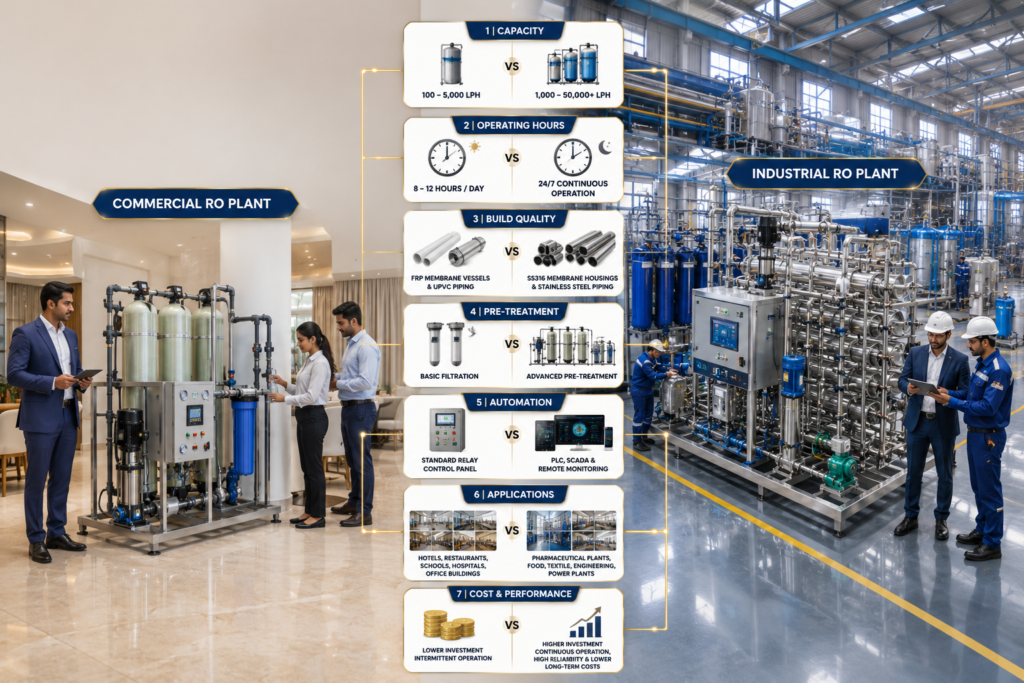
Commercial RO plants are intended for small-to-medium-sized enterprises such as restaurants, hotels, and medical centres. Their primary purpose is to supply high-quality drinking water or treatment water for normal operations, with capacities typically ranging from 100 to 5,000 litres per hour.
The commercial RO plant range in practice covers:
| Sub-category | Typical Capacity | Typical Application |
| Light commercial | 100–250 LPH | Small cafe, cloud kitchen, small office (up to 150 people), clinic |
| Mid commercial | 250–500 LPH | Restaurant, medium hotel, school, corporate office (150–300 people) |
| Large commercial | 500–1,500 LPH | Large restaurant, business hotel, hospital (up to 100 beds), IT campus |
| Heavy commercial | 1,500–5,000 LPH | Large hotel, multi-speciality hospital, large educational institution, medium apartment complex |
Industrial RO Plant Capacity Range
Industrial systems begin where heavy commercial systems end – and extend to capacities that dwarf anything in the commercial category:
| Sub-category | Typical Capacity | Typical Application |
| Light industrial | 1,000–3,000 LPH | Small factory (process water), industrial township (drinking), large campus |
| Medium industrial | 3,000–10,000 LPH | Medium factory, pharmaceutical facility, large hospital (200+ beds), large hotel group |
| Heavy industrial | 10,000–50,000 LPH | Large manufacturing plant, power plant, large pharmaceutical, large food processing |
| Very large industrial | 50,000+ LPH | Municipal-scale, large power generation, large desalination |
The Overlap Zone – Where Classification Gets Complicated
Notice that the 1,500–5,000 LPH range appears in both tables. This is the genuine overlap zone – where a system might legitimately be called either commercial or industrial depending on:
- The application (drinking water for a hotel = commercial; process water for a factory = industrial, even at the same LPH)
- The operating hours (8 hours/day = commercial spec; 20+ hours/day = industrial spec, at any capacity)
- The water quality requirements (BIS drinking water standards = commercial; pharmaceutical or food safety standards = industrial)
Bangalore Aqua uses the purpose-and-specification approach rather than a rigid capacity cutoff to determine the right system for each client – which is why buyers who engage Bangalore Aqua for a site assessment get a system correctly specified for their actual application, not a system that happens to fall into a convenient catalogue category.
Dimension 2: Operating Hours and Duty Cycle
This is arguably the most significant engineering difference between commercial and industrial RO plants – and the one most consequential for component specification.
Commercial Plants: Intermittent Duty
Commercial RO plants are designed for intermittent operation – typically 8 to 12 hours per day, with the system shut down overnight. The water produced during operating hours is stored in SS tanks for on-demand delivery around the clock.
An 8–12 hour daily operating cycle represents approximately 2,900–4,400 operating hours per year. This is the design basis for the component specifications in a commercial plant – the pump, the membrane elements, the UV lamp, and the control system are all selected for this duty level.
Industrial Plants: Continuous Duty
Industrial RO plants – particularly those supplying process water to manufacturing operations – are often required to run continuously: 18 to 24 hours per day, 365 days per year.
Continuous operation at 24 hours per day represents approximately 8,760 operating hours per year – three times the operating hours of a commercial plant running 8 hours per day. Every component in the system must be designed for this duty level.
<cite index=”25-1″>Industrial RO plants are built for robust construction – they use sturdy materials and components that handle prolonged operation and resist corrosion. Advanced automation allows exact monitoring and adjustment of operating parameters, maintaining consistent water quality and efficient operation.</cite>
The engineering implications of continuous versus intermittent duty are significant:
High-pressure pump: Commercial systems use standard centrifugal or positive-displacement pumps rated for intermittent duty. Industrial systems require heavy-duty pump specifications – larger impeller diameters, higher-grade mechanical seal materials, more robust bearing arrangements, and often duplex configurations so that one pump can be isolated for maintenance while the other continues operation.
Membrane elements: The same membrane element (e.g., a 4040 or 8040 spiral-wound element) experiences three times the total operating hours in an industrial continuous-duty system compared to a commercial 8-hour system over the same calendar year. Industrial plants must account for this in their membrane replacement cycle planning.
Control systems: Industrial control panels are built to a higher specification – typically with PLC (Programmable Logic Controller) or SCADA-based automation, redundant sensor inputs, more comprehensive alarm management, and remote monitoring capability. Commercial panels use simpler timer-and-relay logic that is adequate for 8-hour daily operation but not appropriate for continuous industrial use.
Electrical components: Switchgear, contactors, and motor starters in industrial panels are rated for industrial duty cycles – significantly more frequent switching operations per year than commercial equivalent components.
Dimension 3: Build Quality and Materials of Construction
The materials used in a commercial RO plant and an industrial RO plant reflect their different operating environments and duty requirements.
Pressure Vessel Construction
Commercial plants: FRP (Fibre Reinforced Plastic) pressure vessels are standard for the membrane housings in commercial applications. FRP is lightweight, corrosion-resistant, and cost-effective for the moderate pressure (8–12 bar) and intermittent duty of commercial operation. Standard 4040 configuration for smaller commercial systems; 8040 for larger commercial and light industrial.
Industrial plants: For demanding industrial applications – particularly where process water quality is critical or where the feed water has aggressive chemistry – SS304 or SS316 stainless steel pressure vessels are specified. SS construction provides significantly greater pressure rating, longer service life, easier external inspection, and better resistance to the thermal cycling that occurs in processes with variable operating temperatures.
For pharmaceutical applications, SS316L (low carbon, electropolished) is standard – meeting the hygienic construction requirements of GMP (Good Manufacturing Practice) guidelines.
Piping and Fittings
Commercial plants: UPVC or CPVC piping is standard for commercial plant inter-connections. This is appropriate for the feed pressures (up to 12 bar), the water temperatures, and the chemical environment of a typical commercial installation.
Industrial plants: Depending on the application, industrial piping may be UPVC, SS316, or specialised plastic alloys. For applications with elevated temperature feed water (common in some industrial processes), or where chemical compatibility with the pre-treatment chemicals used is a concern, SS piping is specified. For pharmaceutical water systems, all pipework downstream of the RO membranes must be SS316L electropolished to eliminate internal biofilm attachment sites.
Pump Specification
Commercial plants: Single-stage centrifugal pumps or booster pumps from reputable manufacturers (Grundfos CMB series, Taro, CRI) at standard commercial duty ratings. Single pump configuration – no standby.
Industrial plants: Multi-stage centrifugal high-pressure pumps (Grundfos CM, CR, or equivalent; Grundfos CRN for corrosive fluids; Ebara, Lowara for specific applications) rated for continuous duty. For critical industrial applications, duplex pump configuration (two pumps in parallel, each capable of carrying 100% of design flow) provides redundancy – one pump can be isolated for maintenance without shutting down the system.
Dimension 4: Pre-Treatment Requirements
<cite index=”24-1″>Industrial RO plants require pre-treatment systems that are matched to the specific demands of the industrial application and the raw water source – which may include far more aggressive chemistry than a commercial drinking water source.</cite>
This is one of the areas where commercial and industrial plants diverge most significantly – particularly for Karnataka’s industrial clients, where borewell water quality in manufacturing zones can be very challenging.
Commercial Pre-Treatment
For a commercial restaurant, hotel, or office in Bangalore, the pre-treatment train typically consists of:
- Sediment multimedia filter (sand and gravel media) – removes turbidity and suspended solids
- Activated carbon filter – removes chlorine, chloramines, and organics
- Anti-scalant dosing – manages hardness and prevents membrane scaling
- 5-micron and 1-micron cartridge pre-filters – final particulate removal before the membrane
This pre-treatment sequence is adequate for Bangalore’s mixed BWSSB and moderate borewell water quality, where TDS is typically 400–800 mg/L and hardness is below 400 mg/L as CaCO₃.
Industrial Pre-Treatment – More Complex, More Critical
Industrial applications – particularly in Hoskote, Nelamangala, and Doddaballapur where borewell TDS can reach 1,200–1,800 mg/L and hardness can exceed 600 mg/L as CaCO₃ – require significantly more intensive pre-treatment:
Iron and manganese removal: Borewell water in many Bangalore industrial zones contains iron above 1 mg/L. Iron above 0.1 mg/L causes accelerated fouling of RO membranes. Industrial pre-treatment includes dedicated iron removal – typically an aeration oxidation tower, greensand filter with potassium permanganate dosing, or a pressure oxidation-filtration system – upstream of the standard pre-treatment train.
Water softening: For very high hardness (above 400 mg/L as CaCO₃), anti-scalant dosing alone may be insufficient for industrial continuous-duty operation. A dedicated water softener upstream of the RO – sized for the full industrial flow rate – provides complete hardness removal and dramatically extends membrane life.
Multimedia filtration at industrial scale: Industrial multimedia filters are significantly larger than commercial equivalents – with larger media volumes, higher-flow backwash capacity, and automatic backwash controllers rather than manual backwash initiation.
Pharmaceutical-specific pre-treatment: For pharmaceutical process water applications, pre-treatment must comply with pharmacopoeia requirements – including specific limits on chlorine contact time, specific carbon media specifications, and in some cases ozone sanitation of the entire pre-treatment train.
Dimension 5: Automation and Control Systems
This is where the technology gap between commercial and industrial systems is most visible.
Commercial Plant Controls
Commercial RO plants use relay-and-timer logic panels – electrical control panels with contactors, timers, float switches, and pressure switches that automate the basic operating functions:
- Auto-start on low tank level
- Auto-stop on high tank level
- High-pressure cutoff on abnormal pressure
- Low-inlet-pressure cutoff
These panels are simple, reliable, and sufficient for commercial applications where an operator checks the system daily and calls for service if something is visibly wrong.
Display: Typically a TDS meter display showing permeate output TDS and basic indicator lights for operational status and alarms.
Industrial Plant Control Systems
<cite index=”25-1″>Industrial RO plants frequently integrate advanced control systems and automation capabilities – permitting exact monitoring and adjustment of operating parameters, maintaining consistent water quality and efficient operation.</cite>
Industrial control systems may include:
PLC (Programmable Logic Controller): A microprocessor-based controller that replaces the relay-and-timer logic of commercial panels. PLCs offer programmable logic that can be updated as operating requirements change, more sophisticated alarm management (logging, timestamping, multi-tier alert levels), and interface capability with SCADA systems.
SCADA (Supervisory Control and Data Acquisition): For large industrial plants, a SCADA system provides real-time monitoring of all plant parameters from a central control station or remote terminal. Every pressure gauge reading, every flow meter reading, every TDS meter reading, every alarm event is logged with a timestamp. Performance trends are displayed graphically. Alerts can be sent by SMS or email to the plant manager.
Online analysers: Industrial plants may include continuous online analysers measuring conductivity/TDS, pH, ORP (Oxidation Reduction Potential – relevant for pharmaceutical and food applications), turbidity, and in specialised applications, TOC (Total Organic Carbon), which is a key quality indicator for pharmaceutical purified water.
Energy recovery devices: Very large industrial plants (above 10,000 LPH) operating at high pressures may incorporate pressure energy recovery devices – technology that recovers energy from the high-pressure reject stream and uses it to partially drive the feed pump, reducing total electricity consumption by 30–50%.
Dimension 6: Regulatory Compliance Requirements
<cite index=”20-1″>Commercial RO plants must comply with local drinking water health and safety regulations – India’s BIS 14725 – and may be NSF-certified. Consumer safety is assured through regular microbiological testing and sanitising procedures. Industrial RO plants follow industry-specific regulations such as ASTM, FDA, or IS 16219 for demanding applications. Pharmaceutical and food and beverage industries require documented, validation procedure-based protocols and traceable quality control processes.</cite>
Commercial Compliance Framework
A commercial RO plant producing drinking water for a restaurant, hotel, school, or corporate office is governed primarily by:
BIS 10500:2012 – Bureau of Indian Standards specification for drinking water quality. The plant’s permeate must meet these limits for all relevant parameters.
FSSAI regulations – for food business operators, water used in food preparation must be potable and safe under the Food Safety and Standards Act. A commercial RO plant with documented water quality testing provides the compliance evidence for FSSAI inspections.
State PCB (Pollution Control Board) regulations – reject water discharge from commercial plants must comply with discharge standards set by the Karnataka State Pollution Control Board.
Industrial Compliance Framework – More Stringent and More Varied
The regulatory requirements for industrial RO plants vary by sector and are in every case more demanding than commercial drinking water standards:
Pharmaceutical water systems: The Indian Pharmacopoeia, USP (United States Pharmacopeia), and European Pharmacopoeia specify Purified Water and Water For Injection (WFI) quality standards that are far more stringent than BIS 10500. TOC must be below 500 ppb. Conductivity must be below 1.3 μS/cm at 25°C. Bacterial endotoxin limits apply for WFI. The system must be validated under GMP guidelines with formal IQ/OQ/PQ (Installation Qualification, Operational Qualification, Performance Qualification) documentation.
Food and beverage manufacturing: FSSAI Schedule II specifies water quality requirements for food processing that include specific limits on heavy metals, pesticides, and microbiological parameters more stringent than general drinking water standards.
Textile and dyeing: Process water quality requirements for dyeing processes are specified by the textile manufacturer based on their process chemistry – typically requiring very low hardness, controlled silica levels, and specific iron limits to prevent colour inconsistency.
Boiler feed water: IS 10392 specifies quality requirements for boiler feed water based on boiler operating pressure – with progressively more stringent TDS, hardness, silica, and oxygen limits at higher pressures.
Dimension 7: Cost Comparison
Cost differences between commercial and industrial systems reflect the differences in build quality, component specification, automation level, and design complexity.
Commercial RO Plant Costs (2026, Karnataka)
| Capacity | Typical Application | Installed Cost Range | Annual AMC |
| 100 LPH | Small cafe, clinic, startup office | ₹45,000–₹80,000 | ₹15,000–₹25,000 |
| 250 LPH | Medium restaurant, school | ₹80,000–₹1,50,000 | ₹25,000–₹40,000 |
| 500 LPH | Large restaurant, hotel F&B, 300-person office | ₹1,50,000–₹2,80,000 | ₹40,000–₹65,000 |
| 1,000 LPH | Large commercial, 100-bed hospital, IT campus | ₹3,00,000–₹5,50,000 | ₹70,000–₹1,20,000 |
| 2,000 LPH | Heavy commercial, large hotel, large hospital | ₹6,00,000–₹10,00,000 | ₹1,20,000–₹2,00,000 |
Industrial RO Plant Costs (2026, Karnataka)
| Capacity | Typical Application | Installed Cost Range | Annual AMC |
| 1,000 LPH (industrial spec) | Small factory, pharmaceutical, continuous duty | ₹5,00,000–₹9,00,000 | ₹90,000–₹1,60,000 |
| 2,000 LPH | Medium factory, large pharmaceutical | ₹9,00,000–₹16,00,000 | ₹1,60,000–₹2,80,000 |
| 5,000 LPH | Large factory, large campus, institutional | ₹20,00,000–₹40,00,000 | ₹3,50,000–₹6,00,000 |
| 10,000 LPH | Very large industrial, food processing, hospital group | ₹45,00,000–₹85,00,000 | ₹7,00,000–₹12,00,000 |
The cost premium for industrial versus commercial at the same LPH capacity reflects the higher component grades, continuous-duty engineering, enhanced automation, and more intensive pre-treatment required for industrial applications.
The Overlap Zone: When Does a Commercial Plant Become Industrial?
The overlap between 1,000–5,000 LPH deserves explicit treatment because this is where buyers most commonly make the wrong classification decision.
Here is a practical decision framework for determining whether your 1,000–5,000 LPH requirement is commercial or industrial specification:
Your requirement is COMMERCIAL specification if:
- Primary use is drinking water, cooking water, and general hygiene for employees and guests
- System will operate 8–12 hours per day, not continuously
- Your regulatory framework is BIS 10500 / FSSAI for food premises
- Source water is moderate TDS (below 800 mg/L) with standard hardness
- A 4–8 hour supply interruption is inconvenient but not production-critical
- Budget priority is minimising capital cost
Your requirement is INDUSTRIAL specification if:
- Water goes directly into production – boiler feed, process use, product ingredient
- System must operate 16–24 hours per day or continuously
- Your regulatory framework is sector-specific (pharmaceutical, food manufacturing, textile standards)
- Source water is high-TDS (above 800 mg/L), very hard, or contains iron / manganese
- Any supply interruption has immediate production impact measured in financial loss
- Compliance documentation (IQ/OQ/PQ, validation records) is required by your regulator or customer
The hospital case
A 200-bed hospital in Bangalore requires 20,000–35,000 LPD of water for patient care, kitchen, staff drinking, and clinical purposes. At first glance, this might be sized as a 2,000–3,500 LPH commercial plant running 10 hours per day.
But critically: if clinical water requirements include steriliser feed water or dialysis water (in a nephrology department), those specific water uses require industrial-specification purified water meeting IS 16219 (or equivalent pharmacopoeia standards) – which is far more stringent than BIS 10500 drinking water. The hospital needs both: a commercial-specification system for kitchen and staff water, and an industrial-specification system for clinical applications.
Bangalore Aqua regularly designs multi-system configurations for hospitals – a commercial plant for general utility water and a separate, higher-specification system for clinical applications – sized and designed for each application’s specific requirements.
Sector-by-Sector Classification: Which Type Does Your Business Need?
| Sector | Typical Specification | Reasoning |
| Small restaurant (under 100 covers) | Commercial (100–250 LPH) | Drinking and cooking water, FSSAI compliance, 8-hr operation |
| Large restaurant / hotel F&B | Commercial (500–1,000 LPH) | Same purpose, higher volume |
| Business hotel (50–100 rooms) | Commercial (500–2,000 LPH) | Guest drinking, kitchen, housekeeping |
| Large 5-star hotel (150+ rooms) | Industrial spec (2,000–5,000 LPH) | Continuous 24-hr operation, laundry, pool, F&B |
| Small clinic / diagnostic centre | Commercial (100–250 LPH) | Drinking and instrument cleaning only |
| Hospital (general, up to 100 beds) | Commercial (1,000–2,000 LPH) | Drinking and utility; separate clinical system if needed |
| Hospital (with dialysis / pharma) | Industrial for clinical circuits | IS 16219 water quality required |
| Corporate office (200–500 people) | Commercial (250–500 LPH) | Drinking water, 8-hr operation |
| Large IT campus (1,000+ people) | Commercial (1,000–2,000 LPH) | Canteen + drinking, still 8-12 hr |
| Light factory (50–200 workers, drinking only) | Commercial (250–750 LPH) | If no process water requirements |
| Factory with boiler or process water | Industrial (1,000 LPH+) | Continuous duty, water quality impacts production |
| Textile dyeing unit | Industrial | Process water quality affects dye consistency |
| Pharmaceutical manufacturing | Industrial (pharma grade) | GMP requirements, validation, continuous duty |
| Food processing factory | Industrial | FSSAI manufacturing standards, continuous operation |
| Auto components / engineering | Industrial (process water) | Cooling, washing, boiler – production dependent |
| Community apartment complex | Commercial spec (500–5,000 LPH) | Drinking water, intermittent duty |
| Construction worker camp | Commercial (500–1,500 LPH) | Drinking water, intermittent duty |
Common Mistakes in the Commercial vs Industrial Classification Decision
Mistake 1: Classifying by Capacity Alone
A factory owner who needs 1,000 LPH for process water assumes he needs a commercial plant “because the capacity is in the commercial range.” He buys a commercial-spec system and runs it 20 hours per day for his continuous process. The pump seals fail within a year. The commercial-grade pump was not designed for continuous duty at that operating frequency.
The right decision is determined by purpose and operating hours, not just capacity.
Mistake 2: Buying Commercial When Industrial Duty Is Required – to Save Initial Cost
<cite index=”25-1″>Commercial RO plants often cost less upfront than industrial RO plants.</cite> This is true. But the total cost of ownership calculation over five years – including pump replacement due to continuous-duty overload, more frequent membrane replacement due to inadequate pre-treatment, production downtime costs, and eventual system replacement – consistently makes industrial-spec systems cheaper over the plant’s operational life for applications that genuinely require them.
Bangalore Aqua always presents a 5-year total cost of ownership comparison when a buyer is considering a commercial-spec system for what Bangalore Aqua’s assessment identifies as an industrial-duty application.
Mistake 3: Assuming Any 1,000 LPH System Is “Industrial”
Some suppliers label all systems above 1,000 LPH as “industrial” regardless of their actual build specification – using the word as a marketing claim rather than a technical description. A 1,000 LPH system with standard commercial components, a relay-and-timer control panel, and a single commercial-grade pump running on a commercial-duty motor is not an industrial plant. It is a commercial plant with a higher flow rate.
When evaluating any system above 1,000 LPH, ask specifically: What is the pump duty rating? Is the panel PLC or relay-and-timer? What are the motor starter specifications? What is the pressure vessel material? The answers will tell you immediately whether you are looking at a genuine industrial specification or a commercial system with industrial labelling.
Mistake 4: Not Considering Your Future Operating Pattern
A buyer installs a commercial-spec system for a new factory that initially operates one shift (8 hours per day). Within 18 months, the factory adds a second shift – the plant is now running 16 hours per day. The commercial-spec pump and control system were never designed for this duty level. Degradation begins immediately.
If there is any reasonable possibility that your operating hours will increase, build in the industrial specification from the start. The incremental capital cost is far less than the cost of replacing a commercial-spec system with an industrial one two years after installation.
How Bangalore Aqua Classifies and Specifies Each Project
Bangalore Aqua does not ask buyers to self-classify. The engineering team makes the classification recommendation based on a structured site assessment that evaluates:
1. Application review: What is the water used for? Drinking and general utility (commercial) versus process, boiler, or pharmaceutical (industrial)?
2. Operating hours assessment: How many hours per day will the plant run? Current and projected. 8–12 hours supports commercial spec; 14+ hours requires industrial spec.
3. Source water analysis: TDS, hardness, iron, pH, and seasonal variation. High TDS above 1,000 mg/L, very high hardness above 500 mg/L as CaCO₃, or elevated iron above 0.5 mg/L pushes toward industrial pre-treatment regardless of application type.
4. Consequence of failure analysis: If the plant goes offline for 8 hours, what happens? Inconvenience but operations continue (commercial spec acceptable) versus immediate production stop (industrial spec required)?
5. Regulatory framework: What compliance documentation is required? BIS 10500 (commercial) versus sector-specific standards (industrial)?
6. Future growth plan: Will operating hours or water demand increase within the plant’s planned operational life?
The classification recommendation is always explained to the buyer with full justification – so the purchasing decision is made with complete understanding of why each specification element is included and what the consequence of downgrading would be.
Frequently Asked Questions
Q: Is a 2,000 LPH RO plant always considered industrial? Not automatically. Capacity alone does not determine the classification. A 2,000 LPH plant supplying drinking water for a large corporate campus, operating 10 hours per day, is a heavy commercial application. A 2,000 LPH plant supplying boiler feed water for a continuous-process factory operating 20 hours per day is an industrial application – requiring industrial-grade pumps, control systems, and pre-treatment. Bangalore Aqua’s site assessment determines the correct specification based on application, operating hours, and water quality requirements.
Q: My hospital needs 3,000 LPH. Is that commercial or industrial? For general drinking, kitchen, and utility water – commercial specification. If any portion of the water is for dialysis, sterile instrument washing, or pharmaceutical preparation – that portion requires industrial or pharmaceutical-grade specification (IS 16219 compliant). Many hospitals need both – Bangalore Aqua designs multi-system configurations for hospitals with mixed water quality requirements.
Q: Can I run a commercial RO plant for 16 hours per day if I have high demand? Technically possible, but not advisable. Commercial-spec pumps, control panels, and membrane configurations are designed for 8–12 hour daily duty. Running them at 16 hours per day accelerates wear, reduces component life, increases maintenance frequency, and will likely result in earlier-than-expected system failure. If your demand requires 16+ hours of daily operation, the industrial specification is the right economic choice – lower total cost of ownership even at higher initial capital cost.
Q: What is the cost difference between commercial and industrial spec at the same LPH? Industrial specification typically costs 40–80% more than commercial specification at the same LPH capacity. This premium reflects heavy-duty pump specification, PLC control panel, enhanced pre-treatment, industrial-grade pressure vessels, and continuous-duty engineering. Contact Bangalore Aqua for a specific comparison quotation for your capacity and application.
Q: Do commercial and industrial plants use the same membranes? Both use spiral-wound thin-film composite membranes of the same basic technology – but the membrane element selection, the number of elements per pressure vessel, and the membrane array configuration differ. Industrial plants may use 8040 elements (8-inch diameter, 40-inch length) rather than the 4040 elements common in commercial plants – delivering higher output per membrane housing and better energy efficiency at industrial flow rates. For pharmaceutical applications, specific membrane types with validated endotoxin rejection characteristics are specified.
Q: Our factory currently has only one shift but may add a second within two years. Which spec should we buy? Industrial specification. The incremental capital cost between commercial and industrial spec at 1,000–3,000 LPH is typically ₹1.5–4 lakhs. The cost of replacing a commercial-spec system that is being overrun by a second shift – plus the production disruption during replacement – typically exceeds ₹6–12 lakhs. Build for the worst credible case from the start.
Also Read on NikahNamah Blog
- https://bangaloreaqua.com/ro-plant-commissioning-process/
- https://bangaloreaqua.com/industrial-ro-plant-maintenance-checklist/
- https://bangaloreaqua.com/industrial-commercial-ro-plant-amc-services/
- https://bangaloreaqua.com/csr-community-development-water-projects-india/
- https://bangaloreaqua.com/ro-plant-vs-water-softener-bangalore/
- https://bangaloreaqua.com/increase-lifespan-of-industrial-ro-membranes/
The Right System for the Right Application – Every Time
The commercial versus industrial distinction is not marketing taxonomy. It is a genuine engineering difference with real financial and operational consequences for buyers who get it wrong in either direction.
Buying commercial specification for an industrial application means: premature pump failure, inadequate pre-treatment for demanding source water, compliance gaps in regulated industries, and production disruption costs that dwarf the capital cost savings.
Buying industrial specification for a genuinely commercial application means: unnecessary capital expenditure on over-engineered components and automation that the application does not need, with no benefit to water quality or reliability.
Getting it right means: understanding the actual application, the real operating hours, the source water quality, and the regulatory framework – and specifying a system that is precisely matched to all four.
This is what Bangalore Aqua and Energy Pvt. Ltd. does for every client across Karnataka. Free site assessment. Honest classification recommendation with full justification. Transparent quotation for both commercial and industrial specifications where the application falls in the overlap zone. And the committed after-sales AMC service that keeps whichever system is correctly specified running at peak performance for its full operational life.
Call Bangalore Aqua today for a free site assessment and system classification consultation.
📞 +91 76763 93939 | +91 97387 04753 📧 info@bangaloreaqua.com 🌐 bangaloreaqua.com 📍 107/209 2nd Cross, 4th Main Kogilu Layout, Bengaluru – 560064, Karnataka
Commercial and industrial RO plant design, supply, installation, commissioning, and AMC services across Bengaluru, Nelamangala, Hoskote, Doddaballapur, Devanahalli, Whitefield, Electronic City, Koramangala, HSR Layout, Mysuru, Hubballi, Mangaluru, and all Karnataka locations.
Related reads: How to Choose the Right Industrial RO Plant Capacity 2026 | RO Plant Commissioning Process Explained 2026 | Industrial & Commercial RO Plant AMC Services 2026 | RO Plant vs Water Softener – Which One Does Your Bangalore Home Need? 2026 | Top 10 RO Plant Companies in India 2026