The Membrane That Died at 14 Months
A membrane element for an industrial RO plant is not a cheap part. Depending on size and configuration, replacing a full set can run into several lakhs of rupees—and that’s before counting the production downtime while the swap happens. Manufacturers typically design these elements for 2–3 years of service, but with the right operating practices, businesses can Increase the Lifespan of Industrial RO Membranes and achieve 4 or even 5 years from the same membrane while running the same water at the same capacity.
The difference between the plant that replaces membranes every 14 months and the one that gets 5 years out of them almost never comes down to the membrane brand. It comes down to what happens to that membrane every single day it’s in service—the pre-treatment ahead of it, the pressure it’s run at, how quickly fouling is caught, and whether it’s cleaned before damage becomes irreversible. These operational factors play a critical role in helping Increase the Lifespan of Industrial RO Membranes while maintaining consistent water quality and system performance.
This guide covers the specific, practical factors that determine how long an industrial RO membrane actually lasts—and what to change if yours isn’t lasting as long as it should. By following these proven maintenance and operating practices, you can Increase the Lifespan of Industrial RO Membranes, reduce replacement costs, and improve the overall efficiency of your industrial RO plant.
What Actually Kills a Membrane
Before looking at prevention, it helps to know what failure modes are actually shortening membrane life. Almost every premature membrane replacement traces back to one of these:
- Fouling – suspended solids, colloids, or organic matter accumulating on the membrane surface, restricting flow and raising the pressure needed to maintain output
- Scaling – dissolved minerals (calcium, silica, sulphate) precipitating out and crystallising on the membrane once their solubility limit is exceeded
- Chemical attack – chlorine or other oxidants degrading the membrane’s polyamide layer, or cleaning chemicals used at the wrong concentration or pH
- Biofouling – bacterial growth forming a biofilm that traps other foulants and is difficult to remove once established
- Mechanical damage – pressure spikes, water hammer, or dry-running events that physically damage the membrane or its seals
Each of these is preventable. None of them happen overnight – they build up over weeks or months of small operating conditions that go unaddressed.
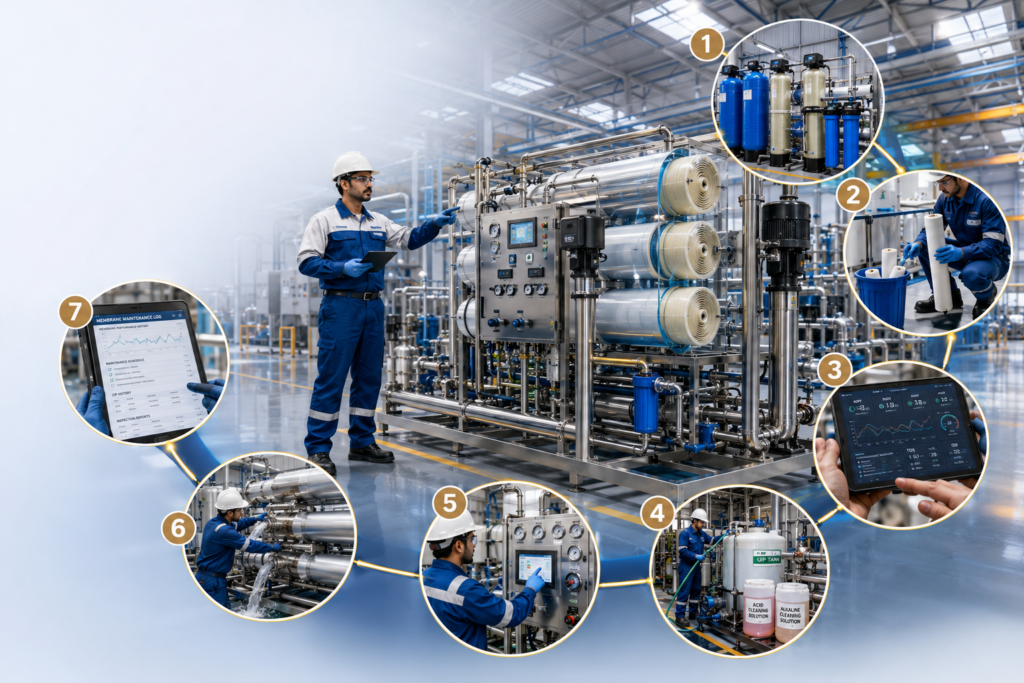
Seven Ways to Extend Industrial RO Membrane Life
1. Get Pre-Treatment Right – This Is the Single Biggest Factor
More membrane life is won or lost in the pre-treatment train than anywhere else in the system. A membrane is only as protected as the water arriving in front of it.
- Multimedia filtration should remove suspended solids down to the micron range the membrane manufacturer specifies before water reaches the pre-filter cartridges
- Anti-scalant dosing must be calibrated to the specific hardness and silica content of the feed water – a generic dosing rate for a different water source under-protects against scaling
- Dechlorination ahead of the membrane (via activated carbon or sodium metabisulphite dosing) is non-negotiable if the feed water is chlorinated; even trace chlorine breakthrough degrades polyamide membranes irreversibly over time
- Iron and manganese removal pre-treatment is essential for borewell or groundwater sources – these foul membranes fast and are difficult to clean out once embedded
2. Replace Pre-Filters on Schedule, Not on Appearance
A sediment or carbon pre-filter that’s allowed to run past its interval doesn’t fail cleanly – it starts passing particulate load through to the membrane while still “looking fine” from the outside. The membrane absorbs the consequence of every delayed pre-filter change. Fixed, calendar-based replacement (typically every 3 months, adjusted for source water quality) protects the membrane far more reliably than replacing based on visible dirt.
3. Monitor Performance Trends, Not Just Point-in-Time Readings
A single day’s pressure or flow reading tells you very little. What matters is the trend over weeks:
- Normalised Permeate Flow (NPF) – a decline of 15% or more from baseline signals developing fouling
- Normalised Salt Rejection (NSR) – a decline indicates membrane integrity issues developing
- Differential pressure (dP) across the membrane train – a steady rise indicates particulate or biofouling accumulating
Catching a 10% NPF decline and cleaning immediately can restore a membrane close to its original performance. Waiting until the decline is 40% and permeate quality is visibly failing often means the fouling has become irreversible.
4. Clean Before the Membrane Needs It, Not After
Cleaning In Place (CIP) is not an emergency procedure – it’s a scheduled intervention triggered by the performance data described above, not by a visible failure. The right cleaning chemistry depends on the foulant:
- Alkaline cleaning for organic fouling and biofilm
- Acid cleaning for carbonate and sulphate scale
- Specialised cleaners for silica fouling, which is common with certain groundwater sources
Cleaning too late, after fouling has hardened into scale or the biofilm has matured, recovers far less performance than cleaning at the first sign of decline – and repeated aggressive cleaning of an already-damaged membrane accelerates its remaining life rather than extending it.
5. Never Run the Membrane Outside Its Design Operating Window
Every membrane element has a manufacturer-specified operating pressure range, maximum feed flow, and maximum recovery ratio. Running a plant above its designed recovery ratio to squeeze out more permeate accelerates scaling risk and shortens membrane life for a marginal short-term output gain. Similarly, pressure spikes from pump surges, valve slam, or uncontrolled startup/shutdown sequences cause mechanical stress the membrane wasn’t designed to absorb repeatedly.
6. Protect the Membrane During Shutdowns
Membranes left idle – overnight, over a weekend, or during a planned production stoppage – are vulnerable to biological growth if not properly preserved. For shutdowns beyond a day or two, membranes should be flushed with permeate or treated with a preservative solution appropriate to the shutdown duration, rather than left standing with feed water inside the housing.
7. Keep a Membrane-Specific Maintenance Log
A membrane’s history – every cleaning performed, every performance reading, every change in feed water source – should be tracked against that specific membrane element, not just the plant in general. This log is what tells a technician whether a current reading represents normal gradual aging or a new developing problem, and it’s essential if a warranty claim is ever needed.
Membrane Life Factors at a Glance
| Factor | Effect on Membrane Life | Action |
| Pre-treatment adequacy | Largest single factor | Match pre-treatment to actual feed water quality, not a generic spec |
| Chlorine exposure | Irreversible polyamide damage | Dechlorinate fully ahead of membrane, verify with residual testing |
| Pre-filter replacement timing | Prevents particulate fouling | Replace on fixed schedule, not visual appearance |
| Operating pressure/recovery | Mechanical and scaling stress | Stay within manufacturer’s design window |
| Cleaning timing | Determines if fouling is reversible | Clean at first sign of NPF/NSR decline, not after failure |
| Shutdown handling | Biofouling risk during idle periods | Flush or preserve for any stoppage beyond 1–2 days |
| Performance trend monitoring | Early warning system | Track NPF, NSR, and dP against baseline every month |
Common Mistakes That Shorten Membrane Life
Treating anti-scalant dosing as “set and forget” Dosing rates calibrated at commissioning stop being correct if the source water changes – a new borewell, seasonal variation, or a municipal supply change can shift hardness and silica levels enough to make the original dosing inadequate.
Cleaning with whatever chemical is on hand Using an acid cleaner on organic fouling, or an alkaline cleaner on scale, does little to remove the actual foulant and can itself stress the membrane. Cleaning chemistry has to match the foulant identified through performance data.
Restarting after a shutdown without a flush Water that sat stagnant in the membrane housing during a shutdown can carry a bacterial load that gets pushed directly into production the moment the plant restarts.
Chasing output by running above design recovery Increasing recovery ratio beyond the design point produces marginally more permeate in the short term while concentrating scaling risk in the last elements of the train – often the first ones to fail.
No baseline recorded at commissioning Without a documented baseline for pressure, flow, and rejection at startup, there’s nothing to compare later readings against – every subsequent reading is just a number, not a trend.
The Cost Case for Membrane Life Extension
A membrane replacement for a mid-sized industrial plant typically runs into several lakhs of rupees for the elements alone, plus the production interruption while the swap and re-commissioning happen. Extending membrane life from an average of 2 years to 4–5 years effectively halves that recurring cost over the plant’s operating lifetime – for an investment that’s mostly procedural discipline rather than capital spend: correct pre-treatment, on-schedule pre-filter changes, and cleaning triggered by data rather than by visible failure.
The membranes that last the longest are rarely the most expensive ones on the market. They’re the ones installed behind properly sized pre-treatment, monitored consistently, and cleaned before damage sets in.
Frequently Asked Questions – Industrial RO Membrane Lifespan
Q: What is a realistic lifespan to expect from an industrial RO membrane? Manufacturers typically design for 2–3 years under normal conditions. Plants with strong pre-treatment, disciplined monitoring, and timely cleaning regularly achieve 4–5 years from the same membrane elements.
Q: How do we know if a membrane needs cleaning versus replacement? Cleaning is indicated when Normalised Permeate Flow has declined but Normalised Salt Rejection remains acceptable – the membrane is fouled but intact. Replacement becomes necessary when salt rejection has dropped below an acceptable threshold even after cleaning, indicating the membrane itself has degraded rather than just fouled.
Q: Does harder feed water always mean shorter membrane life? Not necessarily, if anti-scalant dosing and pre-treatment are correctly matched to the feed water’s actual hardness and silica levels. Harder water requires more careful pre-treatment, but well-managed hard-water plants routinely achieve normal membrane life.
Q: How often should CIP cleaning be performed on a healthy membrane? There’s no fixed universal interval – cleaning should be triggered by performance data (typically a 10–15% NPF decline from baseline) rather than a fixed calendar schedule. A well-protected membrane with good pre-treatment may go a year or more between cleanings; a poorly protected one may need cleaning every few months.
Q: Can a membrane recover fully after aggressive fouling? Partial recovery is common if cleaning happens promptly after fouling is detected. Once scaling has crystallised or biofilm has matured over an extended period, cleaning typically recovers only part of the original performance, and the membrane’s remaining useful life is shortened even after a successful clean.
Also Read on NikahNamah Blog
- https://bangaloreaqua.com/ro-plant-commissioning-process/
- https://bangaloreaqua.com/industrial-ro-plant-maintenance-checklist/
- https://bangaloreaqua.com/industrial-commercial-ro-plant-amc-services/
- https://bangaloreaqua.com/csr-community-development-water-projects-india/
- https://bangaloreaqua.com/ro-plant-vs-water-softener-bangalore/
Protect the Investment Already Sitting in Your Plant
The RO membrane is usually the single most expensive consumable in an industrial RO plant, and its lifespan is determined almost entirely by decisions made elsewhere in the system – pre-treatment quality, pre-filter discipline, and how quickly a performance decline gets acted on.
Bangalore Aqua and Energy Pvt. Ltd. supports industrial and commercial RO plants across Karnataka with membrane performance monitoring, scheduled CIP cleaning, and pre-treatment assessment built into their AMC programmes – designed specifically to get the maximum service life out of every membrane element installed.
Get a membrane performance assessment for your plant. Contact Bangalore Aqua.
📞 +91 76763 93939 | +91 97387 04753 📧 info@bangaloreaqua.com 🌐 bangaloreaqua.com 📍 107/209 2nd Cross, 4th Main Kogilu Layout, Bengaluru – 560064, Karnataka
Related reads: Industrial RO Plant Maintenance Checklist Every Factory Should Follow | Industrial & Commercial RO Plant AMC Services – Complete Maintenance & Spare Parts Solutions (2026) | Best Community RO Project Plants 2026 | Top 10 RO Plant Companies in India 2026