
Best Industrial RO Plant Manufacturer in Nelamangala (2026)
DRINK SAFE AND PURE
Bangalore Aqua - Industrial RO Plant Manufacturer for Nelamangala Taluk
Nelamangala (ನೆಲಮಂಗಲ) is the taluk town on NH-48 between Bengaluru and Tumakuru, with a railway station on the Bengaluru-Hassan line and a taluk area of about 507 sq km (Wikipedia, Nelamangala). Just outside town, NH-75 to Kunigal, Hassan and the Mangaluru side branches off NH-48 (Wikipedia, NH-75). The taluk sits in Bengaluru Rural district, which the Karnataka cabinet approved renaming as Bengaluru North in July 2025 (Indian Express).
Invest Karnataka lists Nelamangala among the district’s four taluks and names its main industrial areas: Dabaspete Phase 1, Sompura 1st and 2nd Stage (Dabaspet 3rd Stage), Awerahalli (Dabaspete Phases 4 and 5) and Obalapura (Dabaspet Phase 6), plus a KSSIDC estate at Nelamangala. It names textiles, aerospace, automobile and electrical and electronics as major sectors, and lists groundwater and rainwater as the district’s water supply systems. Dobbaspet, officially Sompura, is in Nelamangala taluk, about 22 km up NH-48 from Nelamangala and 19 km short of Tumakuru, and its KIADB area hosts mechanical, automobile and electrical engineering units (Wikipedia, Dobbaspet). Further up the corridor, Tumakuru’s Vasanthanarasapura industrial phases and the Chennai Bengaluru Industrial Corridor township continue the same belt (Invest Karnataka, Tumakuru). On the city side, Peenya is the nearest large industrial estate.
The landscape matters for water. Shivagange (ಶಿವಗಂಗೆ), a 1,368 m peak near Dobbaspet, is the source of the Kumudvathi, an Arkavathy tributary that drains a major part of Nelamangala taluk (Wikipedia, Shivagange). Both feed the Thippagondanahalli (TG Halli) reservoir, whose catchment includes parts of Nelamangala (Biome Environmental Trust). Around Thyamagondlu and towards Kunigal, borewells are the usual source, in line with Invest Karnataka’s listing of groundwater as a main district supply. So a Dabaspet engineering plant, an NH-48 warehouse running on tankers and a Shivagange temple kitchen may be dealing with completely different water.
That is why an industrial RO plant in Nelamangala has to be engineered, not picked off a price list. Tanker and piped water are usually treated, if at all, for bacteria and turbidity, not for dissolved salts or fluoride. A water softener swaps calcium and magnesium for sodium. It stops scale, but it does not lower TDS and it does not remove fluoride or chloride. UV disinfection kills microbes and nothing more. In a taluk where CGWB reports an over-exploited aquifer, fluoride above the permissible limit and chloride problems (details below), reverse osmosis with the right pre-treatment is the practical way to get drinking water and low-TDS process water that stays in specification.
Bangalore Aqua And Energy Pvt. Ltd. manufactures RO plants, water treatment systems, softeners, community and solar RO plants, and industrial and commercial systems. Every Nelamangala plant is built at our manufacturing unit in Kogilu Layout, Bengaluru, then dispatched, installed and commissioned on site, with AMC support after handover.
📞 +91 76763 93939 | +91 97387 04753 📧 info@bangaloreaqua.com 🌐 bangaloreaqua.com Nearby pages: Best Industrial RO Plant Manufacturer in Tumakuru | Industrial RO Plant Manufacturer in Bangalore | RO Water Treatment Plant Suppliers in Bengaluru Rural
Nelamangala Water Quality: What the Data Actually Says
An over-exploited aquifer, hard granite bores and a stressed reservoir catchment are different problems
Groundwater stress (CGWB and state assessment). The Central Ground Water Board’s Bangalore Rural Ground Water Information Booklet (2012) put Nelamangala’s stage of groundwater development at 115% (March 2009) and records all four taluks as over-exploited and notified. The joint GWD and CGWB Dynamic Ground Water Resources of Karnataka, 2023 still classes Nelamangala as over-exploited at 103.42%. Annual extraction was 1.53 TMC against 1.48 TMC extractable, with nothing left for future use. Nelamangala’s industrial draw (0.12 TMC) is the highest of the four district taluks in that table. The district as a whole stands at 154%.
Water levels and bores. The CGWB booklet’s summary table puts 2011 piezometer levels at 5-30 m below ground level before the monsoon and 5-40 m after it. CGWB exploratory wells in the district were 33-287 m deep and yielded 0.1-9.13 litres per second, from granite and gneiss aquifers. The 2023 state report notes pre-monsoon levels of 20-40 m and deeper in parts of Bengaluru Rural.
Rainfall. CGWB gives Nelamangala a normal annual rainfall of 776 mm over 51 rainy days, with 742 mm recorded in 2009 (CGWB booklet). Invest Karnataka quotes about 650 mm for the whole district. We use the CGWB taluk figure for storage planning.
Quality flags (CGWB booklet). Electrical conductivity in Nelamangala taluk mostly runs 500-750 micromhos/cm, lower than the 750-1,000 seen across most of the district. The same booklet names Nelamangala among the taluks where fluoride above the permissible limit has been observed, and where chloride of more than 250 up to 1,000 mg/L has been observed. It gives no taluk-level TDS, fluoride or nitrate figure.
CGWB monitoring wells in the taluk. CGWB’s published groundwater quality dataset (NWDP) includes May samples from three Nelamangala stations. At Mahadevapura (2000-2022), EC ranged from 420 to 1,098 µS/cm, total hardness 100-290 mg/L and chloride about 28-128 mg/L. In 2022 it read TDS 467 mg/L, hardness 285 mg/L and EC 740 µS/cm. At Shivagange (2002-2022), EC was mostly 220-720 µS/cm, apart from one 2014 sample at 2,200 µS/cm with 472 mg/L chloride. Hardness was 80-170 mg/L, and 2022 read TDS 265 mg/L. Gangenapura (2013-2017) read EC 370-1,120 µS/cm and hardness 110-130 mg/L. The dataset publishes no fluoride or nitrate values for these wells.
State sampling (May 2022). The 2023 state report names Bengaluru Rural among districts where some samples exceeded 600 mg/L hardness, 1.5 mg/L fluoride and 45 mg/L nitrate. Nelamangala itself is not on that report’s taluk quality-tag list, so fluoride and nitrate are site questions, not a blanket rule.
TG Halli and the Arkavathy (weaker sources). In 2016 a state minister said TDS in TG Halli water had crossed 800 mg/L, citing sewage inflow from catchment areas including Nelamangala, and drinking supply had stopped in 2012 (Times of India). A 2018 NGO visit recorded inlet TDS of about 450 ppm after heavy rains and found the Kumudvathi inlet dry (Biome). Treat these as news and NGO figures only.
Dabaspet, Sompura and Peenya. We did not find a measured, published groundwater chemistry study for the Dabaspet and Sompura KIADB areas that we could open in full, so there are no industrial-area numbers here. On the Bengaluru side, a 2013 study of 40 Peenya samples reported nickel above limits in 95% and cadmium in 87.5% of pre-monsoon samples (IJERT). That is Peenya, not Nelamangala, and the paper’s totals are not fully consistent, so we treat it only as a reason to test for metals near industrial sites.
Planning table
Concern | Planning note | Implication |
Over-extraction | 115% stage (CGWB, 2009) and 103.42% over-exploited (2023); highest industrial draw in the district | Retest bores yearly; plan storage and recovery carefully |
Fluoride | Observed above the permissible limit in the taluk (CGWB); no published taluk number | Fluoride on every lab panel; RO with permeate check at commissioning |
TDS / EC | EC mostly 500-750 micromhos/cm (CGWB); station TDS 265 and 467 mg/L in 2022; EC spikes to 1,098-2,200 µS/cm | Membrane and recovery set from the measured feed, including summer |
Hardness | 80-290 mg/L across CGWB stations | Softener and/or antiscalant ahead of RO as standard |
Chloride | 250-1,000 mg/L observed in parts of the taluk (CGWB) | Chloride on the panel; corrosion-aware material choices |
Nitrate | District samples above 45 mg/L (2022); no Nelamangala value | Lab panel item; verify permeate |
Reservoir and surface water | TG Halli TDS reports of 450-800 mg/L; sewage inflow named | Multimedia, carbon, UF and disinfection before RO |
Industrial-area bores | No Dabaspet data; Peenya study found metals | Add heavy-metal tests near industrial sites |
Takeaway: we do not invent a single Nelamangala TDS. A Dabaspet engineering plant, an NH-48 cold store, a Thyamagondlu food unit and a Shivagange temple bore can sit in completely different chemistry bands. Every Bangalore Aqua quote for Nelamangala starts with a feed-water test from your actual source. The numbers above come from CGWB, state assessments and published studies. Your site test decides the design.
Key Sectors We Build For in Nelamangala
Engineering, Automotive and Electrical Manufacturing (Dabaspet, Sompura, Awerahalli, Obalapura)
The Dabaspet and Sompura KIADB phases are Nelamangala’s main manufacturing belt, with mechanical, automobile and electrical engineering units. Parts washing, paint pre-treatment, cooling tower make-up and shift canteens all need water that stays in specification through the summer.
Typical requirement: 1,000-4,000 LPH for process and utility; 500-1,000 LPH for canteens and drinking water; softener or antiscalant ahead of RO; AMC planned around production calendars.
Warehousing, Logistics and Cold Chain (NH-48 and NH-75 Junction)
The NH-48 and NH-75 junction draws warehouses, truck terminals and cold stores. Most sites need safe drinking water for staff and drivers, and cold-chain sites also need low-TDS water for humidification, ice and wash-down.
Typical requirement: 250-1,000 LPH for drinking water; 1,000-2,000 LPH for cold-chain utilities; UV after RO; tanker-friendly buffer storage.
Food, Beverage and Dairy Processing
Invest Karnataka lists pressed food among the district’s key exports, and the NH-48 corridor suits packing, chilling and distribution units. Washing, CIP and product-contact water need stable chemistry.
Typical requirement: 500-2,000 LPH; carbon and UV on contact streams; softener where hardness is high; documented commissioning for food-safety audits.
Textiles, Pharmaceuticals and Plant Extracts
Invest Karnataka lists textiles as a major district sector, and pharmaceutical products and plant or bio-extract products among key district exports. These are district listings, not a Nelamangala cluster claim; dyeing and extraction lines are sensitive to hardness, chloride and TDS.
Typical requirement: 500-2,000 LPH; double-pass RO or polishing for process water where specified; RO for drinking water.
Hospitals, Colleges and Hostels
Invest Karnataka records 114 colleges and 259 hospitals across the district. Campuses and hospitals here need safe drinking water plus soft water for kitchens, laundries and hot-water loops.
Typical requirement: 500-2,000 LPH; UV plus RO; structured AMC with fast response.
Residential Layouts, Apartments and Townships
New layouts between Nelamangala and Bengaluru often start on borewells and tankers, so with the aquifer over-exploited, associations need treatment that copes with shifting chemistry.
Typical requirement: 1,000-4,000 LPH for shared drinking-water points or full supply; softener plus RO where hardness dominates.
Temples, Pilgrim Kitchens and Tourism (Shivagange)
Invest Karnataka lists Sivagange among district tourism sites, and Shivagange hosts a month-long cattle fair in the Sankranti month (Wikipedia, Shivagange). Temple kitchens and hotels see sharp demand peaks.
Typical requirement: 250-1,000 LPH; UV plus RO; storage sized for festival peaks.
Fluoride-Affected Villages: Community, CSR and JJM Plants
CGWB has observed fluoride above the permissible limit in Nelamangala taluk, and the 2023 state report found district samples above fluoride and nitrate limits. A community RO plant gives villages a safe drinking-water point, and softeners and UV cannot do that job. We build community plants with inlet and permeate water-quality records, Kannada-friendly operator training and multi-year AMC. See Best CSR Project RO Plants, Government Drinking Water Projects and Community RO Plants and Community RO Plants for Tribal Areas.
Typical requirement: 500-1,000 LPH community plants; optional UPI or coin dispensing; permeate fluoride checks on an annual lab cycle where the project requires it.
Industrial RO Plant Capacity and Pricing - Nelamangala 2026
Capacity | Application | Daily Output (indicative) | Indicative Cost |
250-500 LPH | Warehouse drinking water, canteen, temple kitchen, hotel wing | 2,000-5,000 L | ₹85,000 – ₹1.6 lakh* |
500-1,000 LPH | KSSIDC MSME, community plant, hospital block | 4,000-10,000 L | ₹1.1 – ₹2.2 lakh* |
1,000-2,000 LPH | Mid-size Dabaspet unit, cold store, food line | 8,000-20,000 L | ₹1.5 – ₹2.8 lakh* |
2,000-4,000 LPH | Large engineering plant, township, multi-shift campus | 16,000-40,000 L | ₹2.2 – ₹3.5 lakh+* |
Custom / 5,000+ LPH | Multi-line plants, industrial campuses | As designed | On assessment |
*Indicative bands aligned with Bangalore Aqua’s published industrial pricing (Industrial RO Plant Manufacturer in Bangalore). Final quote after water test, automation level, membrane brand, freight to site and site readiness. Daily output assumes roughly 8-10 running hours. AMC slabs: confirm before publish.
Standard skids are typically installed in about 2-5 working days after site readiness. Custom and civil-heavy jobs take longer.
Pre-Treatment Configurations by Water Source
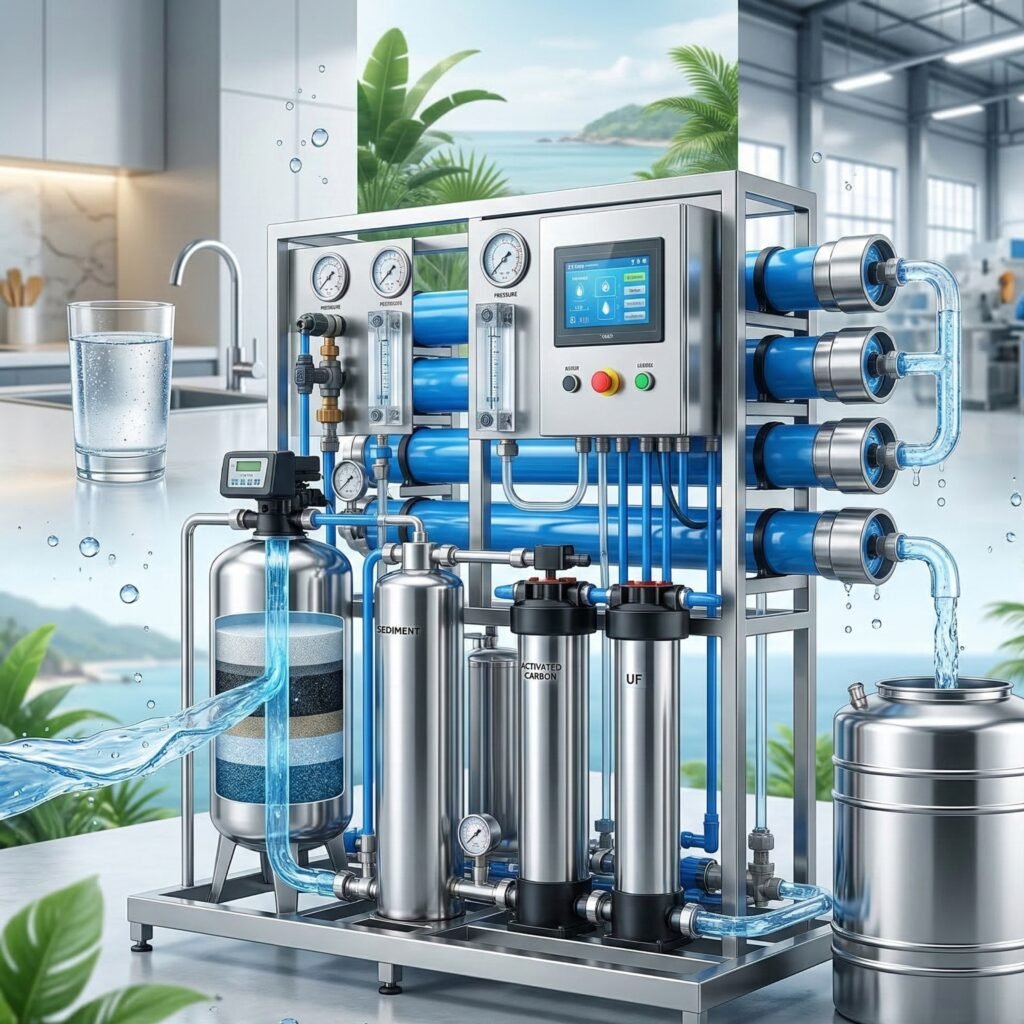
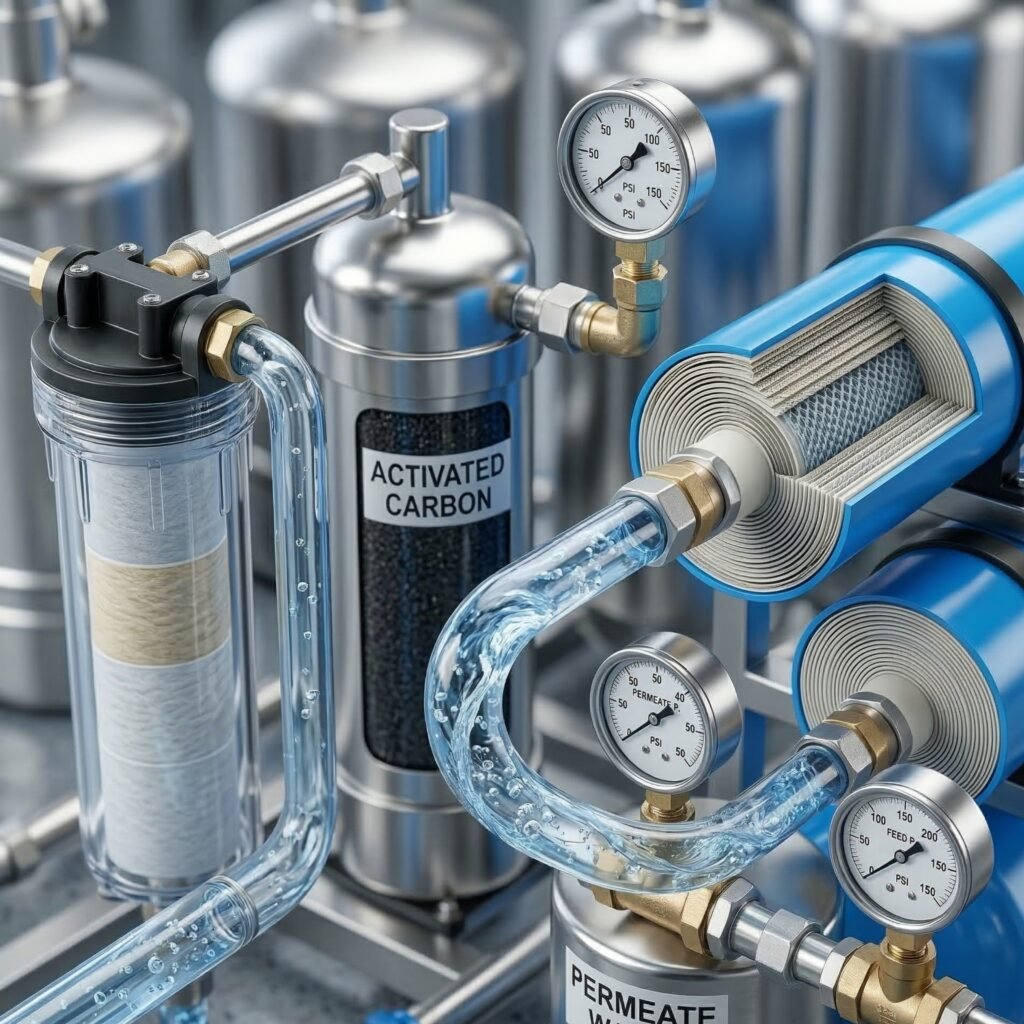
Municipal or KIADB supply (Nelamangala town and connected estates): Buffer storage sized for irregular supply – Multimedia filter – Activated carbon filter (chlorine) – 5-micron cartridge – RO – UV – SS storage
Tanker water (warehouses, new layouts, summer top-up): Test each tanker source – Settling or storage – Multimedia filter – Activated carbon – Antiscalant sized for the worst batch – 5-micron cartridge – RO – UV – SS storage
Hard borewell water (most estates and villages): Multimedia filter – Activated carbon – Industrial softener and/or antiscalant – 5-micron and 1-micron cartridges – RO – UV – SS storage
Fluoride or nitrate borewells (CGWB-flagged pockets and any bore that tests high): Full standard train – RO membranes selected for fluoride and nitrate rejection – Permeate verification at commissioning and on annual lab cycles – Mineral dosing only where the design allows, re-checked after dosing
Industrially impacted bores (near KIADB estates and the Peenya side): Full ion and heavy-metal analysis – Iron or manganese removal where needed – Multimedia – Carbon – Antiscalant tuned to the lab report – High-rejection membranes – Conservative recovery – Planned reject handling
Process polishing (boiler feed, paint pre-treatment, food and pharma contact): Standard train – Double-pass RO or mixed-bed polishing as required – UV – Online TDS monitoring
Community / CSR plants: Robust pre-treatment – RO – Enhanced UV – Optional UPI or coin dispensing – Pre and post water-quality file for CSR or JJM reporting – Multi-year AMC
Areas We Serve in and Around Nelamangala
Nelamangala and the NH-48 belt: Nelamangala town (ನೆಲಮಂಗಲ) | KSSIDC Nelamangala estate | Mahadevapura | Thyamagondlu (ತ್ಯಾಮಗೊಂಡ್ಲು)
Dabaspet KIADB belt: Dobbaspet / Dabaspete (ದಾಬಸ್ಪೇಟೆ) | Sompura (ಸೋಂಪುರ) | Awerahalli | Obalapura
Shivagange and the Kumudvathi side: Shivagange (ಶಿವಗಂಗೆ) | Gangenapura | Thippagondanahalli (ತಿಪ್ಪಗೊಂಡನಹಳ್ಳಿ) side
Adjacent areas:
- Peenya and Bengaluru city (south-east) – Industrial RO Plant Manufacturer in Bangalore | RO Water Treatment Plant Supplier in Bangalore
- Doddaballapur (ದೊಡ್ಡಬಳ್ಳಾಪುರ, north-east) – Best Industrial RO Plant Manufacturer in Doddaballapur (when live) | RO Water Treatment Plant Suppliers in Bengaluru Rural
- Magadi (ಮಾಗಡಿ, south) – Best Industrial RO Plant Manufacturer in Ramanagara
- Kunigal and Tumakuru (ಕುಣಿಗಲ್, ತುಮಕೂರು, west and north-west) – Best Industrial RO Plant Manufacturer in Tumakuru
- Devanahalli (ದೇವನಹಳ್ಳಿ, east) – Best Industrial RO Plant Manufacturer in Devanahalli (when live)
- Hoskote (ಹೊಸಕೋಟೆ, further east) – Best Industrial RO Plant Manufacturer in Hoskote (when live)
Elsewhere around Bengaluru: Chikkaballapur – Best Industrial RO Plant Manufacturer in Chikkaballapur; Kolar – Best Industrial RO Plant Manufacturer in Kolar
Manufacturing base: Kogilu Layout, Bengaluru – Our Presence
- Frequently Asked Questions
Do you manufacture the plant in Nelamangala or ship it from Bengaluru?
We build the skids at our Kogilu Layout unit in Bengaluru, then install and commission them on site anywhere in Nelamangala taluk, including Nelamangala town, Dabaspet, Sompura, Thyamagondlu and Shivagange. AMC and service follow after handover.
We run an engineering or auto-component unit in the Dabaspet KIADB area. What water do we need?
Most units need two streams: low-TDS, low-hardness water for washing, paint pre-treatment and cooling make-up, and safe drinking water for shift canteens. We usually design softener or antiscalant plus RO, sized to your peak shift demand, with AMC planned around your production calendar.
What is the typical TDS of Nelamangala groundwater?
There isn’t one number. CGWB puts EC in most of the taluk at 500-750 micromhos/cm, but its monitoring wells have read TDS of 265 and 467 mg/L in 2022, with EC spikes up to 2,200 µS/cm in some years. We design from your own lab report.
We already have a softener. Why do we need RO?
A softener removes hardness and stops scale. It does not lower TDS, chloride, nitrate or fluoride. In Nelamangala the softener often stays in place as pre-treatment to protect the RO membranes, because CGWB stations show hardness up to 290 mg/L.
Is fluoride a real design concern here?
For drinking water, yes, wherever your lab report shows it. CGWB has observed fluoride above the permissible limit in Nelamangala taluk, but no published taluk-wide number exists. We test fluoride on every panel and verify permeate fluoride at commissioning rather than assume it.
We run a food or cold-chain facility on NH-48. Can your RO plant feed our boiler and utilities?
Our RO plant can be the pre-treatment stage for boiler feed and can also supply humidification, ice, wash-down and drinking water. High-pressure boilers usually need demineralised water after RO, so we design the RO stage around your boiler maker’s specification and hand over commissioning data.
We use a borewell plus tankers in summer. Can one plant handle both?
Yes, if it is designed for the worse of the two. We test both sources, size pre-treatment for tanker variability, and set membranes and recovery for the borewell’s TDS and hardness. Standard skids are typically installed in about 2-5 working days after the site is ready (base, power, inlet and drain).
Can you build community RO plants for villages under CSR or JJM?
Yes. We cover needs assessment, lab testing, manufacture, installation, Kannada-friendly operator training, pre and post water-quality records, and AMC. See Best CSR Project RO Plants.
How much does an industrial RO plant cost in Nelamangala?
Indicative bands run from ₹85,000 for 250-500 LPH to ₹2.2-3.5 lakh+ for 2,000-4,000 LPH, with custom plants on assessment. Civil work, extra pre-treatment and automation change the final figure, which we confirm in writing after the water test.
Do you service RO plants installed by other suppliers?
Yes. We take on AMC and repairs for existing plants after an inspection and a water test.
Get a Site-Tested Industrial RO Proposal for Nelamangala
Share your location (industrial area, town or village), water source (municipal, KIADB, borewell, tanker or mixed) and peak LPH need. We will plan the feed-water test, design the pre-treatment, and send a written proposal.
📞 +91 76763 93939 | +91 97387 04753 📧 info@bangaloreaqua.com 🌐 bangaloreaqua.com 📍 Manufacturing: 107/209 2nd Cross, 4th Main Kogilu Layout, Bengaluru – 560064
Also See
- Industrial RO Plant Manufacturer in Bangalore
- Industrial RO System
- Best Industrial RO Plant Manufacturer in Tumakuru
- Best Industrial RO Plant Manufacturer in Ramanagara
- Best Industrial RO Plant Manufacturer in Chikkaballapur
- Best Industrial RO Plant Manufacturer in Kolar
- Best Industrial RO Plant Manufacturer in Devanahalli (when live)
- Best Industrial RO Plant Manufacturer in Doddaballapur (when live)
- Best Industrial RO Plant Manufacturer in Hoskote (when live)
- RO Water Treatment Plant Suppliers in Bengaluru Rural
- RO Water Treatment Plant Supplier in Bangalore
- Best CSR Project RO Plants
- Government Drinking Water Projects in India – Community RO Plants
- Community RO Plants for Tribal Areas
- Community RO Water Plant Karnataka
- Our Presence