
Best Industrial RO Plant Manufacturer in Ramanagara (2026)
DRINK SAFE AND PURE
Bangalore Aqua - Industrial RO Plant Manufacturer for Ramanagara District
Ramanagara sits about 50 km from Bengaluru with notified industrial land banks of more than 12,000 acres and two of Karnataka’s most active KIADB corridors – Bidadi (multi-phase) and Harohalli (phases 1-5, including a women entrepreneurs park) – plus growth across Kanakapura, Magadi and Channapatna (Invest Karnataka – Ramanagara). The district mixes automobiles and components, food and beverages, silk and textiles (including Asia’s largest cocoon market framing), appliance and light manufacturing, and logistics serving the Bengaluru metro – with named large-unit anchors such as Toyota Kirloskar Motor, Bosch, Toyota Kirloskar Auto Parts, A. O. Smith, Stovekraft and Toyota Tsusho on the Invest Karnataka profile.
For those factories, water treatment is shift-critical: hard, mineral-rich borewells scale wash and cooling loops; mixed tanker and scheme supplies change chemistry without notice; and campus drinking water has to stay consistent for large workforces. Bangalore Aqua and Energy Pvt. Ltd. industrial RO plant manufacturer Ramanagara systems from our Bengaluru facility and installs them across Ramanagara’s industrial nodes with commissioning and AMC.
📞 +91 76763 93939 | +91 97387 04753
📧 info@bangaloreaqua.com
🌐 bangaloreaqua.com | Related: Best RO Water Treatment Plant Suppliers in Bengaluru Rural (covers Kanakapura-side context)
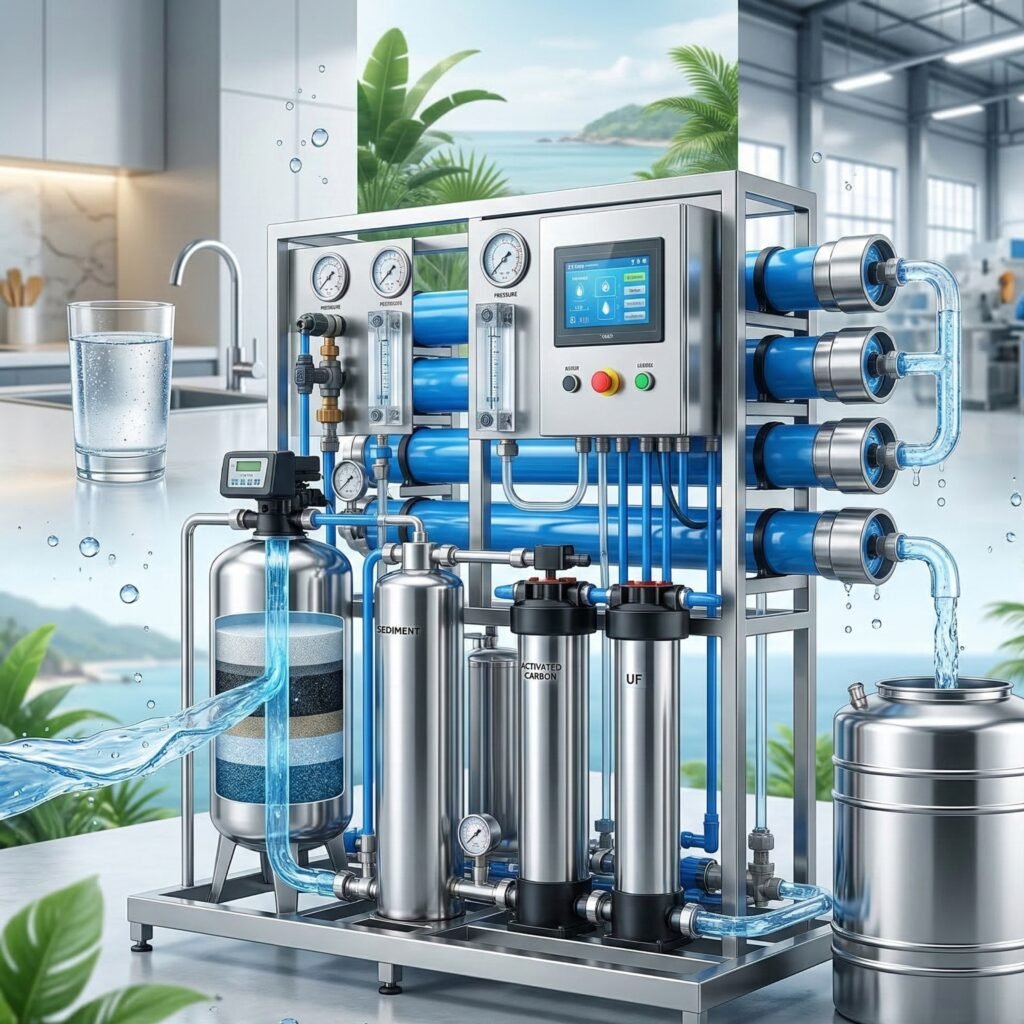
Ramanagara’s Water Quality: Bidadi Bore Chemistry, Harohalli Extraction Pressure and Mixed Supplies
Plot chemistry decides the skid – not a district slogan
Invest Karnataka lists groundwater and Kaveri (Cauvery) river water among district supply options. Harohalli expansion materials have also planned tertiary treated water from Bengaluru’s Vrushabhavathi / BWSSB systems for later phases – source plans and volumes, not a universal feed TDS for your shed (Harohalli Phase II & III EC entry).
Many Harohalli and Bidadi units still run on borewells. Local committee and news coverage around Harohalli has focused on groundwater extraction and fringe water stress – your static water level and chemistry remain plot-specific.
What published industrial-area data shows (Bidadi IA)
A 2022 groundwater study of Bidadi Industrial Area (n=46) reported:
- TDS about 91-1,265 mg/L (mean ~773)
- Total hardness about 80-1,648 mg/L (mean ~592); about 28.6% of samples above the permissible hardness limit used in that paper
- Fluoride about 0.01-0.23 mg/L (all within limits in that set)
Source: GeoJournal DOI / PDF.
Important on-page honesty: these figures are for Bidadi IA only – not a full Harohalli or district atlas. Harohalli, Kanakapura, Magadi and Channapatna plots still need their own lab test. We do not invent a “Ramanagara city TDS.”
Industrial takeaway
- Hardness is a first-order design driver on many Bidadi bores – softener / antiscalant before RO is routine
- TDS can run from low hundreds into four digits – membrane and recovery follow the lab, including summer peaks
- Fluoride was low in the published Bidadi set – still verify elsewhere in the district
- Tanker, Kaveri/scheme and tertiary-treated feeds each need their own pre-treatment logic (chlorine, organics, batch variability)
Industrial zone borewell profile (planning guide)
Concern | Planning note | Manufacturer implication |
Hardness | Wide Bidadi range; many samples hard | Softener and/or antiscalant before RO |
TDS | ~91-1,265 mg/L in Bidadi IA study | Match membrane/recovery to measured feed |
Fluoride (Bidadi set) | Low in published IA samples | Still test; do not assume district-wide |
Mixed tanker + bore | Common on Bengaluru fringe | Test each source type |
Tertiary / scheme feeds | Chlorine, organics, variable TDS | Carbon-heavy pre-treatment + RO polish |
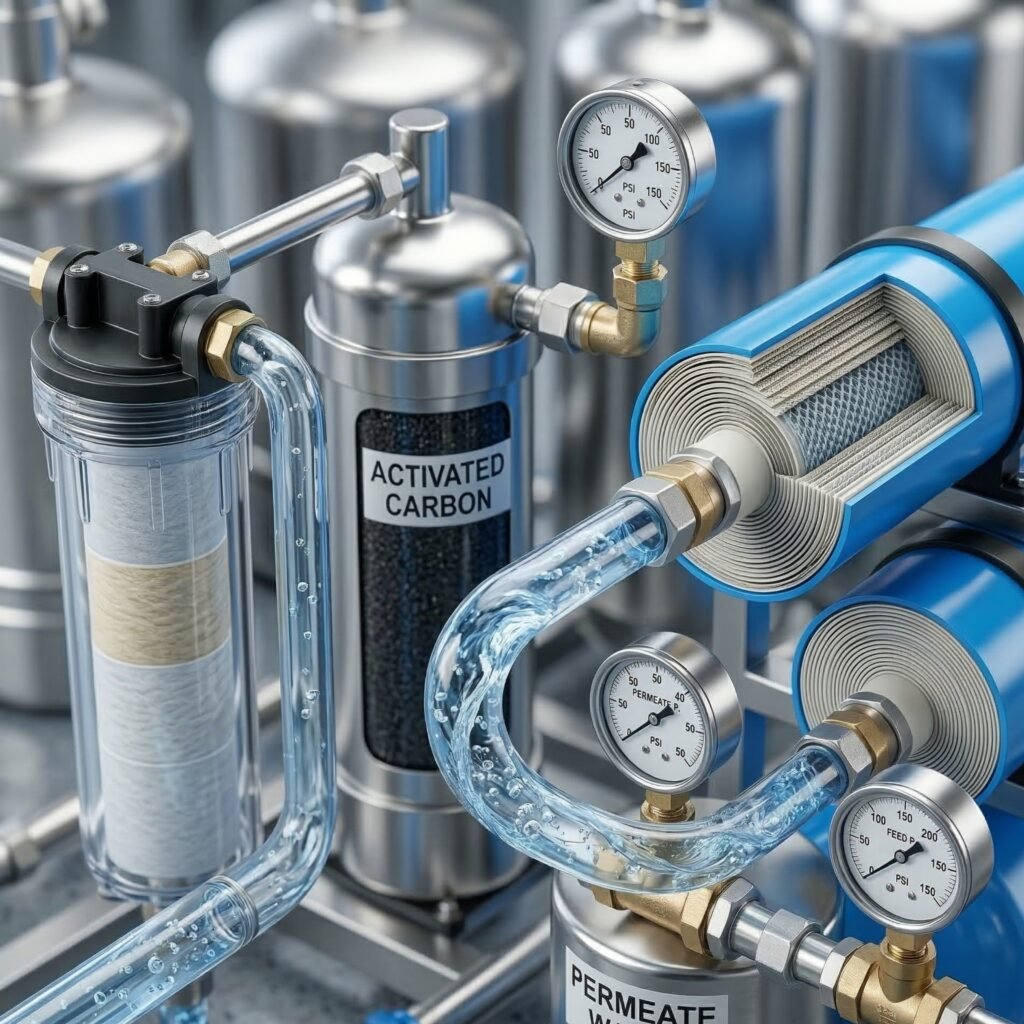
Ramanagara’s Key Sectors and Water Treatment Requirements
Bidadi Industrial Area – Auto, Components and Large Campuses
Bidadi’s multi-phase KIADB footprint is Ramanagara’s densest auto and engineering cluster. Peak shift demand, long distribution runs and dual specs (process vs drinking) are normal.
Hard or elevated-TDS bore water shows up as:
- Scale on wash, paint pre-treat and cooling utilities
- Unstable rinse quality on precision lines
- Workforce drinking water that fails taste or safety expectations
Typical requirement: Industrial RO 1,000-4,000 LPH; 4,000+ LPH for large campuses; PLC options; SS storage; AMC locked to production calendars.
Harohalli Industrial Area (Phases 1-5) – Diversified Manufacturing
Harohalli’s large phased acreage hosts diversified manufacturing, MSMEs and the women entrepreneurs park (Invest Karnataka acreage list). Bore dependence, future tertiary connections and growing campus sizes all affect skid design.
Typical requirement: 500-2,000 LPH for mid units; 2,000-4,000+ LPH for multi-line sheds; design that can accept a source change when scheme/tertiary supply arrives.
Textiles, Silk and Wet Process
Ramanagara’s textile and cocoon-market ecosystem includes wet utilities where TDS and hardness affect bath chemistry and rinse quality. Textile effluent is a separate ETP conversation; process and drinking RO still sit on the fresh-water side. Related context: STP vs ETP.
Typical requirement: Commercial / industrial RO 500-2,000 LPH for process and staff water; softener where scale dominates dyeing/finishing support loops.
Food Processing and Agro Units
Mango, banana and wider food processing need FSSAI-aware wash and product-contact water. Hardness and dissolved solids affect cleaning chemistry.
Typical requirement: 500-2,000 LPH; carbon + UV on contact/drinking streams.
Appliances, Light Manufacturing and Logistics Campuses
Water-heater / appliance manufacturing and warehouse campuses need reliable staff drinking water and controlled utility water for testing and cleaning.
Typical requirement: 250-1,000 LPH for logistics/light sites; 500-2,000 LPH where process rinse is continuous.
Hotels, Hospitals and Institutions
Ramanagara, Kanakapura and Channapatna institutions need guest / patient / student drinking water plus soft water for laundry and hot-water loops.
Typical requirement: 500-2,000 LPH; UV + RO; structured AMC.
Community and CSR Drinking Water Projects
Where companies or local bodies fund public drinking points on the Bengaluru fringe, Bangalore Aqua supplies community RO systems with operator training and AMC. See Community RO Water Plant Karnataka and Best CSR Project RO Plants.
Typical requirement: 500-1,000 LPH community plants; optional UPI/coin dispensing.
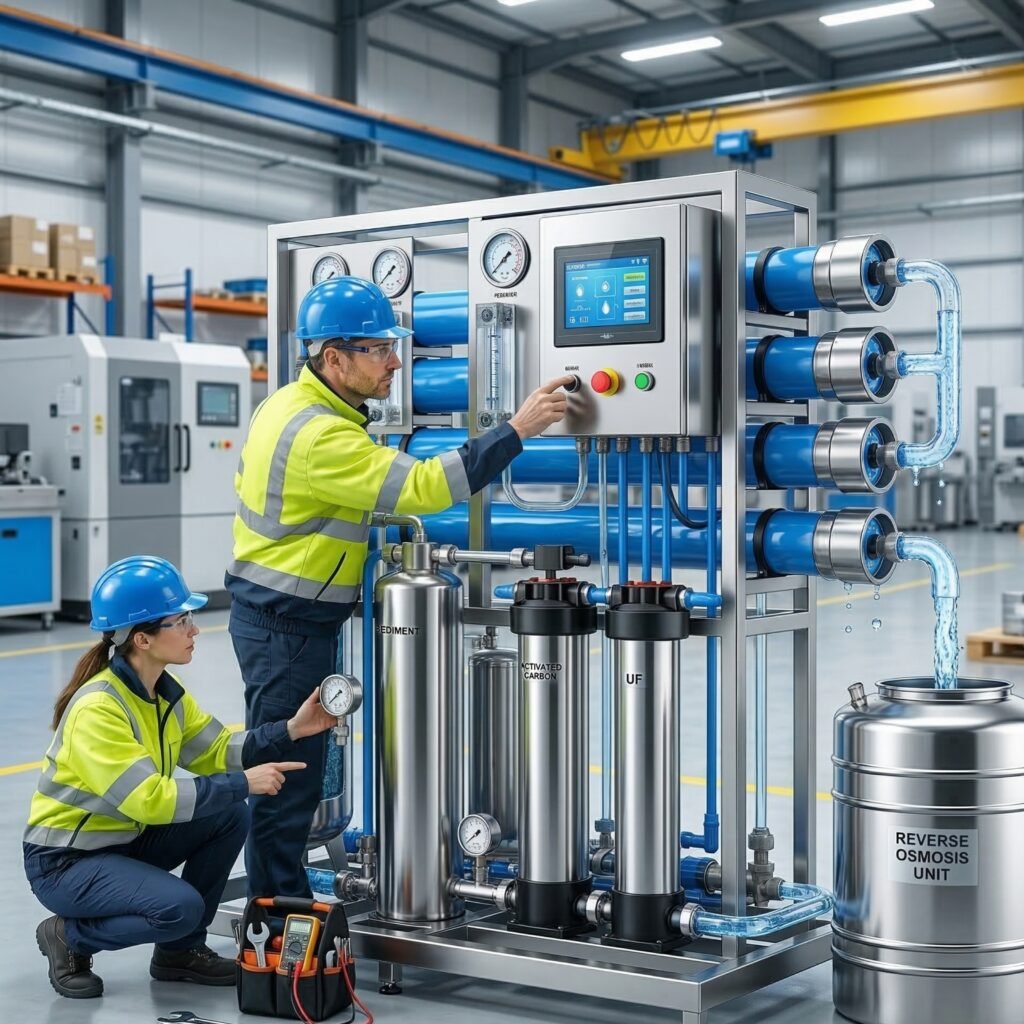
Industrial RO Plant Capacity and Pricing - Ramanagara 2026
Capacity | Application | Daily Output (indicative) | Indicative Cost |
250-500 LPH | Small MSME, hotel wing, logistics site | 2,000-5,000 L | ₹85,000 – ₹1.6 lakh* |
500-1,000 LPH | Medium factory, community plant | 4,000-10,000 L | ₹1.1 – ₹2.2 lakh* |
1,000-2,000 LPH | Harohalli / Bidadi mid campus, hospital | 8,000-20,000 L | ₹1.5 – ₹2.8 lakh* |
2,000-4,000 LPH | Large auto / multi-line industrial | 16,000-40,000 L | ₹2.2 – ₹3.5 lakh+* |
Custom / 5,000+ LPH | Township-scale campuses | As designed | On assessment |
*Indicative bands aligned with Bangalore Aqua’s published industrial capacity pricing (Industrial RO Plant Manufacturer in Bangalore). Final quote after water test, automation, membrane brand and site readiness. AMC slabs: confirm before publish.
Ramanagara manufacturing packages include feed-water testing and commissioning verification (TDS / flow / pressure) plus operator handover.
Pre-Treatment Configuration for Ramanagara
For Bidadi / Harohalli borewells (hardness + TDS driven):
Multimedia sediment filter – Activated carbon filter – Industrial water softener (quality resin, Fleck or Clack class) and/or anti-scalant dosing – 5-micron and 1-micron polishing cartridges – Industrial RO plant – UV disinfection – SS storage
For Kaveri / scheme water:
Sediment – Carbon (chlorine / organics) – Micron – RO – UV
For tertiary treated industrial supply (where connected):
Carbon-heavy organics/chlorine control – Micron – RO polish per lab – UV as required – Conservative recovery until chemistry is stable
For tanker top-up / mixed sources:
Test each source type – Duplex micron – Antiscalant sized to worst-case batch – RO – UV
For community / CSR plants:
Robust pre-treatment – RO – Enhanced UV as specified – Optional UPI/coin dispensing – Multi-year AMC
Coverage: Ramanagara District and Adjacent Areas
Within Ramanagara district: Ramanagara city | Harohalli IA (all phases) | Bidadi IA phases | Kanakapura | Magadi | Channapatna
Adjacent district coverage:
Bengaluru Urban / Rural fringe – metro southern and western approach
Tumakuru – north-west neighbour
Mandya – south-east agro-industrial neighbour
Manufacturing base: Yelahanka, Bengaluru – Our Presence
- Frequently Asked Questions
Do you manufacture for Harohalli and Bidadi factories?
Yes – design and build in Bengaluru, install across Harohalli and Bidadi KIADB plots with commissioning and AMC.
Why cite Bidadi numbers but not a Harohalli TDS?
Because we have a published 2022 Bidadi IA sample set with TDS/hardness/fluoride ranges. Harohalli lacks an equivalent cited atlas on this page – so we test your Harohalli bore instead of inventing a number.
Our Bidadi bore is very hard and scales wash equipment. Softener or RO?
Often both. Softener/antiscalant protect membranes and downstream metal; RO delivers low-TDS process and drinking water. Bidadi study hardness ran up to very high values in places – your lab report decides sizing.
We only have tanker water today but expect tertiary supply later. Can you design for that?
Yes – we design for the current source and plan a changeover train when scheme or tertiary water arrives, so you are not locked into the wrong carbon/chlorine logic.
What capacity do auto/component units usually need?
Often 1,000-4,000 LPH depending on process vs drinking split and shift peaks.
Install timeline?
About 2-5 working days for standard industrial skids after site readiness; longer for custom civil-heavy jobs.
AMC on another brand’s plant?
Often yes, after inspection – filters, membranes, cleaning and breakdown support.
How do we get a quote?
Call or WhatsApp +91 76763 93939 / +91 97387 04753 with industrial area, water source and peak LPH need.
Book Your Free Ramanagara Site Assessment
📞 +91 76763 93939 | +91 97387 04753
📧 info@bangaloreaqua.com
🌐 bangaloreaqua.com
📍 Manufacturing: 107/209 2nd Cross, 4th Main Kogilu Layout, Bengaluru – 560064Free site assessment, water testing and a complete proposal – for industrial, commercial and community water treatment projects in Ramanagara district.
About Bangalore Aqua | Our Karnataka presence | Gallery | Brochure
Also See:
- Industrial RO Plant Manufacturer in Bangalore
- Best RO Water Treatment Plant Suppliers in Bengaluru Rural
- Best Industrial RO Plant Manufacturer in Tumakuru (when live)
- Best Industrial RO Plant Manufacturer in Mandya (when live)
- STP vs ETP Difference
- Industrial RO System
- RO Water Treatment Plant Supplier in Bangalore
- Community RO Water Plant Karnataka
- Our Presence