
Best Industrial RO Plant Manufacturer in Kolar (2026)
DRINK SAFE AND PURE
Bangalore Aqua - Industrial RO Plant Manufacturer for Kolar District
Kolar sits on Bengaluru’s eastern industrial doorstep – historically the “Golden Land” of Kolar Gold Fields, today a dense map of KIADB nodes at Narasapura, Vemgal, Malur, Tamaka, Bangarpet and Jakkasandra, plus silk, milk and horticulture strength inland (Invest Karnataka – Kolar). Auto and component majors, electronics and smartphone manufacturing, aerospace and defence suppliers, agro and food units, textiles and granite/pharma MSMEs all need process and drinking water that survives hard rock aquifers and plot-to-plot chemistry swings.
It is also a district where groundwater is not a soft problem. Published Bangarpet and district work shows elevated TDS and hardness on many bores; the wider Kolar-Tumkur belt and named Kolar/Malur locations have documented fluoride concerns; KGF-adjacent hydrogeochemistry has reported very high dissolved solids and hardness in sample sets. For Kolar industry, RO manufacturing is operational infrastructure – and for fluoride-affected villages, it is a public-health intervention.
Bangalore Aqua and Energy Pvt. Ltd. manufactures industrial RO systems, commercial plants and community water solutions from our Bengaluru facility – with installation, commissioning and AMC across Kolar district.
📞 +91 76763 93939 | +91 97387 04753
📧 info@bangaloreaqua.com
🌐 bangaloreaqua.com
CSR / fluoride village context: Best CSR Project RO Plants
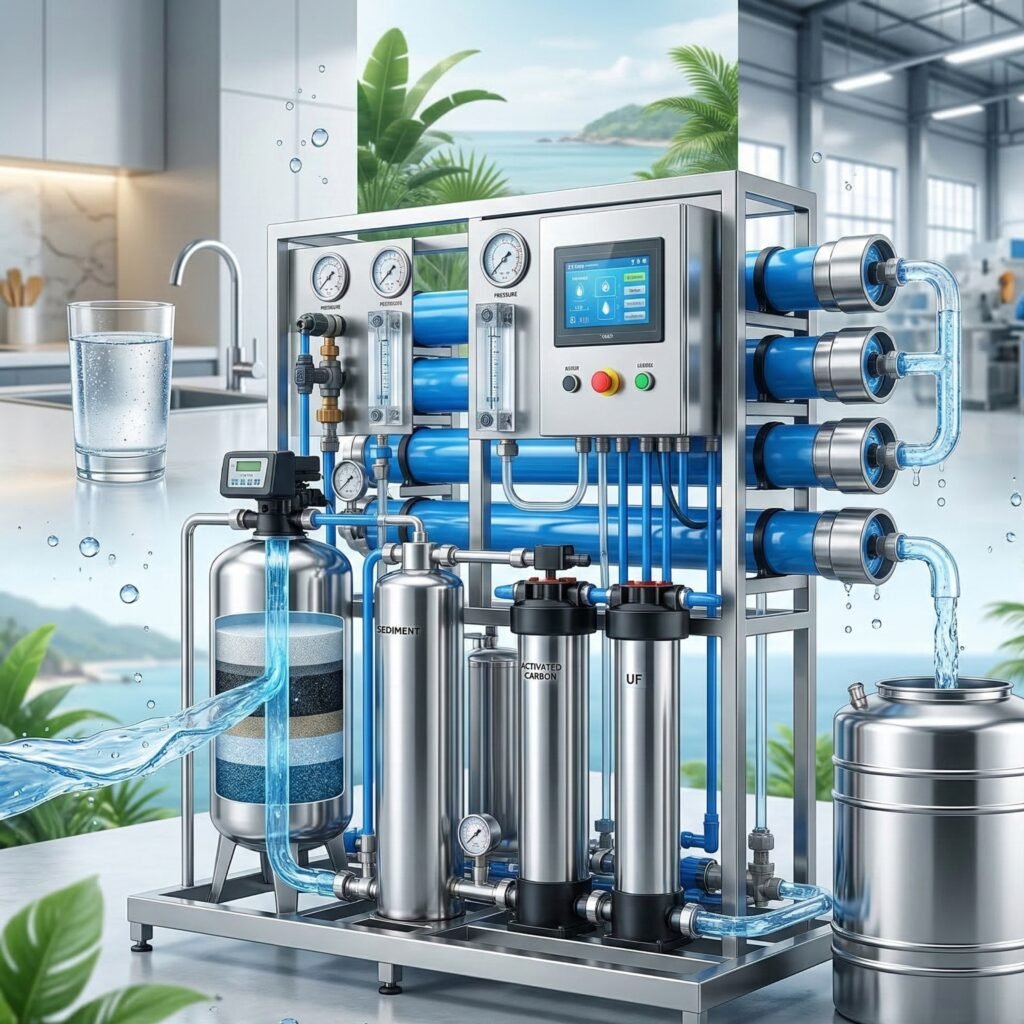
Kolar’s Water Quality: Hard Borewells, High Dissolved Salts and Fluoride Pockets
Not a single “Kolar city TDS”
Municipal, industrial-estate and KGF-side bores differ. Bangalore Aqua never sizes a Narasapura or Malur skid from a guessed town average – we start with site-specific feed-water testing.
What published studies report
Bangarpet taluk borewells (2019 paper): TDS about 384-1,024 mg/L (mean ~739) and hardness about 270-580 mg/L (RJLPCS PDF).
District hardness sampling across taluks has reported very high total hardness in places (seasonal maxima well above domestic comfort limits in published hardness work) – see hardness study DOI.
Kolar Gold Fields hydrogeochemistry: sample sets with TDS roughly 787-3,907 mg/L and hardness about 128-1,440 mg/L in published evaluation (KGF DOI) – KGF-adjacent sites need careful metal/mining-legacy screening alongside standard RO design, not TDS alone.
Fluoride: documented across parts of the Kolar-Tumkur belt (DOI); Kolar/Malur appraisals have flagged fluoride above BIS limits at named locations (Kolar-Malur appraisal). Bangalore Aqua’s CSR content notes fluoride-affected village programmes in Kolar and Chikkaballapur – Best CSR Project RO Plants.
Industrial takeaway:
- Hard, mineral-rich bores – softener / antiscalant before RO is routine engineering
- High TDS pockets (especially KGF-side sample ranges) – membrane and recovery must match measured feed
- Fluoride pockets – RO is the practical drinking-water path; softeners and UV do not remove fluoride
- Mining-adjacent chemistry – expand the lab panel beyond a strip TDS test when location warrants it
We cite ranges from published work. We do not invent a municipal Kolar TDS for SEO.
Industrial zone borewell profile (planning guide)
Concern | Planning note | Manufacturer implication |
Hardness | Often hard; district maxima can be extreme | Softener and/or antiscalant before RO |
TDS | Hundreds to low thousands mg/L in published sets | High-rejection membranes where feed is elevated |
Fluoride | Belt + named Kolar/Malur locations | RO + permeate F verification when lab shows risk |
KGF-adjacent | High TDS/hardness in published KGF sets; screen metals as advised | Full analysis first; staged pre-treatment |
Iron / turbidity | Plot-specific | Iron filter + multimedia as required |
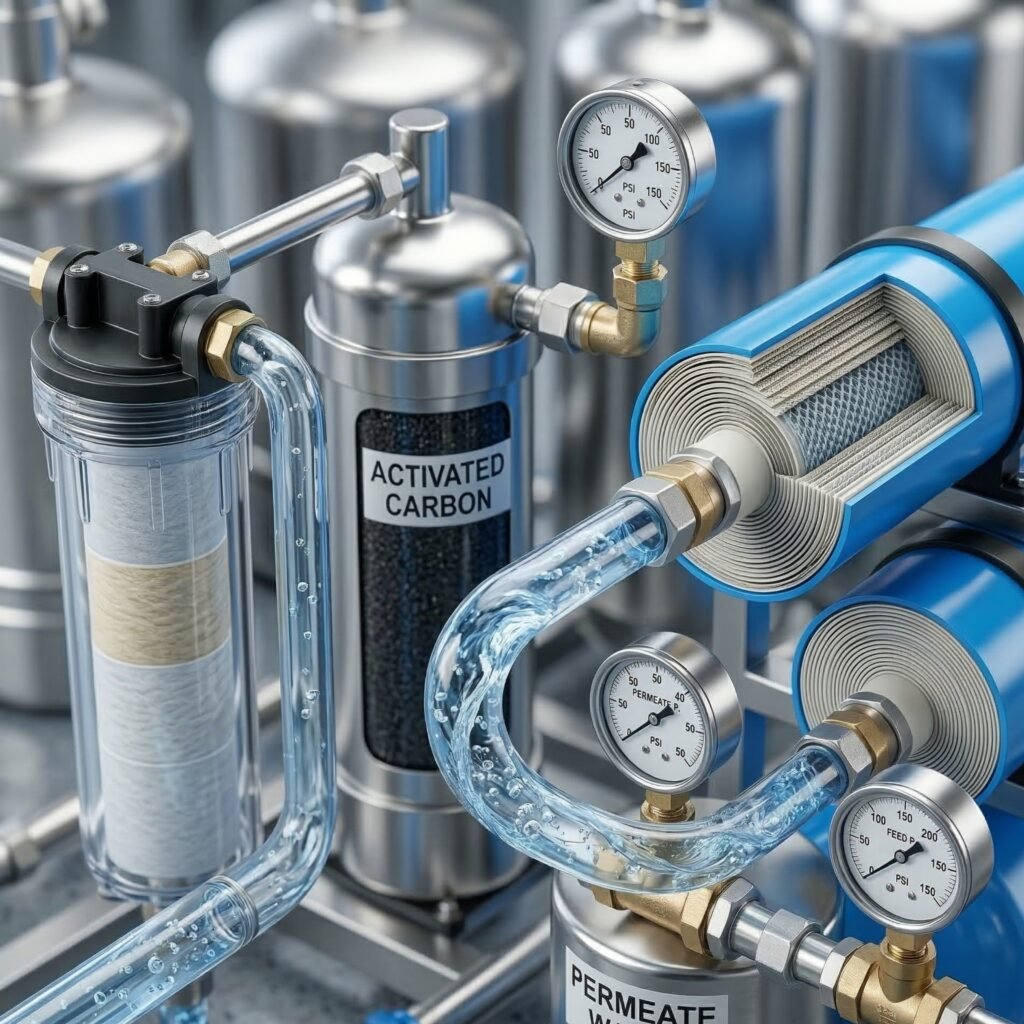
Kolar’s Key Sectors and Water Treatment Requirements
Narasapura and Vemgal – Auto, Electronics and Large IA Campuses
Narasapura and Vemgal are Kolar’s heavy industrial magnets – auto components, electronics/smartphone manufacturing and large KIADB footprints (Invest Karnataka – Kolar; MKAIA). Peak shift demand, long pipe runs and dual specs (process vs drinking) are common.
Hard or high-TDS bore water shows up as:
- Scale on wash, paint pre-treat and cooling utilities
- Unstable rinse quality on precision lines
- Workforce drinking water that fails safety expectations in F-affected or high-TDS zones
Typical requirement: Industrial RO 1,000-4,000 LPH; 4,000+ LPH for large campuses; PLC options; SS storage; AMC locked to production calendars.
Malur – Food, Pharma, Agro and Multi-Phase IA
Malur’s multi-phase industrial areas support food, agro, pharma utilities and general manufacturing. FSSAI-aware wash water and staff drinking water both matter.
Typical requirement: 500-2,000 LPH for mid units; 2,000-4,000 LPH for larger sheds; carbon + UV on contact/drinking streams.
KGF / Bangarpet – Aerospace, Defence Suppliers and Mining-Legacy Chemistry
Kolar Gold Fields and Bangarpet host specialised manufacturing and carry a hydrogeochemical record of elevated dissolved solids and hardness in published sample sets. Workforce drinking water and process utilities need design from a full lab panel.
Typical requirement: 1,000-4,000 LPH depending on campus; expanded feed analysis; robust pre-treatment before RO.
Food, Dairy, Silk and Textile Wet Utilities
Horticulture-linked processing, dairy and silk/textile wet process need consistent low-TDS water. Dyeing and finishing are sensitive to hardness, TDS and ionic interference.
Typical requirement: 500-2,000 LPH; softener where scale dominates; RO for dyeing and drinking where chemistry and fluoride risk require it.
Hotels, Hospitals and Campuses
Kolar city and Bangarpet institutions need reliable guest / patient / student drinking water plus soft water for laundry and hot-water loops.
Typical requirement: 500-2,000 LPH; UV + RO; structured AMC.
Fluoride-Affected Village and Community / CSR Projects
Kolar’s fluoride-affected habitations are among Karnataka’s most cited CSR drinking-water briefs. Community RO plants – with inlet/permeate fluoride documentation, Kannada-friendly operator training and multi-year AMC – are a direct intervention. Softeners and UV alone are not. See Best CSR Project RO Plants and Community RO Water Plant Karnataka.
Typical requirement: 500-1,000 LPH community plants; optional UPI/coin dispensing; annual permeate F verification where the project requires it.
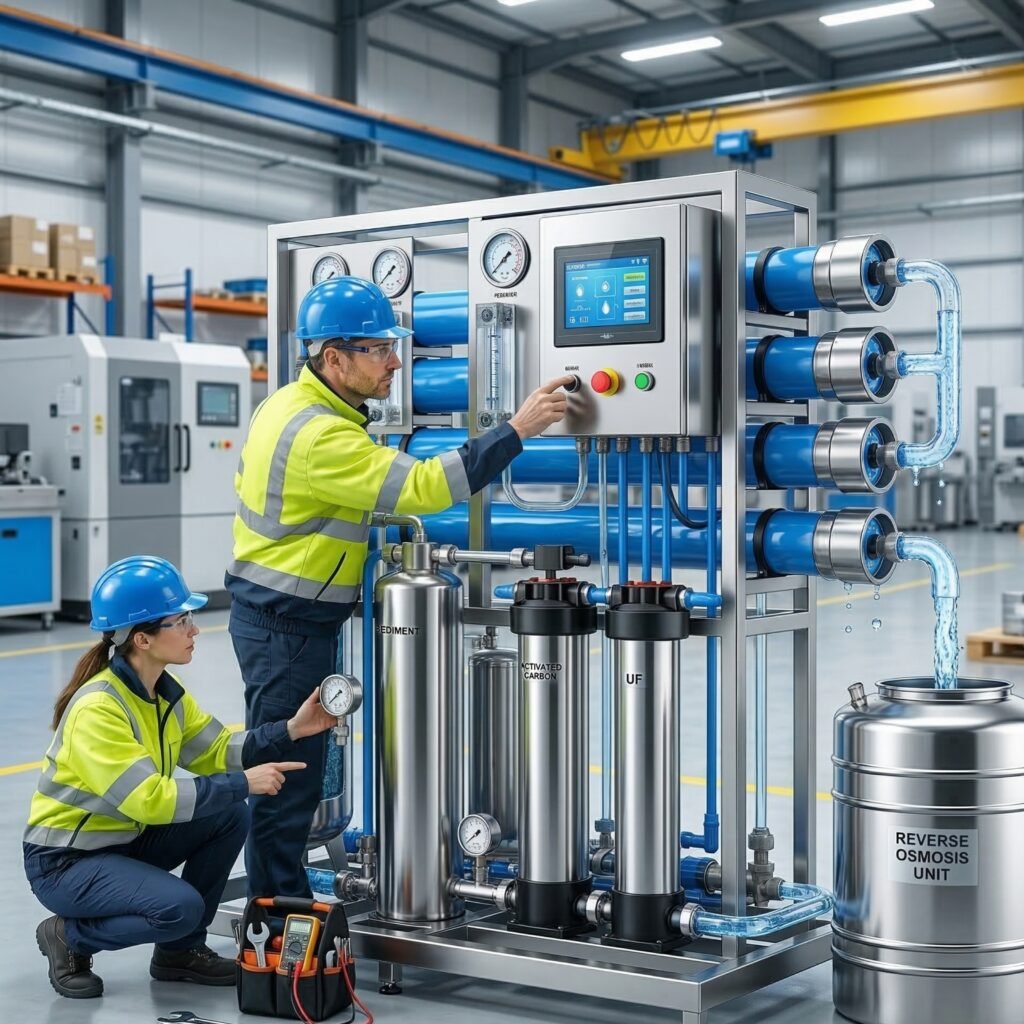
Industrial RO Plant Capacity and Pricing - Kolar 2026
Capacity | Application | Daily Output (indicative) | Indicative Cost |
250-500 LPH | Small MSME, hotel wing, dyeing utility | 2,000-5,000 L | ₹85,000 – ₹1.6 lakh* |
500-1,000 LPH | Medium factory, community plant | 4,000-10,000 L | ₹1.1 – ₹2.2 lakh* |
1,000-2,000 LPH | Narasapura / Malur mid campus, hospital | 8,000-20,000 L | ₹1.5 – ₹2.8 lakh* |
2,000-4,000 LPH | Large auto / electronics / KGF campus | 16,000-40,000 L | ₹2.2 – ₹3.5 lakh+* |
Custom / 5,000+ LPH | Multi-line industrial townships | As designed | On assessment |
*Indicative bands aligned with Bangalore Aqua’s published industrial capacity pricing (Industrial RO Plant Manufacturer in Bangalore). Final quote after water test, automation, membrane brand and site readiness. AMC slabs: confirm before publish.
Kolar manufacturing packages include feed-water testing and commissioning verification. Where fluoride or mining-adjacent chemistry is in scope, expanded lab panels and permeate checks are added to the commissioning pack.
Pre-Treatment Configuration for Kolar
For standard KIADB borewells (Narasapura, Malur, Vemgal – hardness + TDS):
Multimedia sediment filter – Activated carbon filter – Industrial water softener (quality resin, Fleck or Clack class) and/or anti-scalant dosing – 5-micron and 1-micron polishing cartridges – Industrial RO plant – UV disinfection – SS storage
For fluoride-documented rural / belt borewells:
Full standard train – RO with membrane selection aimed at high fluoride rejection (typically 90-96% class performance when healthy) – Enhanced UV as specified – Permeate fluoride verification at commissioning and on annual lab cycles where required – Kannada-friendly operator guidance for community plants
For KGF / mining-adjacent bores:
Full ion + metals panel as advised by lab – Iron/organics stages if indicated – Multimedia – Softener/antiscalant – Micron – RO – UV – Conservative recovery until chemistry is stable
For CMC / scheme water:
Sediment – Carbon (chlorine) – Micron – RO – UV
For community / CSR plants:
Robust pre-treatment – RO – Enhanced UV – Optional UPI/coin dispensing – Multi-year AMC – Pre/post water quality file for CSR reporting
Coverage: Kolar District and Adjacent Areas
Within Kolar district: Kolar city | Narasapura | Malur (all phases) | Vemgal | Tamaka | Jakkasandra | Bangarpet | KGF | Mulbagal | Srinivaspur
Adjacent district coverage:
Bengaluru Rural / Urban fringe – metro eastern approach
Chikkaballapur – northern neighbour / shared fluoride-CSR context
Chittoor (AP) border units – quoted case-by-case
Manufacturing base: Yelahanka, Bengaluru – Our Presence
- Frequently Asked Questions
Do you manufacture plants for Narasapura and Malur factories?
Yes. Skids are built in Bengaluru and installed across Narasapura, Malur, Vemgal, Jakkasandra, Bangarpet/KGF and Kolar city sites.
Our Bangarpet-area bore shows TDS near 800 mg/L and hard water scale. Is RO enough?
Published Bangarpet sampling put many bores in elevated TDS and hardness bands. Typical design is softener/antiscalant plus RO, sized from your lab report – not from a catalogue default.
Is fluoride a design input for Kolar plants?
Where lab results show elevated fluoride, yes. RO is widely used for defluoridation in this belt; softeners and UV do not remove fluoride. We verify permeate at commissioning.
We are near KGF and were told groundwater chemistry is “complicated.” What should we test?
Start with a full panel (TDS, hardness, F, Fe, major ions) and add metals/mining-legacy parameters if your consultant or lab advises – published KGF work shows very wide TDS and hardness ranges. We design only after that report.
What capacity suits auto and electronics units?
Often 1,000-4,000 LPH depending on process vs drinking split and shift peaks. Large campuses may need custom higher capacity.
Can CSR teams fund fluoride-safe village plants in Kolar through Bangalore Aqua?
Yes – needs assessment, lab testing, install, Kannada-friendly training and annual quality files. See Best CSR Project RO Plants.
Install timeline?
About 2-5 working days for standard industrial skids after site readiness; longer for custom civil-heavy jobs.
How do we get a quote?
Call or WhatsApp +91 76763 93939 / +91 97387 04753 with industrial area, water source and peak LPH need.
Book Your Free Kolar Site Assessment
📞 +91 76763 93939 | +91 97387 04753
📧 info@bangaloreaqua.com
🌐 bangaloreaqua.com
📍 Manufacturing: 107/209 2nd Cross, 4th Main Kogilu Layout, Bengaluru – 560064Free site assessment, water testing (including fluoride panel where relevant) and a complete proposal – for industrial, commercial and community water treatment projects in Kolar district.
About Bangalore Aqua | Our Karnataka presence | Gallery | Brochure
Also See:
- Industrial RO Plant Manufacturer in Bangalore
- Best Industrial RO Plant Manufacturer in Tumakuru (when live)
- Best Industrial RO Plant Manufacturer in Chikkaballapur (when live)
- Best RO Water Treatment Plant Supplier in Chikballapur
- Best CSR Project RO Plants
- Community RO Water Plant Karnataka
- RO Water Treatment Plant Supplier in Bangalore
- Industrial RO System
- Our Presence