
Best Industrial RO Plant Manufacturer in Davanagere (2026)
DRINK SAFE AND PURE
Bangalore Aqua - Industrial RO Plant Manufacturer for Davanagere, Karnataka's Textile Capital
Davanagere occupies a unique position in Karnataka’s industrial geography: it is literally the geographic heart of the state – equidistant from Bengaluru, Hubballi, and Mangaluru – and industrially the undisputed capital of Karnataka’s cotton textile sector. The “Manchester of Karnataka” title reflects a textile industry that spans cotton ginning, spinning, weaving, and processing, and that has been drawing water-intensive manufacturing investment to the Tungabhadra river basin for generations.
But Davanagere’s industrial identity extends beyond cotton. Iron and steel pipe manufacturing, tobacco processing, groundnut and sunflower oil extraction, rice milling, and a growing general manufacturing base make Davanagere one of central Karnataka’s most industrially diverse cities. Each of these sectors has specific water treatment requirements – and in a city where borewell water quality in industrial zones presents real challenges for process-sensitive operations, professional industrial water treatment is an operational necessity.
Bangalore Aqua and Energy Pvt. Ltd. manufactures and supplies industrial RO plants, commercial water treatment systems, water softeners, and community water plants for Davanagere’s industrial, commercial, and community sector – from our Bengaluru manufacturing base with committed central Karnataka field service coverage.
📞 +91 76763 93939 | +91 97387 04753 📧 info@bangaloreaqua.com 🌐 bangaloreaqua.com/best-ro-water-treatment-plant-supplier-in-davanagere/
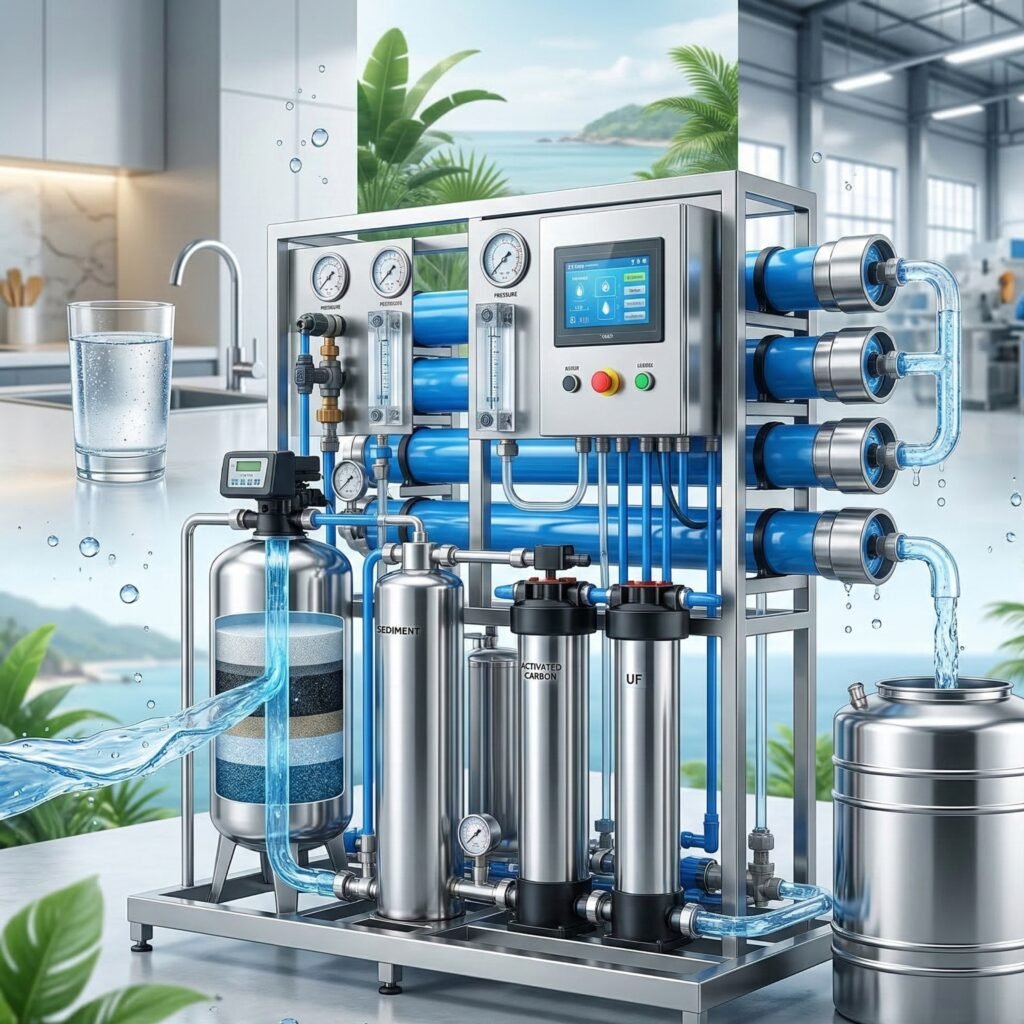
Davanagere's Water Quality: Central Karnataka's Industrial Borewell Reality
Davanagere sits in the Tungabhadra river basin – a geographical position that gives the city access to river-source municipal water with relatively moderate TDS compared to North Karnataka’s more arid districts. Municipal supply from the Tungabhadra typically carries TDS of 150–350 mg/L with moderate hardness.
However, Davanagere’s industrial reality is significantly more demanding than its municipal water quality suggests:
Industrial zone borewell dependence: Davanagere’s textile mills, steel fabrication units, oil mills, and processing plants consume volumes of water that far exceed municipal allocation. Borewell supplementation is universal across the KIADB industrial estates – and Davanagere district borewell water, away from the river recharge zone, typically shows TDS of 400–900 mg/L and hardness of 250–550 mg/L as CaCO₃.
Textile dyeing water requirements: Cotton textile dyeing – the most water-sensitive operation in Davanagere’s textile sector – requires process water significantly purer than even the best municipal supply. The hardness that allows dyeing on silk in other Karnataka textile clusters creates shade inconsistency and equipment scaling in cotton reactive dyeing operations. TDS above 200 mg/L in dyeing water creates dye precipitation and colour fastness problems.
Fluoride presence in some taluk sources: Parts of Davanagere district share the central Karnataka fluoride risk profile – some borewell sources, particularly in the Harihar and Jagalur taluks, carry fluoride above 1.0 mg/L safe limit. Where fluoride is elevated, RO treatment (achieving 90–96% fluoride rejection) is the definitive solution.
Seasonal variation: Peak summer (March–May) sees Davanagere’s borewell water quality deteriorate as water tables drop and mineral concentrations rise. Systems must be specified for worst-case summer conditions.
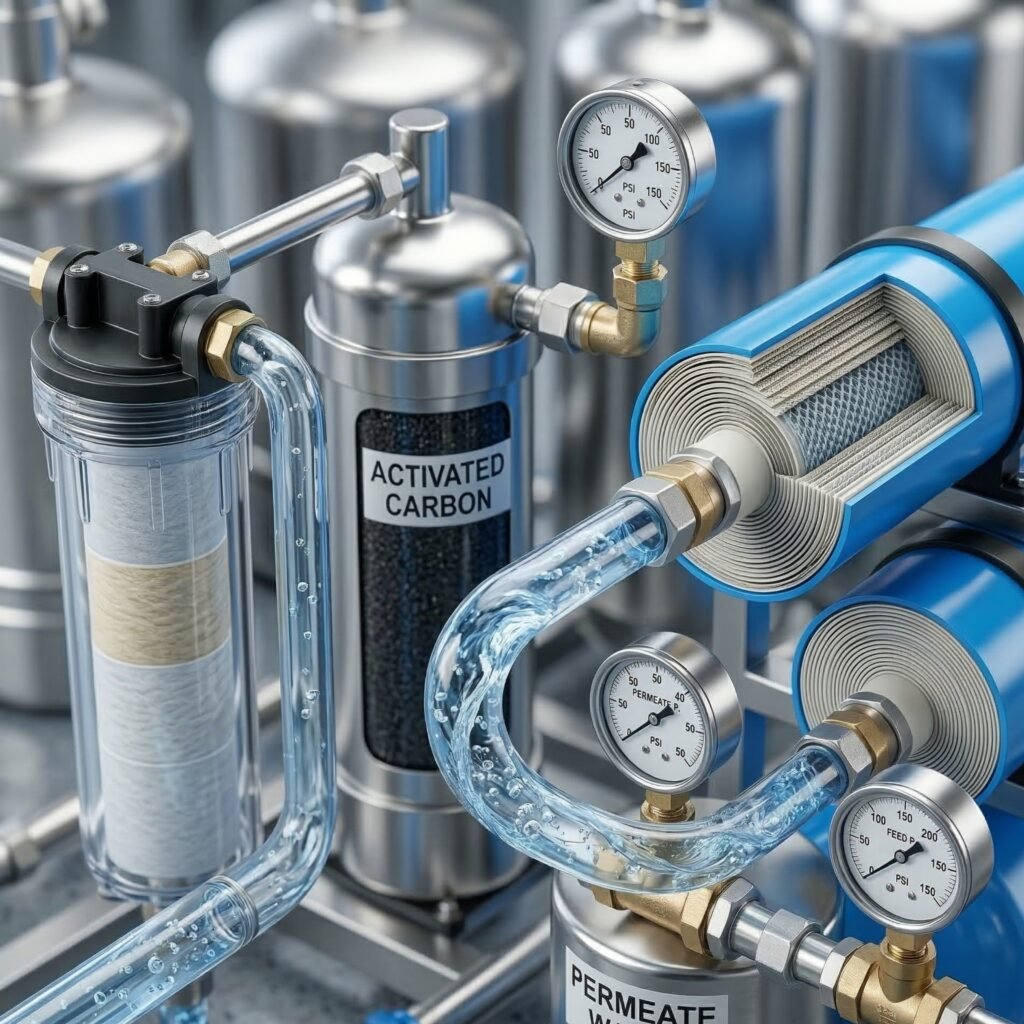
Davanagere's Key Sectors and Water Treatment Requirements
Cotton Textile Industry – The Manchester of Karnataka
Davanagere’s textile sector is the city’s industrial foundation. The concentration of cotton spinning mills, weaving units, and textile processing operations along the city’s industrial corridor makes Davanagere one of Karnataka’s most significant textile manufacturing centres.
Spinning mills: Davanagere’s cotton spinning mills convert raw cotton into yarn for downstream weaving and knitting operations. Spinning is not particularly water-intensive, but the mill’s workforce (often 300–1,000 workers per mill) has substantial drinking water requirements under the Factories Act Section 18 – and the quality of that water in Davanagere’s industrial zone borewell context requires treatment.
For a 500-worker spinning mill drawing from a borewell at 650 mg/L TDS and 380 mg/L hardness: an industrial RO plant of 1,000 LPH for workforce drinking water, with a full pre-treatment train including softener, delivers BIS-compliant safe water throughout the production day.
Textile dyeing and processing: Davanagere’s fabric processing sector – where cotton yarn and grey fabric receive dyeing and finishing before sale – is the most water-quality-sensitive segment of the textile chain. Reactive cotton dyeing requires:
- Process water TDS below 200 mg/L (to prevent dye precipitation and salt crystallisation on fabric)
- Process water hardness below 50 mg/L as CaCO₃ (to prevent calcium-dye complexes that create uneven shade distribution)
- Iron below 0.1 mg/L (to prevent iron catalysis of dye degradation and fabric staining)
From Davanagere borewell water at 500–900 mg/L TDS and 250–550 mg/L hardness, achieving these specifications requires: water softener (hardness removal) + industrial RO plant (TDS reduction) as the core treatment train. See Bangalore Aqua’s TDS standards guide for textile process water specifications.
Typical requirement: Water softener + industrial RO 2,000–10,000 LPH for textile dyeing process water; separate industrial RO 500–1,000 LPH for workforce drinking; commercial RO plant for office and canteen
Steel and Pipe Manufacturing
Davanagere has a significant steel and steel pipe manufacturing presence – including ERW (Electric Resistance Welded) steel pipe manufacturers supplying to construction, infrastructure, and agricultural irrigation markets. Steel manufacturing and pipe production are water-intensive operations involving cooling, surface treatment, and hydraulic testing.
Cooling system water: Steel mill cooling systems – cooling water for induction and electric arc furnaces, quenching baths, and hydraulic systems – require water with controlled hardness and corrosion inhibitor treatment. Davanagere’s moderately hard borewell water, without treatment, scales cooling system heat exchangers and reduces their efficiency measurably within one to two operating seasons.
Pipe hydraulic testing: Finished steel pipes are hydrostatically pressure-tested before delivery. Test water quality – particularly its cleanliness and freedom from suspended particulate – affects test reliability and the pipe’s internal cleanliness at delivery.
Workforce drinking water: Large steel mill workforces (400–800+ workers) require industrial-scale drinking water treatment for Factories Act Section 18 compliance.
Typical requirement: Industrial water softener for cooling system makeup; industrial RO 1,000–3,000 LPH for workforce; SS304 stainless steel tanks for purified water storage
Oil Mills – Groundnut and Sunflower Processing
Davanagere district is a significant groundnut and sunflower oil producing area – with extraction mills processing the oilseeds grown across central Karnataka’s agricultural belt. Oil extraction (solvent extraction or expeller pressing) uses water for oil-water separation, steam stripping, and deodorisation in refining operations.
Food-grade cooking oil processing must use FSSAI-compliant water – safe, potable, and free of contaminants that could carry into the oil product. Oil mill boilers for steam production require softened feed water.
Typical requirement: Water softener for boiler feed water; commercial or industrial RO plant 250–1,000 LPH for FSSAI-compliant process and drinking water; FSSAI food processing documentation
Rice Mills and Agro-Processing
Davanagere district produces significant quantities of paddy – and the rice milling cluster in and around Davanagere processes this paddy into rice for Karnataka’s consumption. Rice milling uses water for paddy washing and parboiling (in the case of parboiled rice production).
Parboiling – a process where paddy is soaked, steamed, and dried before milling – requires large volumes of clean water for the soaking tanks. Water quality (particularly freedom from iron and bacteriological contamination) affects parboiled rice colour and quality. FSSAI food processing compliance applies.
Typical requirement: Commercial or industrial RO plant 500–2,000 LPH; iron removal where borewell iron is elevated; FSSAI food processing compliance documentation
Tobacco Processing (Harihar and Adjacent Zones)
The Harihar taluk of Davanagere district is associated with tobacco processing operations connected to Karnataka’s tobacco growing belt. Tobacco processing – curing, threshing, and grading – uses water for equipment cleaning and humidification. Water quality affects the final product quality and equipment longevity.
Typical requirement: Commercial RO plant 250–500 LPH; workforce drinking water treatment
Hospitals and Healthcare (SSIMS, Bapuji Hospital, District Hospital)
Davanagere is a significant healthcare hub for central Karnataka – with SS Institute of Medical Sciences (SSIMS/DIMS), Bapuji Hospital and Research Centre, and JJM Medical College collectively making Davanagere one of Karnataka’s important medical education and healthcare centres.
For Davanagere’s medical institutions, water treatment requirements span the full clinical scope: drinking water RO, CSSD and autoclave water softening, dialysis AAMI-compliant systems, and NABH compliance documentation. See hospital water treatment solutions.
Davanagere University and Educational Institutions
Davanagere University and the city’s large college cluster (JJM Medical College, SDM Institute of Technology, and numerous undergraduate colleges) constitute a significant institutional water consumer. Campus RO plants for student hostels and canteens, laboratory water systems for science and engineering facilities, and FSSAI-compliant canteen water are standard requirements.
Typical requirement: Community or institutional RO plant 500–2,000 LPH per large campus block; laboratory water systems; water dispensers throughout campus
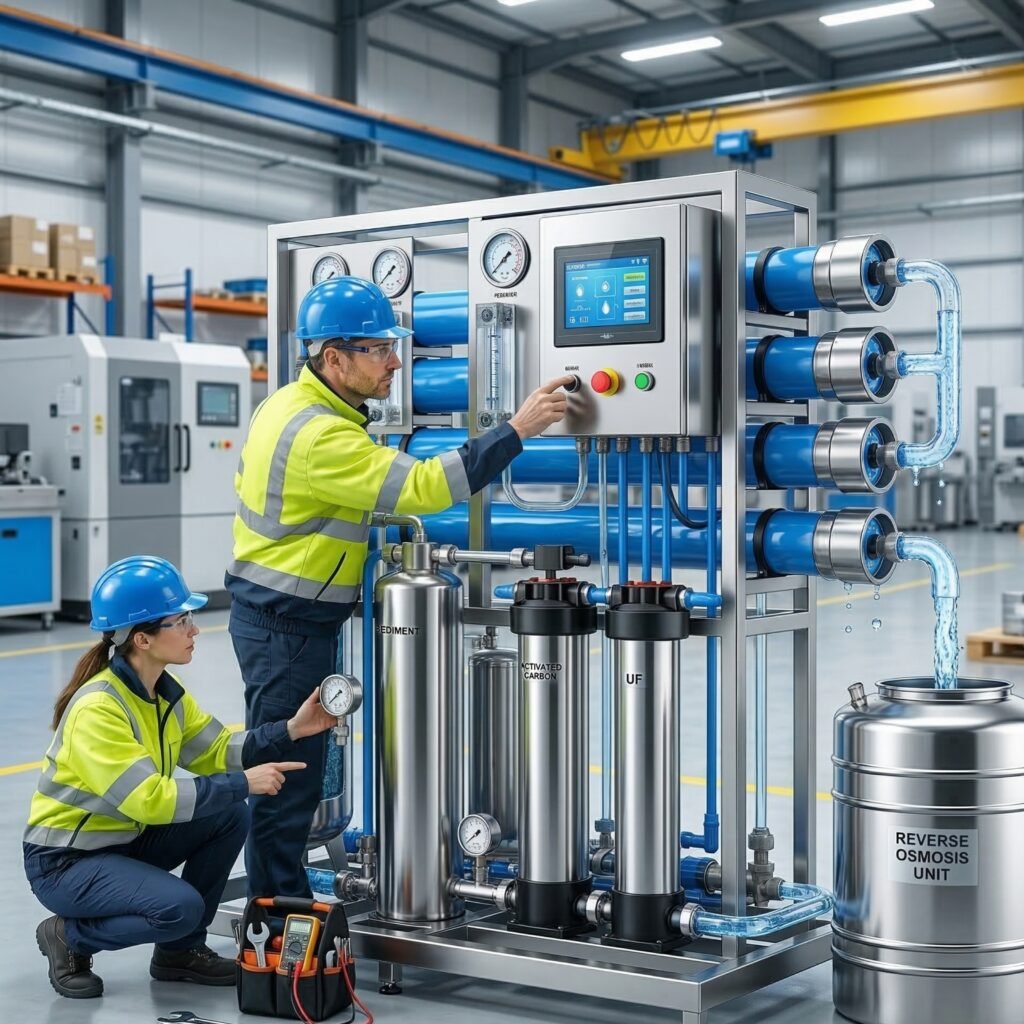
Industrial RO Plant Capacity and Pricing - Davanagere 2026
Capacity | Application | Daily Output | Indicative Cost |
250–500 LPH | Oil mill, small factory, commercial | 2,000–5,000 L | ₹1.5–₄.5 lakh |
500–1,000 LPH | Rice mill, medium factory, hospital | 4,000–10,000 L | ₹4–₁0 lakh |
1,000–2,000 LPH | Spinning mill (workforce), hospital, college | 8,000–20,000 L | ₹8–₁8 lakh |
2,000–5,000 LPH | Textile dyeing (process water), large factory | 16,000–50,000 L | ₹18–₅0 lakh |
5,000–10,000 LPH | Large textile complex, industrial township | 40,000–100,000 L | ₹40–₹1 crore+ |
Davanagere textile sector systems include softener pre-treatment as standard – essential for dyeing process water meeting the <50 mg/L hardness specification that reactive cotton dyeing requires. Contact Bangalore Aqua for a site-specific proposal after NABL water testing.
Pre-Treatment Configuration for Davanagere
For standard Davanagere borewell applications:
- Multimedia sediment filter
- Activated carbon filter
- Industrial water softener (Fleck or Clack control valve, quality resin)
- Anti-scalant dosing
- 5-micron and 1-micron cartridge pre-filters
- Industrial RO plant
- UV disinfection
- SS304 storage
For textile dyeing process water (additional specification):
- Softener sized for the full dyeing machine feed flow
- Anti-scalant dosing optimised for calcium carbonate at Davanagere’s typical alkalinity levels
- RO configured for 95%+ hardness rejection and TDS below 150 mg/L
- Online TDS and conductivity monitoring at the process water outlet
- Backup anti-scalant dosing verified against softener regeneration cycle timing
For fluoride-affected borewell sources (Harihar, Jagalur taluks):
- Standard pre-treatment plus
- NABL fluoride test confirmation before specification
- RO membrane selection optimised for high fluoride rejection (95–96%)
- Post-commissioning fluoride level verification in permeate
Coverage: Davanagere District and Adjacent Areas
Within Davanagere district: Davanagere city | Harihar (steel, tobacco) | Jagalur | Channagiri | Harpanahalli | Nyamathi
Adjacent district coverage:
- Shivamogga | Chitradurga | Ballari | Haveri | Gadag
Adjacent District Coverage from the Dharwad Service Hub
Bangalore Aqua’s Dharwad service coverage extends to the full North Karnataka region:
- Hubballi – see Hubballi RO plant supplier
- Gadag – see Gadag RO plant supplier
- Belagavi – see Belagavi RO plant supplier
- Haveri – agricultural and light industrial
- Bagalkot – see Bagalkot RO plant supplier
- Uttara Kannada (Karwar) – see Uttara Kannada RO plant page
- Frequently Asked Questions
Our textile dyeing unit in Davanagere is having shade inconsistency problems. Could the water be causing this?
Yes – water quality is one of the most common and least suspected causes of shade inconsistency in reactive cotton dyeing. High hardness (above 50 mg/L as CaCO₃) causes calcium and magnesium ions to complex with reactive dyes, creating variable dye uptake across the fabric width. High TDS (above 200 mg/L) changes the ionic strength of the dye bath, affecting dye-fibre bonding kinetics. Davanagere’s borewell water at 300–550 mg/L hardness and 500–900 mg/L TDS is a direct cause of shade inconsistency if used untreated in the dye bath. The solution: water softener upstream of an industrial RO plant, producing dyeing water below 50 mg/L hardness and below 150 mg/L TDS. Contact Bangalore Aqua for a Davanagere dyeing unit water assessment.
We are a spinning mill in Davanagere with 600 workers. What is our Factories Act obligation for drinking water?
Under the Factories Act 1948, Section 18, you must provide “wholesome” drinking water at accessible points throughout the factory. With 600+ workers, you also have an obligation to provide effective means of cooling drinking water during hot weather. Davanagere’s borewell water at 500–900 mg/L TDS is not wholesome by BIS 10500 standards. An industrial RO plant of 500–1,000 LPH connected to dispensing points at the production floor produces BIS-compliant safe drinking water – fulfilling your Factories Act Section 18 obligation. Bangalore Aqua provides NABL water quality certification at commissioning for compliance documentation.
Our oil mill in Davanagere has boiler scaling problems. What treatment do we need for boiler feed water?
For a low-pressure steam boiler (below 10 bar, typical for oil mill operations), feed water should have hardness below 30 mg/L as CaCO₃. From Davanagere’s borewell water at 250–550 mg/L, a water softener on the boiler feed line removes calcium and magnesium – preventing carbonate scale in the boiler tubes. For medium-pressure boilers (10–30 bar), add an RO plant downstream of the softener for TDS reduction. Contact Bangalore Aqua for a Davanagere oil mill boiler assessment.
Does Bangalore Aqua cover the Harihar industrial area in Davanagere district?
Yes – Harihar is approximately 15 km from Davanagere city and is fully within our Davanagere district service coverage. Harihar’s steel pipe manufacturing and tobacco processing operations are both within the scope of our industrial water treatment service. Contact us at +91 76763 93939 to arrange a Harihar site assessment.
What is your service response time for Davanagere?
Davanagere is approximately 260–270 km from Bengaluru via NH-48 (Davangere–Bengaluru highway) – approximately 3.5–4 hours. For AMC customers in Davanagere, quarterly service visits are scheduled from our Bengaluru base. Emergency parts dispatch reaches Davanagere same-day or next-working-day by courier. For urgent field service, our team can reach Davanagere within 4–5 hours of dispatch. Remote troubleshooting support (phone/WhatsApp/video) is available immediately for any urgency.
Book Your Free Shivamogga Site Assessment
📞 +91 76763 93939 | +91 97387 04753 📧 info@bangaloreaqua.com 🌐 bangaloreaqua.com/ro-water-treatment-plant-supplier-in-shivamogga/ 📍 Manufacturing: 107/209 2nd Cross, 4th Main Kogilu Layout, Bengaluru – 560064
Free Shivamogga site assessment, NABL-accredited water quality testing, and a complete proposal – for industrial, commercial, institutional, and community water treatment projects.
About Bangalore Aqua | Our Karnataka presence | Gallery | Brochure
Also See:
- RO Water Treatment Plant Supplier Shivamogga
- Community RO Plants for Tribal Areas
- CSR and Community Development Water Projects
- RO Water Treatment Plant Chikkamagaluru
- Best Industrial RO Plant Manufacturer Bangalore
- Water Treatment Solutions for Hospitals
- Industrial & Commercial RO Plant AMC Services