Most people who own a domestic RO water purifier have a vague sense that it “cleans” the water. They know there are filters inside. They know the service technician comes once a year to change something. They know the water on the RO tap tastes different from the one on the main kitchen line.
But very few people actually understand what is happening inside that white box mounted above or below their kitchen sink – stage by stage, step by step – as raw water enters one end and clean, safe drinking water comes out the other.
That gap in understanding matters more than it might seem. If you do not know what each stage does, you do not know when it is failing. You do not know which filter to prioritise replacing. You do not understand why your water quality degrades gradually rather than all at once when filters age. And you definitely do not know why buying a cheap six-stage unit with a flashy “alkaline” label may be giving you worse water than a simple, well-maintained four-stage unit with quality membranes.
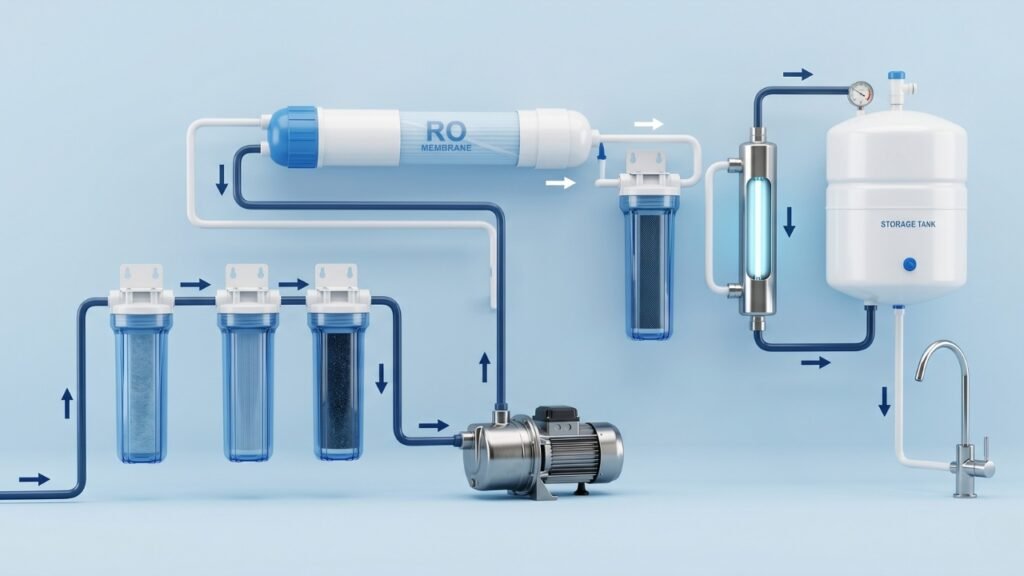
This guide fixes that. We are going to walk through the complete domestic RO water purifier flow diagram – every stage, every component, every function – in plain language that anyone can understand. By the end, you will know more about your RO system than most service technicians, and you will be equipped to make smarter decisions about buying, maintaining, and replacing your water purifier.
What Is a Domestic RO Water Purifier?
A domestic RO water purifier is a point-of-use water treatment system that uses Reverse Osmosis (RO) technology – along with several supporting filtration and disinfection stages – to remove dissolved salts, heavy metals, bacteria, viruses, and other contaminants from your tap or borewell water.
The “domestic” designation distinguishes these systems from commercial RO plants (which serve restaurants, offices, and small industries at 100–2,000 LPH capacity) and industrial RO plants (which serve factories and large facilities at 1,000–50,000+ LPH capacity). A domestic RO unit typically produces 8–15 litres of purified water per hour – enough for a family of four’s daily drinking and cooking needs.
In India, domestic RO purifiers have become almost universally necessary because:
- Indian groundwater – particularly borewell water – carries very high Total Dissolved Solids (TDS), often 300–2,000 mg/L in major cities like Bangalore, while the BIS safe limit for drinking water is 500 mg/L
- Municipal water treatment does not remove dissolved salts, heavy metals, or all biological contaminants – it primarily treats for clarity and bacterial safety at the city level
- Urban water infrastructure (pipes, overhead tanks, apartment plumbing) frequently recontaminates water between the treatment plant and your tap
RO is the only household-level technology capable of reducing TDS. This makes it the cornerstone of safe domestic water purification in most Indian cities.
The Key Parameters: What a Good RO Purifier Must Achieve
Before walking through the flow diagram, it helps to understand what the system is trying to achieve in measurable terms:
| Parameter | Source Water (Bangalore Borewell) | Target After RO Purification |
| TDS (Total Dissolved Solids) | 300–1,500 mg/L | 15–50 mg/L |
| Hardness (as CaCO₃) | 200–800 mg/L | <50 mg/L |
| Fluoride | 0.5–3.0 mg/L (some areas >BIS limit) | <0.5 mg/L |
| Iron | 0–5 mg/L (borewell dependent) | <0.1 mg/L |
| Nitrates | 0–100+ mg/L | <10 mg/L |
| Bacteria (Total Coliform) | Variable (often present) | Absent / Zero |
| Chlorine | 0.2–1.0 mg/L (municipal) | Absent |
| pH | 6.5–8.5 | 6.8–7.5 |
Achieving all of these outcomes simultaneously requires multiple complementary technologies working in sequence – which is exactly what the multi-stage RO flow diagram delivers.
The Complete Domestic RO Water Purifier Flow Diagram: All Stages Explained
A typical high-quality domestic RO purifier in India has six active treatment stages, plus a high-pressure pump and a pressurised storage tank. Here is the complete flow from inlet to output:
Raw Water In → Stage 1 (PP Sediment) → Stage 2 (Pre-Carbon GAC) → Stage 3 (Carbon Block) → Booster Pump → Stage 4 (RO Membrane) → Stage 5 (Post-Carbon GAC) → Stage 6 (UV Steriliser) → Storage Tank → Pure Water Out
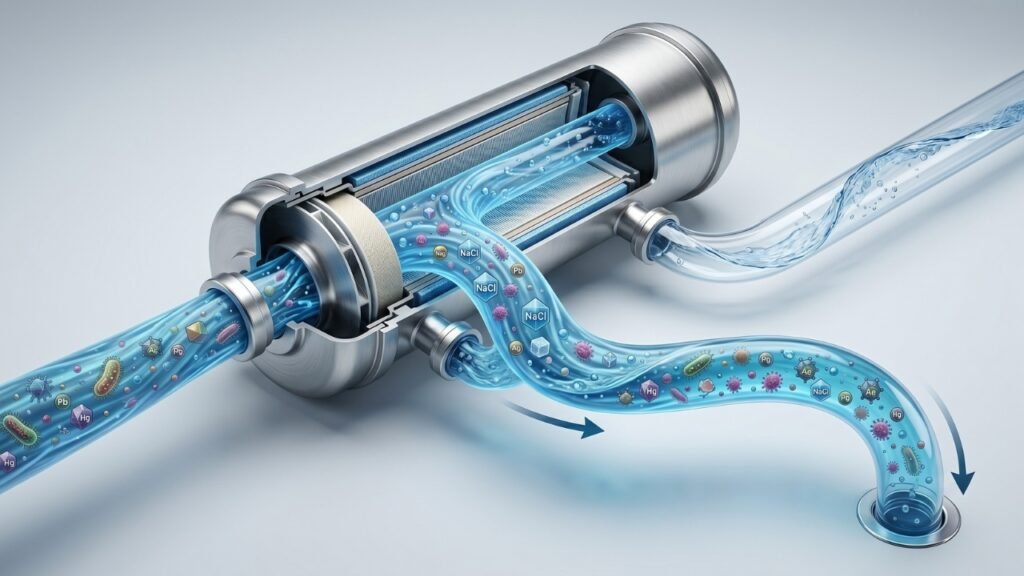
A reject (waste) water stream exits separately from the RO membrane stage and is directed to a drain.
Let us now examine each stage in detail.
Stage 0: Raw Water Source and Inlet
Before any purification begins, raw water must enter the system from your water source. In urban India, this is one of:
- BWSSB / Municipal supply line – Pre-chlorinated, relatively lower TDS but with chlorine, chloramines, occasional bacterial excursion risk, and whatever contamination picked up through aging pipes and overhead tanks
- Borewell – Higher TDS (often 400–1,500 mg/L in Bangalore), very hard, potentially containing iron, manganese, fluoride, nitrates, and bacteria depending on location and depth
- BWSSB + Borewell mix – Very common in Bangalore apartments, where both sources fill the same overhead tank, resulting in variable water quality
The RO system should be connected to a water source with consistent supply pressure. Most domestic RO units have a small feed water solenoid valve that opens when the storage tank drops below a set pressure threshold, allowing raw water to flow into the purification train.
Key point for Bangalore residents: Borewell water in North Bangalore areas – Yelahanka, Devanahalli, Nelamangala, Doddaballapur, Hoskote – is characteristically very hard (300–800 mg/L as CaCO₃) and often carries elevated TDS (600–2,000 mg/L), making multi-stage pre-treatment and a high-quality RO membrane essential rather than optional.
Stage 1: PP Sediment Filter (Pre-Filter)
Type: Polypropylene spun-fibre cartridge Pore size: 5 micron (standard) or 1 micron (fine) Housing colour: Usually transparent, turns brown/orange with use Replacement: Every 2–3 months
What It Does
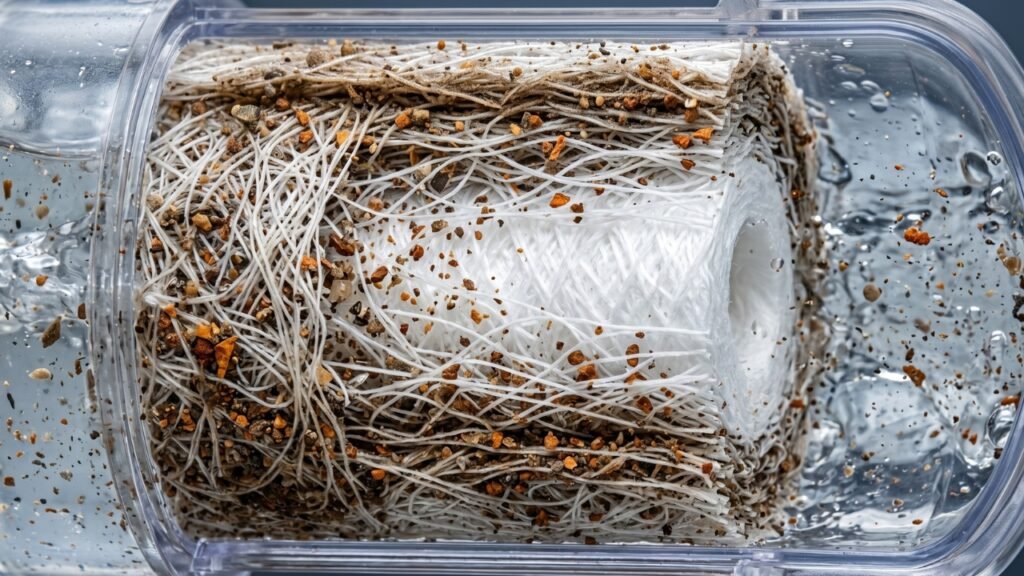
The PP sediment filter is the system’s physical gatekeeper. It is a cylindrical cartridge made of tightly wound polypropylene fibres that physically trap suspended particles as water passes through. Think of it as a very fine strainer – anything larger than 5 microns simply cannot pass through.
What It Removes
- Dust and sand particles
- Rust flakes from iron pipes and aging plumbing
- Silt and clay (especially relevant for borewell water)
- Suspended organic particles
- Any visible turbidity
A 5-micron pore size blocks particles 50 times smaller than the width of a human hair. At 1 micron (as used in some Stage 3 carbon block filters), it blocks particles 250 times smaller.
Why This Stage Is Critical
Without sediment pre-filtration, every particle in your feed water would hit the activated carbon filter and the RO membrane directly. The consequences are severe:
For carbon filters: Sediment particles clog the carbon media, dramatically reducing its surface area and contact time with water. A carbon filter that should last 6 months may fail in 2–3 months when fed with unsediment-filtered water.
For the RO membrane: Sediment particles physically abrade the delicate surface of the thin-film composite membrane. Once the membrane surface is scratched or damaged, it loses its selectivity – dissolved salts begin passing through alongside pure water, destroying the effectiveness of the most expensive component in the system.
The PP sediment filter is the cheapest component in the system (typically ₹80–₹150 per cartridge) and the one most responsible for protecting the most expensive component (the RO membrane, ₹1,500–₹4,000). Replacing it regularly is the single most cost-effective maintenance action you can take.
How to Know When It Needs Replacement
The cartridge will visibly discolour from white to yellow, brown, or orange as it collects particles. Some cartridges are housed in transparent housings, making visual inspection possible. As the cartridge fills with sediment, water flow to the system decreases. When you notice reduced output from your RO tap, a clogged sediment filter is often the first thing to check.
Stage 2: Pre-Carbon GAC Filter (Granular Activated Carbon)
Type: Granular activated carbon (GAC) – coconut shell or coal-based Function: Chemical adsorption Housing colour: Usually opaque white or grey Replacement: Every 6 months
What It Does
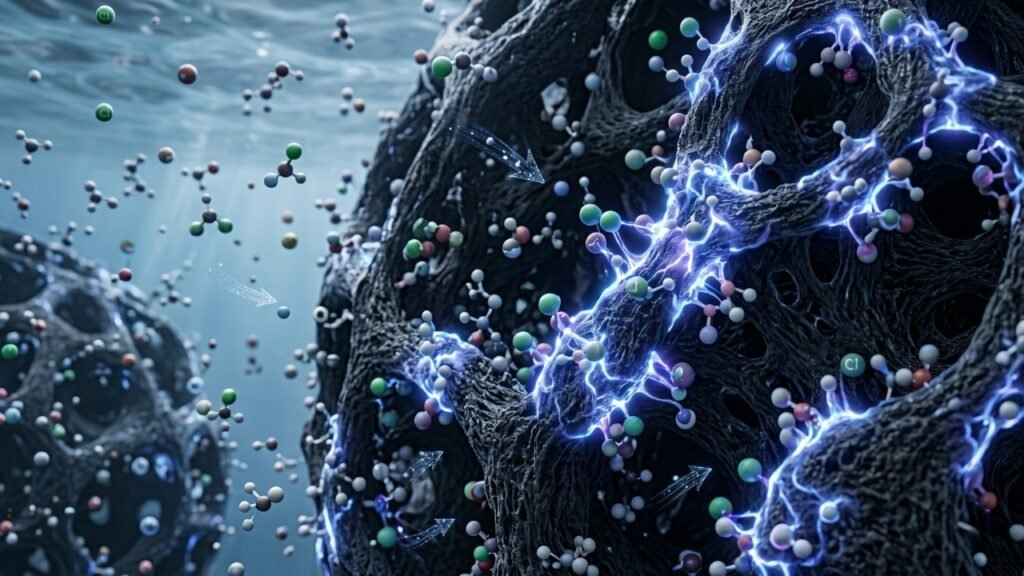
Activated carbon works through a process called adsorption – not absorption. Contaminant molecules bond to the enormous internal surface area of the carbon structure. A single gram of quality activated carbon can have a surface area of up to 1,500 square metres. As water flows through the GAC bed, chlorine molecules, organic compounds, and other adsorbable contaminants bond to the carbon surface and are removed from the water.
What It Removes
- Free chlorine and chloramines (critical protective function)
- Volatile organic compounds (VOCs) – solvents, industrial chemicals
- Herbicides and pesticides
- Trihalomethanes (THMs) – disinfection byproducts from chlorination
- Hydrogen sulphide (rotten egg smell)
- Other taste and odour compounds
Why Chlorine Removal Is the Most Important Function
Chlorine is added to municipal water supplies specifically to kill bacteria – a public health essential. But when chlorinated water flows through an RO membrane, chlorine oxidises the thin-film composite (TFC) polymer that forms the selective barrier.
The chemistry is straightforward: free chlorine reacts with the polyamide polymer of TFC membranes, breaking the molecular bonds that give the membrane its selectivity. Even at the low concentrations present in municipal water (0.2–1.0 ppm), prolonged chlorine exposure progressively degrades the membrane. A membrane rated for 2–3 years of service life may fail in 6–12 months if the pre-carbon filter is not functioning.
This is why the pre-carbon filter must always be replaced before it is exhausted. Unlike a sediment filter whose failure is visible, a carbon filter that has exhausted its adsorption capacity will still allow water to flow through – it just is not removing chlorine anymore. By the time you notice reduced RO performance, the membrane may already be damaged.
Granular vs Block Carbon
Stage 2 typically uses granular activated carbon (GAC), which has a high flow rate but slightly lower chlorine removal efficiency than compressed carbon block. This is why high-quality systems include both a GAC pre-filter (Stage 2) and a carbon block filter (Stage 3) – using the strengths of both formats.
Stage 3: Carbon Block Filter
Type: Compressed activated carbon block Pore size: 0.5–1 micron (mechanical filtration as well as chemical adsorption) Housing colour: Opaque, similar to GAC housing Replacement: Every 6 months
What It Does
The carbon block filter is a dense, compressed cylinder of activated carbon – think of it as the upgrade to the granular carbon filter. Because the carbon is compressed rather than loose, it provides two functions simultaneously:
Mechanical filtration: At 1 micron (or even 0.5 micron in premium versions), it physically blocks fine particles that passed through the 5-micron sediment filter. This makes it a secondary physical filtration stage as well as a chemical treatment stage.
Deep adsorption: The compressed format creates longer contact time between water molecules and the carbon surface, improving removal efficiency for chlorine, VOCs, and other compounds that the GAC filter partially removed.
What It Removes
- Residual chlorine (after Stage 2)
- VOCs and chemical traces not fully removed by Stage 2
- Fine particulate matter (down to 1 micron)
- Trace pharmaceuticals and endocrine disruptors (partial)
- Remaining odour and taste compounds
Why This Is the Last Line of Protection Before the Membrane
The carbon block filter is the final protective layer before water enters the booster pump and hits the RO membrane. At this point, the feed water to the membrane should be:
- Free of all suspended particles above 1 micron
- Free of chlorine and chloramines
- Free of all major chemical contaminants
If all three pre-filter stages are functioning correctly, the RO membrane receives clean, clear, chemical-free water and can operate at maximum efficiency for its full rated service life.
The Booster Pump: The Engine of the System
Type: Small electric pump (24V DC in most domestic units) Operating pressure output: 60–80 PSI Power consumption: 15–25 watts Lifespan: 3–5 years
This is not a filtration stage – it is a mechanical component, but it is fundamental to how the system works.
Why Pressure Is Everything for RO
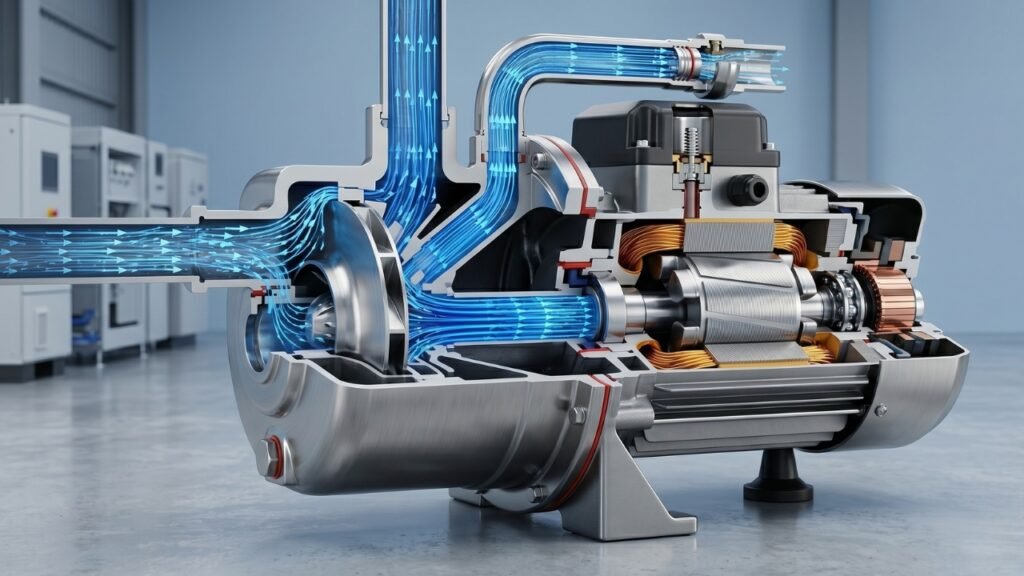
Reverse Osmosis works against the natural principle of osmosis. Normally, water flows from an area of low dissolved-solids concentration to an area of high dissolved-solids concentration through a semi-permeable membrane – this is osmosis, the mechanism that drives water movement in living cells.
In Reverse Osmosis, we want water to flow in the opposite direction – from high concentration to low concentration. To overcome the natural osmotic pressure gradient, we must apply external mechanical pressure. The minimum pressure required depends on the TDS of the source water (higher TDS = higher osmotic pressure to overcome) but typically falls in the range of 40–80 PSI for domestic applications.
Most Indian homes and apartments have supply pressure of only 10–30 PSI – far below the operating minimum. The booster pump solves this. It draws pre-filtered water and pressurises it to 60–80 PSI before it enters the RO membrane module.
What Happens Without Adequate Pressure
Without sufficient feed pressure, the RO system’s output (the “permeate” – the purified water) drops to near zero. The membrane physically cannot reject dissolved salts and force clean water through at low pressure. Some low-quality systems do not include a booster pump, instead relying on municipal supply pressure – these systems consistently underperform in Indian homes.
Stage 4: RO Membrane – The Core of the System
Type: Thin-Film Composite (TFC) spiral-wound membrane Pore size: 0.0001 micron (0.1 nanometre) Rejection rate: 95–99% TDS rejection Capacity: 50–75 GPD (gallons per day) = 190–284 litres per day for standard domestic units Replacement: Every 2–3 years
This is the most important stage in the entire system – the stage that defines what an RO purifier is and what it does.
How the RO Membrane Works
The RO membrane is a thin-film composite (TFC) element wound in a spiral configuration inside a pressurised housing. The membrane itself is a layered structure:
- Polyester backing layer – structural support
- Polysulfone microporous support layer – intermediate structure
- Polyamide thin-film active layer – the actual selective barrier (typically 100–200 nanometres thick)
Under 60–80 PSI of feed pressure, water molecules (H₂O) – which are very small (0.28 nanometres) – can be forced through the 0.1 nanometre pores of the polyamide active layer. Everything larger cannot pass through.
The list of what is larger than an H₂O molecule – and therefore rejected by the membrane – is essentially the entire list of what makes water unsafe to drink:
- Dissolved salts (sodium chloride, calcium carbonate, magnesium sulphate)
- Heavy metals – lead, mercury, cadmium, arsenic, chromium
- Fluoride and nitrate ions
- All bacteria (0.2–10 microns – 2,000 to 100,000 times larger than membrane pores)
- All viruses (0.02–0.3 microns – 200 to 3,000 times larger)
- Pesticides and herbicides
- Pharmaceutical compounds
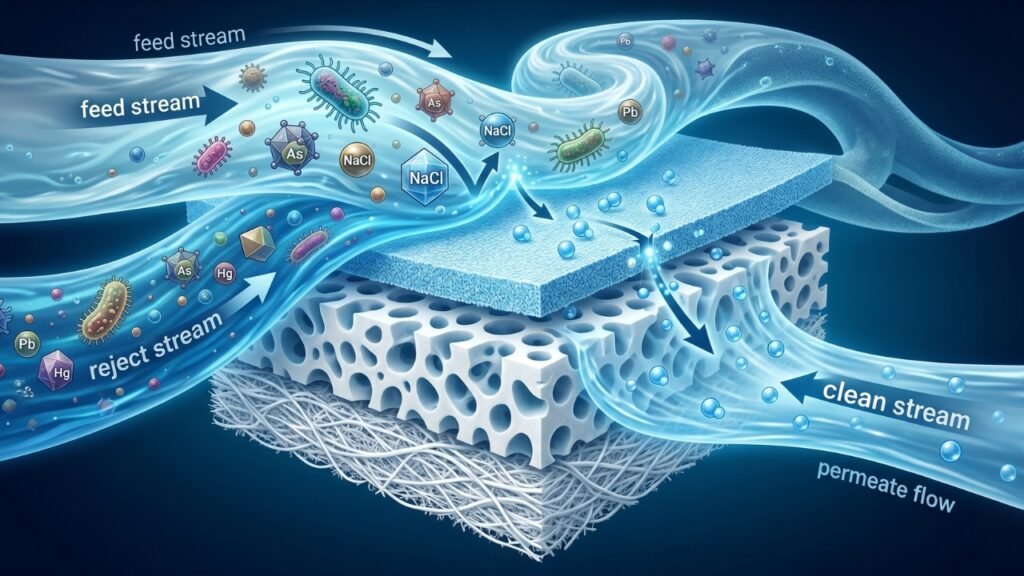
The rejected contaminants are concentrated in the remaining feed water (the “reject” or “concentrate” stream) and flushed out to the drain.
The Permeate and Reject Streams
The RO stage produces two output streams:
Permeate (purified water): Water that has passed through the membrane. This is the product – what eventually comes out of your RO tap. TDS: 15–50 mg/L. Percentage of feed: ~60%.
Reject water (concentrate/brine): The remaining concentrated feed water carrying all the rejected contaminants. This goes to the drain. TDS: significantly higher than the original feed water (because the same dissolved solids are now in less water volume). Percentage of feed: ~40%.
This means that for every 10 litres of water entering the RO system, approximately 6 litres comes out as purified drinking water and 4 litres goes to the drain. This is the “waste water” ratio that many people notice – and which represents a genuine trade-off between purification effectiveness and water efficiency.
Some modern high-efficiency RO systems achieve better recovery ratios (70% permeate, 30% reject), and systems with reject water recycling can further reduce waste.
The Membrane and Mineral Loss
A critical fact that is frequently misunderstood: RO membranes remove virtually all dissolved minerals from water – including beneficial ones like calcium and magnesium. RO-purified water has very low mineral content (15–50 mg/L TDS), which raises concerns in some quarters about whether it is “healthy” to drink.
The scientific consensus is that this is not a health concern for people who eat a normal, balanced diet – dietary mineral intake from food is orders of magnitude greater than from water. However, some premium RO systems include a mineralisation or alkaline cartridge after the membrane stage that adds back controlled amounts of calcium, magnesium, and bicarbonate – improving pH balance and taste while maintaining the safety benefits of RO purification.
For Bangalore-specific context: very high TDS borewell water (800–1,500 mg/L) is not “full of healthy minerals.” At those concentrations, the dominant dissolved solids are calcium carbonate (hardness), magnesium sulphate, sodium chloride, and often sodium fluoride – not nutritionally beneficial and often actively harmful in those quantities.
Signs That Your RO Membrane Needs Replacement
- Gradually increasing output TDS (measurable with an inexpensive handheld TDS meter)
- Noticeably reduced purified water output volume
- Increased reject water flow relative to purified water
- Water that no longer tastes as clean and flat as it used to
A TDS meter costing ₹200–₹500 is the most useful diagnostic tool any RO purifier owner can have. Test your inlet TDS and your purified output TDS monthly. When the rejection rate (calculated as: 1 minus [output TDS / input TDS]) drops below 80–85%, the membrane needs replacement.
Stage 5: Post-Carbon GAC Filter (Polishing)
Type: Granular activated carbon Function: Post-purification taste and odour polishing Replacement: Every 12 months
What It Does
Water that has passed through the RO membrane is essentially pure H₂O with very low mineral content. It should taste clean – but sometimes it does not, for two reasons:
Storage tank effects: Purified water sits in the pressurised storage tank (which has a rubber bladder inside) for variable periods. Some trace odour compounds from the tank materials or internal piping can dissolve into the stored water.
Flat or slightly acidic taste: RO water with very low TDS (15–50 mg/L) tastes different from mineral water (150–400 mg/L TDS). Some people find it flat, and the slightly lower pH of pure water (5.5–6.5 due to dissolved CO₂) can be perceived as a mildly sour or metallic taste.
The post-carbon polishing filter addresses both issues by adsorbing any trace odour and taste compounds as the water flows through on its way from the storage tank to your tap. It is the stage that makes RO water taste good – not just be safe.
What It Removes
- Trace odour compounds from tank bladder or piping
- Residual taste compounds
- Any minor VOC traces picked up in storage
- Partial CO₂ removal (improving pH slightly)
Stage 6: UV Sterilisation Chamber
Type: Germicidal UV lamp (254 nm wavelength) Power consumption: 6–11 watts Flow rate: Typically rated for 1–2 litres per minute Replacement: UV lamp every 12 months (even if it appears to still illuminate)
How UV Sterilisation Works
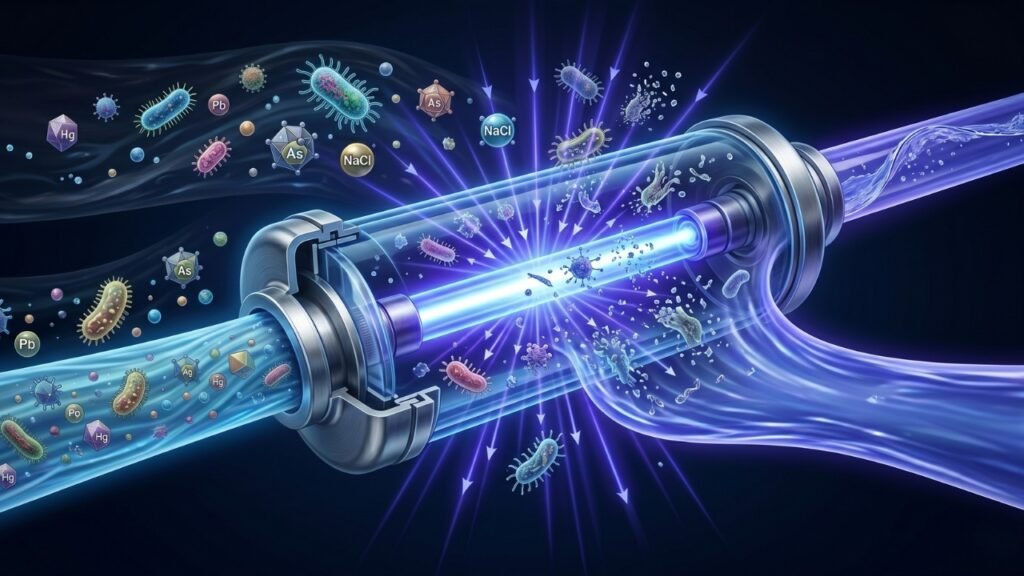
UV light at the specific wavelength of 254 nanometres (called the “germicidal” or “UV-C” wavelength) is absorbed by the DNA and RNA of microorganisms. When a microorganism’s genetic material absorbs this UV energy, it causes molecular damage – specifically, the formation of thymine dimers that prevent the organism from replicating. A microorganism that cannot replicate cannot cause infection, even if it survives in the water.
UV sterilisation is a purely physical process. No chemicals are added. No disinfection byproducts are created. The water chemistry is not affected – only the microbiological status changes.
Why UV Is Included After the RO Membrane
If the RO membrane rejects bacteria at 99.9%+ efficiency and viruses at similarly high rates, why is a UV stage needed?
The answer lies in the concept of defence in depth – multiple independent safety barriers. A properly functioning RO membrane is extraordinarily effective against microbiological contamination. But:
- Post-membrane contamination is possible: Any microorganism that enters the purified water stream after the membrane (from the storage tank, internal piping, or the tap mechanism itself) bypasses the RO protection entirely. UV kills these.
- Membrane bypass events: Minute membrane defects, incomplete sealing at the O-ring, or physical damage during transport/installation can create microscopic channels through which some feed water bypasses filtration. UV catches any microorganisms that slip through.
- Combined risk reduction: The probability of a microbiological illness from drinking RO + UV treated water is orders of magnitude lower than from RO alone, which itself is far safer than untreated water.
The UV Lamp Replacement Issue
UV lamps degrade over time. After approximately 9,000–12,000 hours of use (about one year of continuous operation), the UV output at 254 nm drops significantly even though the lamp may still appear to glow. This is because UV lamps produce visible light and germicidal UV simultaneously – but the germicidal UV wavelength degrades faster than the visible output.
If you can see that your UV lamp is on, this does not mean it is sterilising water at its rated efficiency. Replace UV lamps on a calendar schedule (every 12 months) regardless of whether they appear functional.
The Pressurised Storage Tank
Type: Pressurised with internal rubber bladder Typical capacity: 7–10 litres (domestic) Operating pressure: 7–10 PSI (set by the inlet valve, auto-shut via float mechanism)
The storage tank is often overlooked in discussions of RO purifier stages, but it is fundamental to the user experience of the system.
Why Storage Is Necessary
RO membranes produce water slowly – a 75 GPD (gallon per day) domestic RO membrane produces just 284 litres over 24 hours, or about 12 litres per hour. If there were no storage tank, opening the RO tap would deliver a trickle of water that would not fill a glass for several minutes.
The storage tank solves this by accumulating water during periods when you are not using it (overnight, during working hours) so that a full tank of clean water is immediately available at the tap whenever needed. The pressurised bladder inside the tank maintains enough pressure (7–10 PSI) to push water to the faucet without an additional pump.
The Auto-Shut Mechanism
The RO system has a clever automatic shutoff: when the storage tank pressure reaches a preset level (indicating it is full), the rising pressure triggers a shut-off valve in the feed line, stopping water flow to the membrane. This prevents the system from running continuously when demand is low. When you use water from the tank, pressure drops, the valve reopens, and the system resumes purifying.
Storage Tank Maintenance
The rubber bladder inside the storage tank has a lifespan of approximately 3–5 years. Over time, the bladder material can leach trace compounds into the stored water or develop micro-perforations that allow water to contact the metallic tank casing. Periodic inspection and eventual replacement are important.
Ensure your storage tank is food-grade certified. Quality systems from Bangalore Aqua use food-grade materials throughout, including certified bladder materials that meet NSF/ANSI standards.
The Output: What Your Pure Water Actually Contains
After passing through all stages, your RO purified water contains:
| Parameter | Typical Output |
| TDS | 15–50 mg/L |
| pH | 6.5–7.5 |
| Hardness | <30 mg/L |
| Chlorine | Undetectable |
| Bacteria | None detected |
| Fluoride | <0.3 mg/L |
| Nitrates | <5 mg/L |
| Heavy metals | Below detection limit |
This water meets and typically exceeds BIS IS:10500 standards for safe drinking water in India in every parameter.
The Reject Water: What Happens to the 40%?
The reject water stream from the RO membrane contains a concentrated version of everything the system removed. For source water at 800 mg/L TDS with 60% water recovery, the reject water exits at approximately 1,600–2,000 mg/L TDS.
This reject water is not sewage – it is essentially your source water concentrated 2–2.5 times. It is safe for:
Toilet flushing: Connect the reject water line to your toilet cistern supply. This is the most volumetrically appropriate reuse – toilets use large amounts of water and do not require purified water.
Garden and outdoor plant watering: For plants that are not sensitive to high TDS (most outdoor ornamental plants, trees, and shrubs). Vegetable gardens may be affected if TDS is very high (above 1,500 mg/L concentrate).
Mopping floors: The concentrate is perfectly fine for floor washing and similar domestic cleaning tasks.
Washing vehicles: Suitable for regular car washing. Note: very high TDS concentrate water may leave white mineral spots if not wiped dry – use it in the rinse bucket rather than the final rinse.
Redirecting reject water to productive uses rather than direct drain discharge can effectively bring your overall water efficiency from 60% to 85–90%.
Comparing 5-Stage vs 6-Stage vs 7-Stage Domestic RO Systems
Walk into any water purifier showroom in Bangalore and you will see systems marketed as “5-stage,” “6-stage,” “7-stage,” or even “9-stage.” Here is what these numbers actually mean:
5-Stage System
Typically: PP Sediment → Pre-Carbon GAC → Carbon Block → RO Membrane → Post-Carbon GAC
This is the essential core system. All five stages are genuinely functional and necessary. A well-made 5-stage system from a quality manufacturer is all most households need.
6-Stage System
Adds a UV sterilisation stage after the post-carbon filter. This is a meaningful, genuinely beneficial addition – the UV stage provides an extra safety barrier for microbiological contamination. Recommended if your source water has any history of bacterial excursion risk.
7-Stage System
The standard 6-stage plus one of:
- UF (Ultrafiltration) membrane: Adds a 0.01-micron UF membrane, typically before or after the RO stage. Removes larger pathogens and provides an additional physical barrier.
- Mineralisation cartridge: Adds back calcium, magnesium, and bicarbonate minerals removed by the RO stage. Improves pH and taste. Particularly recommended for people who drink primarily RO water with little other dietary mineral source.
- Alkaline filter: Raises pH slightly and adds minerals. Functionally similar to mineralisation cartridge.
8-Stage and 9-Stage Systems
At this stage, marketing often outpaces functionality. “TDS controller” stages, redundant carbon stages, “antioxidant” cartridges, and various branded “enhancement” stages are frequently included to justify higher price points without proportionate improvement in water quality. Evaluate each additional stage critically – ask what specific contaminant it removes or what measurable improvement it provides.
What Actually Matters More Than Stage Count
The most important factors in domestic RO system quality, in order:
- RO membrane quality – brand, rejection rate, rated GPD capacity
- Pre-filtration effectiveness – genuine protection for the membrane
- Booster pump reliability – consistent pressure for full membrane performance
- Build quality and sealing – no bypass leaks around membranes or filter housings
- After-sales service and AMC – filter replacements on schedule
- Stage count (last and least important)
A 5-stage system with quality membranes, proper pre-filtration, and regular AMC will outperform a 9-stage system with cheap membranes and irregular maintenance every single time.
Filter Replacement Schedule: The Complete Maintenance Guide
One of the most common reasons domestic RO systems fail to deliver safe water is deferred maintenance. Here is the complete recommended replacement schedule:
| Component | Replacement Frequency | Cost (Approx.) |
| PP Sediment filter (Stage 1) | Every 2–3 months | ₹80–₹200 |
| Pre-Carbon GAC filter (Stage 2) | Every 6 months | ₹150–₹300 |
| Carbon Block filter (Stage 3) | Every 6 months | ₹150–₹350 |
| RO Membrane (Stage 4) | Every 2–3 years | ₹1,500–₹4,000 |
| Post-Carbon GAC filter (Stage 5) | Every 12 months | ₹150–₹300 |
| UV Lamp (Stage 6) | Every 12 months | ₹400–₹800 |
| Storage tank bladder | Every 3–5 years | ₹500–₹1,200 |
Annual maintenance cost for a well-maintained domestic RO system: approximately ₹2,000–₹4,000 per year, including parts and service labour under an AMC.
This compares very favourably to:
- 20-litre water jar delivery: ₹40–₹60 per jar, typically 2–4 jars per week = ₹4,000–₹12,000 per year, with no guarantee of purity
- Packaged water bottles (1L): ₹20–₹25 per litre – roughly 100 times the cost per litre of RO purified water
The TDS Meter: Your Best Maintenance Tool
Purchase a handheld TDS meter (₹200–₹500 from any electronics or water store). Every two weeks:
- Measure and record your inlet (source) TDS
- Measure and record your purified water TDS
Calculate rejection rate: (1 – [output TDS / input TDS]) × 100%
A healthy system should show 90–99% rejection. When this drops below 80%, investigate. The most likely causes are:
- Exhausted or damaged RO membrane (needs replacement)
- Bypass leak around the membrane O-ring seals (needs resealing)
- Pre-filter exhaustion allowing chlorine damage to the membrane (pre-filter maintenance overdue)
Understanding Water Quality in Bangalore and Why a Good RO Matters
Bangalore’s water quality situation makes the proper functioning of every stage of the RO flow diagram particularly important.
Borewell water characteristics across key Bangalore zones:
- North Bangalore (Yelahanka, Devanahalli, Doddaballapur, Hoskote, Nelamangala): TDS 600–2,000 mg/L, very hard (400–900 mg/L as CaCO₃), often elevated iron (1–5 mg/L), occasional fluoride above BIS limit in Devanahalli and surrounding villages. Requires robust pre-treatment before RO.
- South Bangalore (Electronic City, Bannerghatta Road, JP Nagar): TDS 400–900 mg/L, moderately to very hard, some iron. Standard 5-6 stage system suitable.
- East Bangalore (Whitefield, Marathahalli, Sarjapur Road): TDS 500–1,200 mg/L, hard to very hard. Pre-carbon filtration critical given proximity to industrial zones.
- BWSSB supply areas (Central Bangalore): Lower TDS (150–400 mg/L), treated and chlorinated, lower hardness. Carbon filtration particularly important for chlorine removal; RO still recommended given pipe contamination risk.
For homes dependent on Bangalore’s borewell water – particularly in North Bangalore – a high-quality RO system with proper pre-treatment is not a luxury. It is a health necessity.
Choosing the Right Domestic RO Purifier for Your Bangalore Home
When selecting a domestic RO purifier for a Bangalore home – whether on BWSSB supply or borewell water – here is a practical decision framework:
For low-TDS BWSSB supply (TDS below 300 mg/L): A 5-stage RO system is fully adequate. Prioritise carbon filtration quality for chlorine removal. RO reduces already-moderate TDS to very safe levels.
For moderate-TDS mixed supply (TDS 300–600 mg/L): Standard 6-stage system with UV. This covers the majority of urban Bangalore apartments with BWSSB + partial borewell supplementation.
For high-TDS borewell supply (TDS 600–1,200 mg/L): 6-stage system with particular attention to pre-treatment quality. Consider a water softener upstream if hardness exceeds 400 mg/L as CaCO₃ – this protects the RO membrane and significantly extends its service life.
For very high-TDS borewell (TDS >1,200 mg/L): Consult with Bangalore Aqua for a customised pre-treatment recommendation. At very high TDS levels, a softener + anti-scalant dosing system upstream of the RO membrane is strongly recommended to achieve adequate water recovery and prevent rapid membrane fouling.
Conclusion: Understanding Your Purifier Is the First Step to Safe Water
A domestic RO water purifier is a genuinely sophisticated multi-stage system – and understanding each stage of the flow diagram is not just an intellectual exercise. It is the foundation for:
- Making better purchasing decisions – knowing what stage count actually means vs what membrane quality means
- Maintaining your system correctly – replacing filters before they fail, not after
- Troubleshooting problems early – using a TDS meter to catch declining membrane performance before water quality is compromised
- Saving money – protecting the expensive RO membrane by maintaining the cheap sediment and carbon pre-filters on schedule
For Bangalore residents dealing with characteristically hard, high-TDS borewell water or BWSSB supply with chlorination and pipe contamination risks, a properly functioning and properly maintained RO purifier is one of the highest-return health investments a household can make.
Bangalore Aqua and Energy Pvt. Ltd. specialises in domestic, commercial, and industrial RO systems across Bengaluru and Karnataka. Their technical team can assess your source water, recommend the right system configuration, and ensure professional installation and ongoing AMC support that keeps your system performing at specification – year after year.
Contact Bangalore Aqua for a free water test and RO system consultation:
📞 +91 76763 93939 | +91 97387 04753
📧 info@bangaloreaqua.com
📍 107/209 2nd Cross, 4th Main Kogilu Layout, Bengaluru – 560064, Karnataka
Related reads: Best Water Softener for Bangalore | Top 10 RO Plant Companies in India 2026 | Best Community RO Project Plants | RO Plants for North Bangalore – Yelahanka, Devanahalli, Hoskote, Nelamangala, Doddaballapur