Best Industrial RO Plant Manufacturer in Peenya (2026)
DRINK SAFE AND PURE
Bangalore Aqua - Industrial RO Plant Manufacturer for Peenya
Peenya (ಪೀಣ್ಯ) lies on the Bengaluru-Tumakuru highway and was established as an industrial area in the late 1970s. It is known for CNC machine tools, die-casting, fabrication, dies and moulds, transformers, motors, hydraulics, rubber moulding and textiles, and is described as one of the biggest industrial areas in Asia (Wikipedia, Peenya, weaker: that line rests on a 2005 newspaper citation). The Hindu called it India’s largest industrial area in 2013 (The Hindu, 2013). Peenya is an urban village of Bengaluru North taluk, Bengaluru Urban district, LGD code 938403 (VillageInfo, weaker).
Our plants are built at our own manufacturing unit in Kogilu Layout, north Bengaluru. Peenya is on the other side of the city’s northern belt, a cross-town drive rather than a next-door visit, so we schedule dispatch and service visits in advance. Each skid is fabricated and tested in our workshop, then commissioned at your site. This page is for buyers who want to deal directly with the manufacturer.
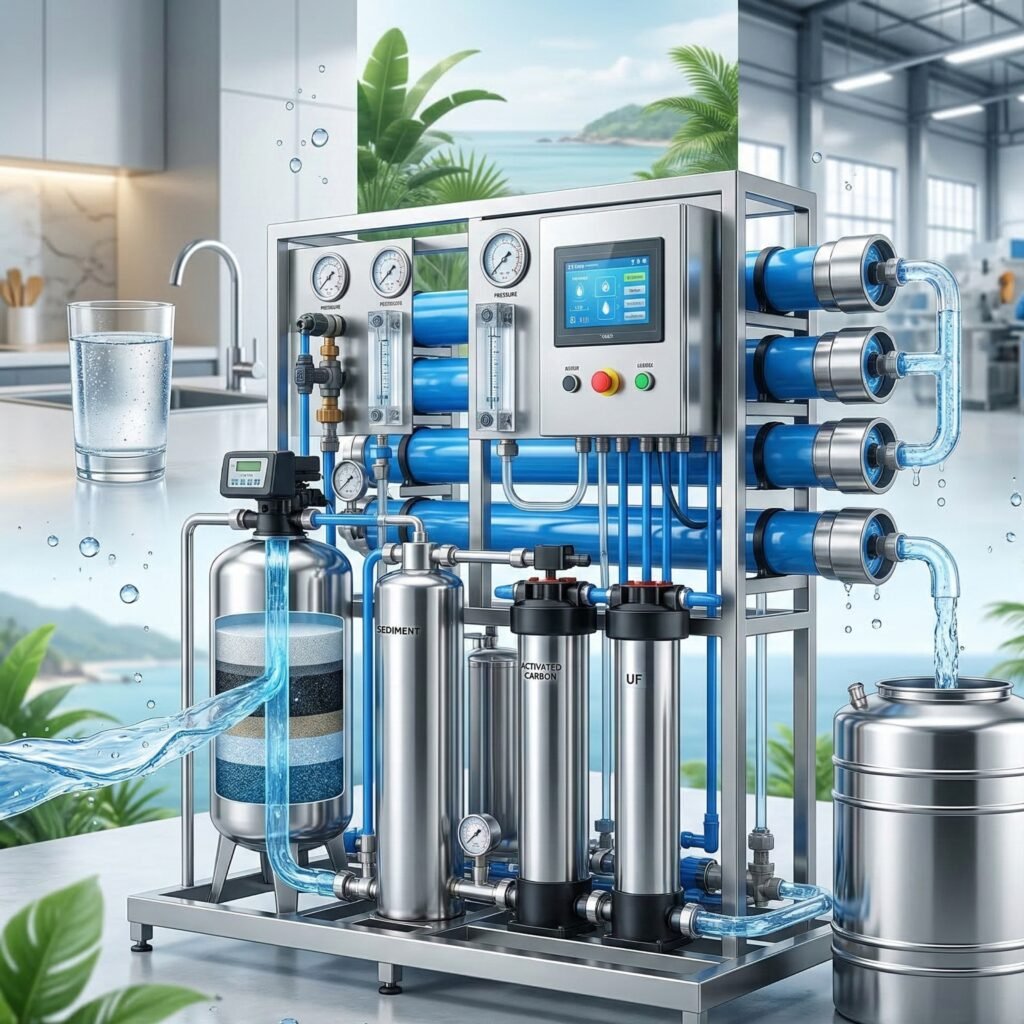
Peenya sits on an over-drawn aquifer, and parts of the estate carry a documented heavy-metal legacy. A softener stops scale but does not lower TDS. UV only kills microbes. Reverse osmosis with the right pre-treatment, and metals testing before design, is the practical way to keep drinking, process and boiler feed water in specification.
Bangalore Aqua And Energy Pvt. Ltd. manufactures RO plants, water treatment systems, softeners, community and solar RO plants, and industrial and commercial systems. Every Peenya plant comes with AMC support after handover.
📞 +91 76763 93939 | +91 97387 04753 📧 info@bangaloreaqua.com 🌐 bangaloreaqua.com
Nearby pages: Industrial RO Plant Manufacturer in Bangalore | Best Industrial RO Plant Manufacturer in Nelamangala | Best Industrial RO Plant Manufacturer in Tumakuru
Peenya Water Quality: What the Data Actually Says
Groundwater stress. The Dynamic Ground Water Resources of Karnataka 2025 report (mirrored copy) puts Bangalore (North) taluk’s stage of extraction at 249.65% and classes it over-exploited: 5,235.18 ham drawn against 2,096.98 ham extractable, 1,339.97 ham of it by industry. The 2023 assessment (mirrored copy) gave 209.2%, with 1.18 TMC drawn against 0.57 TMC. The same reports assess the city core as a separate Bangalore-City unit (216.98% in 2025), so built-up parts of the estate may fall there.
Quality tags. Both reports tag Bangalore (North) for nitrate, one of only two Bengaluru Urban taluks with a quality tag.
Older CGWB mapping. The CGWB Ground Water Information Booklet for Bangalore Urban (December 2008, OpenCity copy) says most of Bangalore North taluk has EC of 500-1,000 micromhos/cm. It reports high chloride and magnesium in the Peenya and Rajajinagar industrial belts and high nitrate in all the industrial belts of Peenya, Hoskote, Rajajinagar and Kanakapura Road. It also says most wells near the Vrishabhavathi river are polluted by sewage. District-wide: hardness 100-600 ppm, fluoride generally below 1 ppm.
CGWB monitoring wells. CGWB’s quality dataset on the National Water Data Portal has no station named Peenya or Jalahalli in Bengaluru. The nearest are:
- Chikkabanavara (May 2013, one sample): EC 950 µS/cm, chloride 199 mg/L, hardness 260 mg/L.
- Rajajinagara (2013-2018): EC 857-1,220 µS/cm, chloride 99.4-238 mg/L, hardness 215-300 mg/L.
- Malleswaram (2013-2019): EC 470-1,016 µS/cm, chloride 50-99.4 mg/L, hardness 120-315 mg/L.
The data has no usable TDS, nitrate or fluoride values for these wells.
Heavy metals in the estate. A 2013 KSPCB survey of 72 borewells found 20 heavily polluted with chromium, with some at 29-35 mg/L against a 0.05 mg/L limit, a legacy of electroplating units (The Hindu, 2013). Peenya has been listed as a severely polluted cluster (CEPI 65.11), and 30 of 61 contaminated borewells had been closed by 2019 (The Hindu, 2019). A KSPCB compliance check found only 62 of 206 effluent-generating units meeting all six conditions (The Hindu, 2019). A BMS College study reported a mean heavy-metal pollution index of 845.1 against a critical value of 100, with 83.33% of samples above it (Anitha et al., IOP 2021). An earlier study of 30 samples found nearly 77% non-potable for nitrate, hardness, TDS, sulphate or fluoride (PubMed abstract, weaker).
Vrishabhavathi valley. A CSIR-NEERI interim report for BBMP observed illegal industrial effluent discharge into the drain beside Peenya, and found the valley treating about 260 MLD of some 431 MLD of sewage (CSIR-NEERI, 2021).
Rainfall. The 2025 state report gives Bengaluru Urban a normal of 846 mm; the CGWB booklet uses 831 mm.
Planning table
Concern | Planning note | Implication |
Over-extraction | 249.65% (2025), 209.2% (2023), Bangalore (North) | Plan storage, high recovery and reject reuse |
TDS / EC | EC 470-1,220 µS/cm at nearest CGWB wells | Membranes set from your measured feed |
Chloride | High in Peenya belt (CGWB 2008); 50-238 mg/L at nearby wells | Check chloride for SS and boiler circuits |
Hardness | 120-315 mg/L at nearby wells | Softener or antiscalant ahead of RO |
Nitrate | State-tagged taluk; high in Peenya belt | Keep nitrate on the test panel |
Chromium and metals | Up to 35 mg/L in 2013 KSPCB survey | Metal panel before any design |
Supply mix | Bore, tanker, piped | Design for the worst source in the blend |
Takeaway: we do not invent a single Peenya TDS. A Phase 1 tool room, a Chikkabanavara apartment and a plating shop can sit in very different chemistry bands. Every quote starts with a feed-water test from your actual source.
Key Sectors We Build For in Peenya
Engineering and Machine Tools
Machine shops need drinking water, coolant make-up and washing water.
Typical requirement: 500-2,000 LPH; softener plus RO; UV at drinking points.
Electroplating and Surface Treatment
Plating lines need low-conductivity rinse water, and feed bores may carry metals.
Typical requirement: 1,000-4,000 LPH; metal panel first; double-pass RO or mixed-bed polishing; conductivity monitoring.
Garments and Textiles
Washing and finishing lines need soft, consistent water.
Typical requirement: 1,000-4,000 LPH; softener ahead; RO for low-TDS process water.
Chemicals
Chemical units need consistent process and boiler feed water.
Typical requirement: 1,000-4,000 LPH; RO with polishing; online TDS logging.
Food and Beverage
Food units need drinking-standard water for processing and cleaning.
Typical requirement: 500-2,000 LPH; carbon, RO and UV; SS contact parts; documented checks.
PIA-Area MSMEs and Canteens
Small units share bores and tankers and need safe drinking water for workers.
Typical requirement: 250-1,000 LPH; compact skid; UV; AMC.
Apartments, Colleges and Community Plants (Jalahalli, Dasarahalli, Bagalagunte)
Associations and campuses blend bore, tanker and piped water. See Best CSR Project RO Plants, Government Drinking Water Projects and Community RO Plants and Community RO Water Plant Karnataka.
Typical requirement: 1,000-4,000 LPH; softener plus RO; SS storage; monthly logs.
Industrial RO Plant Capacity and Pricing - Peenya 2026
Capacity | Application | Daily Output (indicative) | Indicative Cost |
250-500 LPH | Small MSME, canteen | 2,000-5,000 L | ₹85,000 – ₹1.6 lakh* |
500-1,000 LPH | Machine shop, food unit, college | 4,000-10,000 L | ₹1.1 – ₹2.2 lakh* |
1,000-2,000 LPH | Garment or chemical unit | 8,000-20,000 L | ₹1.5 – ₹2.8 lakh* |
2,000-4,000 LPH | Plating rinse, apartment community | 16,000-40,000 L | ₹2.2 – ₹3.5 lakh+* |
Custom / 5,000+ LPH | Large process lines, polishing | As designed | On assessment |
*Indicative bands aligned with Bangalore Aqua’s published industrial pricing (Industrial RO Plant Manufacturer in Bangalore). Final quote after water test, automation, membrane brand and site readiness. Daily output assumes roughly 8-10 running hours. AMC slabs: confirm before publish.
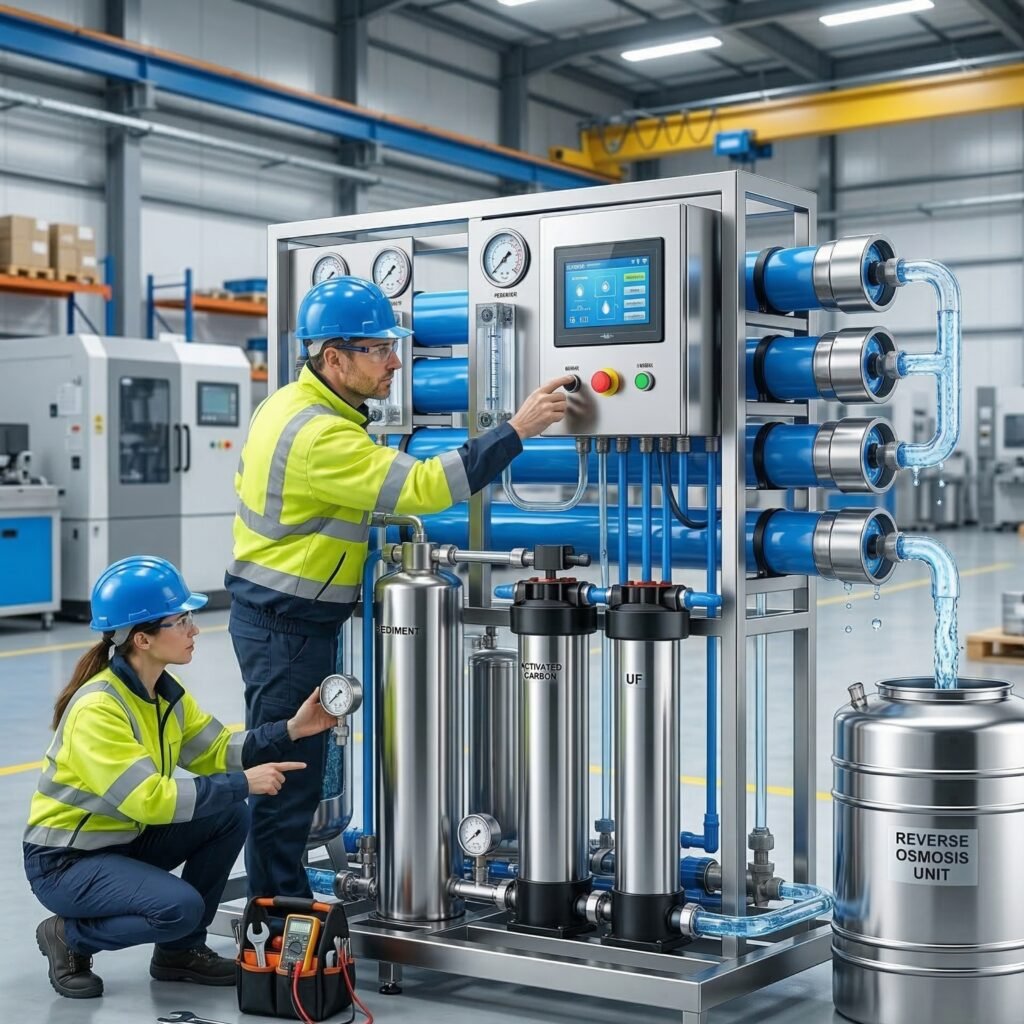
Standard skids are typically installed in about 2-5 working days after site readiness.
Pre-Treatment Configurations by Water Source
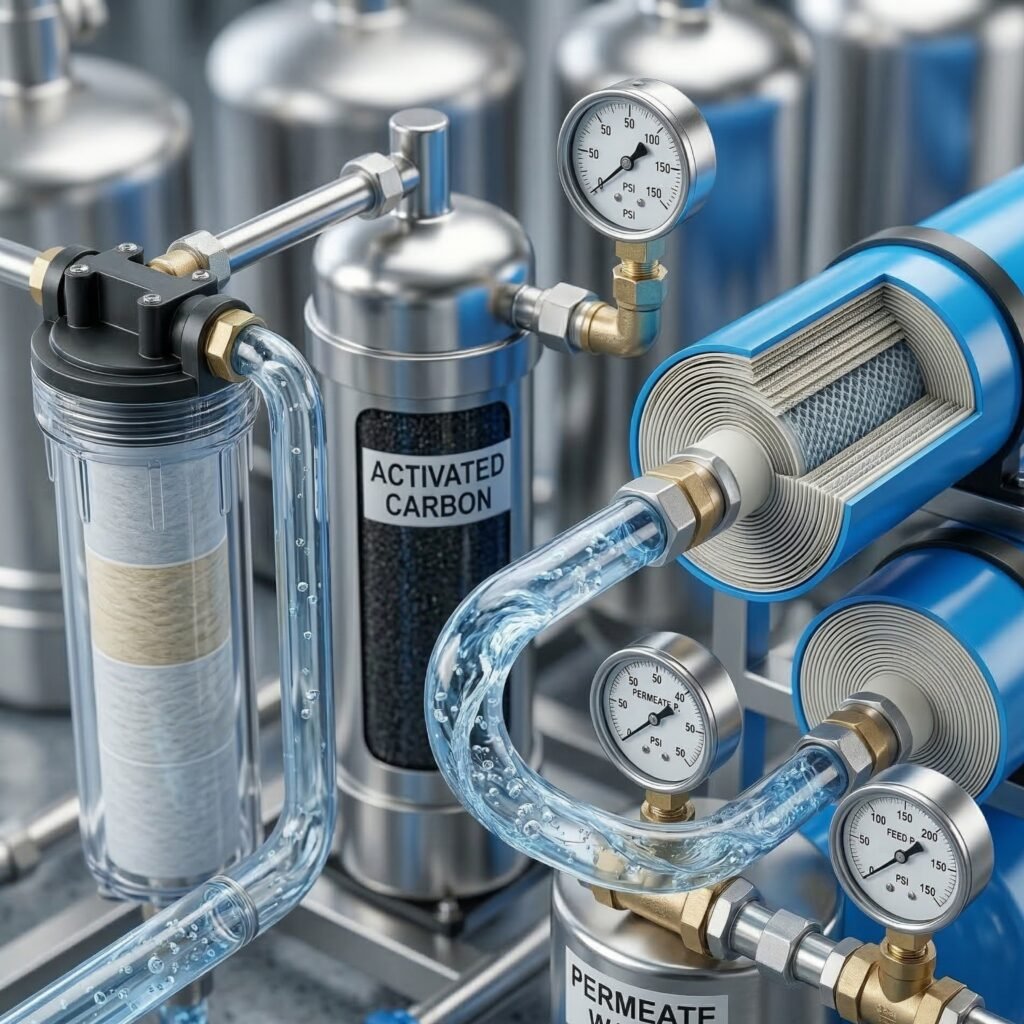
Piped supply: Buffer storage – Activated carbon – 5-micron cartridge – RO where the process needs low TDS – UV – SS storage
Tanker water: Test each source – Storage – Multimedia filter – Carbon – Antiscalant for the worst batch – 5-micron cartridge – RO – UV
Hard borewells: Multimedia – Carbon – Softener and/or antiscalant – 5-micron and 1-micron cartridges – RO – UV – SS storage
Estate bores (metals risk): Full panel with chromium, nickel, cadmium, lead, nitrate and COD – Iron removal where needed – Multimedia – Carbon – High-rejection RO – Permeate metals check at commissioning – Planned reject handling
Process polishing (plating rinse, boiler feed): Softener – Antiscalant – Double-pass RO or mixed bed – Conductivity control
Areas We Serve in and Around Peenya
Peenya core: Peenya Industrial Area Phases 1-4 | KIADB Peenya | Peenya (ಪೀಣ್ಯ) | Jalahalli (ಜಾಲಹಳ್ಳಿ) | Dasarahalli (ದಾಸರಹಳ್ಳಿ) | T. Dasarahalli
North and west, along Tumkur Road: Bagalagunte (ಬಾಗಲಗುಂಟೆ) | Chikkabanavara (ಚಿಕ್ಕಬಾಣಾವರ) | Nagasandra (ನಾಗಸಂದ್ರ) | the Tumkur Road toward Nelamangala
South: Yeshwanthpur (ಯಶವಂತಪುರ) | Rajajinagar Industrial Town (ರಾಜಾಜಿನಗರ)
Adjacent areas:
- Bengaluru city – Industrial RO Plant Manufacturer in Bangalore | RO Water Treatment Plant Supplier in Bangalore
- Nelamangala and Dabaspet (north-west) – Best Industrial RO Plant Manufacturer in Nelamangala
- Tumakuru (further north-west) – Best Industrial RO Plant Manufacturer in Tumakuru
- Devanahalli and the airport (north-east) – Best Industrial RO Plant Manufacturer in Devanahalli
- Yelahanka (north) – Best Industrial RO Plant Manufacturer in Yelahanka (when live)
- Ramanagara (south-west) – Best Industrial RO Plant Manufacturer in Ramanagara
Manufacturing base: Kogilu Layout, north Bengaluru – Our Presence
- Frequently Asked Questions
Where is the plant built?
At our Kogilu Layout unit in north Bengaluru, a cross-town drive from Peenya. We install, commission and service on site.
Are you a manufacturer or a dealer?
A manufacturer. We design and build the skids ourselves.
Which taluk is Peenya in?
Bengaluru North taluk, Bengaluru Urban district.
What is the typical TDS here?
There isn’t one. The nearest CGWB wells read EC of 470-1,220 µS/cm. We design from your lab report.
How stressed is the groundwater?
Very. The 2025 state report gives Bangalore (North) a 249.65% stage of extraction.
Is chromium really a concern?
In parts of the estate, yes. A 2013 KSPCB survey found 20 of 72 bores heavily polluted with chromium. We test metals before design.
Can RO remove chromium and nitrate?
High-rejection RO reduces both, but we verify the permeate at commissioning rather than assume it.
We have a softener. Why RO?
A softener stops scale but does not lower TDS, nitrate or chloride. It often stays as pre-treatment.
What does a plant cost?
From ₹85,000 for 250-500 LPH to ₹2.2-3.5 lakh+ for 2,000-4,000 LPH; custom plants on assessment.
Do you service other suppliers' plants?
Yes, after an inspection and a water test. See AMC Services.
Get a Site-Tested Industrial RO Proposal for Peenya
Share your location, water source (piped, borewell, tanker or mixed) and peak LPH. We will test your feed water, design the pre-treatment and send a written proposal.
📞 +91 76763 93939 | +91 97387 04753
📧 info@bangaloreaqua.com
🌐 bangaloreaqua.com
📍 Manufacturing: 107/209 2nd Cross, 4th Main Kogilu Layout, Bengaluru – 560064
Also See
- Industrial RO Plant Manufacturer in Bangalore
- Industrial RO System
- RO Water Treatment Plant Supplier in Bangalore
- Best Industrial RO Plant Manufacturer in Nelamangala
- Best Industrial RO Plant Manufacturer in Tumakuru
- Best Industrial RO Plant Manufacturer in Devanahalli
- Best Industrial RO Plant Manufacturer in Yelahanka (when live)
- Best Industrial RO Plant Manufacturer in Electronic City (when live)
- Industrial and Commercial RO Plant AMC Services
- Our Presence