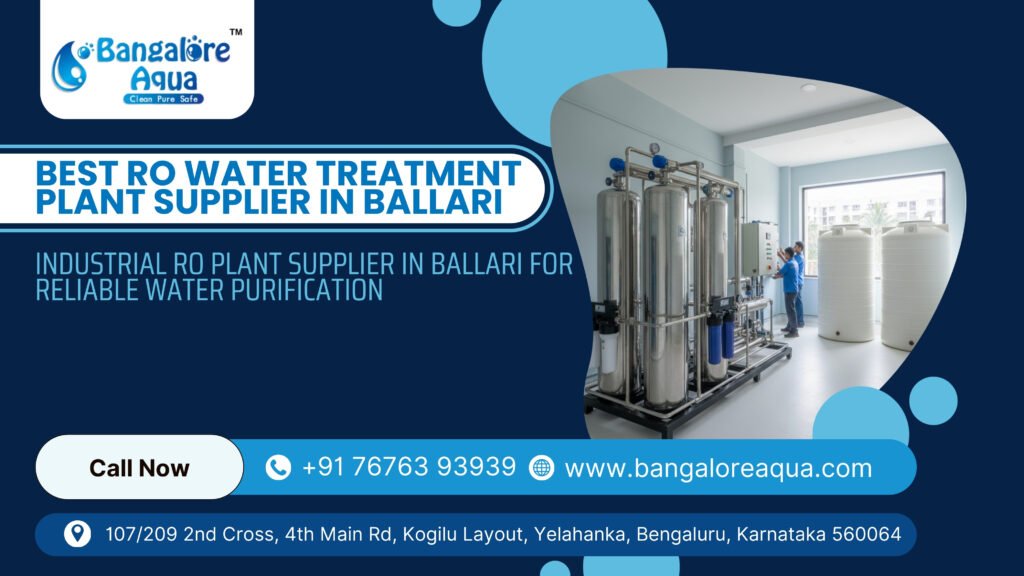
Ballari, formerly known as Bellary, stands as one of Karnataka’s most important industrial cities. However, with rapid industrialization, extensive mining operations, and accelerating urbanization, the region faces a critical challenge that affects every resident and business owner: water quality. The groundwater in Ballari has become increasingly contaminated with high levels of dissolved salts, industrial pollutants, and microbial contaminants. This comprehensive guide explores the world of RO water treatment plants and helps you identify the best supplier for your specific needs in Ballari.
The Water Crisis in Ballari: Understanding the Problem
Ballari’s water quality crisis is not a recent phenomenon, but it has intensified significantly over the past decade. The city’s groundwater contains Total Dissolved Solids (TDS) levels often exceeding 1000 ppm, compared to the World Health Organization’s recommended standard of 500 ppm. This contamination stems from multiple sources: mining operations that have left heavy metals in the soil, industrial effluents from manufacturing units, agricultural runoff laden with pesticides and fertilizers, and inadequate municipal water treatment infrastructure.
The consequences of consuming untreated water from these sources are severe. Residents experience waterborne diseases, digestive problems, skin issues, and long-term health complications from heavy metal exposure. Businesses suffer from equipment damage caused by hard water scale buildup, production quality issues due to contaminated water, and regulatory compliance failures. This has created an urgent need for reliable water treatment solutions throughout the city.
Many families in Ballari have traditionally relied on expensive bottled water, spending thousands of rupees monthly on a solution that’s neither sustainable nor cost-effective in the long term. Others have invested in traditional filters that provide minimal protection against dissolved salts and chemical contaminants. The introduction of Reverse Osmosis (RO) technology has revolutionized water treatment in Ballari, offering a practical, affordable, and highly effective solution for both residential and commercial applications.
Understanding RO Water Treatment Technology
Before selecting a supplier, it’s essential to understand how RO technology works and why it’s become the gold standard for water purification in regions like Ballari.
Reverse Osmosis is a water purification process that uses a semi-permeable membrane to remove ions, molecules, and larger particles from water. The process works by applying pressure to force water molecules through a membrane while blocking contaminants. Unlike traditional filtration that only removes particles, RO removes dissolved salts, minerals, bacteria, viruses, chemical contaminants, and even some pharmaceutical residues.
The complete RO treatment process consists of multiple stages:
Pre-filtration Stage: Raw water first passes through sediment filters that remove sand, silt, and larger particles. This protects the delicate RO membrane from damage and extends its lifespan significantly.
Carbon Filtration Stage: Activated carbon filters remove chlorine, pesticides, volatile organic compounds, and odors. This stage is crucial in Ballari where industrial chemicals and agricultural runoff are common contaminants.
RO Membrane Filtration: This is the core of the system. Water is forced through a semi-permeable membrane with pores so small (0.0001 microns) that only water molecules pass through. Virtually everything else—dissolved salts, minerals, bacteria, viruses, and chemical contaminants—is blocked and flushed away as waste water.
Post-treatment Stage: The purified water then passes through a mineral restoration filter that adds back beneficial minerals like calcium and magnesium, improving taste and providing health benefits. pH adjustment also occurs at this stage to ensure the water is neutral and safe for consumption.
For Ballari specifically, RO technology proves invaluable because it addresses all the region’s water quality issues simultaneously. The high TDS levels that make water unpalatable and potentially harmful are reduced from over 1000 ppm to safe levels of 50-150 ppm. Hard water minerals that damage pipes and appliances are removed. Industrial contaminants and heavy metals are eliminated. Microbial contamination is prevented through the mechanical barrier of the membrane.
Types of RO Water Treatment Plants Available in Ballari
Not all RO plants are created equal. Depending on your specific situation—whether you’re an individual homeowner, a restaurant owner, or an industrial facility manager—different plant capacities and configurations are available.
Residential RO Systems
Specifications: 25-75 liters per hour capacity, compact design, wall-mounted installation, power consumption 40-80 watts
Cost Range: ₹8,000 to ₹20,000
Best For: Individual homes, small apartments, families of 4-6 people
Key Features: These systems are specifically designed for household use. They’re compact enough to fit under kitchen sinks or on walls, user-friendly with simple operation, and include smart indicators that alert you when filters need replacement. Modern residential systems often feature water-saving technology that recovers 50-60% of input water as purified output.
Families in Ballari choosing residential RO systems typically use them for drinking water and cooking. A 50 LPH system can easily provide 100-150 liters of purified water daily, sufficient for a family of five or six people.
Commercial RO Plants
Specifications: 250-1000 liters per hour capacity, high-grade stainless steel construction, automated operations, digital monitoring systems
Cost Range: ₹1,50,000 to ₹5,00,000
Best For: Offices, hospitals, schools, restaurants, small manufacturing units, hotels
Key Features: Commercial plants are engineered for continuous operation and higher water demands. They include large stainless steel storage tanks (500-2000 liters), automated controls that manage filtration and backwashing, digital display panels showing real-time water quality metrics, and optional UV sterilization modules for additional microbiological protection.
These systems are ideal for institutions where water quality directly impacts operations. A hospital in Ballari requires ultra-pure water for patient care and medical equipment. A restaurant needs consistent water quality for food preparation and beverage service. Schools need reliable water for student safety. Bangalore Aqua’s commercial plants serve all these needs effectively.
Industrial RO Plants
Specifications: 1000 to 10,000+ liters per hour capacity, customizable configuration, advanced pre-treatment, zero-liquid discharge capability
Cost Range: ₹5,00,000 to ₹30,00,000+
Best For: Large manufacturing facilities, pharmaceutical companies, food processing plants, beverage industries, mining operations
Key Features: Industrial plants are robust systems designed to handle severely contaminated water sources. They include specialized pre-treatment units that remove the most stubborn contaminants before water reaches the RO membrane. Many include wastewater recycling systems that recover 70-80% of input water as pure output, reducing both water consumption and disposal costs.
Ballari’s mining and manufacturing industries particularly benefit from these systems. A pharmaceutical company requires water meeting strict quality standards. A beverage manufacturer needs consistent water composition for product quality. These industrial plants deliver precisely what’s needed.
Community RO Water Plants
Specifications: 500-2000 liters per hour capacity, 24/7 operation capability, Water ATM integration, UPI payment systems, large stainless steel storage
Cost Range: ₹3,00,000 to ₹10,00,000
Best For: Residential colonies, villages, public areas, community water supply projects
Key Features: These plants represent an innovative solution for providing affordable clean water to large populations. They include stainless steel storage tanks (10,000-20,000 liters), backup systems ensuring continuous operation, Water ATM integration allowing customers to dispense water using digital payment, and monitoring systems tracking water quality 24/7.
Community plants have transformed access to clean water in Ballari’s colonies and villages, providing affordable pure water while generating revenue for maintenance and operations.
Top RO Water Treatment Plant Suppliers in Ballari
1. Bangalore Aqua – The Premier Choice for Water Solutions
Bangalore Aqua stands out as the most comprehensive and customer-focused Best RO water treatment plant supplier in Ballari. Established in 2021, this company has grown rapidly to become a trusted name across Karnataka.
Why Choose Bangalore Aqua?
Experience and Expertise: With over 4 years of dedicated experience in water treatment, Bangalore Aqua has successfully installed and serviced hundreds of RO systems across residential, commercial, and industrial sectors. Their team understands Ballari’s specific water challenges intimately, having served industrial facilities, hospitals, schools, and residential communities throughout the region.
Technology Leadership: The company specializes in RO technology but also offers UV purification, UF (Ultrafiltration), and advanced multi-stage systems. This diverse technology portfolio means they can recommend the perfect solution for any situation, whether you need basic RO treatment or advanced purification with multiple safeguards.
Complete Service Spectrum: Bangalore Aqua doesn’t just sell equipment. They provide comprehensive service including free water quality testing to identify specific contaminants, customized system design based on your unique water source and usage patterns, professional installation with minimal operational disruption, regular maintenance and filter replacements, and 24/7 emergency support for critical issues.
Customer Support Excellence: Available round-the-clock, their support team addresses issues quickly. Their Annual Maintenance Contract (AMC) programs are affordable and comprehensive, covering regular servicing, filter replacements, and emergency repairs. They provide operator training so your staff can safely operate and troubleshoot systems.
Quality Certifications: ISO-certified manufacturing processes ensure every system meets international standards. All components are tested rigorously before delivery and installation.
Why Ballari specifically trusts Bangalore Aqua: The company has proven its commitment to the region through years of reliable service. They maintain local service centers ensuring quick response times for maintenance and emergencies. Their transparent pricing policy means no hidden costs. Payment options including EMI facilities make quality water treatment accessible even for tight budgets. Most importantly, they stand behind every system with comprehensive warranties and long-term customer relationships.
2. Hanuman Water World
Located in Bellary, this supplier specializes in both industrial and drinking water treatment plants. They’re known for quality installation and maintenance services, backed by five-star customer reviews. Their strength lies in understanding the specific needs of Ballari’s industrial sector.
3. Maruthi Pure Water Technologies
Established in 2004, Maruthi has over two decades of experience in water treatment. Located in Narsal Complex, they specialize in water purifiers, sewage treatment plants, and water softening systems. Their annual turnover indicates a well-established business with consistent client satisfaction.
4. RO Care India
Specializing in effluent treatment plants and RO systems, RO Care India offers cost-effective solutions particularly for industrial applications. They provide water analysis, customized design, installation, and maintenance services tailored to industrial requirements.
Comprehensive Selection Guide: Choosing the Right RO Supplier for Ballari
Step 1: Conduct a Thorough Water Quality Assessment
Before contacting any supplier, understand your water’s current condition. Request a free water quality test from Bangalore Aqua or other suppliers. Key parameters to check include:
TDS (Total Dissolved Solids): Measured in parts per million (ppm), this indicates the total concentration of dissolved minerals and salts. Ballari’s typical levels range from 800-1500 ppm, well above the safe standard of 500 ppm.
Hardness: Indicates calcium and magnesium content. Hard water causes scale buildup in pipes and appliances. Ballari typically experiences moderate to high hardness.
pH Level: Should be neutral (6.5-8.5). Acidic or alkaline water requires pH adjustment.
Microbial Contamination: Testing for bacteria, viruses, and coliform presence. Critical for health safety.
Heavy Metals: Arsenic, lead, chromium, and other metals dangerous even in small quantities. Mining activities in Ballari make this especially important.
Iron and Manganese: Common in Ballari’s groundwater, causing discoloration and taste issues.
Most reputable suppliers offer free water testing to determine the best treatment approach. This analysis is essential—it ensures the recommended system actually addresses your water’s specific problems.
Step 2: Calculate Your Water Capacity Requirements
Underestimating capacity leads to frequent outages and customer dissatisfaction. Overestimating wastes money on unnecessary equipment.
For Residences: Calculate 50 liters per person daily for all water needs, multiplied by number of people. A family of five needs 250 liters daily minimum. Choose a system with 20-30% extra capacity to handle peak usage during morning/evening hours.
For Commercial Establishments: Requirements vary dramatically. A restaurant uses 500-2000 liters daily depending on menu and customer volume. A hospital requires 1000-5000 liters based on bed count. Schools need 250-1000 liters depending on student population.
For Industrial Facilities: Capacity depends entirely on manufacturing processes. Textile plants, food processing facilities, pharmaceutical companies, and beverage manufacturers each have different requirements.
Always choose capacity slightly above your calculated need. This prevents system strain, extends equipment lifespan, and ensures reliability during peak demand periods.
Step 3: Evaluate Supplier Credentials and Track Record
Credentials matter because they indicate commitment to quality and customer satisfaction.
Manufacturing Standards: Look for ISO 9001:2015 certification indicating quality management systems. Some suppliers may have BIS (Bureau of Indian Standards) certification for specific products.
Industry Experience: Minimum 3-5 years in business indicates stability and expertise. Suppliers serving Ballari for years understand regional challenges better than newcomers.
Customer Reviews and References: Check online reviews, ask for customer references, and try to speak with existing clients about their experiences. A supplier willing to provide references demonstrates confidence in their service quality.
Local Presence: Service centers in Ballari ensure quick response during maintenance or emergencies. Bangalore Aqua’s local presence is a significant advantage.
Warranty Coverage: Reputable suppliers offer 2-5 year warranties on equipment and components, protecting your investment.
AMC Services: Affordable Annual Maintenance Contracts should include regular servicing, filter replacements, and emergency repairs.
Step 4: Compare Technology and Advanced Features
Modern RO systems include sophisticated features that improve performance and user experience:
Multi-stage Filtration: Systems with 5-7 stages of filtration offer superior purification compared to basic 2-3 stage systems. Additional stages address specific contaminants in Ballari’s water.
UV/UF Technology: Ultraviolet light kills bacteria and viruses without chemicals. Ultrafiltration removes particles without removing beneficial minerals. These complement RO treatment.
Mineral Restoration: Essential in Ballari, these cartridges add back calcium and magnesium for taste and health benefits after RO removes them.
Smart Monitoring: Digital displays showing water quality metrics, filter life remaining, and alert systems notifying you of maintenance needs.
Energy Efficiency: High-pressure pumps consuming less electricity reduce operational costs. Modern systems use 40-80 watts for residential, compared to older models using 100+ watts.
Wastewater Recovery: Systems recovering 50-70% of input water as purified output reduce overall water consumption and environmental impact.
Step 5: Assess Installation and Support Services
Quality suppliers provide professional, hassle-free installation:
Professional Installation: Certified technicians ensure proper system setup. Poor installation compromises performance and voids warranties.
Operator Training: Your staff should understand system operation, maintenance schedules, and troubleshooting basics.
24/7 Customer Support: Reliable suppliers respond quickly to emergencies, minimizing downtime.
Regular Maintenance Programs: Scheduled filter replacements and professional servicing keep systems running optimally.
Spare Parts Availability: Quick access to replacement components prevents extended downtime.
Bangalore Aqua excels in all these areas, offering comprehensive installation and ongoing support that customers consistently praise.
Step 6: Compare Pricing and Calculate Return on Investment
Cost matters, but shouldn’t be the only consideration. Focus on total cost of ownership over 10 years:
Upfront Equipment Cost: Initial investment for the RO plant itself.
Installation Cost: Professional installation fees.
Operational Costs: Electricity consumption, water wastage, and maintenance supplies.
Maintenance Costs: Annual AMC contracts typically cost 10-15% of equipment cost.
Filter Replacement: Pre-filters (₹500-1000), carbon filters (₹1000-2000), RO membranes (₹5000-10000 per replacement every 2-3 years).
Cost Example: A commercial 500 LPH RO plant from Bangalore Aqua costs ₹2,00,000-₹2,50,000 initially. Annual AMC costs ₹15,000-₹20,000. Over 10 years: approximately ₹3,50,000-₹4,50,000 total investment. Compared to bottled water expenses of ₹10,000+ monthly, or health costs from contaminated water, this investment repays itself multiple times over.
Benefits of Investing in Quality RO Systems
Health and Safety Benefits
Quality RO systems remove 95-99% of contaminants, viruses, and bacteria. Families drinking purified water experience fewer waterborne illnesses, digestive problems, and skin issues. Children grow healthier without exposure to heavy metals and microbial contaminants. This alone justifies the investment.
Cost Efficiency
Eliminating dependence on expensive bottled water saves thousands monthly. Preventing appliance damage and pipe corrosion from hard water reduces maintenance costs. Avoiding medical expenses from water-related illnesses provides significant savings.
Environmental Responsibility
Reducing plastic waste from bottled water consumption supports environmental sustainability. Modern RO systems recovering and reusing wastewater minimize overall water consumption. This aligns with global water conservation goals.
Business Continuity
For commercial and industrial users, consistent water quality ensures uninterrupted operations. Restaurants serve better food. Hospitals provide safer patient care. Manufacturers maintain product quality standards.
Installation, Maintenance, and Long-term Care
Installation Timeline
Pre-Installation Phase (1-2 days): Initial consultation, water quality assessment, system selection, site survey, equipment delivery and verification.
Installation Phase (1-3 days): Pipe fitting, tank assembly, electrical connections, system testing, water quality verification.
Post-Installation Phase: Operator training, documentation handover, initial maintenance checks, AMC registration.
Most commercial installations complete within 5-7 working days, minimizing operational disruption.
Maintenance Schedule
Weekly: Check system indicators and water quality.
Monthly: Inspect pre-filters, clean sediment traps.
Quarterly: Replace pre-filters and carbon filters.
Semi-annual: Professional inspection.
Annual: RO membrane replacement, complete servicing.
Regular maintenance extends system lifespan from typical 8-10 years to 15+ years.
Conclusion and Final Recommendation
Water quality directly impacts health, business operations, and quality of life. Ballari’s water challenges—high TDS, industrial contamination, hardness, and microbial threats—make investing in quality RO treatment systems essential, not optional.
When selecting an RO water treatment plant supplier in Ballari, prioritize proven expertise in local water challenges, quality certifications and industry standards, comprehensive installation and maintenance services, 24/7 customer support, transparent pricing, and long-term value.
Bangalore Aqua represents the gold standard for RO water treatment solutions in Ballari. Their proven track record, advanced technology, customer-centric approach, and comprehensive service ecosystem make them the premier choice for families, businesses, and industries seeking pure, safe, healthy drinking water.
Your family’s health and your business’s success depend on water purity. Choose the best—choose Bangalore Aqua.