Best Industrial RO Plant Supplier in Yadgir (2026)
DRINK SAFE AND PURE
Bangalore Aqua - Industrial RO Plant Supplier for Yadgir District
Yadgir (ಯಾದಗಿರಿ) is Karnataka’s newest district, and it sits on two rivers: the Bhima, which flows past Yadgir town, and the Krishna along its southern and western edge. Invest Karnataka lists the district at 5,270 sq km with a population of 11,74,271 and six taluks. It names rice mills, cotton mills and pharma industries as the major industries, the Kadechur-Badiyal Industrial Area as the key industrial area, and pharma as the major industrial sector. The same page counts 31,828 small-scale industries and lists paddy, cotton, jowar, pulses and groundnut as the major crops, with red gram among the pulses. It also describes Yadgir as “rich in uranium resources”, which matters for water, as the data below shows.
Kadechur-Badiyal is the industrial story. In 2021, Karnataka’s industries minister said the state had approved 67 pharma companies for the Kadechur-Badiyal Bulk Drug Park, with an expected investment of over ₹2,812 crore and more than 11,000 jobs. He also said the industrial area had been developed on over 3,000 acres in Kadechur, with pharma infrastructure on about 1,500 acres of it (The Hindu, 2021). Bulk drug and chemical units run boilers, cooling towers, reactor wash and utility loops, and they house workers on site. All of that needs consistent water.
Then there is the canal belt. The Basava Sagar (Narayanpur) dam on the Krishna is part of the Upper Krishna Project. It has a total storage capacity of 37.965 TMC, and its irrigation reaches Shahapur and Shorapur taluks among others. The National Water Mission notes that dug-well irrigation dominates in Yadgir taluk, that Shorapur and Shahapur are irrigated through the Upper Krishna Project canals, and that lift irrigation schemes are being built along the Bhima. A rice mill near Shahapur may therefore run on canal-influenced supply for part of the year and a borewell for the rest, while a unit near Yadgir town may depend on groundwater all year.
That is why an industrial RO plant in Yadgir has to be engineered, not picked off a price list. Scheme water is usually treated for turbidity and bacteria, not for dissolved salts, fluoride or metals. A water softener swaps calcium and magnesium for sodium, so it stops scale, but it does not lower TDS and it does not remove fluoride. UV disinfection only kills microbes, so it does not touch fluoride, nitrate, uranium or arsenic either. Peer-reviewed studies report fluoride, salinity, uranium and arsenic pockets in this district (details below). Here, reverse osmosis with the right pre-treatment is the practical way to get drinking water and low-TDS process water that stays in specification.
Bangalore Aqua And Energy Pvt. Ltd. is the supplier behind the plant from design to AMC. We manufacture RO plants, water treatment systems, softeners, community and solar RO plants, and industrial and commercial systems at our unit in Kogilu Layout, Bengaluru. For Yadgir, we then supply, install and commission each plant on site, and support it with AMC after handover.
📞 +91 76763 93939 | +91 97387 04753 📧 info@bangaloreaqua.com 🌐 bangaloreaqua.com Related Yadgir page: RO Water Treatment Plant in Yadgir
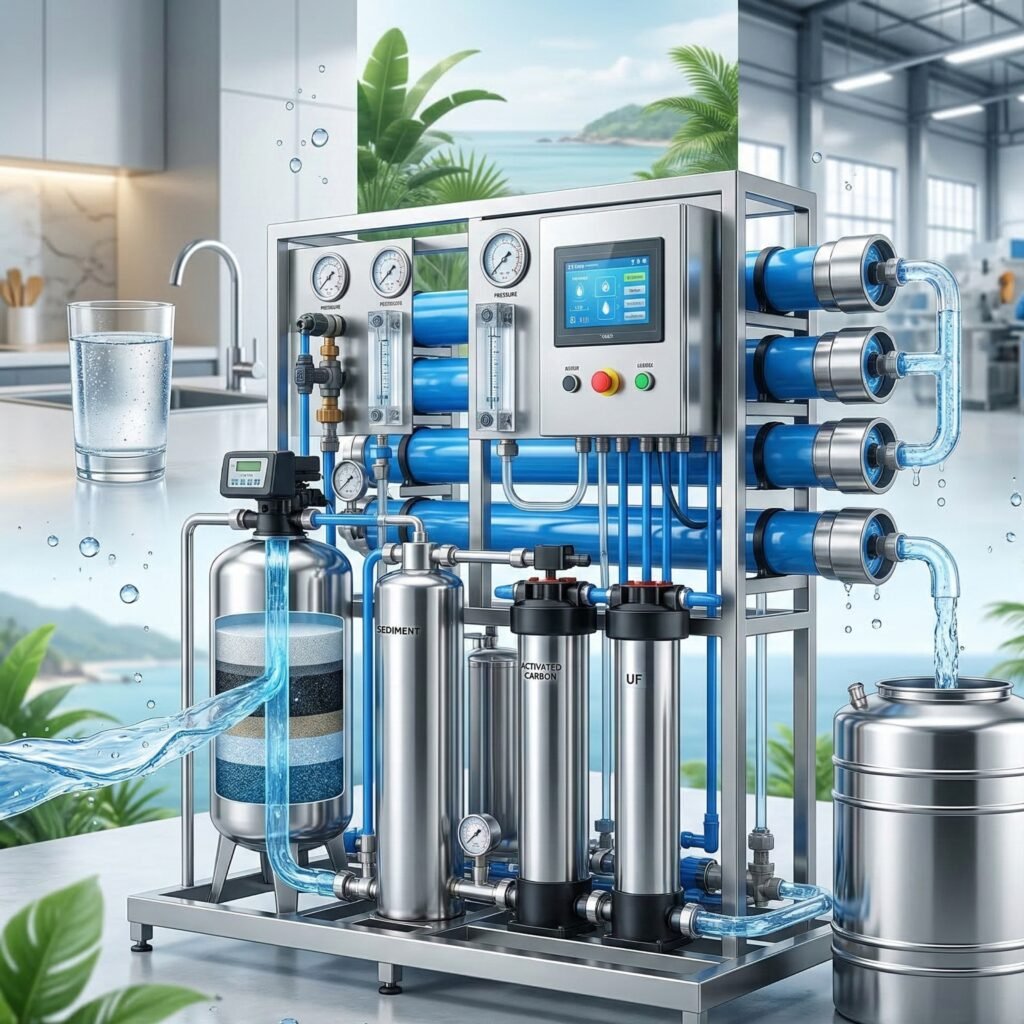
Yadgir Water Quality: What the Data Actually Says
Granite zones, canal zones and the uranium belt are different problems
Granite and gneiss borewell zones (most of the district). A Bangalore University study of 90 borewell samples from Yadgir, Shorapur and Shahapur taluks found fluoride from 0.21 mg/L at Naganur to 4.8 mg/L at Hurasgundagi, with 31.18% of samples above the BIS permissible limit of 1.5 mg/L. The authors link the fluoride to the Peninsular Gneiss and granites and to longer residence time in the aquifer (Kumara Naika et al., RJLBPCS 2020). Taluk work confirms the pattern:
- Shahapur taluk (fluoride): 65 borewell samples showed fluoride of 0.25 to 4.85 mg/L before the monsoon and 0.00 to 2.93 mg/L after it, with 26.14% of pre-monsoon samples above 1.5 mg/L. High-fluoride villages named include Bheemarayanagudi, Diggi, Gogipeta, Saidapur, Hanchinal and Halisagara (International Journal of Chemical Studies, 2020).
- Shahapur taluk (salinity): in the same 65-borewell set, 38.46% of samples fell in the “unsuitable” salinity-hazard class and 58.46% in the “doubtful” class under the USSL classification (IJCMAS, 2023). That study rates the water for irrigation, but for an RO designer the message is the same: many Shahapur bores are brackish.
The uranium belt (Gogi and the Shahapur side). A 2020 baseline study around the proposed uraninite mine at Gogi monitored 52 wells every three months and found uranium from 1.5 to 267 ppb. The WHO and USEPA limit is 30 ppb, and the Atomic Energy Regulatory Board limit is 60 ppb. Concentrations exceeded the limit in about 25% of wells within 20 km of the mineralised zone, with higher values in granitic and limestone terrain (Minerals, MDPI 2023). Separately, a study of the Kamalavathi river basin across Gulbarga and Yadgir districts found uranium above 30 ppb in the north-eastern part of its study area (Journal of the Geological Society of India, 2019).
Arsenic history. A published paper on arsenic exposure in Karnataka states that the state’s earliest groundwater arsenic contamination was identified in villages of Yadgir district in 2008. It lists Mandyal, Rampur, Arker, Gudihal and Bijaspur as affected Yadgir habitations (IJCMPH). A 2025 Current Science paper also notes earlier arsenic reports from Raichur and Yadgir districts (Current Science, 2025).
Canal and river water (Krishna and Bhima belts). Surface water brings seasonal turbidity, silt, algae and organics, especially once releases start and during the monsoon. We found no single published district number that applies here, so it is a site-test item.
Planning table
Concern | Planning note | Implication |
Fluoride | 0.21-4.8 mg/L across 90 district samples, 31.18% above 1.5 mg/L; up to 4.85 mg/L in Shahapur pre-monsoon | RO with permeate fluoride checked at commissioning; softener or UV alone is not a fix |
Salinity / EC | 38.46% of 65 Shahapur bores “unsuitable” and 58.46% “doubtful” for salinity hazard (USSL) | Membrane choice and recovery set from the measured TDS; plan where the reject goes |
Uranium | 1.5-267 ppb around Gogi; about 25% of wells within 20 km above limits | Uranium on the lab panel near Gogi and the Shahapur side; verify permeate |
Arsenic | First Karnataka detection in Yadgir villages (2008); Mandyal, Rampur, Arker, Gudihal, Bijaspur listed | Arsenic on the lab panel; oxidation stage before RO where the lab asks for it |
Seasonal variation | Shahapur fluoride fell from 26.14% to 6.15% of samples above limit after the monsoon | Design for the worst season, not the best one |
Canal / river water | Seasonal turbidity and organics; no single number applies | Multimedia, carbon, and UF where silt spikes |
Takeaway: we do not invent a single “Yadgir TDS”. A pharma unit at Kadechur, a rice mill near Shahapur on canal-influenced supply and a school near Gogi can sit in completely different chemistry bands. Every Bangalore Aqua quote for Yadgir starts with a feed-water test from your actual source. The numbers above come from published studies, and your site test decides the design.
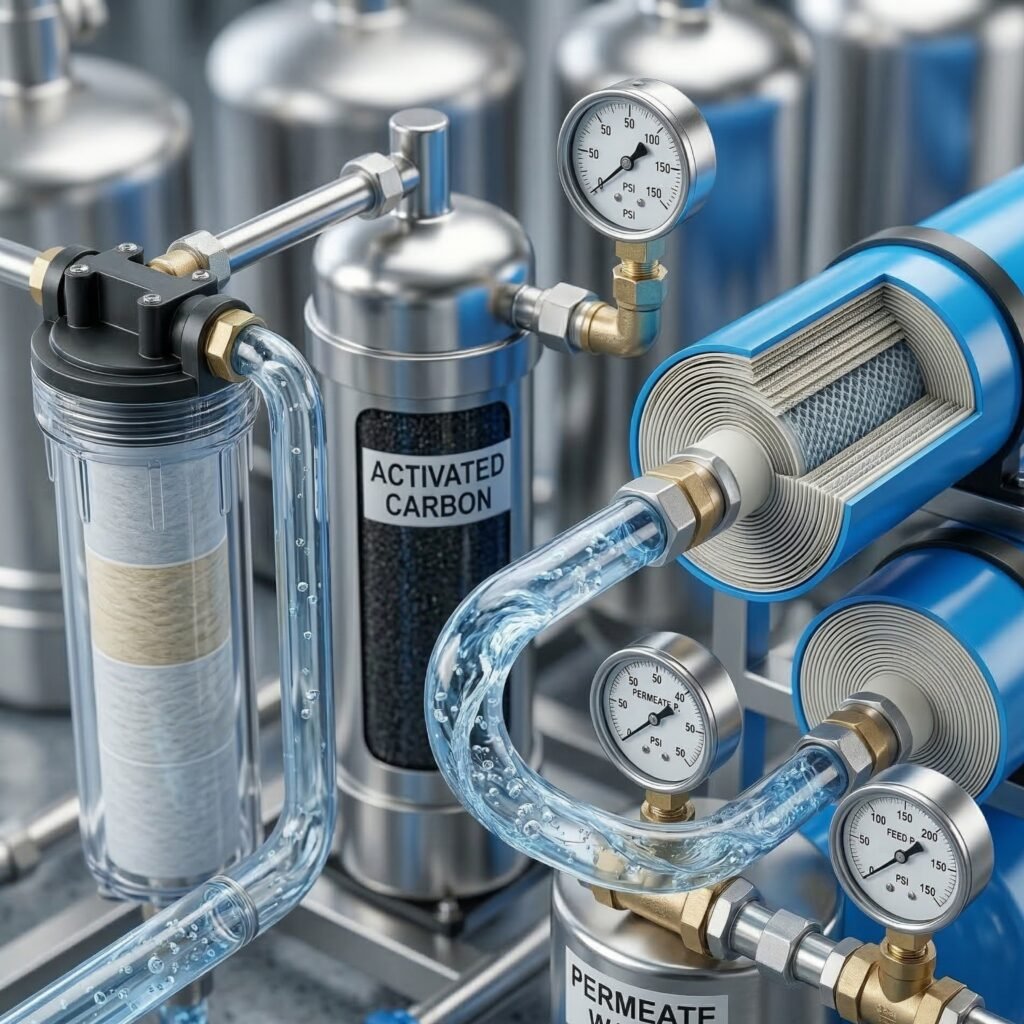
Key Sectors We Supply in Yadgir
Kadechur-Badiyal Pharma and Chemical Units
This is the district’s main industrial cluster, and its water needs are layered: boiler feed, cooling tower make-up, equipment wash, utility water and staff drinking water. For pharma units, our RO plants serve as the pre-treatment and utility stage. Pharmacopoeia-grade purified water needs its own validated system, and we say so upfront. Where a validated purified water system is in scope, we design the RO stage to feed it cleanly and hand over documented commissioning data.
Typical requirement: 1,000-4,000 LPH for utility and boiler feed; double-pass RO or polishing where the process asks for it; 500-1,000 LPH for canteens and worker housing.
Rice Mills, Parboiling and Dal Mills (Yadgir, Shahapur, Shorapur)
Paddy from the canal belt and red gram from the dry-land taluks feed the district’s rice and dal mills. Parboiling needs soaking and steaming water, the boilers need low-hardness feed, and workers need safe drinking water through long seasonal shifts. Hard or saline feed scales boilers and heat exchangers and pushes up fuel bills.
Typical requirement: 500-2,000 LPH for boiler feed and drinking; 2,000-4,000 LPH or more for larger parboiling units; softener or antiscalant ahead of RO as standard.
Cotton Ginning and Pressing
Cotton is a listed major crop, and cotton mills are a listed major industry. Ginning is largely a dry process, but units still need drinking water for large seasonal labour crews, humidification water that won’t scale nozzles, and canteen supply.
Typical requirement: 250-1,000 LPH for drinking and utility water; UV on storage; compact skids that can run seasonally.
Sugar and Agro-Processing (Wadagera and the Canal Belt)
Invest Karnataka lists a sugar and fuels investment in Wadagera taluk. Sugar, groundnut oil and other agro units need boiler feed, process water and drinking water for seasonal crushing crews.
Typical requirement: 1,000-4,000 LPH for boiler feed and utility; softener or antiscalant plus RO; AMC tied to the crushing season.
Dam Colonies, Contractor Camps and Canal Works (Narayanpur, Hunasagi, Shorapur)
Irrigation offices, dam maintenance crews, canal contractors and lift-irrigation project camps along the Krishna and Bhima often run on borewells in fluoride-prone granite. Their headcount rises and falls with the works calendar.
Typical requirement: 1,000-4,000 LPH for camps; 250-1,000 LPH for offices and canteens; SS storage; relocatable skids where the camp moves.
Hospitals, Colleges and Institutions
Invest Karnataka lists 264 health centres, a government medical college, an engineering college, four polytechnics and about 100 colleges in the district. These buildings need safe drinking water plus soft water for laundry, kitchens and hot-water loops.
Typical requirement: 500-2,000 LPH; UV plus RO; structured AMC with fast response.
Fluoride, Uranium and Arsenic Villages: Community, CSR and JJM Plants
Where borewell fluoride, uranium or arsenic is high, a community RO plant is a direct health intervention, which softeners and UV are not. We build community plants with inlet and permeate water-quality records, Kannada-friendly operator training and multi-year AMC. See Best CSR Project RO Plants, Government Drinking Water Projects and Community RO Plants and Community RO Plants for Tribal Areas.
Typical requirement: 500-1,000 LPH community plants; optional UPI or coin dispensing; permeate fluoride checks (plus uranium or arsenic where relevant) on an annual lab cycle where the project requires it.
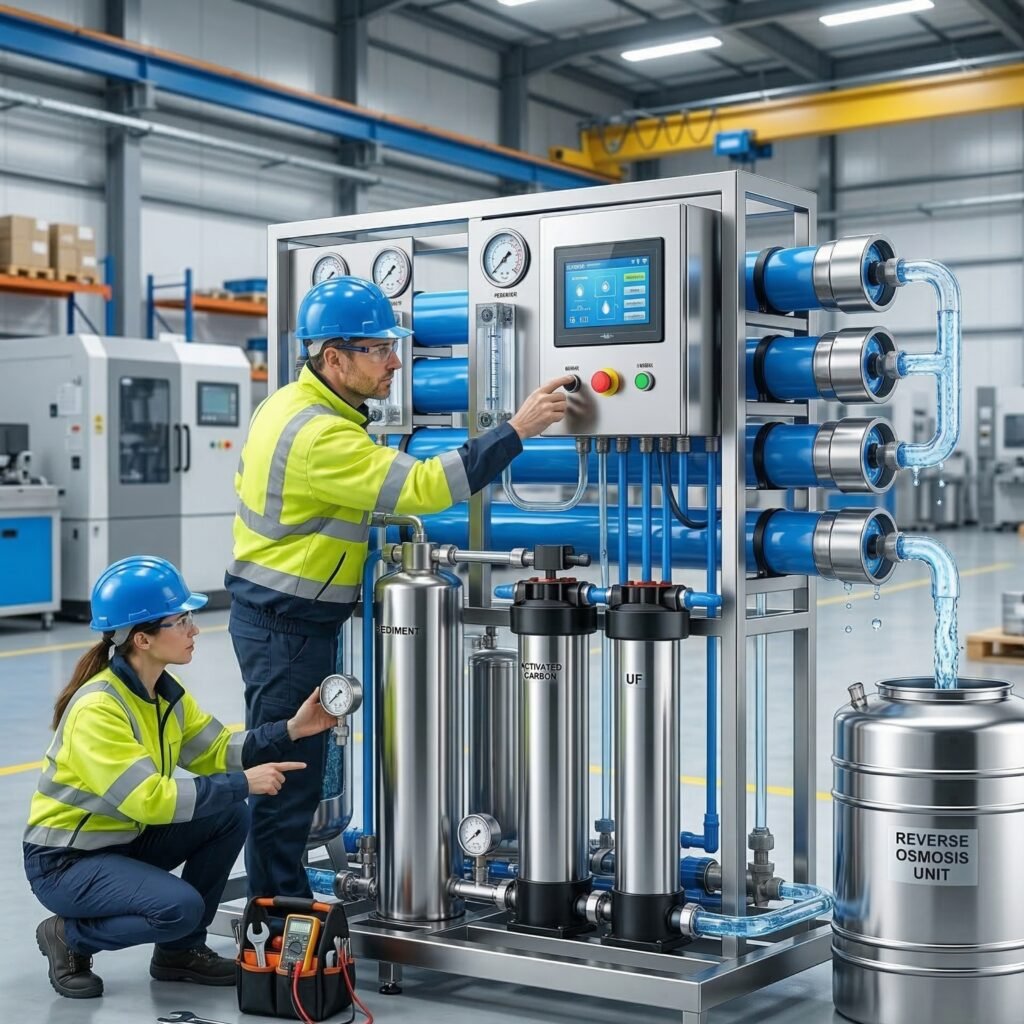
Industrial RO Plant Capacity and Pricing - Yadgir 2026
Capacity | Application | Daily Output (indicative) | Indicative Cost |
250-500 LPH | Ginning unit drinking water, canteen, small MSME, hostel block | 2,000-5,000 L | ₹85,000 – ₹1.6 lakh* |
500-1,000 LPH | Rice or dal mill boiler feed, community plant, hospital block | 4,000-10,000 L | ₹1.1 – ₹2.2 lakh* |
1,000-2,000 LPH | Mid-size parboiling unit, Kadechur utility line, contractor camp | 8,000-20,000 L | ₹1.5 – ₹2.8 lakh* |
2,000-4,000 LPH | Large rice mill, pharma utility block, sugar unit boiler feed | 16,000-40,000 L | ₹2.2 – ₹3.5 lakh+* |
Custom / 5,000+ LPH | Multi-line plants, industrial campuses | As designed | On assessment |
*Indicative bands are aligned with Bangalore Aqua’s published industrial pricing (Industrial RO Plant Manufacturer in Bangalore). The final quote follows the water test and depends on automation level, membrane brand, freight to site and site readiness. Daily output assumes roughly 8-10 running hours. AMC slabs: confirm before publish.
Standard skids are typically installed in about 2-5 working days after the site is ready. Custom and civil-heavy jobs take longer.
Pre-Treatment Configurations by Water Source
Canal and river water (turbidity, silt, organics): Raw water settling or storage – Multimedia filter – Activated carbon filter – UF where silt spikes are frequent – Antiscalant dosing – 5-micron cartridge – RO – UV – SS storage
Hard granite borewell water (most of the district): Multimedia filter – Activated carbon – Industrial softener and/or antiscalant – 5-micron and 1-micron cartridges – RO – UV – SS storage
Brackish bores (Shahapur and similar pockets): Full ion analysis – Multimedia – Carbon – Antiscalant tuned to the lab report – High-rejection brackish-water membranes – Conservative recovery – Planned reject handling
Fluoride borewells (Shahapur, Shorapur, Yadgir taluk pockets): Full standard train – RO membranes selected for fluoride rejection – Permeate fluoride verification at commissioning and on annual lab cycles – Mineral dosing only where the design allows, re-checked after dosing
Uranium and arsenic zones (Gogi belt, listed arsenic habitations): Expanded metals panel including uranium and arsenic – Oxidation and iron removal stage where the lab report calls for it – Multimedia – Carbon – Antiscalant – High-rejection RO – Permeate verified by an accredited lab – Documented reject handling
Process polishing (boiler feed, pharma utility, food contact): Standard train – Double-pass RO or mixed-bed polishing as required – UV – Online TDS monitoring
Community / CSR plants: Robust pre-treatment – RO – Enhanced UV – Optional UPI or coin dispensing – Pre and post water-quality file for CSR or JJM reporting – Multi-year AMC
Areas We Serve in and Around Yadgir
Yadgir and Gurmitkal: Yadgir town | Kadechur | Badiyal | Saidapur | Gurmitkal (ಗುರುಮಠಕಲ್) | Wadagera (ವಡಗೇರಾ)
Shahapur and the Gogi side: Shahapur (ಶಹಾಪುರ) | Bheemarayanagudi | Gogi | Hattigudur | Doranahalli
Shorapur and the Krishna belt: Shorapur / Surapura (ಸುರಪುರ) | Kembhavi | Hunasagi (ಹುಣಸಗಿ) | Narayanpur | Kakkera
Adjacent districts:
- Kalaburagi – RO Water Treatment Plant Supplier in Kalaburagi
- Raichur – RO Water Treatment Plant Supplier in Raichur | Best Industrial RO Plant Manufacturer in Raichur (when live)
- Vijayapura – Vijayapura RO Water Treatment Plant page (when live)
- Telangana border (Narayanpet side): quoted case-by-case
Elsewhere in Kalyana Karnataka:
- Bidar – RO Water Treatment Plant Supplier in Bidar
- Ballari – RO Water Treatment Plant Supplier in Ballari
Manufacturing base: Kogilu Layout, Bengaluru – Our Presence
- Frequently Asked Questions
You are a supplier in Yadgir, but where is the plant built?
We build the skids at our Kogilu Layout unit in Bengaluru, then supply, install and commission them on site anywhere in Yadgir district, including Kadechur, Shahapur, Shorapur, Gurmitkal, Hunasagi and Wadagera. AMC and service follow after handover.
We are setting up a bulk drug unit at Kadechur. Can your RO plant give us purified water?
Our RO plant can be the pre-treatment and utility stage that feeds your purified water system, and it can supply boiler, cooling and wash water. Pharmacopoeia-grade purified water needs a separate validated system. We design the RO stage around that system and hand over commissioning data.
What is the typical TDS of Yadgir groundwater?
There isn’t one number. In Shahapur alone, 38.46% of 65 borewell samples fell in the “unsuitable” salinity class and most of the rest in “doubtful”. A site half a taluk away can test very differently, so we design from your own lab report.
We already have a softener. Why do we need RO?
A softener removes hardness and stops scale. It does not lower TDS, nitrate, fluoride, uranium or arsenic. In Yadgir the softener often stays in place as pre-treatment to protect the RO membranes.
Is fluoride a real design concern for industrial sites?
For drinking water, yes, wherever your lab report shows it. A 90-sample district study found up to 4.8 mg/L, with 31.18% of samples above 1.5 mg/L. We verify permeate fluoride at commissioning rather than assume it.
Our site is near Gogi. Should we worry about uranium?
You should test for it. A 2020 study around Gogi found uranium from 1.5 to 267 ppb, with about a quarter of wells within 20 km above drinking-water limits. We add uranium to the lab panel for sites in that belt and confirm the permeate after commissioning.
What about arsenic?
Published work lists Mandyal, Rampur, Arker, Gudihal and Bijaspur as arsenic-affected Yadgir habitations. If your site is nearby, we add arsenic to the panel and include an oxidation stage before RO where the lab report calls for it.
Our rice mill uses canal-influenced water in season and a borewell in summer. Can one plant handle both?
Yes, if it is designed for the worse of the two sources. We test both, size the pre-treatment for canal turbidity, and set the membranes and recovery for the borewell’s TDS and hardness. Standard skids are typically installed in about 2-5 working days after the site is ready (base, power, inlet and drain).
How much does an industrial RO plant cost in Yadgir?
Indicative bands run from ₹85,000 for 250-500 LPH to ₹2.2-3.5 lakh+ for 2,000-4,000 LPH, with custom plants priced on assessment. Freight, civil work, extra pre-treatment and automation change the final figure, which we confirm in writing after the water test.
Do you service RO plants installed by other suppliers?
Yes. We take on AMC and repairs for existing plants after an inspection and a water test.
Get a Site-Tested Industrial RO Proposal for Yadgir
Share your location (industrial area, taluk or village), your water source (canal, borewell, tanker or mixed) and your peak LPH need. We will plan the feed-water test, design the pre-treatment and send a written proposal.
📞 +91 76763 93939 | +91 97387 04753 📧 info@bangaloreaqua.com 🌐 bangaloreaqua.com 📍 Manufacturing: 107/209 2nd Cross, 4th Main Kogilu Layout, Bengaluru – 560064
Also See
- Industrial RO Plant Manufacturer in Bangalore
- RO Water Treatment Plant in Yadgir
- Industrial RO System
- Best CSR Project RO Plants
- Government Drinking Water Projects in India – Community RO Plants
- Community RO Plants for Tribal Areas
- Community RO Water Plant Karnataka
- Best Industrial RO Plant Manufacturer in Kolar
- Best Industrial RO Plant Manufacturer in Raichur (when live)
- RO Water Treatment Plant Supplier in Raichur
- RO Water Treatment Plant Supplier in Kalaburagi
- RO Water Treatment Plant Supplier in Bidar
- RO Water Treatment Plant Supplier in Ballari
- Vijayapura RO Water Treatment Plant (when live)
- Our Presence