Best Industrial RO Plant Manufacturer in Raichur (2026)

DRINK SAFE AND PURE

Bangalore Aqua - Industrial RO Plant Manufacturer for Raichur District

Raichur (ರಾಯಚೂರು) sits between two great rivers, the Krishna to the north and the Tungabhadra to the south, and that geography explains almost everything about its economy. Invest Karnataka describes the district as the “Rice Bowl” of the region. It is home to Hutti Gold Mines in Lingasugur taluk, the Raichur Thermal Power Station, the Yermarus Thermal Power Station, over 100 rice mills and a strong cotton trading base, and it ranks first in Karnataka for sweet lime. The major industrial sectors listed for the district are rice mills, cotton ginning, dal mills, bulk drugs, fly-ash bricks and agricultural implement manufacturing, and its key exports include bulk drugs, rice, cotton, red chilli, groundnut and pomegranates.

Power is the other half of the Raichur story. The Raichur Thermal Power Station at Yadlapur (Shaktinagar) is KPCL’s coal-fired station with 1,720 MW of nameplate capacity (7 x 210 MW plus 1 x 250 MW), and it draws its cooling water from the Krishna. Further along, the Yermarus Thermal Power Station adds a 1,600 MW (2 x 800 MW) supercritical plant. Townships, contractor colonies, canteens, O&M vendor yards and fly-ash brick units have grown up around both stations, and all of them need safe, consistent water every shift.

Then there is the canal belt. According to the Tungabhadra Board, the Tungabhadra Left Bank Main Canal runs 227 km, and the Narayanpura Right Bank Canal of the Upper Krishna Project carries Krishna water across the northern part of the district (CLARE / WELL Labs). Canal water is what makes paddy, cotton and chilli possible. It also means many Raichur factories switch between canal-fed supply, borewells and tanker water across the year, so the feed water reaching your plant in January may look nothing like the feed in May.

That is why an industrial RO plant manufacturer Raichur has to be engineered, not picked off a price list. Municipal or scheme water is usually treated for turbidity and bacteria, not for dissolved salts or fluoride. A water softener swaps calcium and magnesium for sodium, so it stops scale, but it does not lower TDS and it does not remove fluoride. UV disinfection only kills microbes, so it does not touch fluoride, nitrate or salinity either. Government and peer-reviewed studies report fluoride, hardness, salinity and nitrate pockets in this district (details below). Here, reverse osmosis with the right pre-treatment is the practical way to get drinking water and low-TDS process water that stays in specification.

Bangalore Aqua And Energy Pvt. Ltd. manufactures RO plants, water treatment systems, softeners, community and solar RO plants, and industrial and commercial systems across Karnataka and South India. Every Raichur plant is built at our manufacturing unit in Kogilu Layout, Bengaluru, then dispatched, installed and commissioned on site, with AMC support after handover.

📞 +91 76763 93939 | +91 97387 04753 📧 info@bangaloreaqua.com 🌐 bangaloreaqua.com Related Raichur page: RO Water Treatment Plant Supplier in Raichur
Raichur Water Quality: What the Data Actually Says

Canal zones, borewell zones and mining/thermal zones are different problems

Canal command areas (TLBC and NRBC belts). Surface water brings seasonal turbidity, silt, algae and organics, especially once releases start and during the monsoon. Groundwater under the canals has its own problem. The Central Ground Water Board’s Raichur district brochure (CGWB Raichur brochure, archived copy) records salinity in the canal command areas of Lingasugur, Raichur and Sindhanur taluks, with brackish and saline pockets found in boreholes at Sripuram, Waykarnal, Kotasivara and Kuppeguda.

Borewell-dependent upland zones. The same CGWB brochure reports fluoride in the district from 0.10 to 4.70 mg/L (the permissible limit is 1.5 mg/L), with higher fluoride in deeper aquifers. It also reports electrical conductivity from 150 to 9,600 micromhos/cm (with high values at Kalmala 6,440, Amadihal 9,000 and Potanal 8,680) and chloride from 18 to 2,066 mg/L. Taluk studies confirm the pattern:

  • Lingasugur taluk: a 20-sample study reported TDS of 106 to 928 mg/L (highest at Maski), total hardness of 125 to 525 mg/L, and fluoride around 3 ppm at villages including Hangasadoddi, Santhekallur, Guddenhalli, Kuppigudda, Sarjapur and Halapur (JETIR, 2019).
  • Raichur taluk (Kalmala hobli): a 50-sample table reported total hardness of 150 to 3,750 mg/L and fluoride of about 0.5 to 2.87 mg/L (Hanche and Devappa).
  • Raichur taluk (irrigation study): of 59 groundwater samples, 50 in pre-monsoon and 45 in post-monsoon fell in the “very hard” category (Journal of Applied Geochemistry, 2022).
  • Devadurga taluk (Mashihal village): fluoride of 4.6 to 6.4 ppm in hand pumps and borewells, with skeletal fluorosis recorded in 20.26% of the 153 people surveyed (Eco. Env. & Cons., 2024).
  • Sindhanur taluk (Hanchinal): nitrate of 564 mg/L, with 11 physico-chemical parameters above permissible limits, the worst drinking-water composition in a 45-village study (Current Science, 2025).

Mining and thermal zones. The same Current Science paper notes that arsenic contamination was reported earlier from Raichur and Yadgir districts, and it links the arsenic to gold-bearing greenstone geology. For sites in the Hutti, Mudgal and Maski belt, that is a reason to widen the lab panel. The paper also notes that large industries such as thermal power mostly draw river water, while small and medium units depend on groundwater. A KPCL plant’s own demineralisation system and a contractor camp’s borewell are therefore two very different design problems.

Planning table

Concern

Planning note

Implication

Fluoride

District range 0.10-4.70 mg/L (CGWB); about 3 ppm in parts of Lingasugur; 4.6-6.4 ppm at Mashihal

RO with permeate fluoride checked at commissioning; softener or UV alone is not a fix

Salinity / EC

EC 150-9,600 micromhos/cm; salinity in canal command areas of Lingasugur, Raichur, Sindhanur

Membrane choice and recovery set from the measured TDS; plan where the reject goes

Hardness

Very hard in most Raichur taluk samples; 150-3,750 mg/L in Kalmala hobli

Softener and/or antiscalant before RO to protect the membranes

Nitrate

564 mg/L recorded at Hanchinal, Sindhanur

RO on all drinking streams; confirm with a lab test

Chloride

18-2,066 mg/L (CGWB)

Corrosion-aware materials (SS/FRP), high-rejection membranes

Canal surface water

Seasonal turbidity and organics; no single number applies

Multimedia, carbon, and UF where silt spikes

Mining-belt geology

Arsenic reported earlier in Raichur and Yadgir

Expanded metals panel near Hutti, Mudgal, Maski

Takeaway: we do not invent a single “Raichur TDS”. A rice mill in Sindhanur on canal-fed supply, a camp at Shaktinagar on borewell water and a school near Mashihal can sit in completely different chemistry bands. Every Bangalore Aqua quote for Raichur starts with a feed-water test from your actual source. The numbers above come from published studies, and your site test decides the design.

Key Sectors We Build For in Raichur

Rice Mills and Parboiling Units (Raichur, Sindhanur, Manvi)

Paddy grown in the canal belt feeds the district’s rice mills. Parboiling needs soaking and steaming water, the boilers need low-hardness feed, and workers need safe drinking water through long seasonal shifts. Hard or saline feed scales boilers and heat exchangers and pushes up fuel bills.

Typical requirement: 500-2,000 LPH for boiler feed and drinking; 2,000-4,000 LPH or more for larger parboiling units; softener or antiscalant ahead of RO as standard.

Cotton Ginning and Pressing

The state industries minister has said the district has more than 120 ginning mills (Public TV). Ginning is largely a dry process, but units still need drinking water for large seasonal labour crews, humidification water that won’t scale nozzles, and canteen supply.

Typical requirement: 250-1,000 LPH for drinking and utility water; UV on storage; compact skids that can run seasonally.

Thermal Power Townships and Contractor Camps (Shaktinagar, Yermarus)

The generating units run their own water systems. What we build for is the ecosystem around them: township blocks, contractor labour colonies, canteens, O&M vendor workshops, ash-handling contractors and fly-ash brick units. These sites often depend on borewells with fluoride or salinity risk.

Typical requirement: 1,000-4,000 LPH for camps and township blocks; 250-1,000 LPH for canteens and vendor yards; SS storage; AMC tied to shutdown calendars.

Hutti Mining Township and the Mudgal-Maski Belt

Hutti Gold Mines anchors a township in Lingasugur taluk with housing, schools, hospitals and contractor colonies. The gold-bearing belt has a published arsenic history and Lingasugur has documented fluoride, so drinking-water plants here should be designed from a full lab panel, not a strip TDS reading.

Typical requirement: 1,000-4,000 LPH for township blocks; 500-1,000 LPH for hospitals and schools; expanded metals testing before design.

Industrial Area MSMEs and Bulk Drug Units

Invest Karnataka lists the Raichur Industrial Area, Deosugur Industrial Area, Raichur Growth Centre, Yermarus Industrial Area, Manvi and Devadurga industrial areas, and the Gadwal Road industrial area, with bulk drug units at Deosugur and the Growth Centre. MSMEs here need process water, boiler feed and staff drinking water. For pharma units, our RO plants serve as the pre-treatment and utility stage. Pharmacopoeia-grade purified water needs its own validated system, and we say so upfront.

Typical requirement: 500-4,000 LPH; double-pass RO or polishing where the process asks for it; documented commissioning data.

Food and Oil Processing

Dal mills, groundnut oil units, chilli processors, and packing units for sweet lime and pomegranate all need wash and process water that meets food-safety expectations, plus drinking water for staff.

Typical requirement: 500-2,000 LPH; carbon and UV on contact streams; softener where scale is the main issue.

Hotels, Hospitals and Colleges

Invest Karnataka lists 61 government hospitals, 107 private hospitals, two medical colleges, four engineering colleges, the Agriculture University and Raichur University in the district. Raichur is also a common stop for pilgrims heading to Mantralayam, just across the border in Kurnool district. These buildings need safe drinking water plus soft water for laundry and hot-water loops.

Typical requirement: 500-2,000 LPH; UV plus RO; structured AMC with fast response.

Fluoride-Affected Villages: Community, CSR and JJM Plants

Where borewell fluoride is high (Mashihal in Devadurga is one documented case), a community RO plant is a direct health intervention, which softeners and UV are not. We build community plants with inlet and permeate water-quality records, Kannada-friendly operator training and multi-year AMC. See Best CSR Project RO Plants, Government Drinking Water Projects and Community RO Plants and Community RO Plants for Tribal Areas.

Typical requirement: 500-1,000 LPH community plants; optional UPI or coin dispensing; permeate fluoride checks on an annual lab cycle where the project requires it.

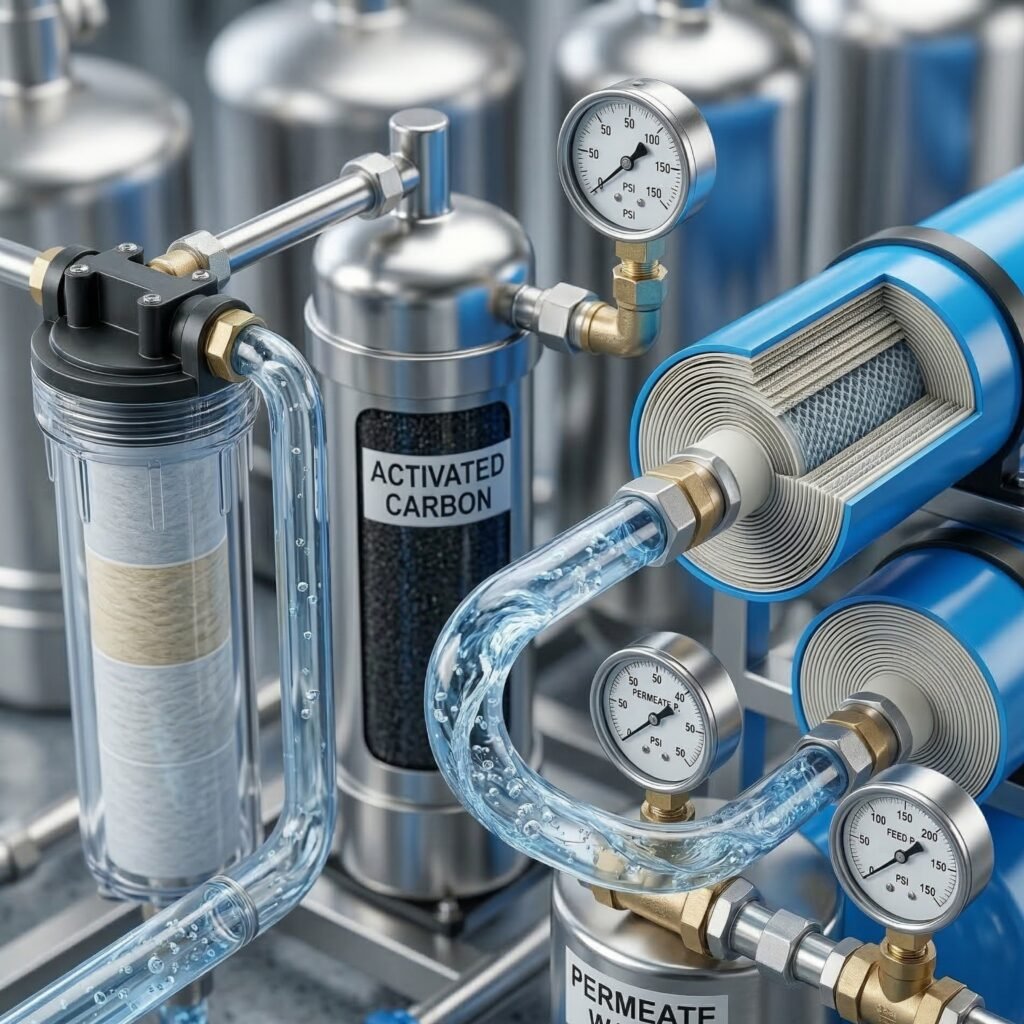
Reverse osmosis water purification system with activated carbon and pressure gauges

Industrial RO Plant Capacity and Pricing - Raichur 2026

Capacity

Application

Daily Output (indicative)

Indicative Cost

250-500 LPH

Ginning unit drinking water, canteen, small MSME, hotel wing

2,000-5,000 L

₹85,000 – ₹1.6 lakh*

500-1,000 LPH

Rice mill boiler feed, community plant, hospital block

4,000-10,000 L

₹1.1 – ₹2.2 lakh*

1,000-2,000 LPH

Mid-size parboiling unit, Growth Centre MSME, contractor camp

8,000-20,000 L

₹1.5 – ₹2.8 lakh*

2,000-4,000 LPH

Large rice mill, township block, Hutti or Shaktinagar colony

16,000-40,000 L

₹2.2 – ₹3.5 lakh+*

Custom / 5,000+ LPH

Multi-line plants, industrial townships

As designed

On assessment

*Indicative bands are aligned with Bangalore Aqua’s published industrial pricing (Industrial RO Plant Manufacturer in Bangalore). The final quote follows the water test and depends on automation level, membrane brand, freight to site and site readiness. Daily output assumes roughly 8-10 running hours. AMC slabs: confirm before publish.

Standard skids are typically installed in about 2-5 working days after the site is ready. Custom and civil-heavy jobs take longer.

Pre-Treatment Configurations by Water Source

Canal surface water (turbidity, silt, organics): Raw water settling or storage – Multimedia filter – Activated carbon filter – UF where silt spikes are frequent – Antiscalant dosing – 5-micron cartridge – RO – UV – SS storage

Hard borewell water (most Raichur taluk bores): Multimedia filter – Activated carbon – Industrial softener and/or antiscalant – 5-micron and 1-micron cartridges – RO – UV – SS storage

High-TDS and saline pockets (canal command areas of Lingasugur, Raichur, Sindhanur): Full ion analysis – Multimedia – Carbon – Antiscalant tuned to the lab report – High-rejection brackish-water membranes – Conservative recovery – Planned reject handling

Fluoride borewells (Devadurga, Lingasugur and similar pockets): Full standard train – RO membranes selected for fluoride rejection – Permeate fluoride verification at commissioning and on annual lab cycles – Mineral dosing only where the design allows, re-checked after dosing

Process polishing (boiler feed, pharma utility, food contact): Standard train – Double-pass RO or mixed-bed polishing as required – UV – Online TDS monitoring

Community / CSR plants: Robust pre-treatment – RO – Enhanced UV – Optional UPI or coin dispensing – Pre and post water-quality file for CSR or JJM reporting – Multi-year AMC

Areas We Serve in and Around Raichur

Raichur sub-division: Raichur city | Shaktinagar (RTPS) | Yermarus (YTPS and industrial area) | Deosugur | Kalmala | Manvi (ಮಾನ್ವಿ) | Kavital | Sirwar (ಸಿರವಾರ) | Devadurga (ದೇವದುರ್ಗ) | Gabbur | Jalahalli | Arakera

Lingasugur sub-division: Lingasugur (ಲಿಂಗಸುಗೂರು) | Hutti | Mudgal | Maski (ಮಸ್ಕಿ) | Sindhanur (ಸಿಂಧನೂರು) | Turvihal

Adjacent districts:

Manufacturing base: Kogilu Layout, Bengaluru – Our Presence

Do you manufacture the plant in Raichur or ship it from Bengaluru?

We build the skids at our Kogilu Layout unit in Bengaluru and install them on site anywhere in Raichur district, including Shaktinagar, Yermarus, Hutti, Lingasugur, Sindhanur, Manvi and Devadurga.

Yes, if it is designed for the worse of the two sources. We test both, size the pre-treatment for canal turbidity, and set the membranes and recovery for the borewell’s TDS and hardness. A plant built only for canal water will struggle when the canal closes.

There isn’t one number. CGWB reports electrical conductivity from 150 to 9,600 micromhos/cm across the district, and a Lingasugur study found TDS from 106 to 928 mg/L across 20 villages. We design from your own lab report.

A softener removes hardness and stops scale. It does not lower TDS, nitrate or fluoride. In Raichur the softener often stays in place as pre-treatment to protect the RO membranes.

For drinking water, yes, wherever your lab report shows it. CGWB reports up to 4.70 mg/L in the district and higher fluoride in deeper aquifers. We verify permeate fluoride at commissioning rather than assume it.

Yes. Standard 1,000-4,000 LPH skids with SS storage are typically installed in about 2-5 working days after the site is ready (base, power, inlet and drain). Tell us the headcount and shift pattern.

Start with TDS, hardness, fluoride, nitrate, iron and major ions, and add metals, including arsenic, because published work notes an arsenic history in the Raichur-Yadgir gold belt. We design only after that report.

Yes. We cover needs assessment, lab testing, manufacture, installation, Kannada-friendly operator training, pre and post water-quality records, and AMC. See Best CSR Project RO Plants.

Indicative bands run from ₹85,000 for 250-500 LPH to ₹2.2-3.5 lakh+ for 2,000-4,000 LPH, with custom plants priced on assessment. Freight, civil work and automation change the final figure, which we confirm in writing after the water test.

Yes. We take on AMC and repairs for existing plants after an inspection and a water test.

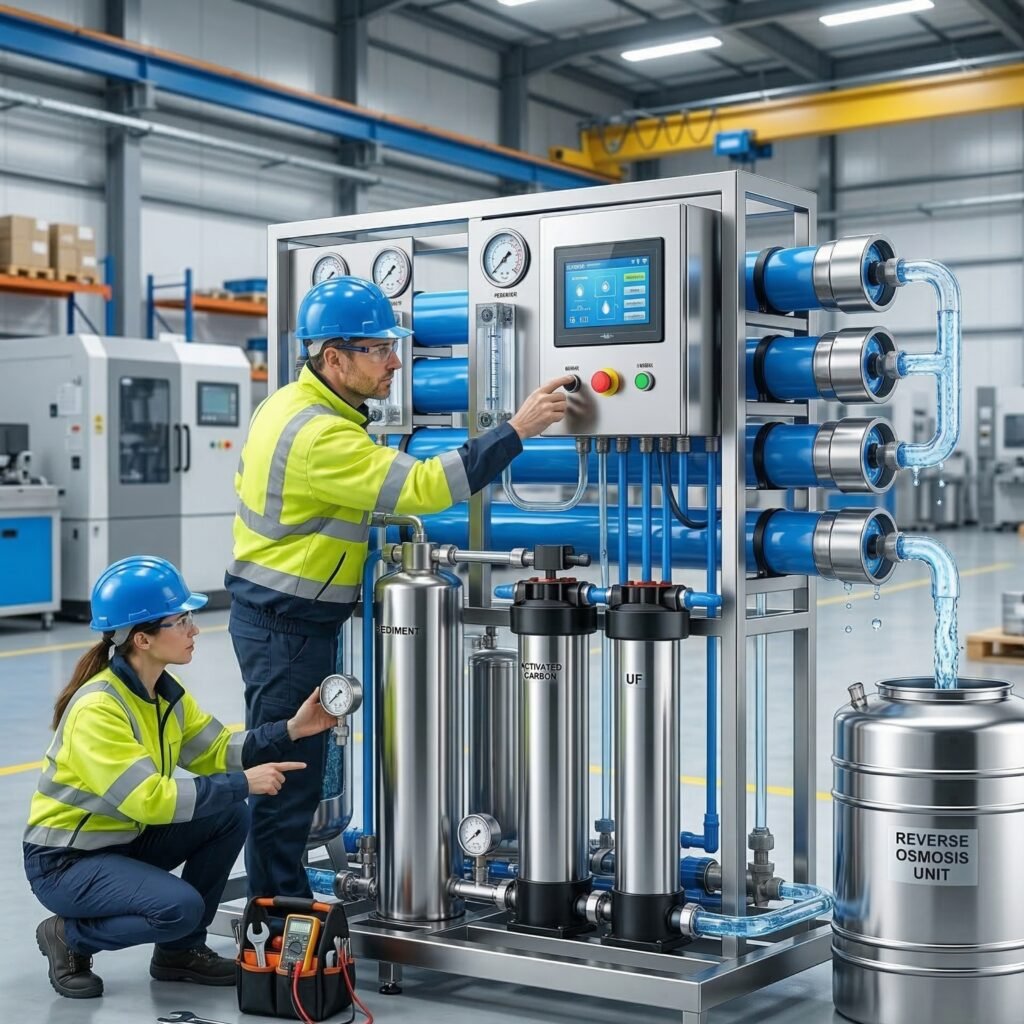
Reverse osmosis water purification system with activated carbon and pressure gauges

Get a Site-Tested Industrial RO Proposal for Raichur