
Best Industrial RO Plant Manufacturer in Haveri (2026)
DRINK SAFE AND PURE
Bangalore Aqua - Industrial RO Plant Manufacturer for Haveri District
Haveri (ಹಾವೇರಿ) sits almost at the centre of Karnataka and is often called a gateway to the northern districts (Haveri district site). Invest Karnataka puts the district at 4,823 sq km, with about 15.98 lakh people, eight taluks (Haveri, Ranebennur, Byadgi, Hangal, Shiggaon, Savanur, Hirekerur and Rattihalli), and lists the Tungabhadra, Varada, Dharma and Kumudwati among its rivers. It names maize, sugar and ethanol, food and chicken processing, general engineering fabrication, and textiles with cold storage as major industrial sectors, flags the world-famous chilli market at Byadagi as a major export hub, and notes about 1,810 acres of industrial land bank plus 98 acres in Byadgi taluk for spice-park development.
Byadagi chilli (ಬ್ಯಾಡಗಿ ಮೆಣಸಿನಕಾಯಿ) is the district’s signature crop and carries a Geographical Indication registration (IP India, Byadagi Chilli, Application No. 129), valid through 31 July 2028. The MSME Brief Industrial Profile of Haveri still describes the district as known for Byadgi chilli, cattle markets, oil mills and cotton markets. The Central Ground Water Board’s Ground Water Information Booklet for Haveri district (September 2012, mirrored copy) notes a sugar factory at Sangur in Haveri taluk among the district’s important industries.
Water arrives in different ways across a short east-west span. The CGWB booklet describes a gently undulating plain, with hillier ground toward Uttara Kannada and ridges in Hirekerur, and records average annual rainfall from about 592 to 903 mm (Hangal wetter, Ranebennur drier; Invest Karnataka quotes about 550 mm). The Tungabhadra runs on the eastern border; the Varada and Kumudvati feed it, and the Dharma drains into the Varada. Haveri town has drawn bulk supply from the Varada and Tungabhadra schemes, with many households still topping up from borewells (ADB Initial Environmental Examination, Haveri 24×7 water supply, 2013). So a chilli unit on a Byadgi borewell, a cold store on Ranebennur scheme water and a hotel near Hangal may be dealing with completely different water.
That is why an industrial RO plant in Haveri has to be engineered, not picked off a price list. Piped scheme water is usually treated for turbidity and bacteria, not for dissolved salts or fluoride. A water softener swaps calcium and magnesium for sodium, so it stops scale, but it does not lower TDS and it does not remove fluoride. UV disinfection only kills microbes, so it does not touch fluoride, nitrate, chloride or sulphate either. In a district where government reports and peer-reviewed studies show fluoride pockets, elevated TDS and hardness, and nitrate and chloride above limits in places (details below), reverse osmosis with the right pre-treatment is the practical way to get drinking water and low-TDS process water that stays in specification.
Bangalore Aqua And Energy Pvt. Ltd. manufactures RO plants, water treatment systems, softeners, community and solar RO plants, and industrial and commercial systems. Every Haveri plant is built at our manufacturing unit in Kogilu Layout, Bengaluru, then dispatched, installed and commissioned on site, with AMC support after handover.
📞 +91 76763 93939 | +91 97387 04753 📧 info@bangaloreaqua.com 🌐 bangaloreaqua.com Nearby district pages: RO Water Treatment Plant Supplier in Dharwad | RO Water Treatment Plant Supplier in Hubballi
Haveri Water Quality: What the Data Actually Says
Ranebennur fluoride belts, Byadgi agro bores and Varada-Tungabhadra scheme water are different problems
District-wide picture (CGWB). The Central Ground Water Board’s Haveri Ground Water Information Booklet (September 2012, mirrored copy) lists nitrate, chloride, fluoride and electrical conductivity as chemical constituents present above the permissible limit in the district, and describes the water as alkaline type. It put the stage of groundwater development at 63.44% (2009 assessment) and recorded three over-exploited blocks. Premonsoon water levels in 2011 ranged from about 4.30 to 13.34 metres below ground level. The booklet does not publish a single district TDS number, so we do not invent one.
Ranebennur taluk (ರಾಣೇಬೆನ್ನೂರು): fluoride. A GIS-based study of 50 groundwater samples in Ranebennur taluk found fluoride from 1.2 to 3.6 mg/L in the pre-monsoon season and from 1.0 to 3.6 mg/L in the post-monsoon season. Forty-five of 50 pre-monsoon samples and 43 of 50 post-monsoon samples were above the 1.5 mg/L BIS limit. The highest reading was 3.6 mg/L at Guddadahosalli in both seasons. The authors link the fluoride to rock-water interaction in granite and gneiss geology (Viswanath, Aravinda and Puttaiah, International Journal of Engineering Inventions 2014).
Southern Ranebennur: TDS and salinity. A 2023 University of Agricultural Sciences study analysed 153 tube-well samples across 51 villages in southern Ranebennur taluk. TDS ranged from 537.6 to 2,758.4 mg/L (mean about 1,378 mg/L). Electrical conductivity ranged from 0.84 to 4.31 dS/m. Sodium and chloride were the dominant ions, and nitrate ran from about 11 to 56 mg/L (Kumar et al., Biological Forum 2023).
Haveri town (older snapshot). An ADB environmental examination for Haveri’s 24×7 water-supply project cites Department of Geology and Mines groundwater data from 2003: TDS of 965 mg/L in July and 731 mg/L in November, total hardness of 480 and 332 mg/L, chloride of 389 and 232 mg/L, nitrate of 72 and 11 mg/L, and fluoride of 0 and 0.75 mg/L (ADB IEE, Haveri 24×7, 2013). Treat these as an older town snapshot, not a 2026 design number.
Hangal, Byadgi, Savanur, Shiggaon and Hirekerur. We did not find a peer-reviewed groundwater chemistry study with published TDS or fluoride ranges for these taluks that we could open in full, so there are no measured ranges here. CGWB’s district booklet already puts fluoride, nitrate, chloride and EC on the district quality list, so treat fluoride and full ion chemistry as first-panel lab items until your own report says otherwise.
River, lake and canal water (Varada, Tungabhadra, Dharma, Heggere Kere). Surface water brings seasonal turbidity, silt, algae and organics, especially after monsoon pulses and when river or lake levels drop. We did not find a single published district TDS number that applies here, so we treat surface sources as a site test item.
Planning table
Concern | Planning note | Implication |
Fluoride | 1.0-3.6 mg/L across 50 Ranebennur samples; 45 of 50 pre-monsoon and 43 of 50 post-monsoon above 1.5 mg/L; named a district quality issue by CGWB | RO with permeate fluoride checked at commissioning; softener or UV alone is not a fix |
TDS / EC | TDS 537.6-2,758.4 mg/L and EC 0.84-4.31 dS/m in southern Ranebennur (153 samples); CGWB flags EC above limit district-wide | Membrane choice and recovery set from the measured TDS; plan where the reject goes |
Hardness | 332-480 mg/L in the 2003 Haveri town snapshot (ADB/Department of Geology and Mines) | Softener and/or antiscalant ahead of RO as standard |
Nitrate and chloride | Nitrate about 11-56 mg/L in southern Ranebennur; nitrate 11-72 mg/L and chloride 232-389 mg/L in the 2003 Haveri town set; both named by CGWB | Nitrate and chloride on the lab panel; verify permeate |
Over-extraction | Three over-exploited blocks and 63.44% stage of development (CGWB 2009); deepening town bores noted in the ADB IEE | Retest bores yearly; chemistry can shift as wells deepen |
Scheme and river water | Varada and Tungabhadra bulk supply for Haveri town; intermittent historically; no single number applies | Multimedia, carbon, and UF where silt spikes; buffer storage for irregular supply |
Takeaway: we do not invent a single Haveri TDS. A Byadgi chilli-powder unit, a Ranebennur cold store, a Hangal hotel and a Savanur school bore can sit in completely different chemistry bands. Every Bangalore Aqua quote for Haveri starts with a feed-water test from your actual source. The numbers above come from CGWB and published studies, and your site test decides the design.
Key Sectors We Build For in Haveri
Byadgi Chilli, Spice Processing and Oleoresin (Byadgi, Haveri)
Byadagi chilli is a registered GI product and the district’s best-known agro brand. Invest Karnataka highlights the Byadagi chilli market and a proposed spice park, with 98 acres identified in Byadgi taluk. Chilli drying, powdering, colour extraction and oleoresin lines need low-TDS wash and process water that will not leave salt marks or scale nozzles, plus safe drinking water for seasonal crews.
Typical requirement: 500-2,000 LPH for process and drinking water; 2,000-4,000 LPH for larger powder and oleoresin lines; carbon and UV on contact streams; AMC timed to the harvest season.
Agro-Processing, Maize, Oilseeds, Cold Storage and Poultry
Invest Karnataka lists maize, soybean, groundnut, sugarcane, jowar and paddy among major crops, and food and chicken processing among major industrial sectors, with cold storage named alongside textiles in the service mix. The MSME profile points to cotton ginning and pressing, chilly and masala powder, maize starch and seed processing as growth areas. Washing, grading, humidification and boiler feed all need chemistry that stays in specification.
Typical requirement: 500-2,000 LPH for most packhouses and ginning units; 2,000-4,000 LPH for larger oil and processing lines; softener or antiscalant ahead of RO where hardness is high.
Sugar and Ethanol (Sangur belt, Haveri taluk)
CGWB’s district booklet names the sugar factory at Sangur in Haveri taluk as one of the district’s important industries, and Invest Karnataka lists sugar-ethanol among major sectors and notable investments. Crushing-season units need boiler feed, cooling tower make-up, process and wash water, and drinking water for large seasonal crews.
Typical requirement: 1,000-4,000 LPH for boiler feed and utility; softener or antiscalant plus RO; 500-1,000 LPH for canteens and labour colonies; AMC timed to the crushing season.
Textiles, Cotton Ginning and Related MSMEs (Ranebennur, Haveri, Shiggaon)
Invest Karnataka lists textiles as a major industrial sector. The MSME profile records cotton textile units and flags cotton ginning and pressing, powerlooms and ready-made garments among potential areas, with Ranebennur, Haveri, Byadgi and Shiggaon named for service-industry potential. Dyeing and yarn processing are sensitive to hardness, iron and TDS.
Typical requirement: 500-2,000 LPH; softener where scale is the main issue; RO for dye-house and drinking streams where the chemistry calls for it.
Engineering Fabrication, Land-Bank Estates and Town MSMEs
Invest Karnataka lists general engineering fabrication among major sectors and a land bank of about 1,810 acres identified across taluks for industrial development. Fabrication, packaging and service MSMEs around Haveri, Ranebennur, Byadgi and Shiggaon need process water, cooling make-up and staff drinking water.
Typical requirement: 500-2,000 LPH for most units; 2,000-4,000 LPH for larger sheds; double-pass RO or polishing where the process asks for it.
Tourism, Hotels, Hospitals and Colleges (Bankapura, Hangal, Ranebennur, Haveri)
Invest Karnataka lists Bankapur Peacock Sanctuary, Ranebennur Blackbuck Sanctuary, Purasiddesvara Temple at Haveri and Nagareshwara Temple at Bankapura among tourism landmarks, plus about 140 colleges, two universities, two engineering and two medical colleges, and a district hospital network. Hotels, hostels, hospitals and campuses need safe drinking water plus soft water for laundry, kitchens and hot-water loops.
Typical requirement: 500-2,000 LPH; UV plus RO; structured AMC with fast response.
Fluoride-Affected Villages: Community, CSR and JJM Plants
With Ranebennur studies showing most sampled bores above 1.5 mg/L fluoride, and CGWB naming fluoride as a district quality issue, a community RO plant is a direct health intervention in affected villages. Softeners and UV are not. We build community plants with inlet and permeate water-quality records, Kannada-friendly operator training and multi-year AMC. See Best CSR Project RO Plants, Government Drinking Water Projects and Community RO Plants and Community RO Plants for Tribal Areas.
Typical requirement: 500-1,000 LPH community plants; optional UPI or coin dispensing; permeate fluoride checks on an annual lab cycle where the project requires it.
Industrial RO Plant Capacity and Pricing - Haveri 2026
Capacity | Application | Daily Output (indicative) | Indicative Cost |
250-500 LPH | Crew drinking water, canteen, small MSME, hotel wing | 2,000-5,000 L | ₹85,000 – ₹1.6 lakh* |
500-1,000 LPH | Chilli powder unit, ginning unit, community plant, hospital block | 4,000-10,000 L | ₹1.1 – ₹2.2 lakh* |
1,000-2,000 LPH | Mid-size agro unit, cold store, estate utility line | 8,000-20,000 L | ₹1.5 – ₹2.8 lakh* |
2,000-4,000 LPH | Sugar-ethanol utility, large spice or textile line | 16,000-40,000 L | ₹2.2 – ₹3.5 lakh+* |
Custom / 5,000+ LPH | Multi-line plants, industrial campuses | As designed | On assessment |
*Indicative bands are aligned with Bangalore Aqua’s published industrial pricing (Industrial RO Plant Manufacturer in Bangalore). The final quote follows the water test and depends on automation level, membrane brand, freight to site and site readiness. Daily output assumes roughly 8-10 running hours. AMC slabs: confirm before publish.
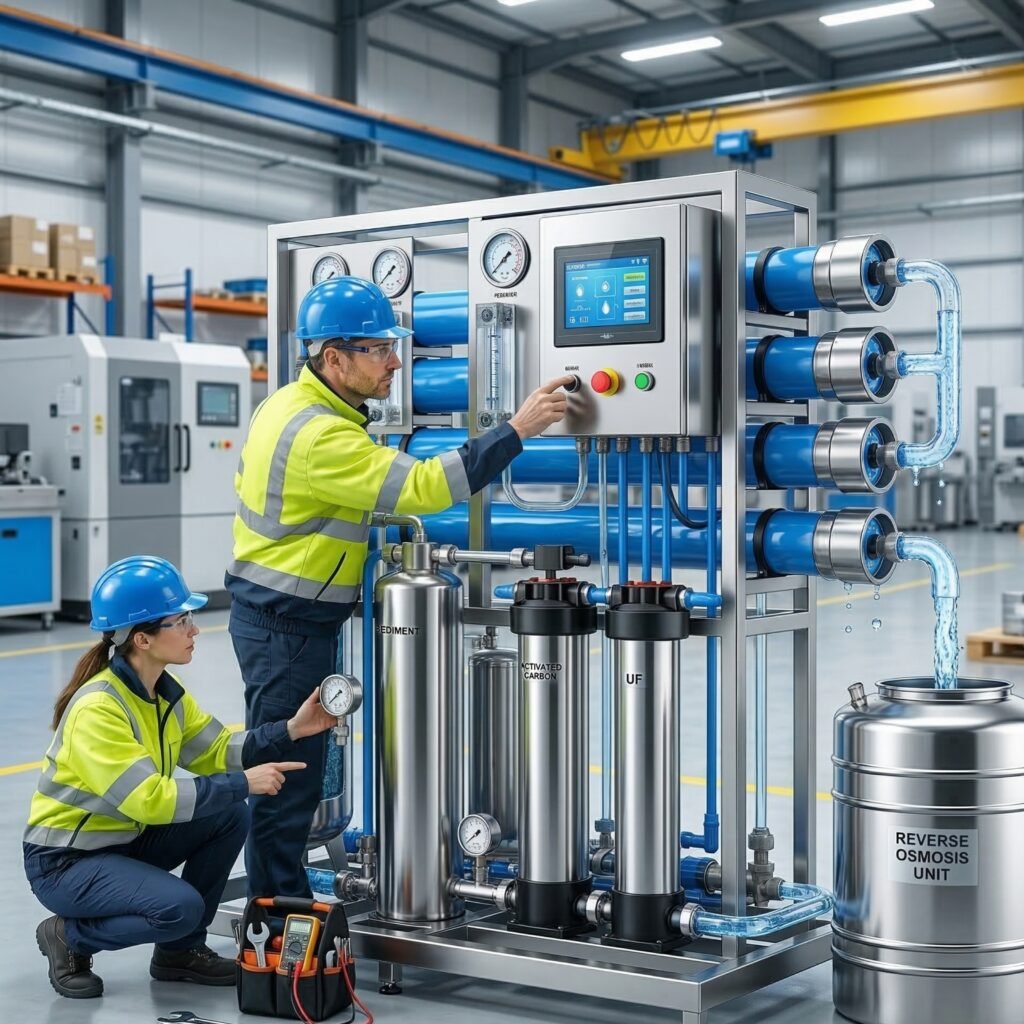
Standard skids are typically installed in about 2-5 working days after the site is ready. Custom and civil-heavy jobs take longer.
Pre-Treatment Configurations by Water Source
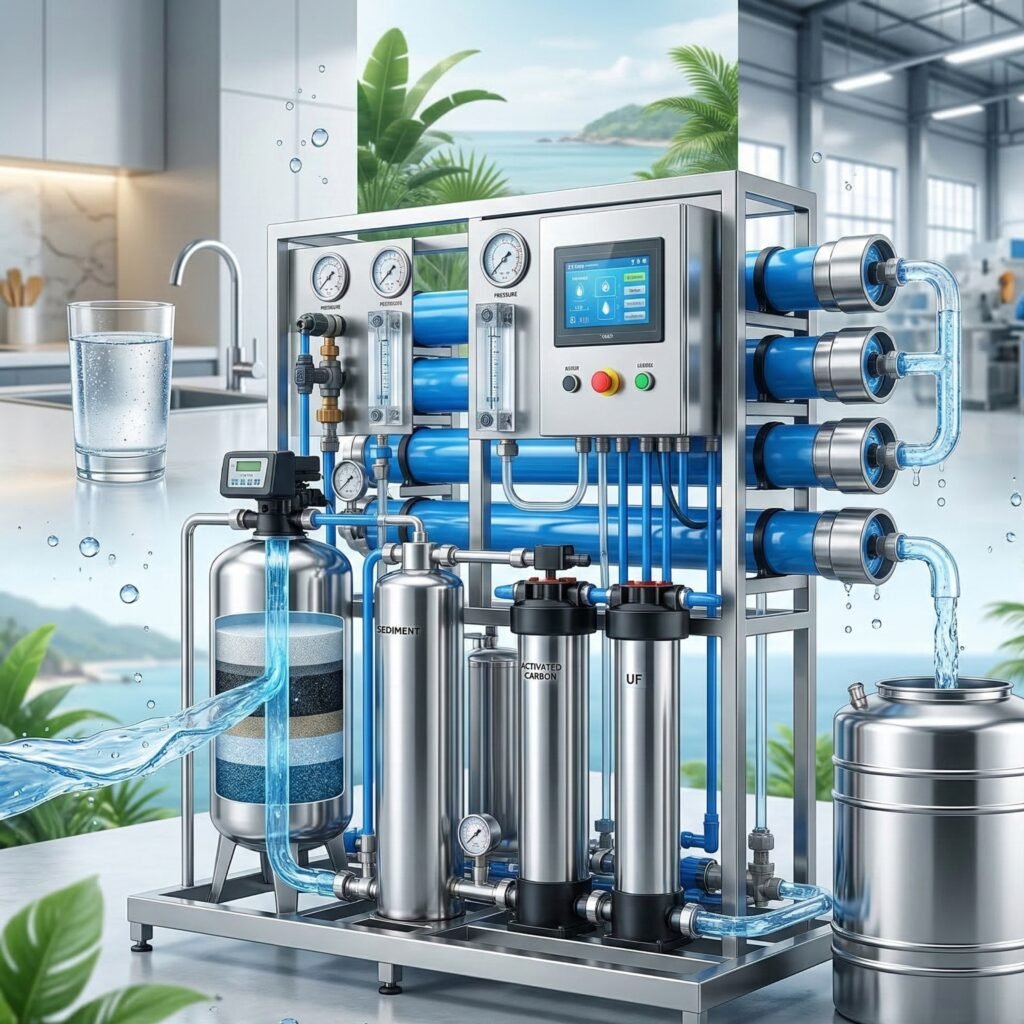
Varada and Tungabhadra scheme water (Haveri town and scheme-fed villages): Buffer storage sized for irregular supply – Multimedia filter – Activated carbon filter (chlorine) – 5-micron cartridge – RO – UV – SS storage
River, lake and canal water (Varada, Tungabhadra, Dharma, Heggere Kere belts): Raw water settling or storage – Multimedia filter – Activated carbon filter – UF where silt spikes are frequent – Antiscalant dosing – 5-micron cartridge – RO – UV – SS storage
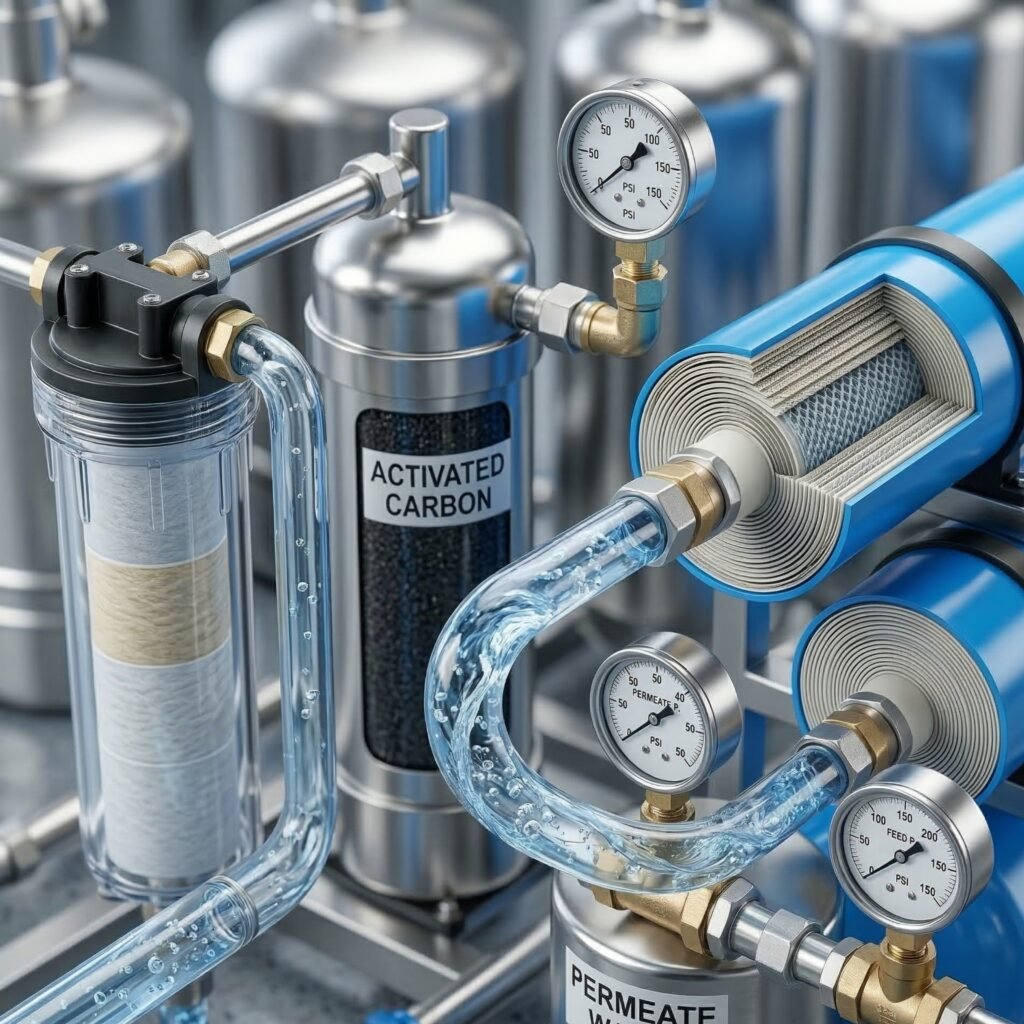
Hard borewell water (most estates and taluks): Multimedia filter – Activated carbon – Industrial softener and/or antiscalant – 5-micron and 1-micron cartridges – RO – UV – SS storage
Fluoride borewells (Ranebennur and other CGWB-flagged pockets): Full standard train – RO membranes selected for fluoride rejection – Permeate fluoride verification at commissioning and on annual lab cycles – Mineral dosing only where the design allows, re-checked after dosing
High-TDS and saline bores (southern Ranebennur and similar pockets): Full ion analysis – Multimedia – Carbon – Antiscalant tuned to the lab report – High-rejection brackish-water membranes – Conservative recovery – Planned reject handling
Process polishing (boiler feed, dye-house, food and spice contact): Standard train – Double-pass RO or mixed-bed polishing as required – UV – Online TDS monitoring
Community / CSR plants: Robust pre-treatment – RO – Enhanced UV – Optional UPI or coin dispensing – Pre and post water-quality file for CSR or JJM reporting – Multi-year AMC
Areas We Serve in and Around Haveri
Haveri and the centre: Haveri city (ಹಾವೇರಿ) | Devagiri | Sangur | Karaji | Heggere
Byadgi and Hangal: Byadgi / Byadagi (ಬ್ಯಾಡಗಿ) | Hangal / Hanagal (ಹಾನಗಲ್) | Kaginele
Ranebennur and the east: Ranebennur (ರಾಣೇಬೆನ್ನೂರು) | Kumarapatnam | Guttal | Halageri | Itagi
Savanur, Shiggaon and Bankapura: Savanur (ಸವಣೂರು) | Shiggaon (ಶಿಗ್ಗಾಂವ್) | Bankapura (ಬಂಕಾಪುರ) | Hulagur
Hirekerur and Rattihalli: Hirekerur (ಹಿರೇಕೆರೂರು) | Rattihalli (ರತ್ತಿಹಳ್ಳಿ) | Haunsabhavi
Adjacent districts:
- Dharwad (north-west) – RO Water Treatment Plant Supplier in Dharwad | RO Water Treatment Plant Supplier in Hubballi
- Gadag (north) – Gadag RO Water Treatment Plant page (when live) | Best Industrial RO Plant Supplier in Gadag (when live)
- Ballari / Vijayanagara (east) – RO Water Treatment Plant Supplier in Ballari
- Shivamogga (south) – Shivamogga RO Water Treatment Plant page (when live)
- Uttara Kannada (west) – Uttara Kannada RO Water Treatment Plant page (when live)
- Bagalkote (further north) – RO Water Treatment Plant Supplier in Bagalkot | Best Industrial RO Plant Manufacturer in Bagalkote (when live)
Elsewhere in North Karnataka: Belagavi – RO Water Treatment Plant Supplier in Belagavi; Raichur – RO Water Treatment Plant Supplier in Raichur | Best Industrial RO Plant Manufacturer in Raichur (when live); Vijayapura – Best Industrial RO Plant Supplier in Vijayapura (when live); Koppal – Koppal RO Water Treatment Plant page (when live)
Manufacturing base: Kogilu Layout, Bengaluru – Our Presence
- Frequently Asked Questions
Do you manufacture the plant in Haveri or ship it from Bengaluru?
We build the skids at our Kogilu Layout unit in Bengaluru, then install and commission them on site anywhere in Haveri district, including Haveri city, Byadgi, Ranebennur, Hangal, Savanur, Shiggaon, Hirekerur, Rattihalli and Bankapura. AMC and service follow after handover.
We run a Byadgi chilli powder or oleoresin unit. What water do we need?
Spice and colour lines need low, stable TDS and hardness so wash water and process water do not leave salt marks or scale nozzles. We usually design RO for process and drinking streams, with carbon and UV on food-contact water, and we size AMC around the harvest season.
What is the typical TDS of Haveri groundwater?
There isn’t one number. A 153-sample study in southern Ranebennur found TDS from 537.6 to 2,758.4 mg/L, and CGWB flags electrical conductivity above the permissible limit district-wide without publishing a single district TDS. We design from your own lab report.
We already have a softener. Why do we need RO?
A softener removes hardness and stops scale. It does not lower TDS, sulphate, chloride, nitrate or fluoride. In Haveri the softener often stays in place as pre-treatment to protect the RO membranes, especially where hardness or fluoride is elevated.
Is fluoride a real design concern for industrial sites here?
For drinking water, yes, wherever your lab report shows it. A Ranebennur study found 1.0 to 3.6 mg/L across 50 samples, with most readings above 1.5 mg/L, and CGWB names fluoride as a district quality issue. We verify permeate fluoride at commissioning rather than assume it.
We run a sugar or ethanol plant near Sangur. Can your RO plant feed our boilers?
Our RO plant can be the pre-treatment stage for boiler feed and can also supply cooling tower make-up, wash water and drinking water for crushing crews. High-pressure boilers usually need demineralised water after RO, so we design the RO stage around your boiler maker’s specification and hand over commissioning data.
Our unit uses scheme water in season and a borewell in summer. Can one plant handle both?
Yes, if it is designed for the worse of the two sources. We test both, size the pre-treatment for scheme or river turbidity, and set the membranes and recovery for the borewell’s TDS and hardness. Standard skids are typically installed in about 2-5 working days after the site is ready (base, power, inlet and drain).
Can you build community RO plants for fluoride-affected villages under CSR or JJM?
Call or WhatsApp +91 76763 93939 / +91 97387 04753 with taluk, water source and peak LPH need.
How much does an industrial RO plant cost in Haveri?
Indicative bands run from ₹85,000 for 250-500 LPH to ₹2.2-3.5 lakh+ for 2,000-4,000 LPH, with custom plants priced on assessment. Freight, civil work, extra pre-treatment and automation change the final figure, which we confirm in writing after the water test.
How much does an industrial RO plant cost in Haveri?
Indicative bands run from ₹85,000 for 250-500 LPH to ₹2.2-3.5 lakh+ for 2,000-4,000 LPH, with custom plants priced on assessment. Freight, civil work, extra pre-treatment and automation change the final figure, which we confirm in writing after the water test.
Do you service RO plants installed by other suppliers?
Yes. We take on AMC and repairs for existing plants after an inspection and a water test.
Get a Site-Tested Industrial RO Proposal for Haveri
Share your location (industrial area, taluk or village), your water source (scheme, river, lake, borewell, tanker or mixed) and your peak LPH need. We will plan the feed-water test, design the pre-treatment and send a written proposal.
📞 +91 76763 93939 | +91 97387 04753 📧 info@bangaloreaqua.com 🌐 bangaloreaqua.com 📍 Manufacturing: 107/209 2nd Cross, 4th Main Kogilu Layout, Bengaluru – 560064
Also See
- Industrial RO Plant Manufacturer in Bangalore
- Industrial RO System
- Best CSR Project RO Plants
- Government Drinking Water Projects in India – Community RO Plants
- Community RO Plants for Tribal Areas
- Community RO Water Plant Karnataka
- Best Industrial RO Plant Manufacturer in Kolar
- Best Industrial RO Plant Manufacturer in Bagalkote (when live)
- Best Industrial RO Plant Supplier in Gadag (when live)
- Best Industrial RO Plant Supplier in Vijayapura (when live)
- Best Industrial RO Plant Manufacturer in Raichur (when live)
- RO Water Treatment Plant Supplier in Dharwad
- RO Water Treatment Plant Supplier in Hubballi
- RO Water Treatment Plant Supplier in Belagavi
- RO Water Treatment Plant Supplier in Ballari
- RO Water Treatment Plant Supplier in Raichur
- RO Water Treatment Plant Supplier in Bagalkot
- Koppal RO Water Treatment Plant (when live)
- Our Presence