Best Industrial RO Plant Supplier in Bidar (2026)
DRINK SAFE AND PURE
Bangalore Aqua - Industrial RO Plant Supplier for Bidar District
Bidar sits atop Karnataka’s map as the state’s pulse bowl – Invest Karnataka notes strong agro and food-processing potential, with a large share of cultivation in sugarcane, jowar, bajra, pulses, ginger, sunflower and soybean, and major sectors spanning sugar, dal, chemicals and engineering (Invest Karnataka – Bidar). Sugar mills (including integrated cane crushing and co-gen examples in the district), dal mills, KIADB nodes such as Kolhar Industrial Area, food processors, hotels around Bidar Fort / pilgrimage circuits, hospitals and campuses all need process and drinking water that does not inherit whatever the nearest Deccan-trap bore happens to carry.
It is also part of the Hyderabad-Karnataka water-stress belt. Published district and town work shows alkaline, often hard groundwater, fluoride above guidance in multiple village samples, and elevated TDS/hardness/nitrate/chloride in places such as Humnabad. Pipe connections without treatment do not fix chemistry. Softeners do not remove fluoride. UV does not remove fluoride. Industrial and community RO supply – designed from a lab report – is the practical path.
Bangalore Aqua and Energy Pvt. Ltd. industrial RO plant supplier in Bidar and manufactures, installs and services industrial, commercial and community plants across Bidar district – with AMC and breakdown support for North Karnataka sites.
📞 +91 76763 93939 | +91 97387 04753
📧 info@bangaloreaqua.com
🌐 bangaloreaqua.com | Related: RO Water Treatment Plant Supplier in Bidar
Bidar’s Water Quality: Hard Borewells, Fluoride Pockets and Town-Level TDS Spikes
Plot chemistry decides the skid
Bidar city industrial-area bores, Humnabad town supplies, sugar-belt village wells and Kolhar IA plots are not one number. Bangalore Aqua sizes every industrial RO supply after site-specific feed-water testing.
What published / official sources report
CGWB-style Bidar district quality ranges (brochure data): electrical conductivity about 165-1,140 µS/cm; fluoride about 0.02-1.6 mg/L; nitrate about 2-120 mg/L; chloride about 14-187 mg/L; water type described as alkaline (Bidar district groundwater summary).
Village fluoride survey (Bidar district): tube-well and open-well samples about 0.5-2.1 mg/L, with authors reporting fluorosis concerns where excess fluoride is consumed untreated (IJSRD Bidar fluoride PDF).
Humnabad town groundwater study: water described as hard across sampling points; elevated TDS, nitrate and chloride flagged; authors recommend treatment before drinking. Reported means in that work include hardness about 398 mg/L (maxima into the 700+ mg/L band) and TDS about 856 mg/L (maxima into the 1,500+ mg/L band) (IJSRD Humnabad PDF).
Bidar urban and industrial-area seasonal studies have applied multivariate / WQI methods across city wards – useful as proof that industrial-area chemistry varies ward-to-ward and season-to-season, not as a single “Bidar TDS” (IJRET Bidar urban/industrial multivariate study; IJES Bidar WQI abstract).
North Karnataka JJM / community context also lists Bidar among districts with elevated fluoride / TDS / nitrate risk in groundwater zones (Government Drinking Water Projects).
Supplier takeaway:
- Expect hard water on many bores – softener/antiscalant before RO is routine
- Screen fluoride for drinking and community plants – softeners/UV are not enough
- Treat Humnabad-class TDS/hardness as a design warning for that town and similar pockets
- We do not invent a single municipal Bidar TDS for SEO
Industrial / town borewell profile (planning guide)
Concern | Planning note | Supplier implication |
Hardness | Hard in many Humnabad / district samples | Softener and/or antiscalant before RO |
TDS | Elevated in Humnabad set; variable city-wide | Match membrane/recovery to lab |
Fluoride | Village samples to ~2.1 mg/L; CGWB up to ~1.6 | RO + permeate F check for drinking/community |
Nitrate / chloride | Elevated in Humnabad and some CGWB points | Full ion panel before design |
Seasonal / industrial-area variation | Documented in Bidar urban studies | Re-test before capacity upgrades |
Bidar’s Key Sectors and Water Treatment Requirements
Sugar Mills and Cane-Belt Utilities
Sugarcane dominates a large share of Bidar’s cultivated land. Integrated sugar mills with co-gen need process rinse, boiler-support chemistry, equipment cleaning and large workforce drinking water through the crushing season.
Typical requirement: Industrial RO 1,000-4,000 LPH depending on mill/campus size; SS storage; AMC locked to crushing calendars.
Dal Milling and Pulse / Food Processing
As Karnataka’s pulse bowl, Bidar supports dal mills and agro-food processing that need FSSAI-aware wash water and safe staff drinking water.
Typical requirement: 500-2,000 LPH for mid mills; 2,000-4,000 LPH for larger continuous food units; carbon + UV on contact/drinking streams.
Kolhar and KIADB Industrial Area Units
Kolhar Industrial Area (including Phase-II development coverage) and other KIADB plots host engineering, chemical and agro-linked MSMEs. Invest Karnataka also notes CETP context for industrial wastewater – fresh-water RO and effluent treatment are related but separate scopes.
Typical requirement: 500-2,000 LPH for MSMEs; 2,000-4,000 LPH for larger sheds; estate power/drain-aware skid layout.
Chemicals and Light Engineering
Chemical and engineering units need controlled utility water and reliable workforce drinking supply – especially where groundwater fluoride or hardness is elevated.
Typical requirement: 500-2,000 LPH; expanded lab panel when process water specs tighten.
Hotels, Fort / Pilgrimage Hospitality and Institutions
Bidar Fort, Gurudwara Nanak Jhira, Basavakalyan and related circuits drive hospitality demand for guest drinking water, kitchen supply and laundry loops.
Typical requirement: 500-2,000 LPH; UV + RO; fast AMC in peak travel seasons.
Hospitals, Colleges and Campuses
Institutional drinking water is a patient / student safety issue in a district with documented F and hardness pockets.
Typical requirement: 500-2,000 LPH; documented commissioning; structured AMC.
Fluoride-Affected Village and Community / CSR / TSP Projects
Bidar is repeatedly listed among North Karnataka districts needing community RO where groundwater fluoride, TDS or nitrate undermine untreated supply – including ST-focused TSP contexts (Tribal community RO; CSR water projects). Softeners and UV alone are not defluoridation.
Typical requirement: 500-1,000 LPH community plants; optional UPI/coin dispensing; solar options for weak-grid sites; annual permeate F verification.
Industrial RO Plant Capacity and Pricing - Bidar 2026
Capacity | Application | Daily Output (indicative) | Indicative Cost |
250-500 LPH | Small MSME, hotel wing, light process | 2,000-5,000 L | ₹85,000 – ₹1.6 lakh* |
500-1,000 LPH | Medium dal mill / food unit, community plant | 4,000-10,000 L | ₹1.1 – ₹2.2 lakh* |
1,000-2,000 LPH | Factory, hospital, mid sugar utility block | 8,000-20,000 L | ₹1.5 – ₹2.8 lakh* |
2,000-4,000 LPH | Sugar / multi-line food / IA campus | 16,000-40,000 L | ₹2.2 – ₹3.5 lakh+* |
Custom / 5,000+ LPH | Large mills and industrial campuses | As designed | On assessment |
*Indicative bands aligned with Bangalore Aqua’s published industrial capacity pricing (Industrial RO Plant Manufacturer in Bangalore). Final quote after water test, automation, membrane brand and site readiness. AMC slabs: confirm before publish.
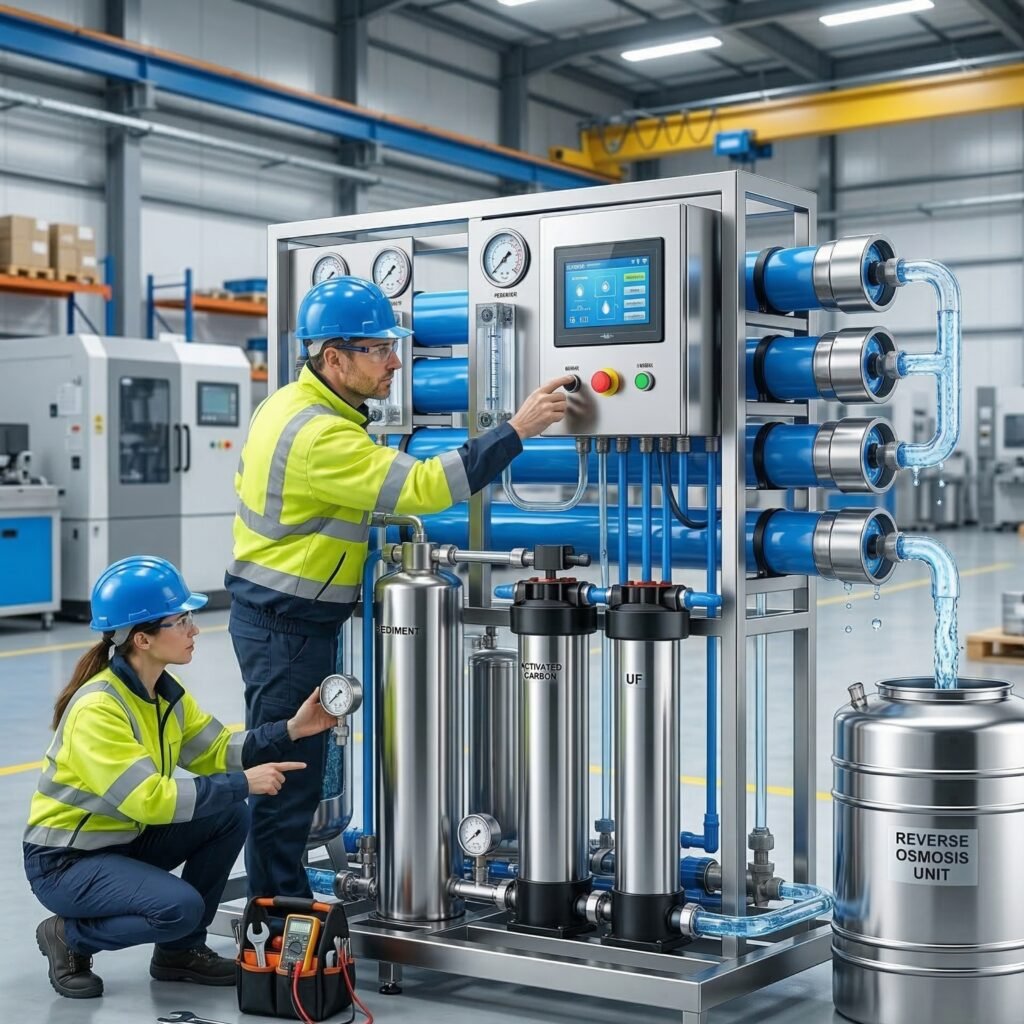
Bidar supply packages include feed-water testing, installation, commissioning verification and operator handover. Where fluoride is in scope, permeate F checks are added to the commissioning pack.
Pre-Treatment Configuration for Bidar
For standard industrial / city borewells (hardness + variable TDS):
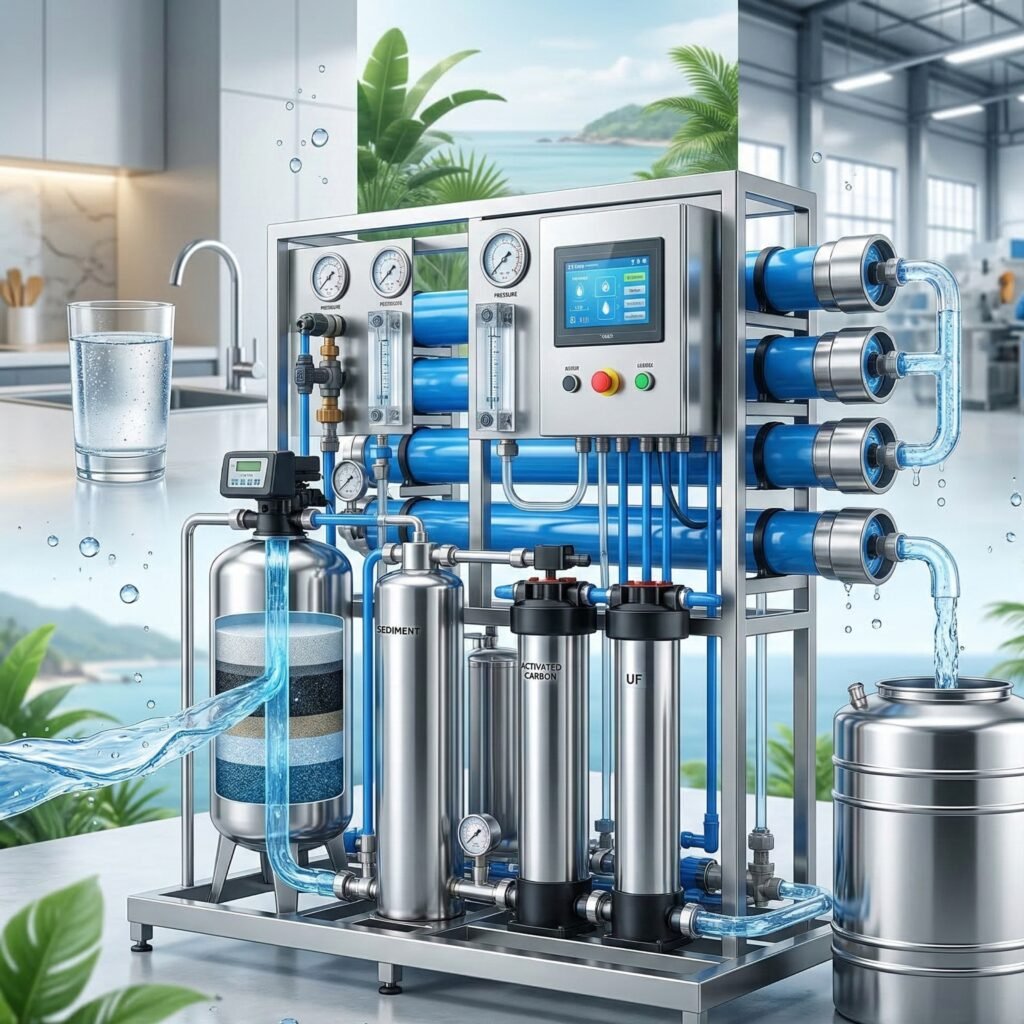
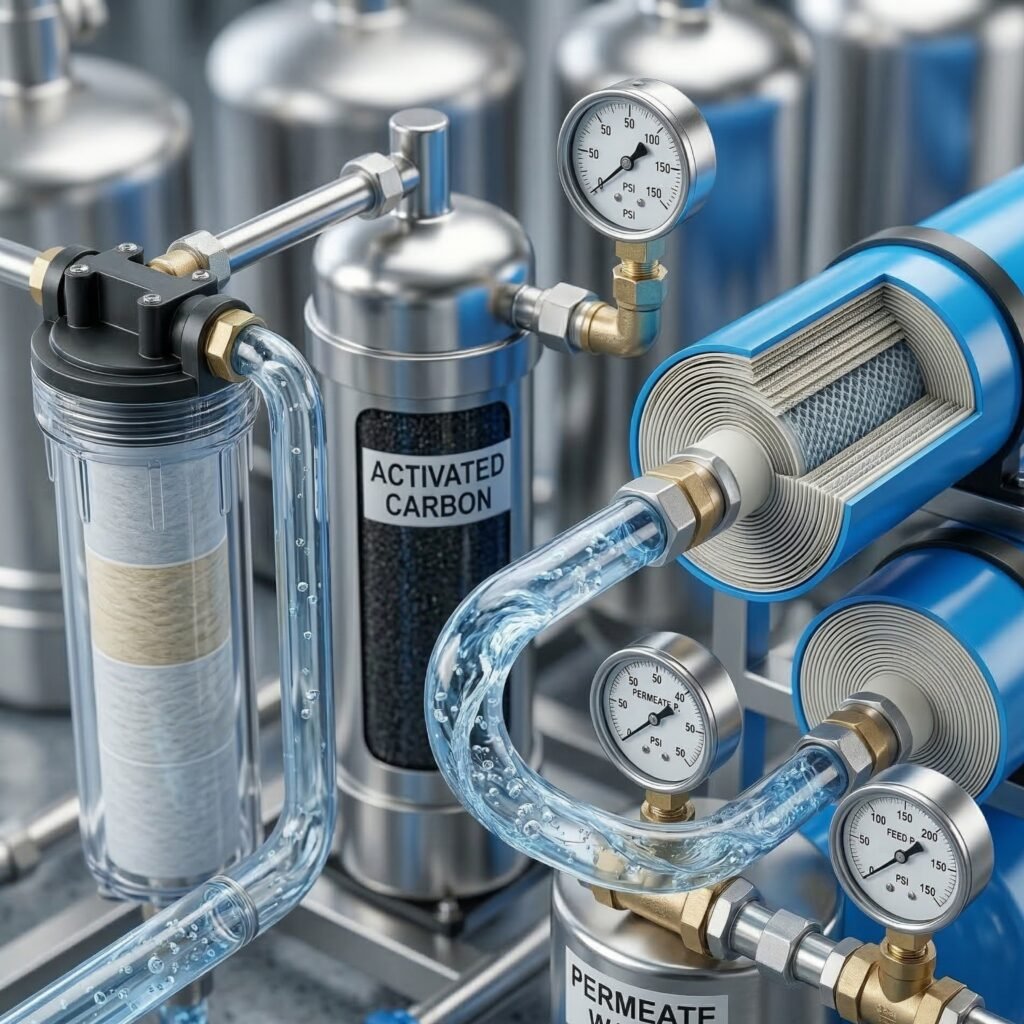
Multimedia sediment filter – Activated carbon filter – Industrial water softener (quality resin, Fleck or Clack class) and/or anti-scalant dosing – 5-micron and 1-micron polishing cartridges – Industrial RO plant – UV disinfection – SS storage
For Humnabad-class high TDS / hardness / nitrate-chloride feeds:
Strengthened multimedia and antiscalant programme – Softener as required – RO sized to measured TDS – Conservative recovery – Close commissioning checks
For fluoride-documented village / taluk borewells:
Full standard train – RO with membrane selection aimed at high fluoride rejection (typically 90-96% class performance when healthy) – Enhanced UV as specified – Permeate fluoride verification at commissioning and on annual lab cycles – Local-language operator guidance for community plants
For sugar / food process rinse polishing:
Application-specific organics/turbidity control upstream – then standard RO train – CIP-friendly layout
For community / CSR / TSP plants:
Robust pre-treatment – RO – Enhanced UV – Optional UPI/coin dispensing – Optional solar for weak-grid sites – Multi-year AMC – Pre/post water quality file for funder reporting
Coverage: Bidar District and Adjacent Areas
Within Bidar district: Bidar city | Kolhar industrial area | Humnabad | Basavakalyan | Aurad | Bhalki | sugar-belt villages (e.g. Markunda / Mogdal corridor) | other IA and agro clusters
Adjacent North Karnataka coverage:
Kalaburagi – RO supplier Kalaburagi
Yadgir – RO plant Yadgir
Raichur – quoted case-by-case
Manufacturing / supply base: Yelahanka, Bengaluru – Our Presence
- Frequently Asked Questions
Are you only a trader, or do you manufacture what you supply to Bidar?
Bangalore Aqua manufactures and assembles industrial RO plants in Bengaluru and supplies them to Bidar with installation, commissioning and AMC – not a pass-through catalogue flip.
Our Humnabad bore is very hard with high TDS. Softener or RO?
Published Humnabad work flags hard water and elevated TDS/nitrate/chloride. Typical supply design is softener/antiscalant plus RO, sized from your lab report.
Village fluoride is above 1.5 mg/L. Will RO fix drinking water?
Yes – when designed for the measured feed. Softeners and UV do not remove fluoride. Community/CSR/TSP routes: Best CSR Project RO Plants.
Do you supply sugar mill and dal mill RO plants in Bidar?
Yes – capacities commonly 500-4,000 LPH depending on line size, with season-aware AMC for crushing calendars.
Can you service remote Bidar village community plants?
Yes – North Karnataka AMC routes combine multi-village visits; IoT monitoring options where network allows. See Government Drinking Water Projects FAQ context.
Install timeline?
About 2-5 working days for standard industrial skids after site readiness; longer for custom civil-heavy jobs. Bidar logistics are planned from our Bengaluru base.
AMC on another brand’s plant?
Often yes, after inspection.
How do we get a quote?
Call or WhatsApp +91 76763 93939 / +91 97387 04753 with taluk, water source and peak LPH need.
Book Your Free Bidar Site Assessment
📞 +91 76763 93939 | +91 97387 04753
📧 info@bangaloreaqua.com
🌐 bangaloreaqua.com | RO supplier – Bidar
📍 Manufacturing: 107/209 2nd Cross, 4th Main Kogilu Layout, Bengaluru – 560064Free site assessment, water testing (including fluoride panel where relevant) and a complete proposal – for industrial, commercial and community water treatment projects in Bidar district.
About Bangalore Aqua | Our Karnataka presence | Gallery | Brochure
Also See:
- RO Water Treatment Plant Supplier in Bidar
- RO Water Treatment Plant Supplier in Kalaburagi
- RO Water Treatment Plant in Yadgir
- Industrial RO Plant Manufacturer in Bangalore
- Best Industrial RO Plant Manufacturer in Kalaburagi (when live)
- Best CSR Project RO Plants
- Government Drinking Water Projects India
- Community RO Plants for Tribal Areas
- Industrial RO System
- Our Presence