Best Industrial RO Plant Manufacturer in Doddaballapur (2026)
DRINK SAFE AND PURE
Bangalore Aqua - Industrial RO Plant Manufacturer for Doddaballapur Taluk
Doddaballapur (ದೊಡ್ಡಬಳ್ಳಾಪುರ), also written Doddaballapura or Dodballapur, sits roughly 40 km north of Bengaluru on SH-9, with NH-648 passing through the taluk and the Satellite Town Ring Road now tolled on its Doddaballapur-Hoskote section (Wikipedia, Deccan Herald). It is the largest taluk of Bengaluru Rural district, which the state cabinet has approved for renaming as Bengaluru North (Indian Express). The town has a long powerloom and silk-weaving tradition, and the district’s own description calls the taluk “Power and Silks” (Bengaluru Rural district). Around it, KIADB has built the Doddaballapur industrial area, Apparel Park Phase-1 and Phase-2, Obadenahalli (Doddaballapura Phase-3) and Adinarayana Hosahalli (Invest Karnataka).
Industry here runs almost entirely on borewells, and those borewells are under pressure. Water quality also changes sharply from one part of the taluk to another. A bore in Bashettihalli, one near the Arkavathy lakes and one out in Thubagere can give three very different results. That is why an industrial RO plant for Doddaballapur has to be engineered for your water rather than picked off a catalogue list. A softener alone will not bring down high TDS or chloride. UV alone will not fix salinity, hardness or dissolved metals. The right train depends on what your bore water actually contains.
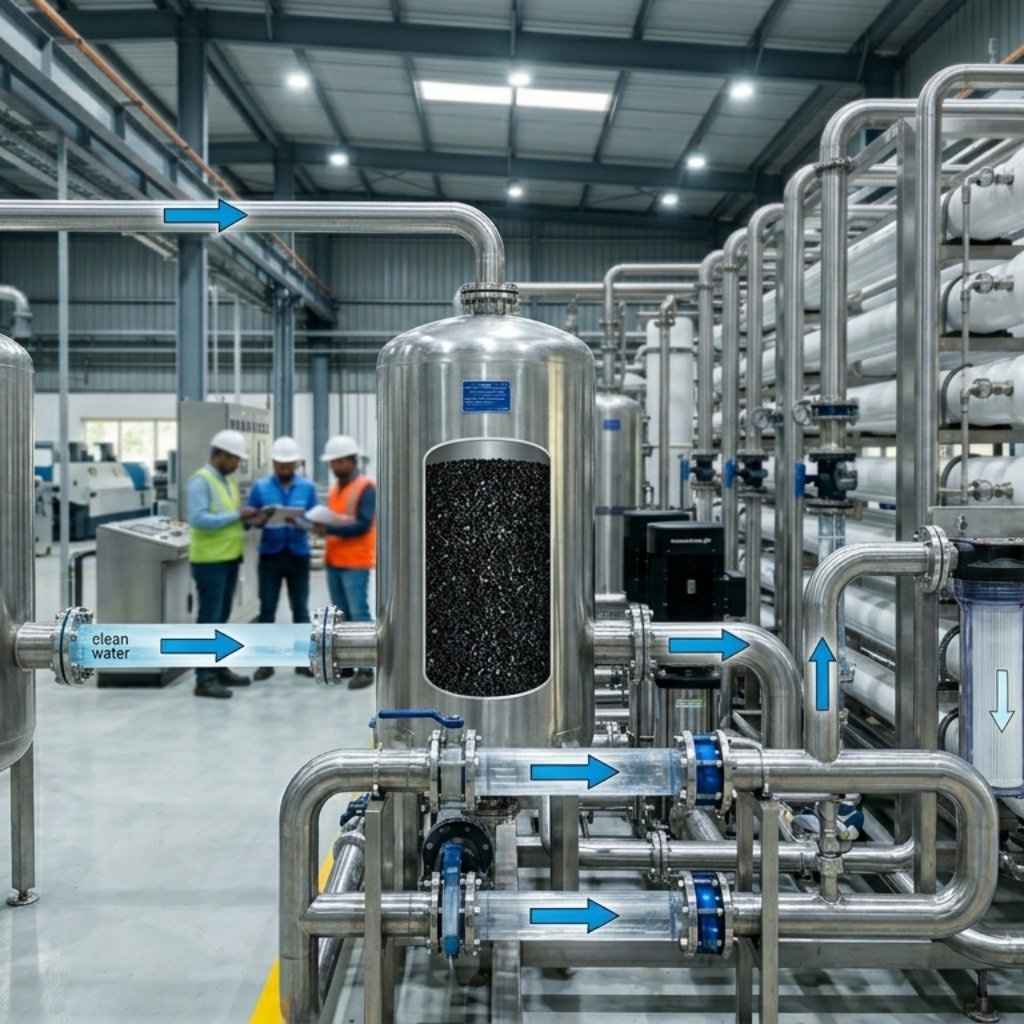
Bangalore Aqua And Energy Pvt. Ltd. manufactures industrial RO plants at our facility in Kogilu Layout, Bengaluru. We test your water, design the pre-treatment and RO train, build and factory-check the skid, then install and commission it at your site in Doddaballapur. After handover, we support the plant with AMC, membrane care and spares.
📞 +91 76763 93939 | +91 97387 04753 📧 info@bangaloreaqua.com 🌐 bangaloreaqua.com
Nearby pages: Industrial RO Plant Manufacturer in Bangalore | Best Industrial RO Plant Manufacturer in Chikkaballapur | Best Industrial RO Plant Manufacturer in Tumakuru | Industrial and Commercial RO Water Treatment from Yelahanka
Doddaballapur Water Quality: What the Data Actually Says
Over-extracted aquifers, hard and saline bores, and a lake belt under pressure
Groundwater is over-extracted. The joint CGWB and state Dynamic Ground Water Resources of Karnataka 2025 report (mirrored copy) puts Doddaballapura’s stage of groundwater extraction at 150.96% and classes the taluk as over-exploited. Annual extraction is 7,495.8 ham against 4,965.46 ham of extractable recharge, with nothing left for future allocation. The 2023 assessment (mirrored copy) gave 161.92%, and the CGWB Bangalore Rural Ground Water Information Booklet (2012) recorded 131% as of March 2009. Different years and methods give different numbers, but every one is above 100%. In practice, a plant should waste as little reject water as possible, and many sites benefit from storage and recharge planning.
Rainfall is the lowest in the district. The CGWB booklet gives Doddaballapura a normal annual rainfall of 680 mm, the lowest of the four taluks. Other sources differ: 799 mm for the district in the 2025 assessment and 774 mm for the Hesaraghatta catchment, which includes the taluk (Paani). We plan around the lower taluk figure.
TDS and EC run high at the town stations. CGWB monitoring wells published on the National Water Data Portal (CGWB groundwater quality dataset) show:
- Dodballapur station: EC of 2,030-2,990 µS/cm across 2013-2022 May samples, and TDS of 1,268 mg/L in 2022.
- Siddanayakanahalli: TDS of 1,500 mg/L in 2022.
- Gollahalli, to the north: EC as low as 782 µS/cm in 2018.
The CGWB booklet describes EC of 750-1,000 micromhos/cm across most of the district. The town-area bores are clearly worse than that.
Hardness is a major issue. The same stations record total hardness of 440-710 mg/L at Dodballapur and up to 1,020 mg/L at Siddanayakanahalli in 2022 (NWDP). Water like this scales boilers, cooling towers, dyeing machines and RO membranes quickly unless the pre-treatment is right.
Chloride and sulphate are elevated. Chloride at the Dodballapur station ranged from 199 to 703 mg/L in 2013-2022, and sulphate from 140 to 223 mg/L (NWDP). The CGWB booklet notes chloride above 250 and up to 1,000 mg/L in parts of the taluk. A 2022 study of nine town borewells, sampled monthly for two years, found average chloride of 120-565 mg/L across seasons (Pollution Research, 2022; abstract, weaker source).
Fluoride is flagged, but there are no published taluk numbers. The CGWB booklet reports fluoride above the permissible limit in parts of Doddaballapura taluk, and the monitoring stations do not publish fluoride values. We treat fluoride as something to test at every site, not something to assume.
Nitrate and bacteria are present in town bores. The 2022 town borewell study reports seasonal average nitrate of roughly 3-58 mg/L and total coliform throughout the study period (abstract, weaker source). CGWB treats nitrate above 45 mg/L as a quality concern (PIB).
Uranium is worth a single test. The Dodballapur station recorded uranium of 0.03 mg/L (30 ppb) in 2022 (NWDP), right at the 30 ppb mark CGWB uses (PIB). It is one sample, not a pattern, but it is a reason to include uranium in drinking-water tests.
Industry and lakes interact. In January 2026 the Karnataka Lokayukta took up a suo motu case over pollution in the Doddatumakuru and Chikkatumakuru lakes, linked to industries in the Bashettihalli area and to STPs that were not functioning properly (The Hindu). Villages in Doddatumakuru and Majara Hosahalli panchayats were reported to rely on tanker water from Jakkalamadagu, about 30 km away (New Indian Express). If your site is in this belt, we test for heavy metals before we size anything.
Surface supply is limited, and new supply is still years away. Doddaballapur town draws on about 80 borewells plus Jakkalamadugu reservoir water when it is available (Paani). The Yettinahole project’s balancing reservoir has moved to Lakkenahalli in Doddaballapur taluk, with completion targeted for the end of 2027 (Daijiworld), but a CAG report in January 2026 noted that land acquisition for that reservoir had not begun (The Hindu).
Planning table
Concern | Planning note | Implication |
Over-extraction | Stage 150.96% (2025), 161.92% (2023), over-exploited | Design for high recovery; plan storage and recharge |
TDS / EC | TDS 1,268-1,500 mg/L at town stations in 2022; EC 2,030-2,990 µS/cm | RO needed for process and drinking water; size membranes for the tested TDS |
Hardness | 440-1,020 mg/L at town stations | Softener or antiscalant before RO; boiler-feed polishing |
Chloride / sulphate | Chloride 199-703 mg/L, sulphate 140-223 mg/L | Corrosion-resistant materials; check RO rejection targets |
Fluoride | Reported above the limit in parts of the taluk; no station values | Test every site; RO for drinking lines |
Nitrate and bacteria | Nitrate up to about 58 mg/L and coliform in town bores (abstract only) | RO plus UV for potable water |
Uranium | 0.03 mg/L at one station, 2022 | Include in drinking-water tests |
Lake-belt and industrial-area bores | Lokayukta case on polluted lakes near Bashettihalli | Heavy-metal and COD testing before design |
Supply mix | Borewells, Jakkalamadugu, tankers; Yettinahole not before end-2027 | Design for variable feed; tanker-water inlet option |
Takeaway: we do not invent a single Doddaballapur TDS. The published data shows a wide range across the taluk, so every Bangalore Aqua proposal starts with a laboratory test of your own bore or tanker water.
Key Sectors We Build For in Doddaballapur
Apparel, Weaving and Textile Processing
Doddaballapur is known for powerloom silk and saree weaving, and KIADB’s Apparel Park phases sit just outside the town (Invest Karnataka). Dyeing, washing and humidification need soft, low-TDS water. Hard bore water causes uneven shades and scaling.
Typical requirement: 1,000-5,000+ LPH RO with softener, plus boiler-feed polishing.
KIADB Engineering, Automobile and Electrical Units
Invest Karnataka lists textile, aerospace, automobile and electrical/electronics as the district’s focus sectors. These units need RO water for parts washing, cooling towers, coating lines and canteens.
Typical requirement: 500-2,000 LPH RO with antiscalant dosing and a UV drinking line.
Food, Beverage, Pharma and Plant Extracts
Processed food, pharmaceutical products and plant extracts appear among the district’s exports in Invest Karnataka’s listing. These uses need consistent product water, sanitary design and good documentation.
Typical requirement: 1,000-4,000 LPH RO in SS construction, with UV or UF polishing and double pass where needed.
Warehousing and Logistics
NH-648, the STRR and the roughly 25 km link to Kempegowda International Airport (DITP status report) make the taluk a logistics corridor. Warehouses need drinking and washroom water for large shift workforces.
Typical requirement: 250-1,000 LPH RO with UV and storage.
Hospitals, Colleges and the Planned Health City
Invest Karnataka lists 259 hospitals and 114 colleges in the district, and a Health City planned in Doddaballapura taluk. Hospitals need safe drinking water, dialysis-feed pre-treatment, and kitchen and laundry water. Colleges and hostels need dependable drinking-water plants.
Typical requirement: 500-2,000 LPH RO with UV; dialysis-grade lines designed separately.
Residential Layouts and Apartments
New layouts along the Yelahanka-Doddaballapur road and around the town often rely on bores with high hardness.
Typical requirement: 1,000-4,000 LPH RO or softener-plus-RO for blending.
Temples, Pilgrim and Tourist Sites
Ghati Subramanya near Thubagere draws large crowds, especially during its December cattle fair (Wikipedia), and Makalidurga attracts trekkers (Wikipedia). Peak-day drinking-water demand at these sites is high.
Typical requirement: 500-2,000 LPH RO with UV and large storage.
Community, CSR and Jal Jeevan Mission Plants
Villages in the lake belt have relied on tanker water. We build community RO plants for gram panchayats, CSR partners and government programmes, with inlet and permeate water-quality records, Kannada-friendly operator training and multi-year AMC. See Best CSR Project RO Plants and Government Drinking Water Projects and Community RO Plants.
Typical requirement: 500-2,000 LPH community RO with UV, optional UPI or coin dispensing, and AMC.
Industrial RO Plant Capacity and Pricing - Doddaballapur 2026
Capacity | Application | Daily Output (indicative) | Indicative Cost |
250-500 LPH | Canteens, small units, warehouses | 2,000-5,000 L | ₹85,000 – ₹1.6 lakh* |
500-1,000 LPH | Mid-size factories, schools, hospitals | 4,000-10,000 L | ₹1.1 – ₹2.2 lakh* |
1,000-2,000 LPH | Textile units, apparel, layouts | 8,000-20,000 L | ₹1.5 – ₹2.8 lakh* |
2,000-4,000 LPH | Dyeing, food and process water | 16,000-40,000 L | ₹2.2 – ₹3.5 lakh+* |
Custom / 5,000+ LPH | Large process, multi-stage | As designed | On assessment |
*Indicative bands aligned with Bangalore Aqua’s published industrial pricing (Industrial RO Plant Manufacturer in Bangalore). The final quote depends on the water test, automation level, membrane brand, freight to site and site readiness. Daily output assumes roughly 8-10 running hours. AMC slabs: confirm before publish.
Standard skids are typically installed in about 2-5 working days after site readiness. Custom and civil-heavy jobs take longer.
Pre-Treatment Configurations by Water Source
Town and Kasaba borewells (hard, high TDS): Multimedia filter – Activated carbon – Softener or antiscalant dosing – 5-micron cartridge – RO – UV for drinking lines
Bashettihalli and Arkavathy lake-belt bores: Full lab test first (metals, COD) – Iron or manganese removal where needed – Multimedia – Carbon – Antiscalant – Cartridge – RO – Double pass or UF polishing if the test demands it
Thubagere, Sasalu and northern rural bores: Sand or multimedia filter – Carbon – Antiscalant – Cartridge – RO sized for site TDS – UV, with fluoride checked at every site
Tanker water (Jakkalamadugu or private): Storage with chlorination – Multimedia – Carbon – Cartridge – RO – UV, designed for a feed that varies from load to load
Boiler feed and dyeing process water: Softener – RO – Optional mixed-bed or second pass for low conductivity
Community / CSR plants: Robust pre-treatment – RO – Enhanced UV – Optional UPI or coin dispensing – Pre and post water-quality file – Multi-year AMC
Areas We Serve in and Around Doddaballapur
Town and Kasaba: Doddaballapur town (ದೊಡ್ಡಬಳ್ಳಾಪುರ) | Bashettihalli (ಬಾಶೆಟ್ಟಿಹಳ್ಳಿ) | KIADB Doddaballapur Industrial Area | Apparel Park Phase-1 and Phase-2 | Obadenahalli (Phase-3) | Adinarayana Hosahalli | Veerapura | Siddanayakanahalli
Thubagere and the north: Thubagere (ತೂಬಗೆರೆ) | Ghati Subramanya (ಘಾಟಿ ಸುಬ್ರಹ್ಮಣ್ಯ) | Makalidurga (ಮಾಕಳಿದುರ್ಗ) | Gollahalli
Sasalu, Madhure and Doddabelavangala hoblis: Sasalu (ಸಾಸಲು) | Madhure (ಮಧುರೆ) | Doddabelavangala (ದೊಡ್ಡಬೆಳವಂಗಲ) | Lakkenahalli (ಲಕ್ಕೇನಹಳ್ಳಿ)
Arkavathy lake belt: Nagarakere | Chikkatumakuru | Doddatumakuru (ದೊಡ್ಡತುಮಕೂರು) | Majara Hosahalli | Rajaghatta (ರಾಜಘಟ್ಟ) | Melekote
Adjacent areas:
- Devanahalli – Best Industrial RO Plant Manufacturer in Devanahalli (when live)
- Nelamangala – Best Industrial RO Plant Manufacturer in Nelamangala (when live)
- Hoskote – Best Industrial RO Plant Manufacturer in Hoskote (when live)
- Yelahanka and Bengaluru – Industrial and Commercial RO Water Treatment from Yelahanka | Industrial RO Plant Manufacturer in Bangalore
- Chikkaballapur and Gauribidanur – Best Industrial RO Plant Manufacturer in Chikkaballapur | Best RO Water Treatment Plant Supplier in Chikballapur
- Tumakuru and Koratagere – Best Industrial RO Plant Manufacturer in Tumakuru
Manufacturing base: Kogilu Layout, Bengaluru – Our Presence
- Frequently Asked Questions
Is the RO plant built in Bengaluru and installed in Doddaballapur?
Yes. We manufacture every plant at our Kogilu Layout facility in Bengaluru and factory-check it there. We then deliver, install and commission it at your Doddaballapur site. AMC and service visits continue after handover.
Can you supply RO water for dyeing and weaving units in the Apparel Park?
Yes. Textile processing needs soft, low-TDS water for consistent shades and scale-free machines. We usually combine a softener or antiscalant with RO and size the plant for your daily process load.
What is the typical TDS of borewell water in Doddaballapur?
There is no single number. CGWB stations near the town recorded TDS of 1,268 and 1,500 mg/L in 2022, and EC of 2,030-2,990 µS/cm over several years, while a station further north was much lower. We test your water before we quote.
My bore is near Bashettihalli or the Arkavathy lakes. Is that a problem?
It can be. These lakes are the subject of a 2026 Lokayukta pollution case. We test for heavy metals and organic load before we design, and we add the pre-treatment the result calls for.
Will a softener be enough, or do I need RO?
A softener removes hardness but not TDS, chloride or fluoride. Hardness at town stations has reached 1,020 mg/L alongside high TDS, so most sites need softening or antiscalant plus RO.
Is fluoride or nitrate a concern in Doddaballapur?
CGWB reports fluoride above the permissible limit in parts of the taluk, and a study of town bores found seasonal nitrate averages up to around 58 mg/L. RO reduces both. We confirm the levels with a site test.
Groundwater is over-exploited here. How does that affect my plant?
The taluk’s stage of extraction is 150.96% in the 2025 assessment. We design for high recovery, minimise reject water and can advise on storage and rooftop recharge.
Will the Yettinahole project fix the water problem?
Not soon. Completion is targeted for the end of 2027, and the CAG flagged that land acquisition for the Lakkenahalli reservoir had not begun. Plan for groundwater and tankers for now.
Do you build community, CSR or JJM RO plants?
Yes. We build community RO plants with UV and dispensing for panchayats, CSR partners and government programmes, with AMC. See Best CSR Project RO Plants.
How much does an industrial RO plant cost in Doddaballapur?
Indicative bands start at ₹85,000 – ₹1.6 lakh for 250-500 LPH and rise to ₹2.2 – ₹3.5 lakh+ for 2,000-4,000 LPH. Plants of 5,000+ LPH are priced on assessment. The final price depends on your water test and site.
Get a Site-Tested Industrial RO Proposal for Doddaballapur
Send us your location, daily water requirement and a recent bore water report (or let us collect a sample). We will design a pre-treatment and RO train for your actual water, build it in Bengaluru and commission it at your Doddaballapur site, with AMC support after handover.
📞 +91 76763 93939 | +91 97387 04753
📧 info@bangaloreaqua.com
🌐 bangaloreaqua.com
📍 Manufacturing: 107/209 2nd Cross, 4th Main Kogilu Layout, Bengaluru – 560064
Also See
- Industrial RO Plant Manufacturer in Bangalore
- Industrial RO System
- Best Industrial RO Plant Manufacturer in Chikkaballapur
- Best Industrial RO Plant Manufacturer in Tumakuru
- Best Industrial RO Plant Manufacturer in Kolar
- Best Industrial RO Plant Manufacturer in Devanahalli (when live)
- Best Industrial RO Plant Manufacturer in Nelamangala (when live)
- Best Industrial RO Plant Manufacturer in Hoskote (when live)
- RO Water Treatment Plant Suppliers in Bengaluru Rural
- Best CSR Project RO Plants
- Government Drinking Water Projects in India – Community RO Plants
- Community RO Water Plant Karnataka
- Our Presence