Best Industrial RO Plant Manufacturer in Ballari (2026)
DRINK SAFE AND PURE
Bangalore Aqua - Industrial RO Plant Manufacturer for Ballari District
Ballari (Bellary) is often called the Steel City of south India – Invest Karnataka frames it as a fast-growing mineral and manufacturing district with iron and steel, garments, food processing and general engineering at the core, and more than 18,000 small-scale units plus dozens of large and medium industries on the district profile (Invest Karnataka – Ballari). The Ballari-Hospete iron ore belt feeds integrated steelmaking at Toranagallu – JSW’s Vijayanagar Works spans a vast campus with multi-MTPA crude steel capacity and full-chain beneficiation-to-rolling operations (JSW Vijayanagar Works) – alongside other steel and mineral names on the Invest Karnataka list and expanding KIADB footprints such as Kuduthini Industrial Area Phase-2.
Mining and steel create two water briefs at once. Plants need process, utility and workforce drinking water that survives hard, high-TDS bore chemistry. Mining-affected communities need safe drinking water – and Ballari’s District Mineral Foundation (DMF) is explicitly positioned for Tier-1 drinking-water welfare spend in mining districts (Bangalore Aqua DMF / government water projects context).
Bangalore Aqua and Energy Pvt. Ltd. industrial RO plant manufacturer in Ballari, commercial plants and community water solutions from our Bengaluru facility – with installation, commissioning and AMC across Ballari district.
📞 +91 76763 93939 | +91 97387 04753
📧 info@bangaloreaqua.com
🌐 bangaloreaqua.com | Related: Best RO Water Treatment Plant Supplier in Ballari
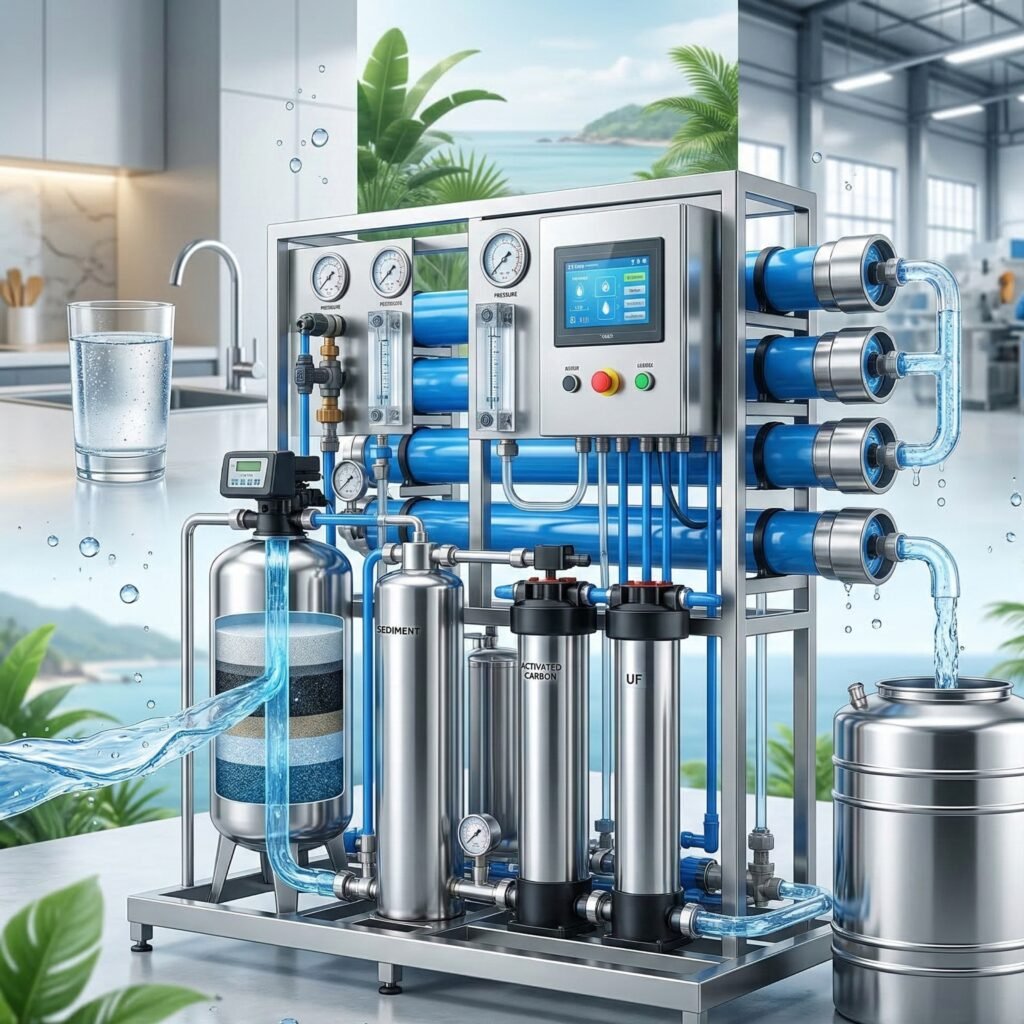
Ballari’s Water Quality: High TDS Borewells, Hardness and Local Fluoride Pockets
Plot chemistry decides the skid – mining districts are not uniform
Ballari city, Toranagallu/steel campus utilities, Hospete and Sandur mining taluks do not share one feed number. Some published Hospete/Sandur drinking-water sample sets look relatively mild; city and taluk groundwater studies show wide TDS and hardness bands and fluoride above guidance in named locations. Bangalore Aqua designs only after site-specific feed-water testing – including expanded panels when mining-adjacent location warrants it.
What published studies report
Bellary city and surroundings groundwater assessment: TDS about 220-4,100 mg/L; fluoride about 0.11-2.10 mg/L with multiple samples above drinking limits in that set; elevated values of several parameters linked to geology and infiltration; faecal contamination flagged in a subset of samples (NEPT Bellary city PDF).
Ballari taluk hydrochemical / WQI work: TDS, total hardness, fluoride, alkalinity and EC identified among major controlling factors; CCME-style ratings in one seasonal set were mostly fair, with marginal and poor shares as well (Ballari taluk multivariate assessment).
Sandur taluk fluoride appraisal: fluoride about 0.89-1.89 mg/L, with named villages above WHO/BIS-style permissible limits and authors linking geology and mining context to elevated F in parts of the aquifer (IJSRD Sandur fluoride paper).
Hospete/Sandur drinking-water comparison study (2022): one mining vs non-mining sample set reported comparatively moderate mean TDS/hardness/fluoride within BIS desirable bands for those particular samples (Pharma Journal PDF) – useful as a reminder that averages are not your bore. Always re-test.
Industrial takeaway:
- Expect high TDS potential on many Ballari-area bores – membrane and recovery follow the lab
- Expect hardness as a scale driver on process heat and wash equipment
- Treat fluoride as a design question for drinking and community plants, especially Sandur-side pockets
- Mining-adjacent sites: expand the lab panel beyond a strip TDS test when consultants advise
- We do not invent a single municipal Ballari TDS for SEO
Industrial / mining borewell profile (planning guide)
Concern | Planning note | Manufacturer implication |
TDS | City study into four digits mg/L | High-rejection RO; conservative recovery |
Hardness | Major factor in taluk analyses | Softener and/or antiscalant before RO |
Fluoride | City subset and Sandur villages above limits | RO + permeate F verification for drinking/community |
Iron / solids | Plot and process specific | Iron/multimedia stages as lab indicates |
Microbial | Faecal flags in some city samples | UV / disinfection after RO for drinking |
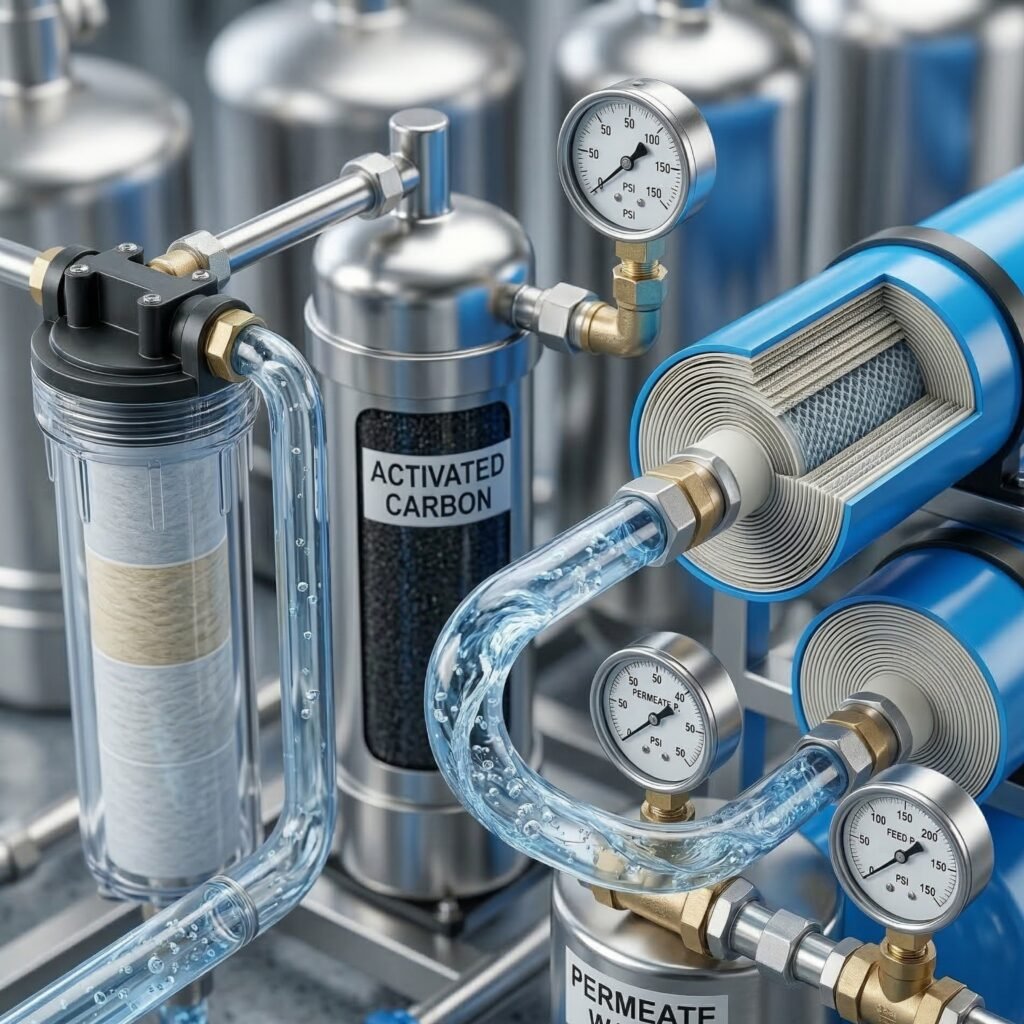
Ballari’s Key Sectors and Water Treatment Requirements
Integrated Steel and Iron & Steel Downstream
Toranagallu / Vijayanagar-scale steelmaking and allied steel units need utility water for process support, equipment cleaning, cooling-side make-up where specified, and very large workforce drinking supply. Beneficiation and pellet circuits are water-intensive upstream of steelmaking (JSW Vijayanagar overview).
Hard, high-TDS bore water shows up as:
- Scale on heat-transfer and wash equipment
- Unstable rinse chemistry
- Workforce drinking water that fails safety expectations in high-TDS or F-affected zones
Typical requirement: Industrial RO 1,000-5,000+ LPH depending on block/campus scope; robust pre-treatment; PLC options; structured AMC around shutdown windows.
Iron Ore Mining, Beneficiation Support and DMF Community Water
Sandur and Hospete mining geographies create plant-side utility demand and community drinking-water obligations. DMF funds in mining-significant Karnataka districts – including Bellary/Ballari – can support Tier-1 safe drinking water projects for mining-affected habitations (DMF / PMKKKY context; tribal / DMF RO context).
Typical requirement: Industrial RO for mine/plant workforce blocks; community RO 500-1,000 LPH for DMF/CSR village projects with inlet/permeate documentation.
Kuduthini and KIADB Industrial Area Growth
Kuduthini Industrial Area Phase-2 (~538 acres in planning/EC coverage) and related steel-downstream projects (including CRGO electrical steel proposals at Kuduthini Phase-II) add process and drinking demand on Ballari’s industrial map.
Typical requirement: 1,000-4,000+ LPH for mid-to-large sheds; staged capacity growth; estate power/drain-aware skid layout.
Garments and Textile Wet Utilities
Ballari’s garment sector needs staff drinking water and, where wet process exists, stable low-TDS rinse water.
Typical requirement: 500-2,000 LPH; softener where scale dominates; RO when TDS/F require it.
Food Processing and Cold Storage
Food and cold-storage utilities need FSSAI-aware wash and staff drinking water that does not inherit random bore chemistry.
Typical requirement: 500-2,000 LPH; carbon + UV on contact/drinking streams.
Hotels, Hospitals and Campuses
Ballari, Hospete and Sandur institutions need guest / patient / student drinking water plus soft water for laundry and hot-water loops.
Typical requirement: 500-2,000 LPH; UV + RO; structured AMC.
Fluoride-Affected and Community / CSR / DMF Projects
Where Sandur-side or other village bores exceed fluoride guidance, community RO is the practical intervention – softeners and UV do not remove fluoride. Bangalore Aqua delivers testing, install, local-language operator guidance and multi-year AMC with pre/post quality files for DMF/CSR reporting. See Best CSR Project RO Plants and Community RO Water Plant Karnataka.
Typical requirement: 500-1,000 LPH community plants; optional UPI/coin dispensing; annual permeate F verification.
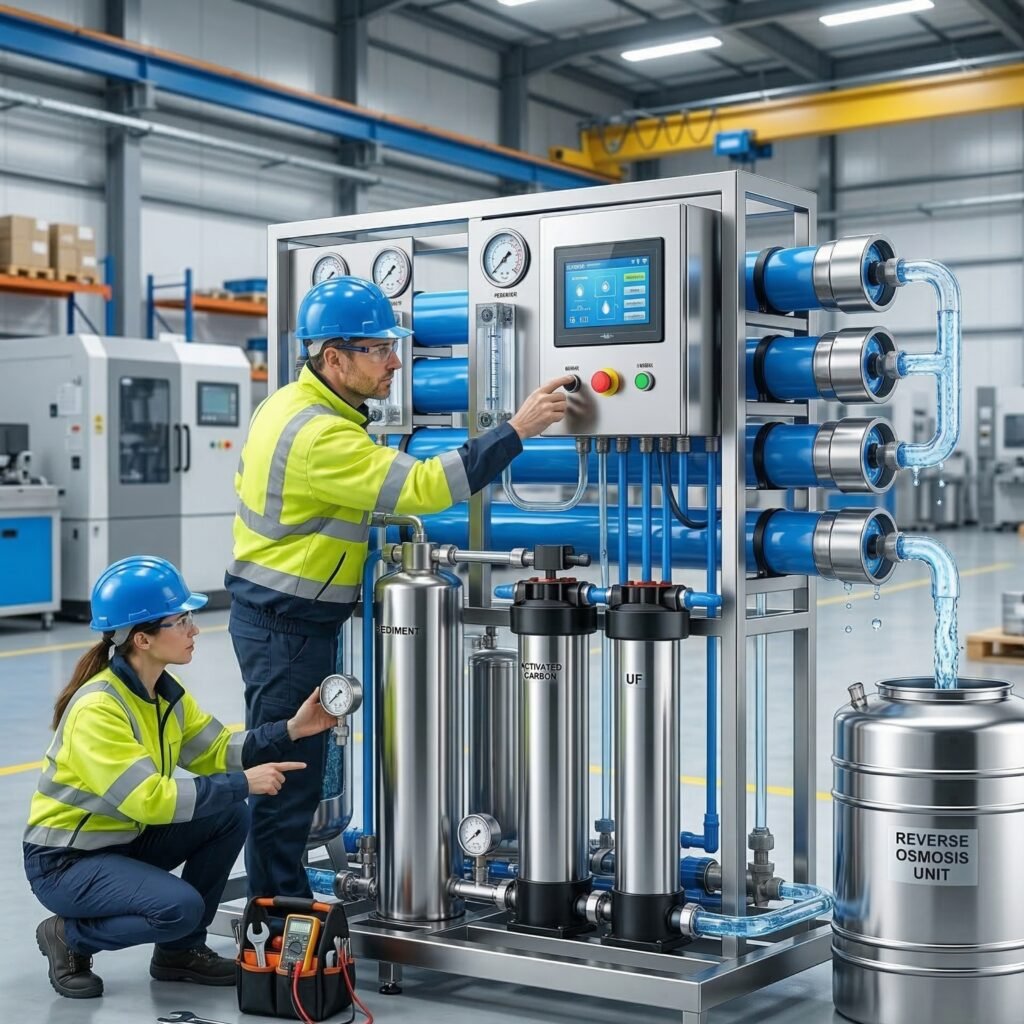
Industrial RO Plant Capacity and Pricing - Ballari 2026
Capacity | Application | Daily Output (indicative) | Indicative Cost |
250-500 LPH | Small MSME, hotel wing, O&M block | 2,000-5,000 L | ₹85,000 – ₹1.6 lakh* |
500-1,000 LPH | Medium factory, community / DMF plant | 4,000-10,000 L | ₹1.1 – ₹2.2 lakh* |
1,000-2,000 LPH | Mid steel-ancillary / garment / hospital | 8,000-20,000 L | ₹1.5 – ₹2.8 lakh* |
2,000-5,000 LPH | Large steel utility block, industrial township | 16,000-50,000 L | ₹2.2 – ₹3.5 lakh+* |
Custom / 5,000+ LPH | Integrated campus multi-block supply | As designed | On assessment |
*Indicative bands aligned with Bangalore Aqua’s published industrial capacity pricing (Industrial RO Plant Manufacturer in Bangalore). Final quote after water test, automation, membrane brand and site readiness. Very high TDS feeds may need heavier pre-treatment that moves the quote. AMC slabs: confirm before publish.
Ballari manufacturing packages include feed-water testing and commissioning verification. Where fluoride is in scope, permeate F checks are added to the commissioning pack.
Pre-Treatment Configuration for Ballari
For standard industrial / city borewells (hardness + elevated TDS):
Multimedia sediment filter – Activated carbon filter – Industrial water softener (quality resin, Fleck or Clack class) and/or anti-scalant dosing – 5-micron and 1-micron polishing cartridges – Industrial RO plant – UV disinfection – SS storage
For high-TDS / highly mineralised feeds (city-study upper band):
Strengthened multimedia and antiscalant programme – Possible dual-pass or staged RO as lab requires – Conservative recovery – Close commissioning TDS verification
For Sandur / fluoride-documented village bores:
Full standard train – RO with membrane selection aimed at high fluoride rejection (typically 90-96% class performance when healthy) – Enhanced UV as specified – Permeate fluoride verification at commissioning and on annual lab cycles – Local-language operator guidance for community plants
For mining-adjacent expanded panels:
Full ion + metals/iron screening as advised – Iron/organics stages if indicated – then standard RO train
For community / DMF / CSR plants:
Robust pre-treatment – RO – Enhanced UV – Optional UPI/coin dispensing – Multi-year AMC – Pre/post water quality file for funder reporting
Coverage: Ballari District and Adjacent Areas
Within Ballari district: Ballari city | Toranagallu / Vijayanagar belt | Hospete | Sandur | Kuduthini industrial area | Siruguppa | Hadagali | other steel-ancillary and mining clusters
Adjacent district coverage:
Chitradurga – mining / fluoride-belt neighbour
Vijayanagara district areas – quoted case-by-case
Koppal / Raichur approach – case-by-case
Manufacturing base: Yelahanka, Bengaluru – Our Presence
- Frequently Asked Questions
Do you manufacture RO plants for steel and mining-ancillary units in Ballari?
Yes – skids built in Bengaluru and installed across Toranagallu-belt utilities, Kuduthini IA, Hospete and Sandur-side sites after feed-water testing.
Our Ballari bore shows very high TDS. Can RO still work?
Published Bellary-area sampling has reported TDS from hundreds into four digits mg/L. RO can treat high-TDS feeds when pre-treatment, membrane selection and recovery are matched to the lab – sometimes with staged designs. We do not quote from a guessed city average.
Sandur village fluoride is above 1.5 mg/L. Softener or RO?
RO. Softeners and UV do not remove fluoride. Community/DMF projects: Best CSR Project RO Plants.
Can Bangalore Aqua help structure a DMF-funded community RO plant?
Yes – needs assessment, lab testing (including fluoride), install, operator training and annual quality files suitable for DMF/CSR reporting. See Government Drinking Water Projects.
Typical capacity for mid steel-ancillary or garment units?
Often 500-2,000 LPH; large utility blocks 2,000-5,000+ LPH.
Install timeline?
About 2-5 working days for standard industrial skids after site readiness; longer for custom civil-heavy jobs. Ballari logistics are planned from our Bengaluru manufacturing base.
AMC on another brand’s plant?
Often yes, after inspection.
How do we get a quote?
Call or WhatsApp +91 76763 93939 / +91 97387 04753 with taluk/industrial area, water source and peak LPH need.
Book Your Free Ballari Site Assessment
📞 +91 76763 93939 | +91 97387 04753
📧 info@bangaloreaqua.com
🌐 bangaloreaqua.com | RO supplier – Ballari
📍 Manufacturing: 107/209 2nd Cross, 4th Main Kogilu Layout, Bengaluru – 560064Free site assessment, water testing (including fluoride panel where relevant) and a complete proposal – for industrial, commercial and community / DMF water treatment projects in Ballari district.
About Bangalore Aqua | Our Karnataka presence | Gallery | Brochure
Also See:
- Best RO Water Treatment Plant Supplier in Ballari
- Industrial RO Plant Manufacturer in Bangalore
- Best Industrial RO Plant Manufacturer in Kalaburagi (when live)
- Best CSR Project RO Plants
- Government Drinking Water Projects India
- Community RO Plants for Tribal Areas
- Community RO Water Plant Karnataka
- Industrial RO System
- Our Presence