
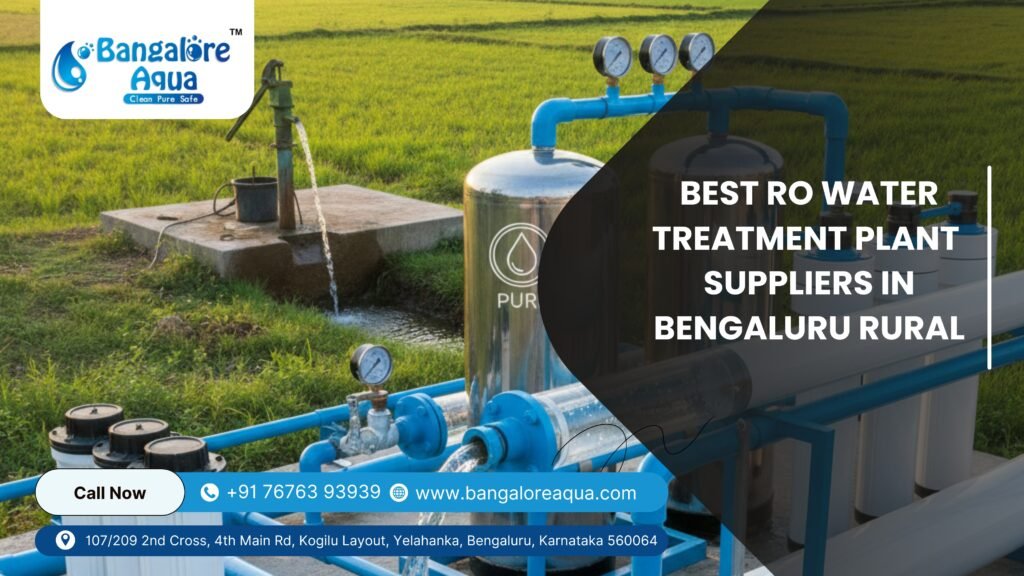
Bengaluru Rural district, surrounding the urban Bengaluru metropolitan area, faces distinct water challenges that differ significantly from its urban counterpart. With agriculture as a primary activity, expanding residential communities, and industrial development, the demand for pure water continues to grow across villages and small towns in Bengaluru Rural.
Finding the best RO water treatment plant suppliers in Bengaluru Rural requires understanding the region’s specific context. Unlike urban areas served by centralized water systems, Bengaluru Rural communities often rely on a mix of municipal supply, groundwater bore wells, and agricultural water sources—each presenting unique purification challenges.
Why This Guide Matters for Bengaluru Rural
Residents and businesses across Bengaluru Rural—from villages like Hoskote, Kanakapura, and Anekal to smaller towns and agricultural communities—increasingly recognize that accessing pure drinking water isn’t a luxury but a necessity. The best RO water treatment plant suppliers in Bengaluru Rural understand these specific regional needs and offer solutions tailored to rural conditions.
This comprehensive guide explores how to identify reliable water treatment suppliers, understand your water quality challenges, select appropriate systems, and ensure long-term water purity for your household or business in Bengaluru Rural.
Understanding Bengaluru Rural’s Unique Water Issues Distinctive Water Quality Challenges in Bengaluru Rural
Bengaluru Rural faces water challenges distinctly different from urban areas, making specialized solutions essential.
Agricultural Water Contamination
The agricultural backbone of Bengaluru Rural creates specific water quality issues:
- Pesticide and fertilizer runoff affecting groundwater
- High nitrate content from agricultural chemicals
- Seasonal variations based on farming cycles
- Contamination from livestock and farm operations
For communities relying on bore wells, these agricultural pollutants accumulate over time, requiring specialized water treatment solutions.
Groundwater Dependency Issues
Many villages and towns in Bengaluru Rural depend heavily on bore wells:
- Inconsistent water quality across different bore wells
- High mineral content and hardness from deep aquifers
- Iron oxide presence causing water discoloration
- Occasional microbial contamination in shallow wells
- Fluoride contamination in certain areas (particularly Kanakapura region)
This groundwater dependency makes finding the best RO water treatment plant suppliers in Bengaluru Rural critical foealth protection.
Seasonal Variatior hns
Water quality in Bengaluru Rural changes dramatically with seasons:
- Monsoon brings increased turbidity and contamination
- Summer causes water scarcity and concentration of minerals
- Post-monsoon brings bacterial growth in storage tanks
- Dry season intensifies hardness and salinity issues
Reliable suppliers understand these seasonal patterns and recommend appropriate filtration stages.
Limited Municipal Infrastructure
Unlike urban Bengaluru served by BWSSB, Bengaluru Rural communities often have:
- Inconsistent municipal water supply
- Limited water treatment at source
- Older pipes prone to contamination
- Gaps in water supply during dry seasons
- Lack of advanced testing facilities
This infrastructure gap makes private RO solutions essential for most Bengaluru Rural households.
Industrial Proximity Concerns
Some areas near Bengaluru’s industrial zones face:
- Chemical discharge affecting groundwater
- Heavy metal contamination from factories
- Industrial effluent seepage into aquifers
- Plastic and waste material contamination
- Air-borne pollutants settling in water sources
These industrial impacts necessitate comprehensive water treatment from qualified suppliers.
Health Implications of Poor Water Quality
Contaminated water in Bengaluru Rural contributes to:
- Waterborne diseases (typhoid, cholera, hepatitis A)
- Chronic health issues from long-term chemical exposure
- Dental fluorosis in areas with high fluoride
- Growth and development issues in children
- Reduced immunity and general health decline
Investing in quality RO water treatment plant suppliers in Bengaluru Rural directly protects family health.
What Makes a Reliable RO Water Treatment Supplier
Essential Qualities of Best Water Treatment Providers
Finding reliable water treatment suppliers in Bengaluru Rural requires evaluating specific characteristics.
Local Knowledge and Regional Expertise
The best RO water treatment plant suppliers in Bengaluru Rural possess:
- Understanding of local water sources and their characteristics
- Knowledge of seasonal water quality variations
- Familiarity with region-specific contaminants
- Experience with agricultural area water challenges
- Understanding of groundwater conditions in different zones
This regional expertise ensures recommendations match actual conditions rather than generic solutions.
Technical Competence and Qualifications
Reliable suppliers demonstrate:
- Proper training in water treatment technology
- Certifications in water quality analysis
- Understanding of RO membrane technology
- Knowledge of multi-stage filtration systems
- Ability to diagnose and solve water quality problems
Ask potential suppliers about technician qualifications and training programs.
Quality Products and Components
Best suppliers use:
- Genuine international-brand RO membranes
- Quality pre-filtration cartridges
- Reliable pumps and electronic components
- Food-grade tanks and piping
- Certified and tested components
Avoid suppliers offering suspiciously cheap systems—quality components are essential for long-term reliability.
Professional Accessibility and Service
Reliable water treatment suppliers in Bengaluru Rural offer:
- Accessible service locations across rural areas
- Responsive maintenance and support systems
- Quick problem resolution capabilities
- Trained technician network
- 24/7 emergency support for critical issues
Living in rural areas shouldn’t mean slower service or poor support.
Transparent Business Practices
Best suppliers maintain:
- Clear, honest pricing without hidden charges
- Detailed quotations explaining each cost element
- Written warranty terms and conditions
- Proper documentation of all transactions
- Ethical customer relationships
Customer-Centric Approach
Look for suppliers who:
- Conduct free water quality testing
- Provide detailed analysis and recommendations
- Explain technical concepts in understandable terms
- Offer flexible payment and maintenance options
- Follow up to ensure satisfaction
Characteristics of Top Water Treatment Providers
How to Identify Best RO Water Treatment Plant Suppliers in Bengaluru Rural
Established Track Record
Top suppliers demonstrate:
- Years of operation in Bengaluru Rural and surrounding areas
- Consistent customer retention and satisfaction
- Growing customer base through recommendations
- Recognition in local communities
- Longevity suggesting reliability and stability
A supplier operating for 5+ years in rural areas has proven ability to serve customers in challenging conditions.
Comprehensive Service Range
Best providers offer:
- Multiple system types for different needs and budgets
- Both residential and commercial solutions
- Agricultural water treatment (if applicable)
- Customization capabilities for specific challenges
- Extended product range (softeners, filters, etc.)
This range ensures they match appropriate solutions to diverse needs rather than forcing one system onto everyone.
Professional Installation and Setup
Quality suppliers provide:
- Site assessment before installation
- Professional installation by trained technicians
- Proper plumbing connections and setup
- Complete system testing and verification
- User training and documentation
Poor installation leads to problems even with quality equipment.
Reliable Maintenance Infrastructure
Best suppliers maintain:
- Regular maintenance schedules and services
- Quick response to service requests
- Spare parts availability
- Filter and membrane replacement protocols
- Water quality monitoring and testing
Maintenance quality often matters more than initial equipment quality.
Strong Customer Testimonials
Reputable suppliers can provide:
- References from satisfied Bengaluru Rural customers
- Online reviews from verified purchasers
- Case studies showing problem resolution
- Long-term customer relationships (5+ years)
- Community reputation and trust
Don’t hesitate to contact existing customers before deciding.
Types of RO Systems for Rural Bengaluru
Understanding RO System Options for Bengaluru Rural Conditions
Different rural situations require different system approaches. Understanding available options helps select the best solution.
Basic RO Systems (10-15 LPH)
Ideal for small families and households in Bengaluru Rural:
Specifications:
- Capacity: 10-15 liters per hour
- Pre-filtration: Sediment and carbon stages
- Main filtration: RO membrane
- Storage: Compact 5-10 liter tank
- Cost: ₹8,000-₹15,000
Best For:
- Individual homes in villages
- Small households (2-3 persons)
- Budget-conscious families
- Adequate water for drinking and cooking
Advantages:
- Low initial cost
- Minimal electricity consumption
- Simple installation
- Reliable technology
- Easy maintenance
Standard RO Systems (15-25 LPH)
Suitable for medium-sized households and small commercial establishments:
Specifications:
- Capacity: 15-25 liters per hour
- Multi-stage filtration (sediment, carbon, RO)
- Larger storage tanks (10-15 liters)
- Better flow rates
- Cost: ₹12,000-₹25,000
Best For:
- Average-sized families in Bengaluru Rural
- Small community water solutions
- Small shops or offices
- Agricultural households
- Continuous water needs
Advanced Systems with Pre-Treatment (20-50 LPH)
For challenging water conditions in Bengaluru Rural:
Specifications:
- Water softening stage (for hard water areas)
- Activated carbon filtration (for chlorine/odor)
- UV sterilization (for microbial protection)
- Multi-membrane RO (for high contamination)
- Cost: ₹25,000-₹60,000
Best For:
- Areas with extremely hard water
- High contamination levels
- Agricultural communities with polluted sources
- Health-conscious families
- Better quality water requirements
Alkaline RO Systems (15-25 LPH)
For health-conscious Bengaluru Rural residents:
Specifications:
- Standard RO filtration
- Alkaline mineral cartridge added
- pH balancing stage
- Beneficial minerals maintained
- Cost: ₹20,000-₹35,000
Best For:
- Families preferring mineralized water
- Health-conscious households
- Those concerned about demineralized water
- Long-term water consumption focus
Community Water Treatment Solutions
For villages and larger communities in Bengaluru Rural:
Specifications:
- Capacity: 100+ LPH
- Multi-stage treatment
- Storage capacity: 500-5000 liters
- Distribution system capability
- Cost: ₹1,00,000-₹10,00,000+
Best For:
- Village communities
- School or institutional water needs
- Small towns in Bengaluru Rural
- Shared water solutions
- Agricultural cooperatives
Selection Guide for Rural Communities
Step-by-Step Process for Choosing Best RO Water Treatment Plant Suppliers in Bengaluru Rural
Step 1: Assess Your Water Source
Begin by understanding what water you’re treating:
- Municipal supply? Predictable but may contain impurities
- Bore well? Variable quality depending on depth and location
- Surface water? Seasonal variations and contamination risks
- Mixed sources? Consistency challenges
Different sources require different treatment approaches.
Step 2: Get Professional Water Testing
Contact potential water treatment suppliers in Bengaluru Rural requesting:
- Free water quality analysis from your source
- Testing for TDS (Total Dissolved Solids)
- Hardness measurement
- pH level assessment
- Specific contaminant screening (fluoride, iron, pesticides)
- Written analysis report with findings
This testing forms the foundation of proper system selection.
Step 3: Understand Your Water Challenges
Based on testing results, identify specific issues:
- High TDS: Requires RO treatment
- Hard water: May need softening pre-stage
- Iron content: Needs iron removal filters
- Chlorine: Requires activated carbon
- Microbial contamination: Needs UV or advanced RO
- Pesticides: Demands multi-stage filtration
Different problems require different solutions.
Step 4: Determine Your Capacity Needs
Consider your water requirements:
- Household size: More people need higher capacity
- Daily usage: Drinking, cooking, bathing, cleaning
- Seasonal variations: Peak and low season needs
- Future growth: Family expansion plans
- Commercial needs: Business water requirements
Right-sizing prevents both inadequate supply and wasted investment.
Step 5: Evaluate Multiple Suppliers
Contact at least 3 potential best RO water treatment plant suppliers in Bengaluru Rural:
- Compare their water testing results
- Evaluate system recommendations
- Assess explanation clarity
- Review pricing structures
- Check warranty offerings
- Verify service accessibility
Don’t choose based on price alone—quality matters.
Step 6: Consider Service and Support
Evaluate supplier capabilities:
- Service response time: How quickly can they respond?
- Maintenance options: What plans are available?
- Spare parts availability: Can they source components?
- Technical expertise: Can they troubleshoot issues?
- Customer support: How responsive is their team?
Long-term service often matters more than initial equipment.
Step 7: Make Your Decision
Choose the supplier offering:
- Quality products and components
- Appropriate system for your needs
- Transparent pricing
- Reliable service infrastructure
- Clear warranty terms
- Good references from local customers
Pricing for Bengaluru Rural RO Solutions
Understanding Costs for Water Treatment in Rural Areas
Initial System Costs
| System Type | Capacity | Equipment Cost | Installation | Total |
| Basic RO | 10-15 LPH | ₹8,000-₹12,000 | ₹1,000-₹2,000 | ₹9,000-₹14,000 |
| Standard RO | 15-25 LPH | ₹12,000-₹20,000 | ₹1,500-₹2,500 | ₹13,500-₹22,500 |
| Advanced RO | 25-50 LPH | ₹20,000-₹40,000 | ₹2,500-₹4,000 | ₹22,500-₹44,000 |
| Alkaline RO | 15-25 LPH | ₹18,000-₹30,000 | ₹2,000-₹3,000 | ₹20,000-₹33,000 |
| Community RO | 100+ LPH | ₹1,00,000+ | ₹10,000+ | ₹1,10,000+ |
Operating Costs for Bengaluru Rural Systems
Annual Maintenance Expenses
For typical 15-20 LPH system:
- Sediment filter: ₹400-₹700 (every 3-6 months)
- Carbon filter: ₹700-₹1,000 (every 6-12 months)
- RO membrane: ₹3,000-₹5,000 (every 2-3 years)
- Electricity: ₹1,500-₹3,000 per year
- Service and labor: ₹1,500-₹3,000 per year
Total annual cost: ₹3,500-₹7,000 (excluding membrane replacement years)
Cost-Benefit Analysis for Bengaluru Rural
Monthly water expense comparison:
- Bottled water purchase: ₹1,200-₹2,000 per month
- RO system cost: ₹250-₹500 per month (including maintenance)
- Monthly savings: ₹700-₹1,500
Payback period: 8-15 months depending on system type and current bottled water spending.
5-year total cost comparison:
- Bottled water approach: ₹72,000-₹1,20,000
- RO system approach: ₹17,500-₹37,500 (including purchase and maintenance)
- 5-year savings: ₹34,500-₹1,02,500
Installation in Rural Areas
How Installation Works in Bengaluru Rural Conditions
Pre-Installation Assessment
Best water treatment suppliers in Bengaluru Rural conduct:
- Water source evaluation – Understanding your bore well, municipal supply, or other source
- Site inspection – Assessing installation location and space
- Plumbing assessment – Evaluating existing water connections
- Electrical evaluation – Checking power availability and requirements
- Documentation – Creating detailed installation plan
Installation Timeline for Bengaluru Rural
- Assessment to installation: 2-7 days typically
- Actual installation: 2-4 hours for residential systems
- Testing and flushing: 4-8 hours after installation
- System ready: Same day or next day usually
Rural location may add some travel time, but experienced suppliers account for this.
Professional Installation Process
Quality suppliers provide:
- System placement – Installing unit in optimal location
- Water line connection – Safe connection to your water source
- Reject water management – Proper waste water routing
- Storage tank setup – Installation of clean water storage
- Electrical connection – Safe power supply connection
- System testing – Thorough functionality verification
- Output verification – Testing water quality of system
- User training – Teaching you system operation and basic maintenance
- Documentation – Providing warranty and instruction materials
Post-Installation Support
After installation, best suppliers provide:
- Initial maintenance appointment (1-2 weeks later)
- User support for any questions
- First service scheduling
- Spare parts identification
- Emergency contact information
Maintenance and Support Services
Keeping Your RO System Performing Optimally in Bengaluru Rural
Regular Maintenance Schedule
Monthly Maintenance (Your responsibility):
- Visual inspection for leaks
- Check water output clarity
- Listen for unusual system sounds
- Note any performance changes
- Keep area around system clean
Quarterly Professional Service (Every 3 months):
- Professional system inspection
- Pre-filtration cartridge review
- Sediment filter cleaning/replacement
- System pressure and flow testing
- Water quality verification
Annual Comprehensive Maintenance:
- Carbon filter replacement
- Complete system cleaning
- Full water quality analysis
- Performance assessment
- System efficiency optimization
- Documentation update
Biennial Maintenance (Every 2-3 years):
- RO membrane inspection and replacement
- System overhaul and recalibration
- Thorough water analysis with report
- Component efficiency check
- System optimization
Maintenance Packages Available
Best suppliers offer flexible options:
Basic Annual Package (₹2,000-₹3,000/year):
- One comprehensive service annually
- Filter replacement as needed
- Water quality testing once yearly
- Spare parts at cost price
Standard Quarterly Package (₹3,500-₹5,000/year):
- Quarterly professional maintenance
- Included filter replacements
- Quarterly water testing
- Priority support access
- Spare parts discount
Premium Service Package (₹5,500-₹8,000/year):
- Monthly system monitoring
- All filters and parts included
- Monthly water quality testing
- 24/7 emergency support
- Annual comprehensive report
Service Response in Bengaluru Rural
Given rural locations, understand:
- Central rural areas: 24-48 hour response typically
- Remote areas: 3-5 days response, depending on distance
- Emergency issues: Priority scheduling when possible
- Emergency support: Phone support available immediately
Discuss response expectations with supplier before committing.
Comparing Different Water Purification Options
How RO Compares to Alternative Treatment Methods
When selecting among water treatment suppliers in Bengaluru Rural, understand different purification approaches.
RO (Reverse Osmosis) Systems
How it works: Water forced through semi-permeable membrane removing dissolved substances
Advantages:
- Removes 95-99% of dissolved impurities
- Handles wide range of contaminants
- Produces clean, pure water
- Proven technology with track record
- Available across Bengaluru Rural
Disadvantages:
- Waste water production (1:2 to 1:3 ratio)
- Requires electricity
- Removes beneficial minerals (unless alkaline model)
- Membrane replacement needed every 2-3 years
- Higher initial investment than some alternatives
Best For: Most Bengaluru Rural situations, especially for bore well and contaminated water
Reverse Osmosis + UV Systems
How it works: RO filtration followed by UV sterilization
Advantages:
- Maximum protection against contaminants
- Bacteria and virus elimination
- Excellent for microbiologically challenged water
- Comprehensive safety assurance
Disadvantages:
- Higher cost than standard RO
- More complex system
- Greater maintenance requirements
- Dual technology complexity
Best For: Areas with known microbial contamination or extreme water quality concerns
Water Softening Systems
How it works: Mineral removal focusing on hardness (calcium/magnesium)
Advantages:
- Addresses hard water specifically
- Protects appliances from scale
- Less costly than full RO
- Maintains more minerals
Disadvantages:
- Doesn’t address other contaminants
- Requires salt replacement (brine tank)
- Produces salty water unsuitable for drinking
- Doesn’t improve taste or remove chlorine
Best For: As pre-treatment before RO, not as standalone drinking water solution
Boiling and Traditional Filtration
How it works: Heat treatment or basic mechanical filtration
Advantages:
- Very low cost
- No equipment needed
- Traditional and familiar
- No electricity required
Disadvantages:
- Doesn’t remove dissolved minerals
- Doesn’t address hardness
- Doesn’t remove chemical contaminants
- Labor-intensive and time-consuming
- Not adequate for Bengaluru Rural conditions
Best For: Emergency situations only, not recommended as primary solution
Activated Carbon Filtration
How it works: Water passing through carbon removes chlorine and odor
Advantages:
- Improves taste and odor significantly
- Removes chlorine
- Inexpensive option
- Simple to maintain
Disadvantages:
- Doesn’t address hardness or TDS
- Doesn’t remove dissolved minerals
- Limited contaminant removal
- Requires frequent cartridge replacement
Best For: As pre-treatment stage in larger systems, not standalone
Comparative Recommendation for Bengaluru Rural
For most situations, best RO water treatment plant suppliers in Bengaluru Rural recommend:
- RO as the primary treatment
- Water softening pre-treatment if hardness is extreme
- Activated carbon as part of multi-stage system
- UV addition if microbial contamination is confirmed
This combination addresses most water quality challenges specific to Bengaluru Rural conditions.
Frequently Asked Questions
Q: What are the most common water quality issues in Bengaluru Rural?
A: The most frequent problems are hard water (from deep bore wells), high TDS levels, agricultural contamination (pesticides and fertilizers), iron oxide discoloration, and occasional microbial presence. Best RO water treatment plant suppliers in Bengaluru Rural assess your specific situation through testing rather than assuming generic problems.
Q: How do I know if I need a water softening pre-treatment stage?
A: If your water hardness exceeds 200 ppm (often the case in Bengaluru Rural bore wells), or if you see scale buildup in kettles and pipes, water softening becomes worthwhile. It extends RO membrane life and improves overall water quality. Many suppliers recommend it for Bengaluru Rural conditions.
Q: Can RO systems handle water from agricultural areas with chemical contamination?
A: Yes, quality RO systems effectively remove pesticides and fertilizers. However, in heavily contaminated agricultural areas, additional pre-filtration stages may be necessary. Discuss your area’s agricultural activities with potential suppliers—they can recommend appropriate additional filtration.
Q: Is RO water completely safe to drink daily?
A: Yes, RO-purified water is completely safe and healthy for daily consumption. While some worry about demineralized water, this is primarily a concern for people without any other mineral intake. If concerned, alkaline RO systems add back beneficial minerals while removing harmful ones.
Q: How often do RO membranes need replacement in Bengaluru Rural?
A: In typical Bengaluru Rural water conditions, RO membranes last 2-3 years with regular usage and maintenance. Hard water areas or high-contamination locations may require replacement every 18-24 months. Annual water quality testing helps determine replacement timing.
Q: What happens to the waste water from RO systems?
A: RO systems produce waste water (reject water) at a ratio of 1 unit pure water for every 2-3 units of input. This waste water can be:
- Used for gardening and plant watering
- Used for floor and vehicle cleaning
- Used for toilet flushing
- Directed to drainage (only option in some cases)
Many Bengaluru Rural residents utilize waste water effectively, minimizing actual waste.
Q: Do I need different systems for residential and agricultural use?
A: Generally, yes. Agricultural water needs (for livestock, equipment cleaning) can use different treatment than drinking water. Discuss with suppliers if you have both residential drinking needs and agricultural water requirements—they may recommend separate systems or a hybrid approach.
Q: How much electricity does an RO system consume?
A: A typical residential RO system consumes approximately:
- 50-100 watts while operating
- Operates 2-4 hours daily for average family
- Monthly cost: ₹150-₹300 in electricity
- Annual cost: ₹1,500-₹3,000
This modest electricity consumption makes RO systems practical even in areas with power limitations.
Q: Can RO systems be installed in areas without constant water supply?
A: Yes, but modifications are needed:
- Larger storage tanks for water shortage periods
- Check valves preventing backflow
- Pressure tanks managing variable supply
- Possibly enhanced pre-filtration for irregular water quality
Discuss your water supply consistency with best RO water treatment plant suppliers in Bengaluru Rural—they can design appropriate solutions.
Q: What maintenance can I do myself, and what requires professionals?
A:
You can do:
- Monthly visual inspections
- Keeping area clean
- Noting performance changes
- Basic troubleshooting
Professionals should handle:
- Filter and membrane replacement
- System servicing and cleaning
- Water quality testing
- Pressure and flow testing
- Electrical connections
Most maintenance requires professional expertise in rural areas.
Q: How do I verify a supplier’s credibility before purchasing?
A: Ask for:
- Customer references from your area
- Warranty documentation
- Service center locations and contacts
- Technician qualifications
- Years of operation in Bengaluru Rural
- Verifiable online reviews
- Business registration details
Don’t rely on marketing alone—verify claims independently.
Getting Started with Your RO System
Your Action Plan for Finding Best RO Water Treatment Plant Suppliers in Bengaluru Rural
Immediate Actions (Week 1):
- Identify potential suppliers operating in your Bengaluru Rural area
- Request water quality testing from at least 3 suppliers
- Schedule home visits for assessment
- Prepare questions about your specific situation
Evaluation Phase (Week 2-3):
- Compare test results from different suppliers
- Review system recommendations for each
- Evaluate pricing and warranty terms
- Check references from local customers
- Assess service accessibility from each supplier
Decision Phase (Week 3-4):
- Select preferred supplier based on comprehensive evaluation
- Finalize system specifications with chosen supplier
- Clarify installation timeline and process
- Arrange payment and warranty documentation
- Schedule installation at convenient time
Post-Installation (Month 1-3):
- Observe system operation and water quality
- Maintain regular usage for proper system functioning
- Schedule first maintenance appointment
- Report any concerns to supplier immediately
- Establish maintenance schedule for long-term care
Key Takeaways
When searching for the best RO water treatment plant suppliers in Bengaluru Rural, remember:
Water quality testing is foundational – Never select without professional testing
Rural conditions are unique – Choose suppliers understanding your specific challenges
Service quality matters long-term – Initial equipment is just the beginning
Maintenance is non-negotiable – Regular servicing ensures system longevity
Right-sized systems are cost-effective – Avoid oversizing that wastes money
Local knowledge helps – Suppliers familiar with your area make better recommendations
Comparison shopping is worth it – Don’t rush; evaluate multiple options
Clear warranty terms are important – Understand what’s covered and for how long
Final Thoughts on Pure Water in Bengaluru Rural
Access to pure drinking water is fundamental to health, prosperity, and wellbeing in Bengaluru Rural communities. Whether you’re in a village, small town, or agricultural area, quality RO water treatment systems from reliable suppliers provide the water security your family and business deserve.
The best RO water treatment plant suppliers in Bengaluru Rural recognize that rural water challenges are real, significant, and require thoughtful, customized solutions. By following this guide’s recommendations—getting proper water testing, evaluating suppliers comprehensively, and prioritizing long-term service quality—you’ll make a decision that serves you well for years to come.
Pure water isn’t a luxury. In Bengaluru Rural, it’s essential. Make the smart choice today.
Next Steps
Ready to ensure pure water for your Bengaluru Rural home or business?
- Identify 3 potential RO water treatment suppliers in your area
- Request free water quality testing from each
- Compare their analysis and recommendations
- Evaluate service infrastructure and accessibility
- Make your informed decision
Your journey to pure water starts now.
Contact trusted RO water treatment plant suppliers in Bengaluru Rural for your free water quality assessment today.
Disclaimer: This comprehensive guide reflects current water treatment practices and information about Bengaluru Rural water conditions. Always verify specific information with local water authorities and conduct proper water testing before making investment decisions.
© 2026 RO Water Treatment Guide – Bengaluru Rural