
Best Industrial RO Plant Manufacturer in Kalaburagi (2026)
DRINK SAFE AND PURE
Bangalore Aqua - Industrial RO Plant Manufacturer for Kalaburagi District
Kalaburagi (formerly Gulbarga) is North Karnataka’s commercial hub and the state’s tur bowl – Invest Karnataka notes the district contributes about 40% of Karnataka’s tur production – while also being recognised as a cement producing zone with abundant limestone and multiple large cement units (Invest Karnataka – Kalaburagi; District Industries Centre). Around that core sit hundreds of dal mills historically, Shahabad stone and granite crushing/polishing, food industries, cotton ginning, dairy under the KMF cooperative network, textiles and expanding KIADB footprints including Nandur-Kesartagi phases.
It is also one of Karnataka’s most water-challenged industrial districts. Semi-arid climate, heavy groundwater dependence and published taluk studies showing fluoride routinely above drinking limits, very hard water on most sampled wells, and frequent TDS/nitrate/chloride exceedances mean a catalogue RO skid without a lab report is bad engineering – for factories and for communities.
Bangalore Aqua and Energy Pvt. Ltd. manufactures industrial RO systems, commercial plants and community water solutions from our Bengaluru facility – with installation, commissioning and AMC across Kalaburagi and the wider Hyderabad-Karnataka region.
📞 +91 76763 93939 | +91 97387 04753
📧 info@bangaloreaqua.com
🌐 bangaloreaqua.com | Related: RO Water Treatment Plant Supplier in Kalaburagi
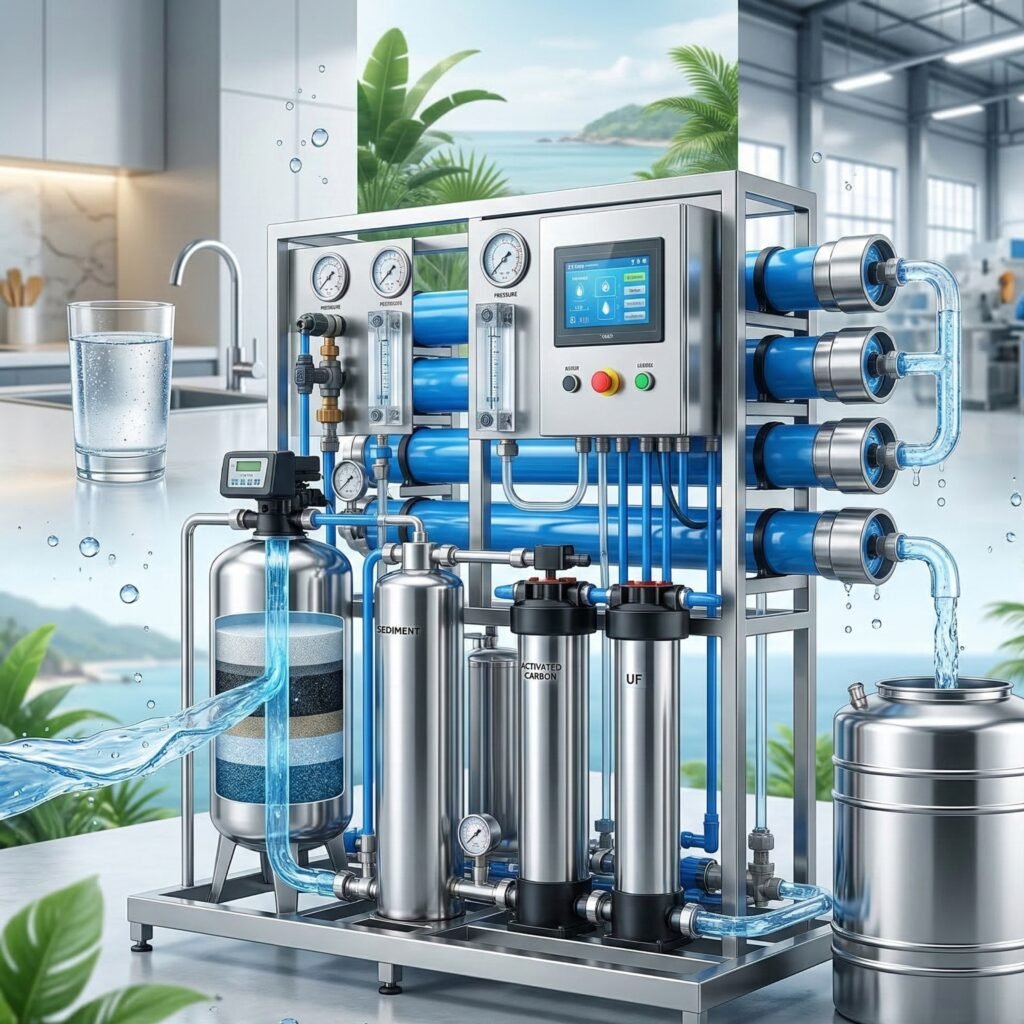
Kalaburagi’s Water Quality: Fluoride, Very Hard Borewells and High Dissolved Solids
Why this district is not a soft “TDS only” page
North Karnataka’s Hyderabad-Karnataka belt – including Kalaburagi – is repeatedly flagged for groundwater that carries elevated TDS, fluoride and nitrate in drought-prone, bore-dependent settings (Bangalore Aqua government/JJM context). Water softeners do not remove fluoride. UV does not remove fluoride. Reverse osmosis – when designed for the measured feed – is the practical path to bring fluoride and dissolved solids down for drinking and many process uses.
What published studies report
Gulbarga (Kalaburagi) city borewell work (150 samples): fluoride ranged about 0.05-1.9 mg/L (a subset above 1.5 mg/L); nitrate, chloride and TDS exceeded drinking guidance in large shares of samples in that study set – treatment before domestic use was recommended (AJEST Gulbarga city study).
Gulbarga taluk fluoride study: fluoride about 1.61-5.17 mg/L (mean ~2.46) with the authors reporting the entire sampled taluk set above permissible fluoride limits; hardness spanned roughly 24-1,350 mg/L, with most wells in hard / very hard classes (Zenodo / taluk correlation study; IJCAR geology PDF).
Seasonal district sampling around Kalaburagi has similarly reported hard-category total hardness means and fluoride values that often sit at or above guidance depending on station and season – always re-test the exact bore (seasonal Kalburagi analyses).
Industrial takeaway:
- Expect very hard bore water on many plots – softener/antiscalant before RO is routine
- Expect elevated TDS and ionic load – membrane and recovery follow the lab, including summer peaks
- Treat fluoride as a default design question for drinking and community plants in this district
- We do not invent a single municipal Kalaburagi TDS for SEO
Industrial zone borewell profile (planning guide)
Concern | Planning note | Manufacturer implication |
Fluoride | Taluk sets reported 1.61-5.17 mg/L; city subset above 1.5 | RO + permeate F verification for drinking/community |
Hardness | Often hard/very hard; taluk maxima into four digits | Softener and/or antiscalant before RO |
TDS / salinity | Frequently elevated vs desirable drinking limits | High-rejection membranes; conservative recovery |
Nitrate / chloride | Exceedances common in city study set | Full ion panel before design |
Semi-arid summer peaks | Drought-prone North Karnataka | Spec for worst-case feed |
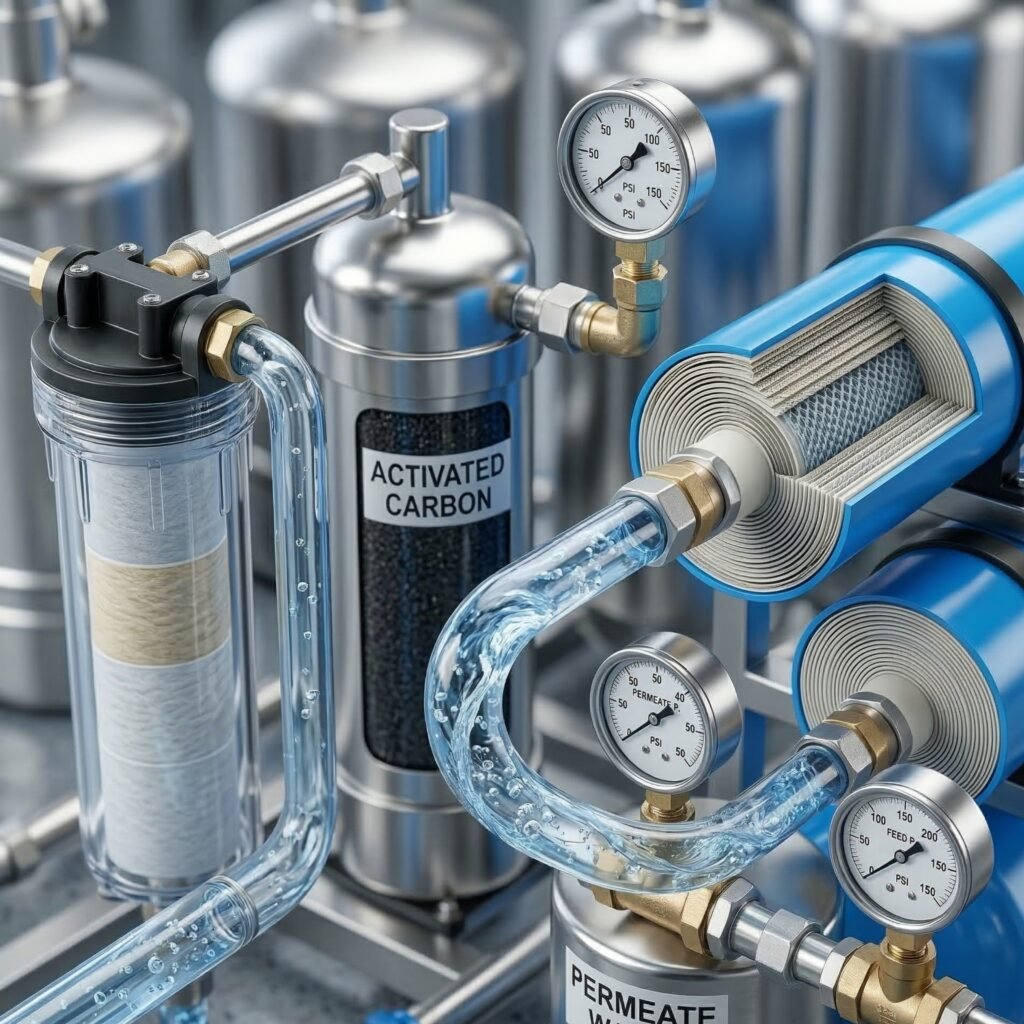
Kalaburagi’s Key Sectors and Water Treatment Requirements
Cement and Limestone-Linked Industry
Kalaburagi’s cement zone – multiple large cement units drawn by limestone deposits (DIC Kalaburagi) – needs process and utility water for grinding support, dust suppression circuits (quality specs vary), boiler/steam support where used, and large workforce drinking water under Factories Act obligations.
In a fluoride-affected groundwater district, providing safe drinking water to plant workforces is both a compliance and an ethical requirement.
Typical requirement: Industrial RO 1,000-5,000 LPH for plant utilities and workforce water depending on headcount and process split; robust pre-treatment for hard, high-TDS bores; structured AMC.
Dal Milling and Tur / Food Processing
Kalaburagi’s identity as the tur bowl supports a dense dal-milling and food-processing cluster (historically hundreds of dal mills in older district profiles) plus food-park opportunity (Invest Karnataka; DCMSME Gulbarga DIPS). Wash water, boiler make-up support and FSSAI-aware product-contact water all suffer when hardness and TDS swing.
Typical requirement: 500-2,000 LPH for mid mills; 2,000-4,000 LPH for larger continuous food units; carbon + UV on contact/drinking streams.
Shahabad Stone, Granite Crushing and Polishing
Stone cutting and polishing use continuous cooling and rinse water. Hard, mineral-rich bore water scales diamond wire, saws and polish circuits and shortens blade life.
Typical requirement: Water softener for cutting/polishing cooling loops; commercial / industrial RO 250-1,000 LPH for workforce drinking and canteen water.
Cotton Ginning, Textiles and Light Manufacturing
Ginning and textile-linked MSMEs need staff drinking water and, where wet process exists, stable low-TDS utility water.
Typical requirement: 500-2,000 LPH; softener where scale dominates; RO when TDS/F require it.
KIADB / Nandur-Kesartagi Industrial Area Growth
Nandur-Kesartagi industrial area expansion (including proposed Phase III acreage in planning coverage) will add metallurgical, paint, distillery-class and wider Category B / non-EC industry demand for process and drinking water. New plots should budget RO from day one in this chemistry belt.
Typical requirement: 1,000-4,000+ LPH for mid-to-large sheds; PLC options; staged capacity growth.
Dairy (KMF Cooperative Network)
Dairy plants need hygienic process and CIP-support water with stable dissolved solids – plus safe staff drinking water in an F-affected district.
Typical requirement: 500-2,000 LPH; UV on contact/drinking lines.
Hotels, Hospitals and Campuses
Kalaburagi city institutions need guest / patient / student drinking water that does not inherit taluk fluoride and hardness profiles.
Typical requirement: 500-2,000 LPH; UV + RO; structured AMC.
Fluoride-Affected Village and Community / CSR / TSP Projects
This is Kalaburagi’s most distinctive water brief alongside cement and dal milling. Community RO plants for F-affected habitations – including ST-focused TSP contexts called out for North Karnataka – need inlet/permeate fluoride documentation, Kannada-friendly (and local-language) operator training and multi-year AMC. Solar-powered community plants are often relevant where grid reliability is weak. See Best CSR Project RO Plants, Community RO Plants for Tribal Areas and Government Drinking Water Projects.
Typical requirement: 500-1,000 LPH community plants; optional UPI/coin dispensing; solar integration where off-grid; annual permeate F verification.
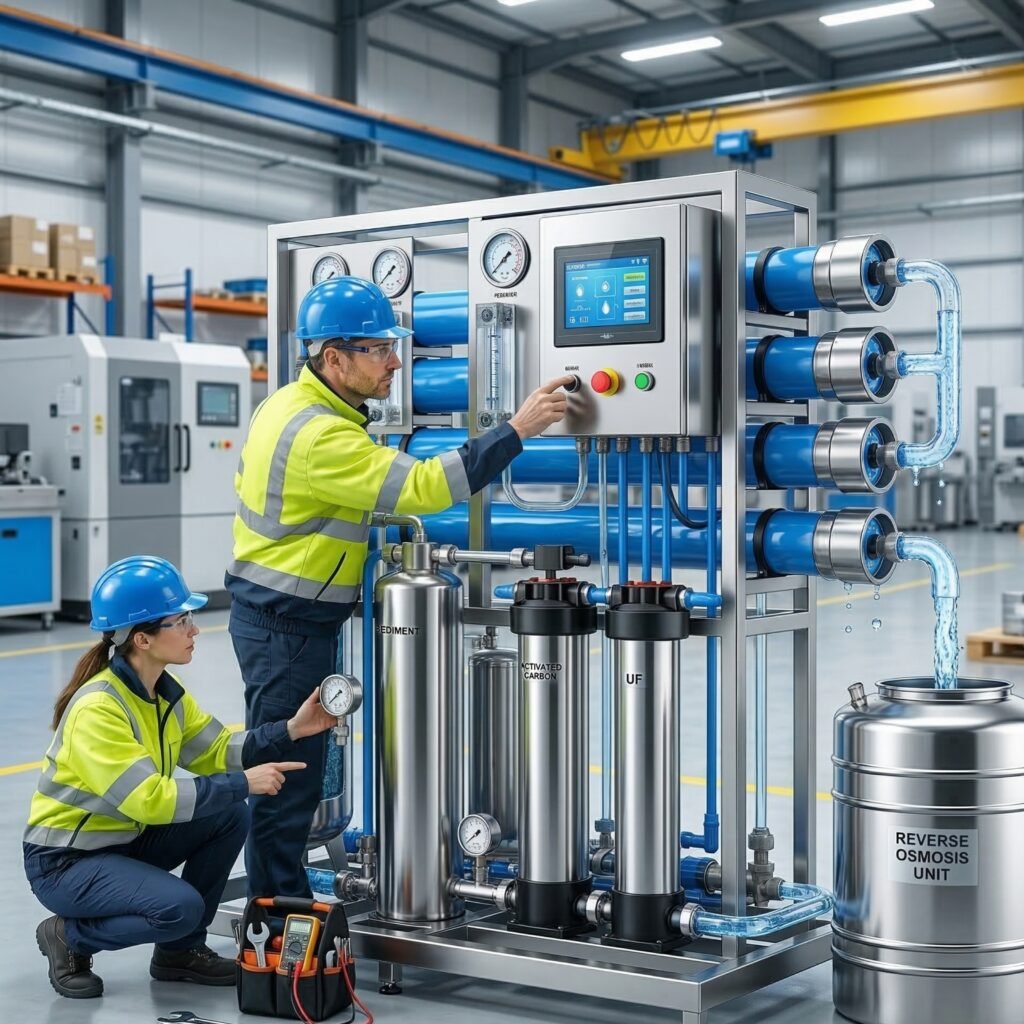
Industrial RO Plant Capacity and Pricing - Kalaburagi 2026
Capacity | Application | Daily Output (indicative) | Indicative Cost |
250-500 LPH | Small MSME, stone unit drinking, hotel wing | 2,000-5,000 L | ₹85,000 – ₹1.6 lakh* |
500-1,000 LPH | Medium dal mill / food unit, community plant | 4,000-10,000 L | ₹1.1 – ₹2.2 lakh* |
1,000-2,000 LPH | Factory, hospital, mid cement workforce block | 8,000-20,000 L | ₹1.5 – ₹2.8 lakh* |
2,000-5,000 LPH | Large cement / food campus, industrial township | 16,000-50,000 L | ₹2.2 – ₹3.5 lakh+* |
Custom / 5,000+ LPH | Multi-line industrial campuses | As designed | On assessment |
*Indicative bands aligned with Bangalore Aqua’s published industrial capacity pricing (Industrial RO Plant Manufacturer in Bangalore). Final quote after water test, automation, membrane brand and site readiness. High-TDS / high-F feeds may need heavier pre-treatment that moves the quote. AMC slabs: confirm before publish.
Kalaburagi manufacturing packages include feed-water testing and commissioning verification. Where fluoride is in scope, permeate F checks are standard in the commissioning pack.
Pre-Treatment Configuration for Kalaburagi
For standard industrial / city borewells (hardness + elevated TDS):
Multimedia sediment filter – Activated carbon filter – Industrial water softener (quality resin, Fleck or Clack class) and/or anti-scalant dosing – 5-micron and 1-micron polishing cartridges – Industrial RO plant – UV disinfection – SS storage
For fluoride-documented taluk / village borewells (priority drinking & community):
Full standard train – RO with membrane selection aimed at high fluoride rejection (typically 90-96% class performance when healthy) – Enhanced UV (community plants often 40+ mJ/cm² class dosing as specified) – Permeate fluoride verification at commissioning and on annual lab cycles – Pictorial / local-language operator guidance – Optional solar power for off-grid sites
For cement / high-dust industrial environments:
Upstream solids control as site requires – Full standard train – Robust pump specification – Conservative recovery until chemistry is stable
For stone cutting cooling loops (scale-driven):
Dedicated industrial softener on cooling water – Separate RO for drinking/canteen if required
For community / CSR / TSP plants:
Robust pre-treatment – RO – Enhanced UV – Optional UPI/coin dispensing – Multi-year AMC – Pre/post water quality file for funder reporting
Coverage: Kalaburagi District and Adjacent Areas
Within Kalaburagi district: Kalaburagi city | Sedam | Chittapur | Chincholi | Aland | Afzalpur | Jewargi | Chincholi belt | Nandur-Kesartagi industrial area | Shahabad stone belt
Adjacent North Karnataka coverage:
Yadgir – RO Water Treatment Plant Yadgir
Raichur | Bidar | Vijayapura – quoted case-by-case for industrial and community projects
Manufacturing base: Yelahanka, Bengaluru – Our Presence
- Frequently Asked Questions
Our village bore in Gulbarga taluk shows fluoride above 2 mg/L. Will RO fix drinking water?
Yes – when designed for the measured feed. Published taluk work has reported fluoride from about 1.61 up to 5.17 mg/L. RO membranes reject the large majority of fluoride; softeners and UV do not. We verify permeate at commissioning. Community/CSR/TSP routes: Best CSR Project RO Plants.
We run a dal mill with hard bore water scaling our boiler and wash lines. Softener or RO?
Often both. Softener/antiscalant protect heat equipment and membranes; RO delivers low-TDS process and drinking water. Taluk hardness has been reported into very hard classes – your lab report decides sizing.
Do you manufacture for cement plant workforce and utility water?
Yes – industrial RO skids sized for process/utility split and headcount, with robust pre-treatment for hard, high-TDS North Karnataka bores.
Can Bangalore Aqua supply solar-powered community RO for off-grid fluoride villages?
Yes – solar community RO is a standard offering for weak-grid North Karnataka deployments, with battery backup and remote monitoring options as specified. See Community RO Plants for Tribal Areas.
Is there a standard TDS for Kalaburagi city water?
No responsible supplier should invent one. City and taluk studies show wide ranges. Your quotation follows a lab test of the water that will feed the plant.
Install timeline?
About 2-5 working days for standard industrial skids after site readiness; longer for custom civil-heavy jobs. North Karnataka logistics are planned into the schedule from our Bengaluru manufacturing base.
AMC on another brand’s plant?
Often yes, after inspection – filters, membranes, cleaning and breakdown support.
How do we get a quote?
Call or WhatsApp +91 76763 93939 / +91 97387 04753 with taluk, water source and peak LPH need.
Book Your Free Kalaburagi Site Assessment
📞 +91 76763 93939 | +91 97387 04753
📧 info@bangaloreaqua.com
🌐 bangaloreaqua.com | RO supplier – Kalaburagi
📍 Manufacturing: 107/209 2nd Cross, 4th Main Kogilu Layout, Bengaluru – 560064Free site assessment, water testing (including fluoride panel) and a complete proposal – for industrial, commercial and community water treatment projects in Kalaburagi district.
About Bangalore Aqua | Our Karnataka presence | Gallery | Brochure
Also See: