
Best Industrial RO Plant Manufacturer in Mandya (2026)
DRINK SAFE AND PURE
Bangalore Aqua - Industrial RO Plant Manufacturer for Mandya District
Mandya sits in the Cauvery command belt between Bengaluru and Mysuru – designated by the Government of Karnataka as a food processing and sugar zone, with deep roots in sugar, jaggery, dairy, rice milling, sericulture and a growing garments ecosystem that includes major exporters (Invest Karnataka – Mandya). Industrial demand also runs through Tubinakere and other IA plots, Maddur and Malavalli process belts, and food-park development at Bannenahalli, K.R. Pet (KIADB-allotted food-park land with Hemavati water allocation noted in park materials) (Favorich Mega Food Park profile; Invest Karnataka park note).
Canal irrigation shaped the district’s agriculture, but factories still commonly run on borewells or mixed scheme water whose hardness and dissolved solids will not stay polite for a catalogue RO skid. Published Mandya city and district work shows hard, mineralised bores in town sampling and fluoride above 1.5 mg/L in multiple surveyed villages. For Mandya industry, RO manufacturing is process infrastructure – and in F-affected pockets, it is also a workforce and community health tool.
Bangalore Aqua and Energy Pvt. Ltd. manufactures industrial RO systems, commercial plants and community water solutions from our Bengaluru facility – industrial RO plant manufacturer Mandya, with installation, commissioning and AMC across Mandya district. (We have also delivered large softener/filter township work in Mandya – see commercial purification case notes.)
📞 +91 76763 93939 | +91 97387 04753
📧 info@bangaloreaqua.com
🌐 bangaloreaqua.com,
Udupi's Key Sectors and Water Treatment Requirements
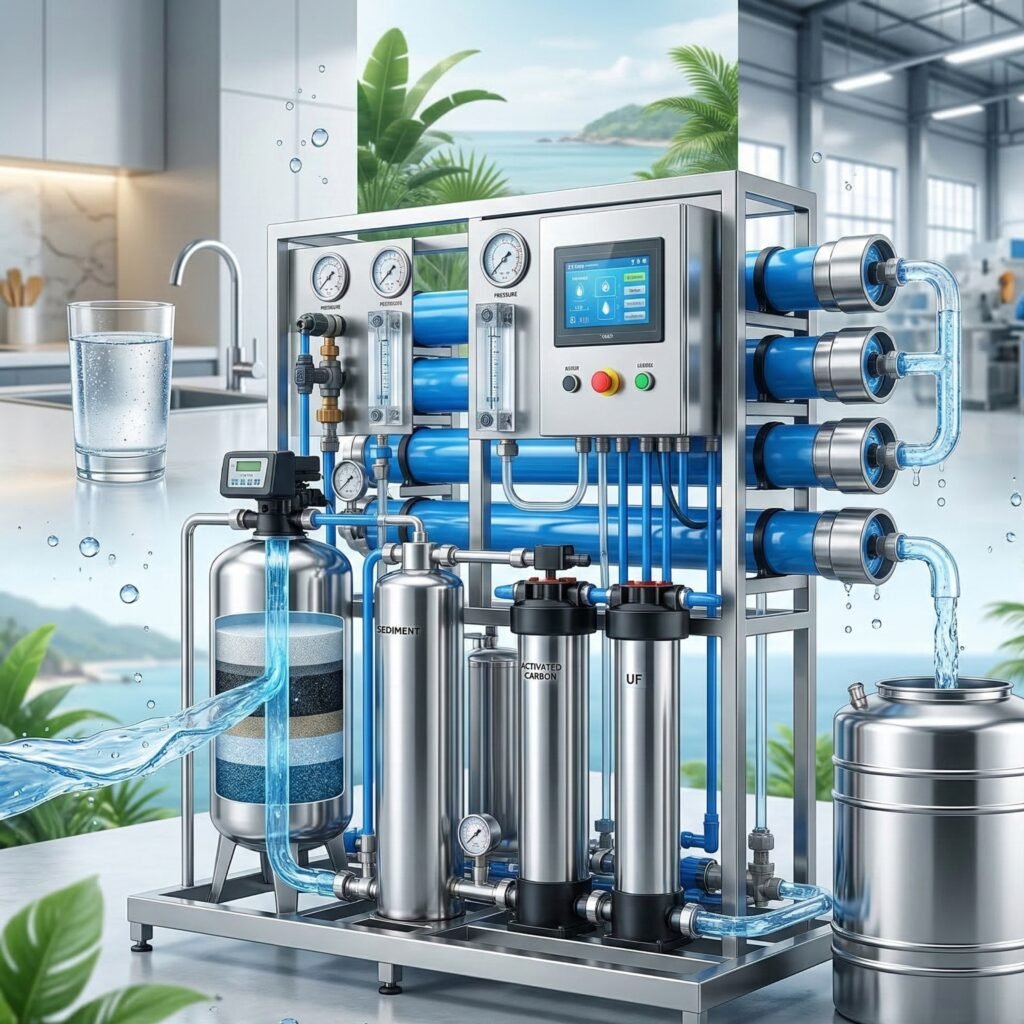
Mandya’s Water Quality: Hard City Borewells, Canal Options and Village Fluoride Pockets
Plot chemistry decides the skid
Cauvery-command / scheme water, Tubinakere estate bores, sugar-factory utilities and K.R. Pet food-park feeds are not one chemistry. Bangalore Aqua sizes every industrial RO plant after site-specific feed-water testing.
What published studies report
Mandya city – Sugar Town borewell study: TDS about 359-665 mg/L and total hardness about 255-410 mg/L as CaCO3, with fluoride in that set about 0.60-0.72 mg/L (IJERA physico-chemical paper PDF).
Pandavapura town groundwater work: a mix of temporary and permanent hardness across samples (IISc energy/water proceedings note).
Mysore-Mandya fluoride assessment: fluoride varied widely across surveyed villages; 13 villages in Mandya district were reported above the 1.5 mg/L allowable mark in that study set, with elevated bands noted in taluks including K.R. Pet and others (Scope Journal PDF).
District hydrogeochemistry: higher TDS in places linked to rock-water interaction and residence time – not a single municipal average (IJE hydrogeochemical case).
Industrial takeaway:
- Expect hard, mineralised bore water on many plots – softener/antiscalant before RO is routine
- Screen fluoride where village/taluk data suggest risk – softeners and UV do not remove fluoride
- Test bore vs Cauvery/scheme/Hemavati-allocation feeds separately
- We do not invent a Mandya-city municipal TDS for SEO
Industrial / process borewell profile (planning guide)
Concern | Planning note | Manufacturer implication |
Hardness | 255-410 mg/L class in Sugar Town set; Pandavapura hard-water mix | Softener and/or antiscalant before RO |
TDS | ~359-665 mg/L in Sugar Town set; higher elsewhere possible | Match membrane/recovery to lab |
Fluoride | 13 Mandya villages >1.5 mg/L in one survey set | RO + permeate F check when lab shows risk |
Scheme / canal-linked supply | Chlorine, seasonal turbidity | Carbon-led pre-treatment before RO |
Food-park Hemavati allocation | Treated surface chemistry varies | Confirm residuals – carbon – RO polish |
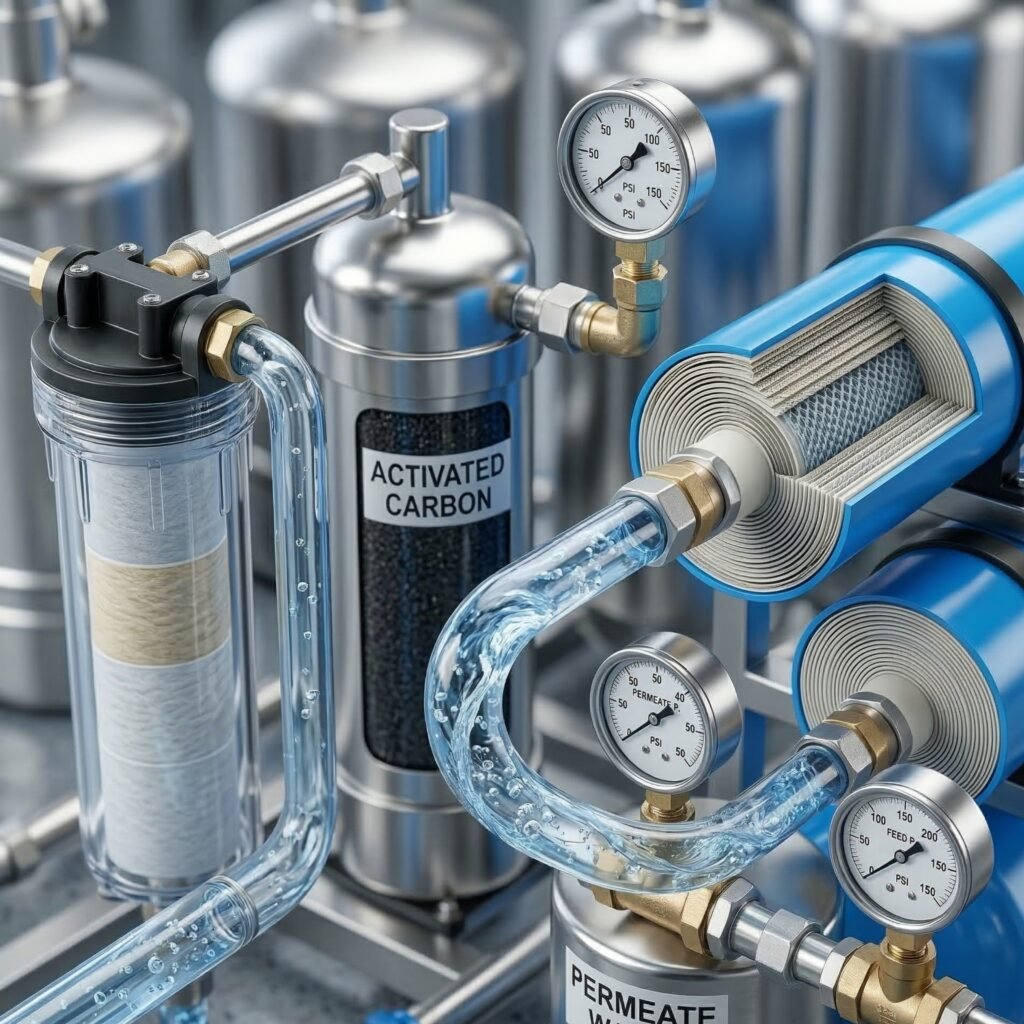
Mandya’s Key Sectors and Water Treatment Requirements
Sugar and Jaggery Process Utilities
Mandya’s sugar identity runs through mills and allied units across Mandya, Maddur and related belts (DCMSME Mandya DIPS). Process rinse, boiler make-up support, equipment cleaning and large workforce drinking water all sit on feed chemistry that hard borewells will punish if untreated.
Hard water shows up as:
- Scale on heat-transfer and wash equipment
- Higher cleaning chemical use
- Staff drinking water that fails taste or safety expectations in F-affected zones
Typical requirement: Industrial RO 1,000-4,000 LPH depending on mill/campus size; SS storage; AMC locked to crushing / peak season calendars.
Dairy and Milk Products
Dairy plants need hygienic process and CIP-support water with stable dissolved solids. Staff drinking water cannot inherit random bore chemistry.
Typical requirement: 500-2,000 LPH; carbon + UV on contact/drinking streams; softener where hardness dominates.
Rice Mills, Edible Oil and Agro Processing
Rice milling, oil extraction and allied agro MSMEs need consistent wash and utility water. Hardness affects cleaning chemistry and equipment life.
Typical requirement: 500-2,000 LPH; multimedia + softener/antiscalant + RO as lab indicates.
Mega Food Park / Packaged Foods (K.R. Pet / Bannenahalli)
Food-park and packaged-food units need FSSAI-aware process water at continuous-line volumes, with room to grow capacity as tenants scale (Favorich profile).
Typical requirement: 1,000-4,000 LPH for larger units; staged expansion into the skid room; UV on product-contact and drinking lines.
Garments and Textiles
Mandya’s garment ecosystem (including major exporters named on Invest Karnataka) needs staff drinking water and, where wet process exists, stable low-TDS utility water for rinse and finishing support.
Typical requirement: 500-2,000 LPH; softener where scale hits utility loops; RO when TDS/F require it.
Tubinakere IA – Biotech and Specialty Utilities
Tubinakere industrial area hosts specialty and biotech-linked utilities that tighten purified-water expectations. RO becomes the backbone stage before any further polishing the process demands.
Typical requirement: 1,000-2,000 LPH with documented commissioning; validation paperwork as buyer QA requires.
Hotels, Hospitals and Campuses
Mandya city and Srirangapatna institutions need guest / patient / student drinking water plus soft water for laundry and hot-water loops.
Typical requirement: 500-2,000 LPH; UV + RO; structured AMC.
Fluoride-Affected Village and Community / CSR Projects
Where surveyed villages exceed fluoride guidance, community and CSR RO plants are a direct intervention. Softeners and UV alone are not. Bangalore Aqua supports testing, install, Kannada-friendly operator guidance and multi-year AMC. See Best CSR Project RO Plants and Community RO Water Plant Karnataka.
Typical requirement: 500-1,000 LPH community plants; permeate fluoride check at commissioning where F is the design driver.
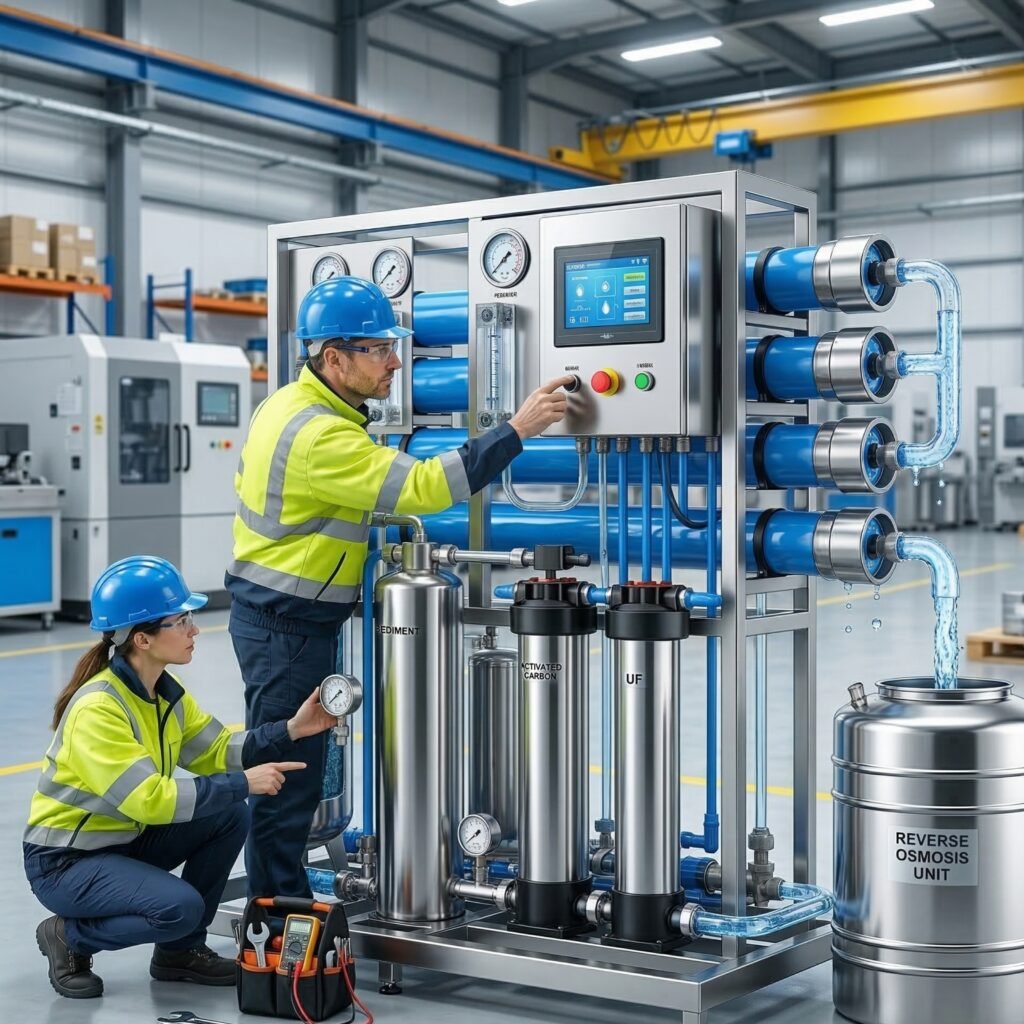
Industrial RO Plant Capacity and Pricing - Mandya 2026
Capacity | Application | Daily Output (indicative) | Indicative Cost |
250-500 LPH | Small MSME, hotel wing, light process | 2,000-5,000 L | ₹85,000 – ₹1.6 lakh* |
500-1,000 LPH | Medium dairy / rice / garment unit, community plant | 4,000-10,000 L | ₹1.1 – ₹2.2 lakh* |
1,000-2,000 LPH | Factory, hospital, food-park mid unit | 8,000-20,000 L | ₹1.5 – ₹2.8 lakh* |
2,000-4,000 LPH | Sugar / multi-line food campus | 16,000-40,000 L | ₹2.2 – ₹3.5 lakh+* |
Custom / 5,000+ LPH | Large mills and food-park campuses | As designed | On assessment |
*Indicative bands aligned with Bangalore Aqua’s published industrial capacity pricing (Industrial RO Plant Manufacturer in Bangalore). Final quote after water test, automation, membrane brand and site readiness. AMC slabs: confirm before publish.
Mandya manufacturing packages include feed-water testing and commissioning verification. Where fluoride is in scope, permeate F checks are added to the commissioning pack. Softener + RO combinations are common where hardness dominates (aligned with township softener work already referenced for Mandya).
Pre-Treatment Configuration for Mandya
For city / IA borewells (hardness + TDS driven – e.g. Sugar Town profile):
Multimedia sediment filter – Activated carbon filter – Industrial water softener (quality resin, Fleck or Clack class) and/or anti-scalant dosing – 5-micron and 1-micron polishing cartridges – Industrial RO plant – UV disinfection – SS storage
For Cauvery / scheme / canal-linked supply:
Sediment – Carbon (chlorine / organics) – Micron – RO – UV
For food-park Hemavati allocation (where connected):
Confirm residual chlorine/organics – Carbon – Micron – RO polish – UV as required
For fluoride-documented village / taluk borewells:
Full standard train – RO with membrane selection aimed at high fluoride rejection (typically 90-96% class performance when healthy) – Enhanced UV as specified – Permeate fluoride verification at commissioning and on annual lab cycles where required
For sugar / food process rinse polishing:
Application-specific organics/turbidity control upstream – then standard RO train – CIP-friendly layout
For community / CSR plants:
Robust pre-treatment – RO – Enhanced UV – Optional UPI/coin dispensing – Kannada-friendly operator guidance – Multi-year AMC – Pre/post water quality file for CSR reporting
Coverage: Mandya District and Adjacent Areas
Within Mandya district: Mandya city | Tubinakere industrial area | Maddur | Malavalli | K.R. Pet / Bannenahalli food-park belt | Nagamangala | Pandavapura | Srirangapatna
Adjacent district coverage:
Mysuru – southern industrial neighbour
Ramanagara – Bengaluru-fringe approach
Hassan – north-west agro corridor (case-by-case)
Manufacturing base: Yelahanka, Bengaluru – Our Presence
- Frequently Asked Questions
Do you manufacture plants for sugar and food factories in Mandya?
Yes. Skids are built in Bengaluru and sized for sugar, dairy, rice-mill and packaged-food utilities after a water test.
What do Mandya city borewell studies suggest?
Published Sugar Town sampling showed TDS roughly 359-665 mg/L and hardness roughly 255-410 mg/L – hard enough that softener/antiscalant pre-treatment is often justified. Your plot still needs its own lab report.
Is fluoride a design input?
In some Mandya villages/taluks, yes – one Mysore-Mandya survey found 13 Mandya villages above 1.5 mg/L. Softeners and UV do not remove fluoride. We only add fluoride-focused design when your analysis shows it.
Can you support K.R. Pet / mega food park units?
Yes – process and drinking RO for food-park and agro units, including higher capacities for continuous lines.
Typical garment unit capacity?
Often 500-2,000 LPH for staff plus wet utilities – confirm peak shift demand.
Softener only for our hard bore?
Sometimes for machinery loops – but drinking and many process rinses still need RO when TDS, hygiene or fluoride specs are tight. We decide from your report.
Install timeline?
About 2-5 working days for standard industrial skids after site readiness; longer for custom civil-heavy jobs.
How do we get a quote?
Call or WhatsApp +91 76763 93939 / +91 97387 04753 with taluk, water source and peak LPH need.
Book Your Free Mandya Site Assessment
📞 +91 76763 93939 | +91 97387 04753
📧 info@bangaloreaqua.com
🌐 bangaloreaqua.com
📍 Manufacturing: 107/209 2nd Cross, 4th Main Kogilu Layout, Bengaluru – 560064Free site assessment, water testing (including fluoride panel where relevant) and a complete proposal – for industrial, commercial and community water treatment projects in Mandya district.
About Bangalore Aqua | Our Karnataka presence | Gallery | Brochure
Also See:
- Industrial RO Plant Manufacturer in Bangalore
- Importance of Water Purification in Commercial Settings (includes Mandya township softener note)
- Best Industrial RO Plant Manufacturer in Ramanagara (when live)
- Best Industrial RO Plant Manufacturer in Hassan (when live)
- Best CSR Project RO Plants
- Community RO Water Plant Karnataka
- RO Water Treatment Plant Supplier in Bangalore
- Industrial RO System
- Our Presence