Best Industrial RO Plant Manufacturer in Mangaluru (2026)
DRINK SAFE AND PURE
Bangalore Aqua - Industrial RO Plant Manufacturer for Mangaluru's Coastal Industrial Sector
Mangaluru is unlike any other Karnataka city that Bangalore Aqua serves. It is a port city, a refinery city, a seafood export hub, Karnataka’s cashew processing capital, and a coastal tourism destination – all at once. The Arabian Sea is not just a backdrop; it shapes every dimension of the water treatment challenge that Mangaluru’s industries face.
The salt-laden coastal air that makes Mangaluru’s seafront beautiful corrodes mild steel, degrades ordinary stainless steel grades, and creates a corrosive environment that equipment designed for inland industrial applications simply cannot withstand. The fish processing plants of Baikampady operate under HACCP and FSSAI standards that demand water quality documentation that most of their current water treatment systems cannot produce. The chemical and refinery sector along the coast needs water treatment built to the quality standards that global chemical industry practice requires.
Bangalore Aqua and Energy Pvt. Ltd. manufactures, installs, and services water treatment systems for Mangaluru’s coastal industrial environment – with the material specifications (SS316L where required, SS304 as the minimum standard), the technical depth, and the service commitment that coastal industry demands.
📞 +91 76763 93939 | +91 97387 04753 📧 info@bangaloreaqua.com 🌐 bangaloreaqua.com/ro-water-treatment-plant-supplier-mangaluru/
Mangaluru's Water Quality: The Coastal Industrial Reality
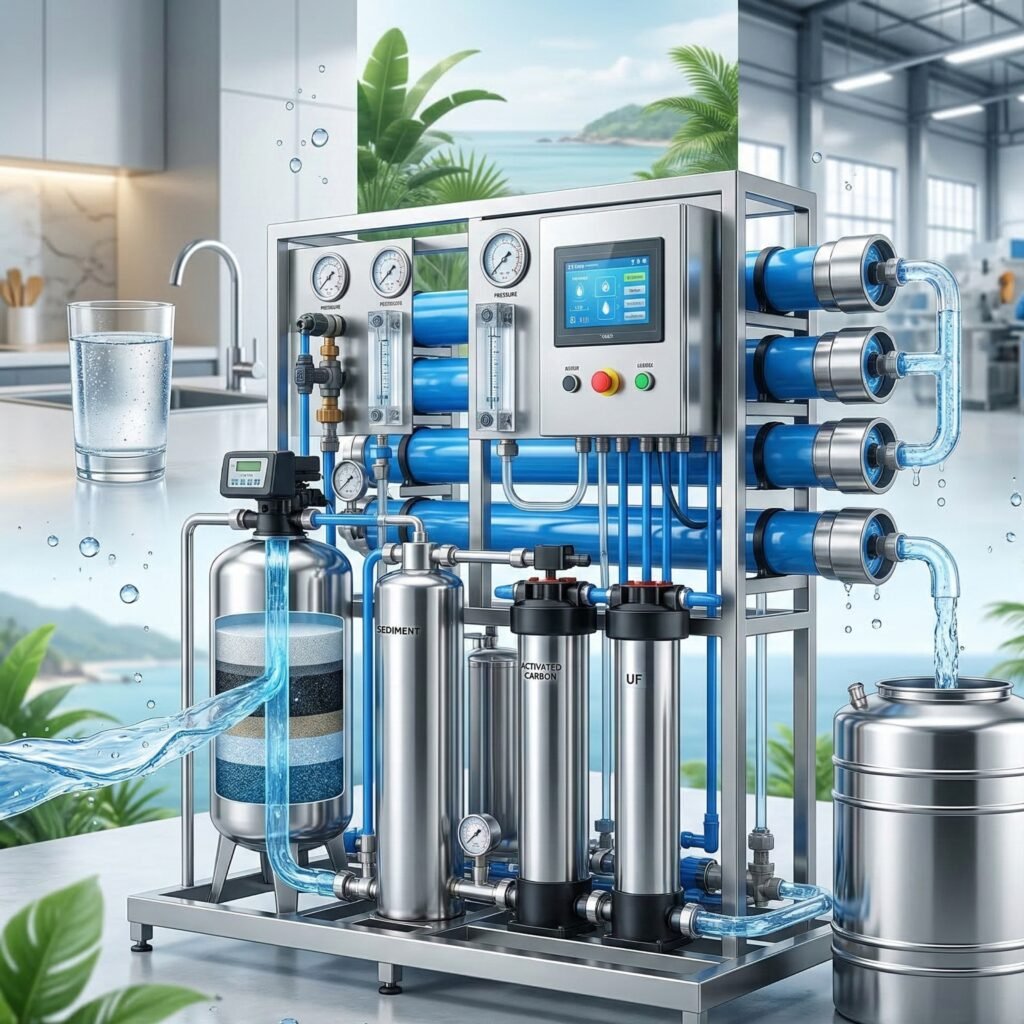
Mangaluru’s water quality picture is more nuanced than a single “TDS and hardness” characterisation covers. The city and its industrial zones sit at the interface of coastal, laterite, and riverine geological environments – each producing different groundwater chemistry.
Municipal Supply: Nethravathi and Gurpur River Sources
Mangaluru City Corporation draws its municipal supply from the Nethravathi and Gurpur rivers – relatively soft, moderate-TDS water that serves much of the city’s residential areas. Municipal supply TDS is typically 80–250 mg/L – among the lowest in Karnataka’s major cities.
However, municipal supply reliability is seasonal. During summer months when river flows reduce and water table levels drop, supply frequency decreases. Industrial properties supplement with borewell water – which carries a different quality profile.
Industrial Zone Borewell Water
Mangaluru’s major industrial zones – Baikampady Industrial Area, Moodbidri, Kenjar, and the chemical corridor along the coast – draw from borewells in laterite and coastal geological formations:
Laterite borewell water: Mangaluru’s characteristic red laterite soil produces borewell water with elevated iron (0.5–3.0 mg/L in many sources) and moderate hardness (150–350 mg/L as CaCO₃). Iron is a particular pre-treatment challenge – visible as orange-red discolouration, and damaging to RO membranes if not removed in a dedicated iron removal stage upstream.
Coastal proximity and chloride: Near the coast, shallow borewells can show elevated chloride from tidal influence and salt spray infiltration – requiring attention in membrane selection and system material specification. SS316 (with its superior chloride resistance due to molybdenum content) is the preferred storage and distribution material over SS304 for coastal installations in Mangaluru.
Iron removal is non-negotiable: Unlike most other Karnataka cities where iron is an occasional concern, elevated iron in laterite borewell water is the norm across Mangaluru’s industrial and residential zones. Every Bangalore Aqua system specification for Mangaluru begins with iron analysis – and every system for laterite borewell sources includes a dedicated iron removal stage.
For detailed guidance on stainless steel grade selection for coastal and RO water environments, see Bangalore Aqua’s SS316 guide.
Mangaluru's Key Industries and Water Treatment Requirements
Chemical Industry, Petrochemicals, and MRPL
Mangaluru Refinery and Petrochemicals Limited (MRPL) – one of India’s significant refineries – anchors the heavy industrial character of the Mangaluru coast. Alongside MRPL, the chemical industry cluster includes fertiliser producers, agrochemical manufacturers, and industrial chemical processors.
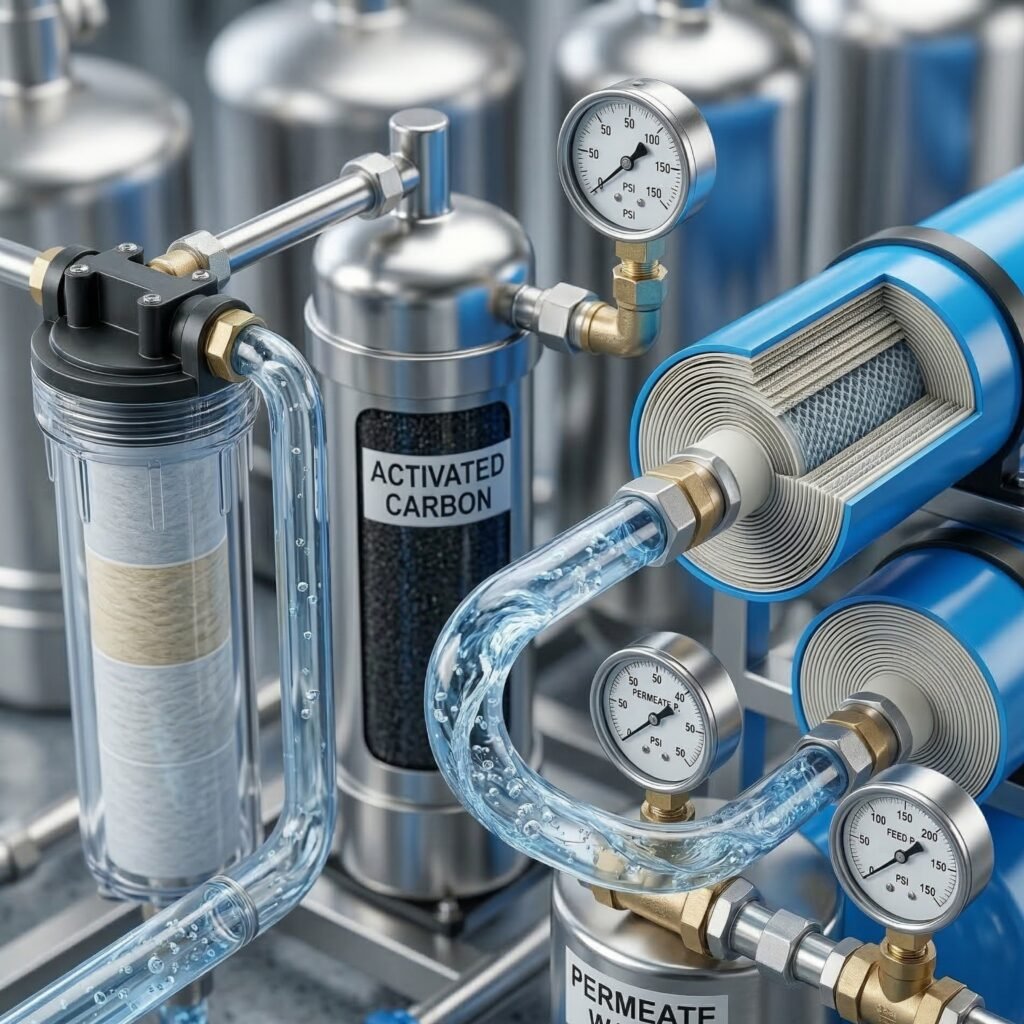
Chemical and refinery industry water treatment requirements are among the most technically demanding:
Cooling tower makeup water: Large refinery and chemical plant cooling towers consume millions of litres of water daily. Cooling tower scale formation in Mangaluru’s laterite borewell water – primarily calcium carbonate and iron scale – reduces heat exchange efficiency significantly. Water softening and scale inhibitor dosing on cooling makeup water is standard practice in correctly operated refinery facilities.
Boiler and steam system feed water: High-pressure industrial boilers (40–100+ bar) in refinery and chemical plants require near-pure water – TDS below 10 mg/L and total hardness effectively zero. This requires multi-stage treatment: iron removal → softener → RO → mixed bed deionisation → degasification. Industrial water treatment systems at this specification level are engineered to site-specific requirements.
Process water quality: Chemical manufacturing processes have specific water quality requirements depending on the reactions involved – pH, dissolved oxygen, TDS, ionic composition. Bangalore Aqua’s industrial engineering team designs process water systems to meet process-specific requirements.
Typical requirement: Large-scale industrial water treatment systems (5,000–50,000+ LPH); specialised high-purity water systems for process use
Cashew Processing – Mangaluru’s Heritage Industry
Mangaluru is India’s cashew processing capital – with the largest concentration of cashew processing units in the country concentrated in and around the city. Cashew processing is a water-intensive operation: raw cashew nuts are steam-cooked, the shells are removed, the kernels are graded and packed for export.
Water used in cashew processing must be:
- Safe and potable (FSSAI requirements apply to food processing operations)
- Low in iron (iron staining damages premium cashew kernel grades and creates rejection in export markets)
- Low in dissolved solids that affect product quality
For Mangaluru’s cashew processing units – where laterite borewell iron is a consistent challenge – the water treatment configuration typically includes iron removal followed by an RO plant for processing and drinking water. The iron removal stage is particularly critical: even moderate iron levels (above 0.3 mg/L) cause visible staining on premium cashew kernels that export buyers reject immediately.
Typical requirement: Iron removal pre-treatment + commercial or industrial RO plant 500–2,000 LPH; food-grade documentation for FSSAI compliance; SS316 storage tanks preferred for coastal environment
Seafood Processing and Cold Chain (Baikampady and Coastal Processing Zones)
Baikampady Industrial Area hosts one of Karnataka’s major seafood processing clusters – fish and shrimp processing units exporting to the EU, USA, Japan, and Middle East under HACCP and MPEDA (Marine Products Export Development Authority) quality frameworks.
Seafood export processing is among the most water-quality-sensitive food processing operations. EU buyers and MPEDA certification both require:
- Potable process water meeting BIS 10500 or equivalent international standards
- Zero detectable coliforms in all water used in contact with seafood
- Documented water quality testing at defined intervals
- Ice-making water meeting potable water standards (ice contacts seafood directly)
Mangaluru’s laterite borewell water – with its elevated iron and bacterial risk from shallow coastal borewells – does not meet these standards without treatment. An industrial RO plant with UV disinfection, producing zero-coliform water with documented NABL-accredited water quality certification, is the compliance infrastructure that every Baikampady seafood export unit requires.
Typical requirement: Iron removal + industrial RO 1,000–5,000 LPH + UV disinfection; SS316 storage tanks for coastal environment; NABL water quality certification for HACCP and MPEDA documentation
Coastal and Heritage Hotels, Resorts, and Tourism
Mangaluru’s coastal tourism sector – beachfront resorts, heritage properties, business hotels serving the city’s significant corporate traffic, and boutique coastal guesthouses – operates in an environment where guest water quality expectations are high and the consequences of water quality failure (visible scale in bathrooms, metallic-tasting water, orange-stained sanitary ware) are immediately visible to guests and immediately damaging to reviews.
The specific challenges for Mangaluru’s hospitality sector:
Salt spray corrosion: Hotels within 1–3 km of the coast face aggressive salt spray corrosion on all metal components. SS304 water tanks may develop pitting corrosion in this environment over 5–10 years. SS316 is the recommended grade for any water storage or distribution equipment in coastal hotel applications – its molybdenum content provides the chloride resistance that SS304 lacks.
Guest water quality: International guests at Mangaluru’s premium hotels expect water quality that matches their experience in other coastal tourism destinations. An RO plant producing 40–80 mg/L TDS purified water, combined with a building-level water softener protecting all plumbing and bathroom fittings from the hardness and iron in laterite borewell water, delivers the water quality that premium coastal hospitality demands.
Typical requirement: Commercial RO plant 500–2,000 LPH for drinking and F&B; water softener on building supply; SS316 tanks for coastal environment
Hospitals and Healthcare (KMC, AJ Hospital, Kasturba Medical College)
Mangaluru’s healthcare sector is among the most significant in Coastal Karnataka – with Kasturba Medical College and Hospital, A.J. Hospital, Fr. Muller Medical College Hospital, and other major facilities serving as regional health hubs for Dakshina Kannada, Udupi, and parts of Kerala.
For hospital water treatment in Mangaluru’s coastal environment, the specifications align with Bangalore Aqua’s standard healthcare offering – but with the coastal premium: SS316L for clinical water distribution loops rather than SS304, given the increased chloride levels in coastal air that can cause localised corrosion at welded joints in long-term installations.
See hospital water treatment solutions for the complete healthcare water treatment scope including dialysis water, CSSD water, and NABH documentation.
IT, BPO, and Commercial Offices
Mangaluru’s growing IT and BPO sector – concentrated in Deralakatte, Kuloor, and the city’s developing office corridors – requires standard commercial RO water treatment for employee welfare, canteen operations, and FSSAI compliance in their kitchen facilities.
For commercial office buildings and IT campuses, Bangalore Aqua’s commercial RO plant range (100–2,000 LPH) provides safe drinking water with NABL-accredited certification – satisfying both FSSAI compliance requirements and the ESG water quality reporting that larger IT companies now include in their sustainability reporting.
The Coastal Premium: SS316 for Mangaluru's Salt Spray Environment
This deserves its own section because it differentiates Mangaluru from every inland Karnataka city in Bangalore Aqua’s service portfolio.
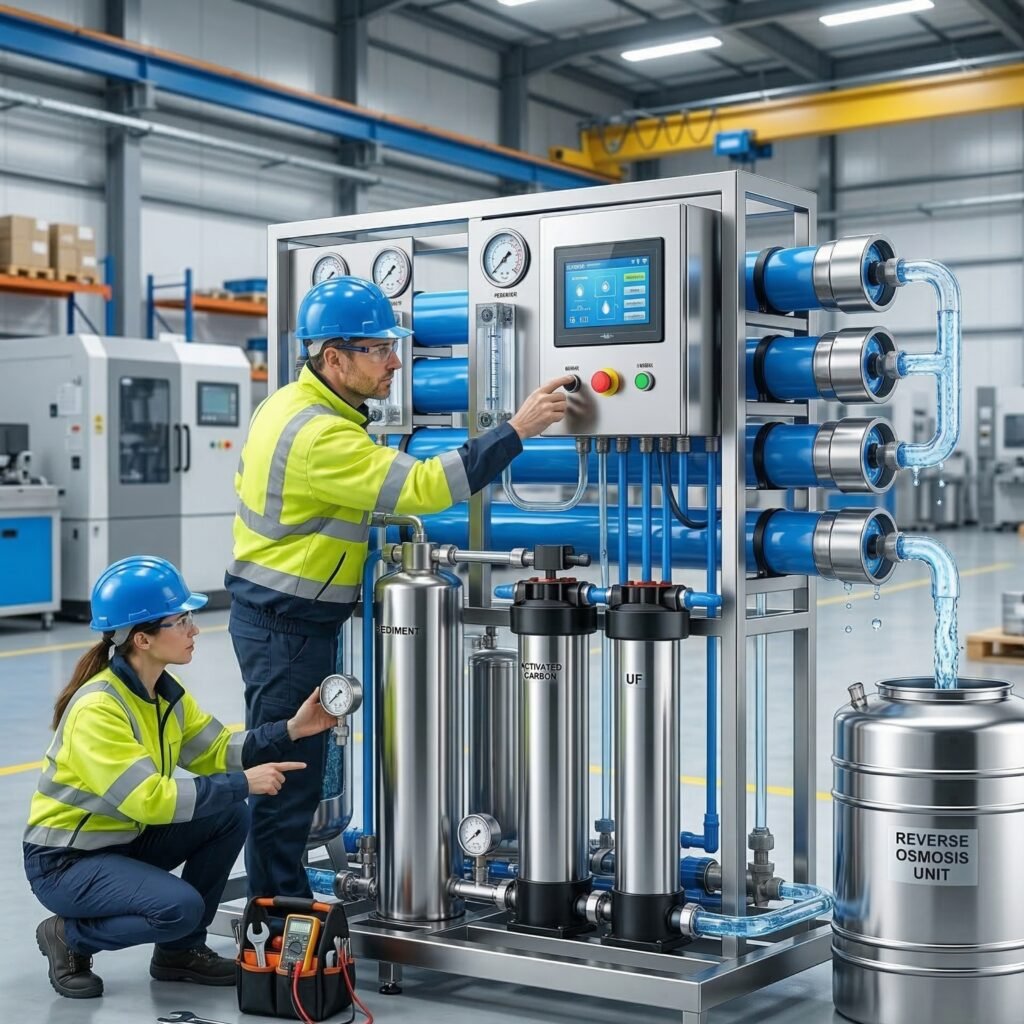
Within approximately 3–5 km of the Arabian Sea coastline, airborne salt spray (chloride aerosol from wave action) creates an aggressive corrosive environment. Standard SS304 stainless steel – adequate for inland Karnataka water treatment applications – can develop surface pitting corrosion over 5–15 years of exposure in this environment.
For Mangaluru water treatment systems, Bangalore Aqua recommends:
- SS316 storage tanks (in preference to SS304) for all permeate storage in coastal installations – particularly for systems within 3 km of the coast
- SS316L distribution piping for pharmaceutical and clinical water systems – for all Mangaluru installations regardless of proximity to coast (since clinical systems are long-lived and high-consequence)
- SS316 frame and enclosure components for outdoor or partially outdoor equipment installations
- Epoxy-coated or SS316 fasteners for all structural connections in the water treatment system
The cost premium of SS316 over SS304 (approximately 25–40%) is amortised over a much longer service life in the coastal environment – and avoids the replacement cost and water quality risk of pitting corrosion in storage tanks that are nominally food-grade but have developed surface defects from chloride attack.
For more on SS316 vs SS304 in water treatment environments, see Bangalore Aqua’s guide: Does SS316 Stainless Steel Rust with RO Water?
Industrial RO Plant Capacity and Pricing - Mangaluru 2026
|
Capacity |
Application |
Daily Output |
Indicative Cost |
|
250–500 LPH |
Restaurant, hotel (small), clinic |
2,000–5,000 L |
₹1.8–₀₅ lakh |
|
500–1,000 LPH |
Cashew processor, seafood unit (small), hotel |
4,000–10,000 L |
₹4–₀₁0 lakh |
|
1,000–2,000 LPH |
Seafood export unit, hospital, large hotel |
8,000–20,000 L |
₹8–₀₂0 lakh |
|
2,000–5,000 LPH |
Large seafood/food processor, campus, MRPL auxiliary |
16,000–50,000 L |
₹18–₀₵5 lakh |
|
5,000+ LPH |
Chemical industry, large industrial, refinery auxiliary |
40,000+ L |
Custom quote |
Mangaluru system costs include iron removal pre-treatment (standard for laterite borewell water) and SS316 tank specification for coastal environment. Contact Bangalore Aqua for a Mangaluru-specific proposal after NABL water testing.
Service Coverage: Mangaluru and Dakshina Kannada District
Bangalore Aqua serves all of Mangaluru’s industrial zones and the broader Dakshina Kannada district:
- Baikampady Industrial Area – seafood processing, chemical, manufacturing
- Moodbidri – tile manufacturing, processing industries
- Kenjar – industrial estates
- Deralakatte – IT and commercial
- Mangaluru Port area – logistics, storage, marine industries
- Puttur, Sullia, Bantwal – agro-processing, plantation industries
Adjacent district coverage:
- Frequently Asked Questions
Our cashew export unit in Baikampady needs water certification for EU buyers. Can Bangalore Aqua help?
Yes. Bangalore Aqua provides NABL-accredited water quality test certificates covering the parameters that EU food safety buyers and MPEDA auditors typically require – including TDS, pH, iron, total coliform, E. coli, and other food safety parameters. Our commissioning certification and annual AMC water quality testing programme provides the documented water quality evidence that food export compliance requires. Contact us for a Baikampady site assessment.
Should we use SS316 or SS304 tanks for our Mangaluru coastal hotel?
For a coastal hotel within 3–5 km of the sea, SS316 is strongly recommended over SS304 for water storage tanks, particularly for purified water storage. The 25–40% cost premium is recovered in service life – SS316’s molybdenum content resists chloride-induced pitting corrosion that can develop in SS304 over 5–15 years of coastal salt spray exposure. Bangalore Aqua specifies SS316 as standard for all coastal Mangaluru water treatment storage. See SS316 guide.
We run a seafood processing plant in Mangaluru. Our borewell water is orange-coloured. What is the problem and how do we fix it?
The orange colouration is iron – from the characteristic laterite borewell sources in Mangaluru’s industrial zones. Iron above 0.3 mg/L causes the colouration, stains your processing equipment and product, fouls filter media rapidly, and if allowed to reach an RO membrane, destroys the membrane through iron fouling within months. The solution: an iron removal pre-treatment stage (aeration oxidation filter with greensand or Birm media) upstream of your RO plant, removing iron before it reaches any downstream treatment component. Contact Bangalore Aqua for a Baikampady site assessment and iron-specific pre-treatment design.
What water treatment does MPEDA require for seafood export processing in Mangaluru?
MPEDA (Marine Products Export Development Authority) requires that water used in seafood processing be potable – meeting BIS 10500:2012 standards. This includes zero detectable E. coli and total coliform, iron below 0.3 mg/L, TDS below 500 mg/L, and the full BIS 10500 parameter set. Bangalore Aqua’s RO plants with iron removal pre-treatment and UV disinfection produce water meeting BIS 10500 for all MPEDA-relevant parameters. NABL-accredited water test certificates are provided at commissioning and with every annual AMC cycle – the documentation that MPEDA and HACCP auditors require.
Is Bangalore Aqua's service reach adequate for Mangaluru given the distance from Bengaluru?
Mangaluru is approximately 350 km from Bengaluru (approximately 5.5–6 hours via NH-75). Bangalore Aqua serves Mangaluru through a combination of coordinated field visits from our Bengaluru base and logistics network for spare parts. For AMC customers in Mangaluru, quarterly service visits are scheduled efficiently as dedicated Mangaluru field visits; emergency parts dispatch is same-day by courier and typically arrives next working day; field engineer dispatch for complex emergencies is within 24–48 hours. For time-sensitive production situations, Bangalore Aqua’s remote troubleshooting support via phone, WhatsApp, and video call provides immediate guidance while field support is arranged. Contact +91 76763 93939 for a Mangaluru-specific service discussion.
Book Your Free Mangaluru Industrial RO Plant Assessment
📞 +91 76763 93939 | +91 97387 04753 📧 info@bangaloreaqua.com 🌐 bangaloreaqua.com/ro-water-treatment-plant-supplier-mangaluru/ 📍 Manufacturing base: 107/209 2nd Cross, 4th Main Kogilu Layout, Bengaluru – 560064
Free Mangaluru site assessment, NABL-accredited water testing (including iron, chloride, and coastal-specific parameters), and a complete coastal-specification proposal – no obligation.
About Bangalore Aqua | Our Karnataka presence | Complete RO Guide | Gallery | Brochure
Also See:
- RO Water Treatment Plant Supplier Mangaluru
- Best RO Water Treatment Supplier Dakshina Kannada
- Does SS316 Stainless Steel Rust with RO Water?
- Stainless Steel Water Tank Supplier Bangalore
- Water Treatment Solutions for Hospitals
- Best Industrial RO Plant Manufacturer Bangalore
- Industrial & Commercial RO Plant AMC Services