
RO High Pressure Pump Supplier in Bangalore (2026) – Complete Buyer's Guide for Commercial and Industrial RO Systems
DRINK SAFE AND PURE
The Component That Makes Everything Else Possible
Remove every other component from a commercial RO plant – the pre-filters, the carbon filter, the UV lamp, the control panel, the TDS display – and the system is incomplete but the concept is still intact. Remove the high-pressure pump, and you have no RO process at all.
Reverse osmosis is not a passive filtration process. It does not work by gravity, by suction, or by any naturally occurring pressure in the water supply system. It works by applying hydraulic pressure – specifically, enough pressure to overcome the osmotic pressure differential between the feed water and the permeate – forcing water molecules through a semi-permeable membrane that rejects 95–99% of dissolved ions, bacteria, viruses, and other contaminants.
<cite index=”21-1″>High-pressure pumps generate the operating pressure needed in RO systems, boosting water pressure to 8–15 kg/cm² (8–15 bar) at the design flow rate. The Grundfos CRI series vertical multistage centrifugal pumps are designed for use in high-pressure water treatment applications, with in-line design enabling installation in horizontal single-pipe systems with suction and discharge ports at the same level and dimensions.</cite>
For Bangalore’s borewell water – typically 600–1,500 mg/L TDS with hardness of 300–700 mg/L as CaCO₃ – the operating pressure required at the RO membrane ranges from 8–15 bar depending on TDS level and the system’s target water recovery ratio. This is not pressure that the municipal supply or a standard booster pump can provide. It requires a purpose-designed high-pressure pump – a multi-stage centrifugal pump or positive displacement pump specifically selected for the combination of flow rate and pressure that your RO system demands.
This guide covers everything a facilities manager, procurement team, or industrial buyer needs to know about RO high-pressure pumps in Bangalore – types, specifications, brand comparison, sizing methodology, common failure modes, spare parts, and where to source genuine HP pumps and components reliably.
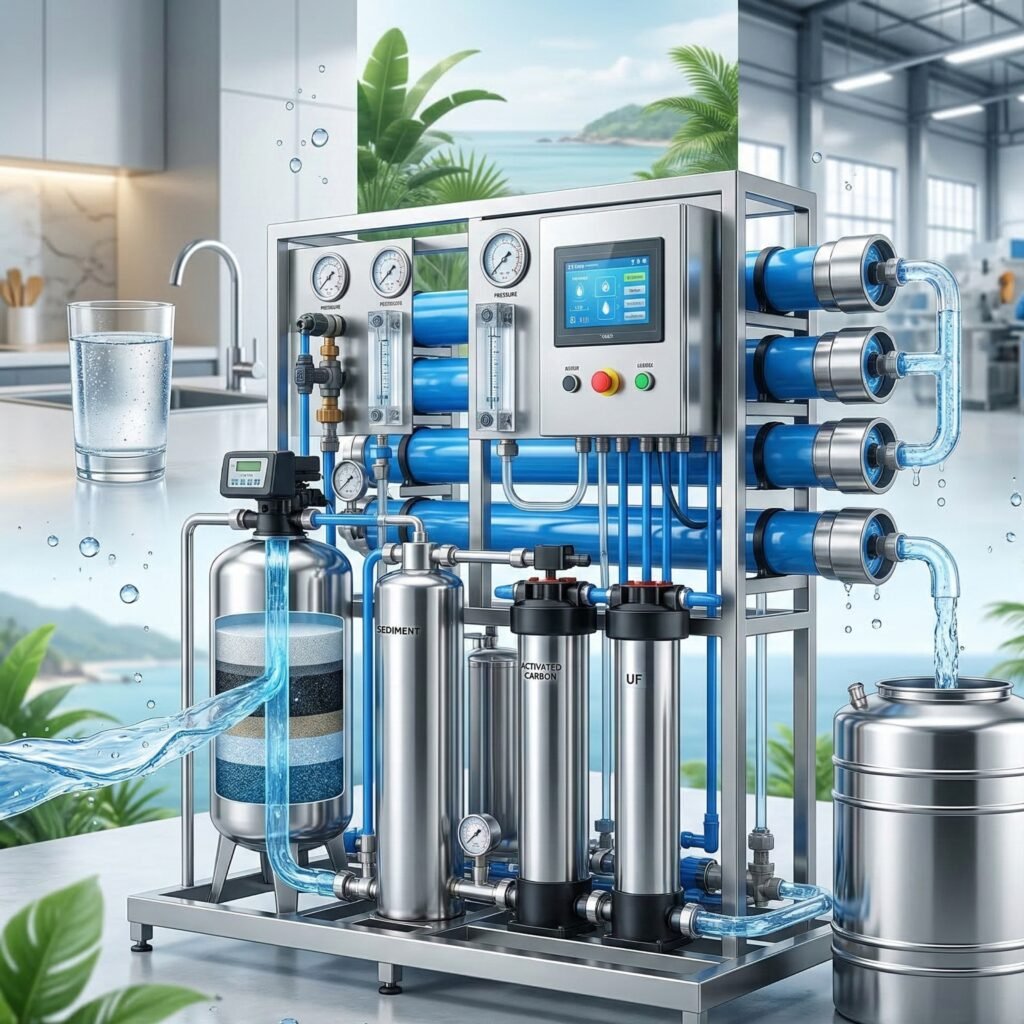
How the RO High Pressure Pump Works - The Physics Made Clear
Understanding what an RO high-pressure pump actually does makes every subsequent decision about pump selection and maintenance clearer.
Osmotic Pressure – What the Pump Is Working Against
When two solutions of different concentration are separated by a semi-permeable membrane, water naturally moves from the lower concentration solution to the higher concentration solution – this is osmosis. To reverse this process (hence “reverse osmosis”), you must apply pressure to the higher concentration side that exceeds the osmotic pressure differential.
Osmotic pressure in water treatment is directly related to TDS concentration. For every 100 mg/L of TDS in the feed water, the osmotic pressure is approximately 0.7–0.8 bar. For Bangalore borewell water at 800 mg/L TDS, the osmotic pressure is approximately 5.6–6.4 bar.
But the pump must deliver more than just the osmotic pressure – it must also provide the net driving pressure (NDP) that actually moves water through the membrane at the design permeate flow rate, plus overcome the friction losses in the membrane housing and piping. This is why commercial RO systems operating on 800 mg/L TDS borewell water typically require 10–12 bar of feed pressure, not just the 6 bar osmotic pressure.
The Multi-Stage Centrifugal Pump Approach
A single-stage centrifugal pump – the type used in domestic water booster applications – cannot efficiently achieve the 8–15 bar pressure required for RO applications at commercial flow rates. The pressure-flow curve of a single-stage centrifugal pump falls rapidly at high pressure, making it inefficient and thermally stressed when used to develop RO operating pressure.
<cite index=”28-1″>Grundfos CRI vertical multistage centrifugal pumps add pressure incrementally through multiple impeller stages in series – each stage adding approximately 1–3 bar depending on impeller diameter and speed. By stacking 5–15 stages, these pumps efficiently achieve the 8–15 bar output pressure required for RO applications without the heat generation and efficiency penalties of single-stage pumps operating far from their best efficiency point.</cite>
The result: a compact, efficient, high-pressure pump that operates reliably at the combination of pressure and flow rate that the RO system requires – with stable performance across the duty range and efficient electrical consumption.
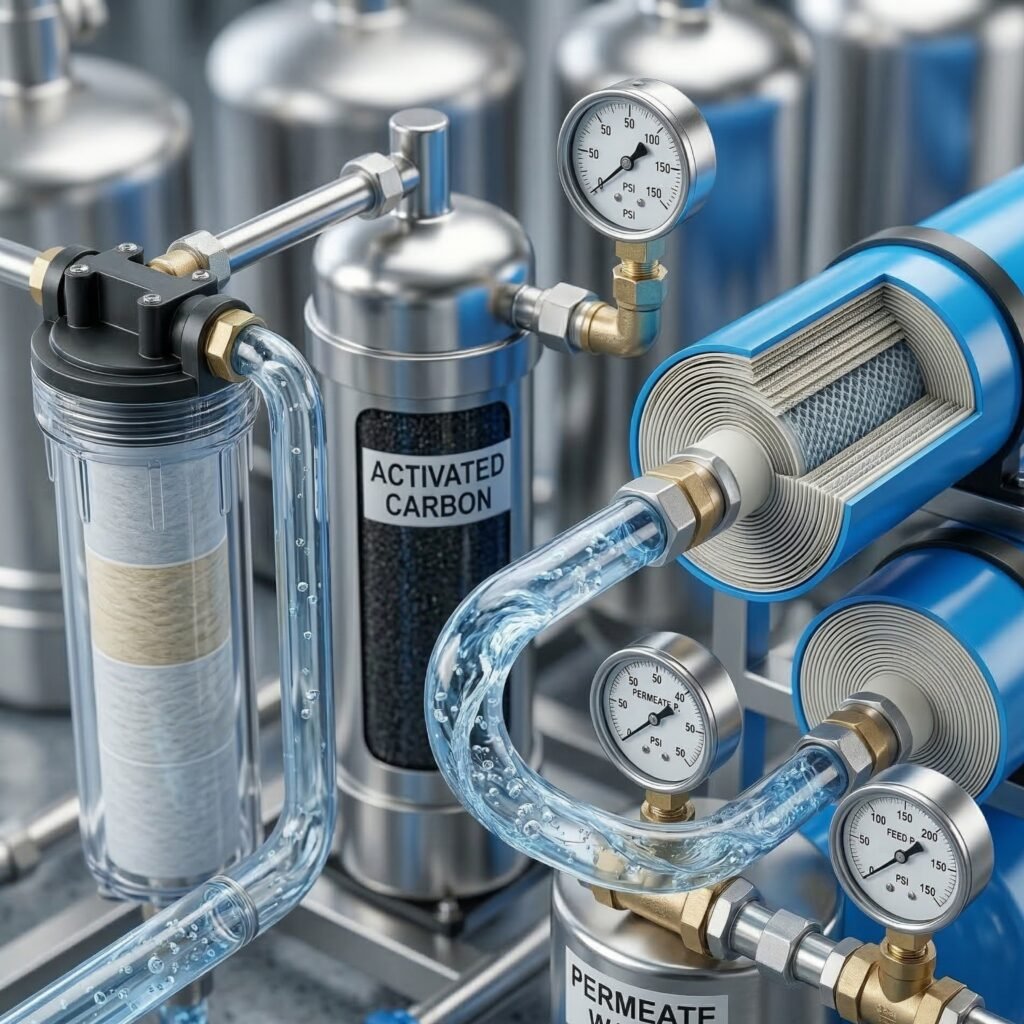
Types of RO High-Pressure Pumps - Which One Is Right for Your Application?
Not all RO applications use the same type of high-pressure pump. The right pump type depends on the flow rate required, the operating pressure, the duty cycle (intermittent vs. continuous), and the budget.
Type 1: DC Diaphragm Pump (For Domestic RO Units – 5–15 LPH)
How it works: A small electric motor drives a rotating eccentric that flexes a rubber diaphragm, creating an alternating displacement that pumps water at high pressure in small quantities. Most domestic under-sink RO units use a 24V DC diaphragm pump operating at 60–80 psi (4–5.5 bar).
Applications: Domestic RO units (Kent, Pureit, AO Smith, Livpure and equivalent brands); under-counter domestic systems producing 8–15 LPH of purified water.
Not appropriate for: Any commercial or industrial RO application. DC diaphragm pumps are designed for intermittent domestic duty – not continuous 8–12 hour commercial operation.
Common brands in Bangalore: Shurflo (USA), Aquatec (USA), NSF-certified Chinese diaphragm pump OEM brands. These are typically factory-installed in domestic RO units and sourced as repair parts through domestic water purifier spare part dealers.
Bangalore 2026 pricing: ₹800–₹2,500 depending on pressure rating and flow rate specification.
Type 2: Single-Stage Centrifugal Booster Pump (For Light Commercial – 50–200 LPH)
How it works: A standard single-stage centrifugal impeller driven by a small motor (0.25–0.5 HP). Suitable for light commercial RO systems where operating pressure requirements are at the lower end (6–8 bar) and flow rates are modest.
Applications: Small commercial RO plants producing 50–200 LPH; residential building booster systems; water dispensing systems connected to low-TDS BWSSB supply where osmotic pressure is modest.
Limitation: Efficiency drops significantly above 8 bar. Not recommended for Bangalore borewell water above 800 mg/L TDS where 10–12 bar is typically required.
Common brands: CRI (India) SW series, Taro booster series, Kirloskar Jalraaj series.
Bangalore 2026 pricing: ₹3,000–₹8,000 for a complete booster pump set with motor.
Type 3: Vertical Multistage Centrifugal Pump (Commercial and Industrial – 100 LPH to 10,000+ LPH)
How it works: Multiple impeller stages in series, each adding pressure incrementally. The vertical in-line configuration (suction and discharge in the same horizontal plane) makes installation compact – the pump sits inline with the pipe system with no need for offset suction piping.
This is the standard high-pressure pump for virtually all commercial and industrial RO plants in Bangalore. The sizing parameters are:
- Flow rate: sized for the design feed flow rate (permeate + reject)
- Pressure: sized for the required operating pressure at the design flow rate
- Number of stages: determined by the pressure requirement at the design flow rate
<cite index=”28-2″>Grundfos CRI vertical multistage centrifugal pumps offer dry-running protection, unique cartridge seal design for easy service, and highly efficient motors – designed for water treatment systems requiring continuous high-pressure operation. The stainless steel construction of the wetted components ensures compatibility with treated and potable water applications.</cite>
Key brands in the Bangalore commercial and industrial market:
Grundfos CRI series (Danish engineering, India manufactured): The most widely respected and most technically advanced multi-stage pump brand in the Bangalore commercial RO market. The CRI series (not to be confused with CRI India – see below) uses complete stainless steel wetted construction, a unique cartridge mechanical seal for easy maintenance, and is available in a wide range of flow/pressure combinations. The CRI 1, CRI 3, CRI 5, CRI 10, CRI 15, CRI 20 designation indicates flow capacity (approximately 1, 3, 5, 10, 15, 20 m³/hour respectively at design conditions).
For commercial RO in Bangalore:
- CRI 1 series (Grundfos): For 100–300 LPH RO plants
- CRI 3 series (Grundfos): For 300–800 LPH RO plants (model CRI 3-19 at ₹37,000 is widely used for 500-1000 LPH systems)
- CRI 5 series (Grundfos): For 800 LPH–1,500 LPH RO plants
- CRI 10/15/20 series (Grundfos): For 1,500 LPH to 5,000 LPH industrial plants
CRI Pumps India Ltd. (Coimbatore, Indian brand): A completely separate company from Grundfos – a leading Indian pump manufacturer headquartered in Coimbatore. CRI India’s multi-stage pumps are widely used in Bangalore commercial RO plants, particularly for cost-sensitive applications where the Grundfos price premium is not justified. The CRI MVC series (Multistage Vertical Centrifugal) is the standard RO pump model.
Important note: In the Bangalore market, vendors may refer to either Grundfos CRI series or CRI India brand pumps as “CRI pumps” – creating potential confusion. Verify which brand and model you are being quoted before committing.
- CRI MVC-2/11 TR: Suitable for 250 LPH industrial RO, 1.5 HP, three-phase. 1.5 m³/hr at 90 metres head (approximately 9 bar).
- Available in single-phase (for sites without three-phase supply) and three-phase configurations.
Taro Pumps (India): Indian brand with good local presence; adequate for commercial duty at competitive prices. Popular in cost-sensitive Bangalore commercial applications.
Kirloskar Brothers (India): Strong industrial brand; Kirloskar multi-stage pumps are used in larger industrial RO applications. Good service network in Bangalore’s industrial zones.
CNP Pumps (China, with Indian manufacturing): Widely available at competitive pricing; used in many Bangalore commercial RO installations. Parts availability is improving with growing local distribution networks.
Lucky Pumps (India): Budget segment Indian brand; adequate for light commercial duty; limited service support in Bangalore.
Type 4: Horizontal Multi-Stage Pump (Industrial – For Large Plants and High Pressure)
For industrial RO plants producing 5,000 LPH or more, or where operating pressure requirements exceed 15 bar (high-TDS sources above 3,000 mg/L, or specific industrial process applications), horizontal multi-stage pumps may be more appropriate than vertical inline configurations – particularly where very high flow rates require larger pump casings that are more practically oriented horizontally.
Brands: Grundfos CM/MQ series, KSB, Wilo, Flowserve for large industrial applications.
Price range: ₹30,000–₹5,00,000+ depending on flow rate, pressure, and specification.
Type 5: Positive Displacement Pump (High-Pressure Niche Applications)
For applications requiring very high pressure (above 30 bar) at modest flow rates – not typical for commercial water purification but relevant for industrial RO applications on very high-TDS waters (seawater desalination and some industrial process applications) – positive displacement pumps (plunger or piston type) are used. Not standard for Bangalore’s commercial and industrial freshwater RO applications.
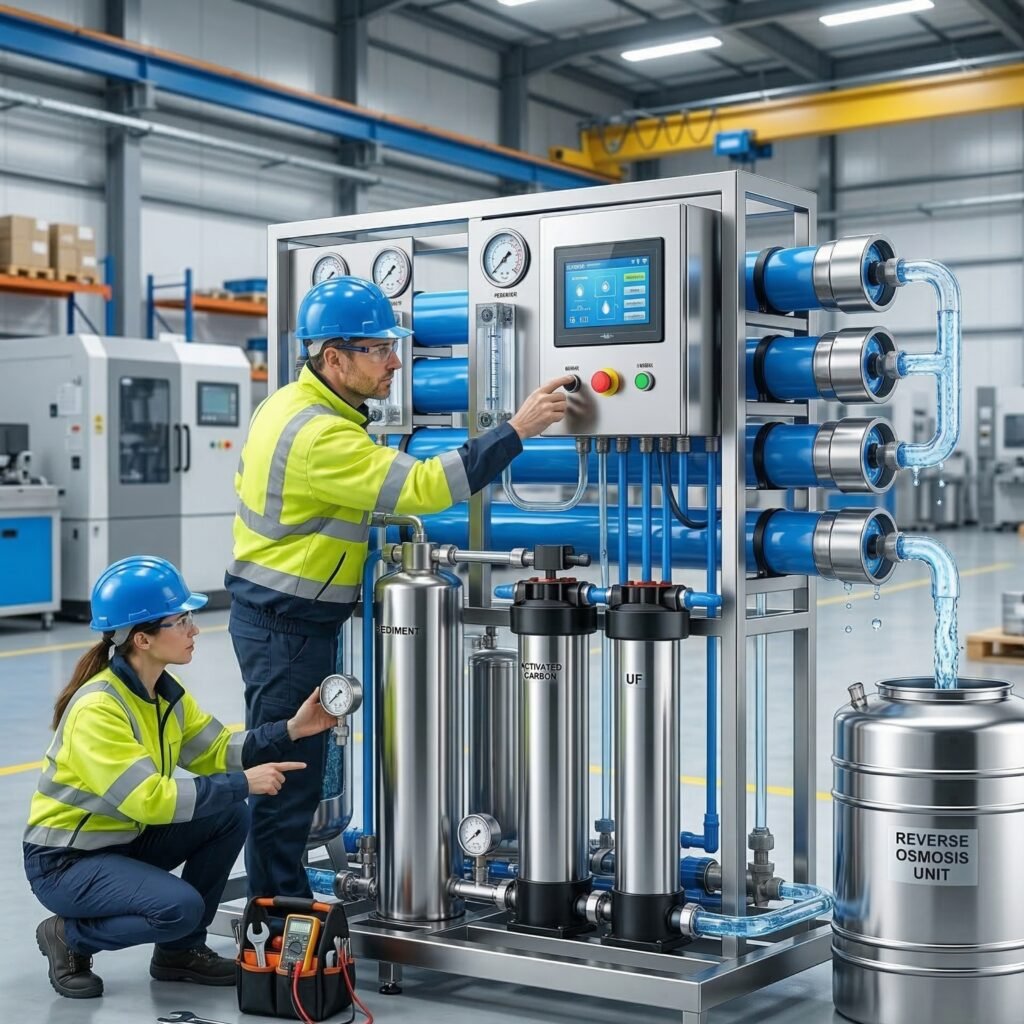
How to Size an RO High-Pressure Pump for Bangalore Applications
The sizing methodology for an RO high-pressure pump requires simultaneous consideration of two parameters: flow rate (in m³/hour or LPH) and pressure (in bar). Getting either wrong – particularly undersizing pressure for Bangalore’s high-TDS borewell water – produces a system that consistently underperforms.
Step 1: Determine Required Feed Flow Rate
The RO membrane sees the entire feed flow – not just the purified permeate output. At a recovery ratio of 50% (typical for commercial RO plants), the feed flow is twice the permeate output:
Feed flow (LPH) = Permeate output (LPH) ÷ Recovery ratio
Examples:
- 250 LPH permeate plant at 50% recovery: 500 LPH feed flow
- 500 LPH permeate plant at 50% recovery: 1,000 LPH feed flow
- 1,000 LPH permeate plant at 65% recovery: 1,538 LPH feed flow
The pump must be capable of delivering the feed flow at the required operating pressure. This is the design duty point: (flow in m³/hour) × (pressure in bar).
Step 2: Determine Required Operating Pressure
Operating pressure is determined by:
Minimum operating pressure = Osmotic pressure of feed water + Net driving pressure (NDP) + System friction losses
For Bangalore’s typical borewell water:
Feed Water TDS | Approximate Osmotic Pressure | Typical Operating Pressure |
300–500 mg/L | 2–3.5 bar | 7–9 bar |
500–800 mg/L | 3.5–5.6 bar | 9–11 bar |
800–1,200 mg/L | 5.6–8.4 bar | 11–13 bar |
1,200–2,000 mg/L | 8.4–14 bar | 13–16 bar |
Above 2,000 mg/L | 14+ bar | 16–20 bar |
Critical for Bangalore buyers: Because Bangalore’s borewell TDS spans a wide range (600–1,800 mg/L depending on location and borewell depth), and because TDS rises significantly in summer, the pump should be sized for the worst-case summer TDS – not the post-monsoon average. Undersizing for the low-TDS period produces a pump that cannot achieve adequate membrane pressure during summer’s high-TDS months.
Step 3: Match Duty Point to Pump Curve
Every centrifugal pump has a performance curve – a graph showing flow rate vs. head (pressure) at the pump’s operating speed. The duty point (your required flow and pressure) must fall on or above the pump’s curve.
For multi-stage centrifugal pumps like the Grundfos CRI series, selecting the number of stages determines the pump’s maximum head – the appropriate series for your application:
Application | Permeate Output | Feed Flow | Operating Pressure | Recommended Grundfos Model |
Small commercial | 100 LPH | 200 LPH | 9–11 bar | Grundfos CMB 3-37 or CRI 1 series |
Medium commercial | 250 LPH | 500 LPH | 10–12 bar | CRI India MVC-2/11 or Grundfos CRI 3 |
Large commercial | 500 LPH | 1,000 LPH | 11–13 bar | Grundfos CRI 3-19 (₹37,000) |
Light industrial | 1,000 LPH | 2,000 LPH | 11–13 bar | Grundfos CRI 5 series |
Industrial | 2,000 LPH | 4,000 LPH | 12–14 bar | Grundfos CRI 10 series |
Large industrial | 5,000 LPH | 10,000 LPH | 12–15 bar | Grundfos CRI 20 or CR 20 series |
Step 4: Select Motor Phase and Protection Rating
Single-phase (230V, 50Hz): Available for smaller pumps (up to approximately 1.5–2 HP). Appropriate for commercial premises with standard single-phase supply. Requires a start capacitor; available in single-phase versions of CRI India, Taro, and some Grundfos CMB models.
Three-phase (415V, 50Hz): Required for pumps above approximately 2 HP. More energy efficient than single-phase equivalent; smoother starting torque; longer motor life. Standard for industrial RO plants. All commercial premises in Karnataka’s industrial zones receive three-phase supply.
IP (Ingress Protection) rating: RO plant pump rooms in Bangalore can experience high humidity and occasional water splash. Specify minimum IP54 protection rating for pump motors in plant room environments – protects against dust ingress and water splash from all directions.
Common RO High-Pressure Pump Failures and Their Causes
Understanding failure modes – and their root causes – allows maintenance teams to both respond correctly to failures and prevent them through proper installation and maintenance practices.
Failure 1: Cavitation Damage
What it is: Cavitation occurs when the local pressure at the pump impeller inlet drops below the vapour pressure of the water – causing vapour bubbles to form. When these bubbles collapse as pressure rises through the impeller, they release intense micro-shockwaves that erode impeller and wear-ring surfaces.
Symptoms: Crackling or rattling noise at the pump (sounds like gravel in the pump); vibration; erosion of impeller vanes (visible when pump is disassembled); reduced flow and pressure output at given speed.
Root causes in Bangalore RO plants:
- Insufficient inlet pressure (blocked pre-filter cartridges starving the pump of flow)
- High inlet temperature (water above 35°C reduces cavitation margin significantly)
- Pump installed with excessive suction lift (should be flooded suction where possible)
- Operating pump below minimum flow rate (common when RO system auto-shuts on full tank and the pump has no minimum flow bypass)
Preventive measures:
- Maintain pre-filter cartridges on schedule – blocked pre-filters are the most common cause of RO pump cavitation in Bangalore
- Ensure the feed tank is above the pump inlet (flooded suction) wherever possible
- Install minimum flow bypass (recirculation valve) for large industrial pumps
Failure 2: Mechanical Seal Failure
What it is: The mechanical seal is the shaft seal that prevents water from leaking along the rotating pump shaft. It consists of a rotating ring (attached to the shaft) and a stationary ring (in the pump casing), held together by spring force with a thin film of water between their faces.
Symptoms: Water dripping or spraying from the pump body near the shaft entry point. Early stage: occasional drops during operation. Late stage: continuous water escape with visible shaft spray.
Root causes:
- Normal wear after 10,000–20,000+ operating hours
- Dry running (pump operates without water – the thin water film between seal faces provides both lubrication and cooling; without it, the seal faces overheat and fail within minutes)
- Abrasive particles in feed water (if pre-filter has failed or been bypassed)
- Chemical attack (incorrect anti-scalant chemistry reacting with seal materials)
Replacement: Mechanical seal replacement requires pump disassembly – a skilled task that Bangalore Aqua’s AMC services team handles during scheduled maintenance or emergency call-out. See industrial RO spare parts Bangalore for seal availability.
Bangalore 2026 pricing: CRI India model-specific seals: ₹500–₹2,500. Grundfos cartridge seal assembly: ₹1,500–₹5,000.
Failure 3: Bearing Failure
What it is: The pump’s bearings support the rotating shaft. Bearing failure causes the shaft to become misaligned, producing vibration, noise, and eventually catastrophic seizure.
Symptoms: Abnormal noise (grinding, rumbling, or whining from the motor end); elevated motor temperature; visible vibration at the pump/motor unit; reduced performance as vibration causes shaft seal leakage.
Root causes:
- Normal bearing life exhaustion (typically 15,000–25,000 hours for quality bearings)
- Water contamination of bearings (from seal failure allowed to progress to bearing contamination)
- Incorrect belt tension or coupling alignment (for belt-driven or flexible-coupled configurations)
- Voltage imbalance causing uneven motor loading (common in Bangalore’s industrial zones with three-phase supply issues)
Replacement: Motor bearing replacement is a motor rewind workshop task – Bangalore has several authorised pump service workshops in the Peenya, Yeshwanthpur, and Bommasandra industrial areas. Grundfos and CRI India both have Bangalore-based authorised service centres.
Failure 4: Motor Burnout
What it is: Motor winding insulation failure due to thermal overload, moisture ingress, or voltage-related stress – causing inter-winding short circuit or winding-to-earth fault.
Root causes in Bangalore:
- Voltage fluctuation (under-voltage causes motors to draw higher current; the most common cause of premature motor failure in Bangalore’s variable power supply environment)
- Frequent starts and stops (the inrush current at each start heats motor windings; excessive cycling from tank-full auto-stop/start accelerates winding degradation)
- Single-phasing (loss of one phase in three-phase supply causes the motor to attempt to run on two phases – drawing very high current that burns windings within minutes without overcurrent protection)
- Moisture ingress (particularly in plant rooms with inadequate ventilation)
Prevention:
- Install a voltage stabiliser on the pump power supply – particularly critical in Bangalore’s North and East industrial zones where voltage variation is frequent
- Ensure overload protection (overload relay on the motor starter) is correctly set to the motor’s rated current
- Ensure the control panel includes single-phase preventer (SPP) for three-phase motors
Bangalore 2026 pricing: Motor rewinding by authorised workshop: ₹3,000–₹15,000 depending on motor size. New motor replacement: ₹4,000–₹30,000 depending on HP and brand.
Failure 5: Pressure Loss Without Visible Damage
A pump that is running but producing insufficient pressure – without any of the visible signs above – is often experiencing:
- Impeller wear: Erosion at the impeller vane tips and wear ring reduces the pump’s ability to build pressure. Common when feed water carries abrasive particles (inadequate sediment pre-filtration).
- Wear ring clearance increase: The wear rings between impeller and casing progressively increase clearance with running time – recirculating increasing proportions of discharge flow back to inlet, reducing net output.
- Air entrainment: Air entering the suction piping (from cracks in suction fittings, vortex formation in a low tank, or faulty foot valve) reduces effective pump performance.
- Incorrect pump rotation: For three-phase motors, swapping any two phase connections reverses motor rotation – the pump will run but produce approximately 60% of design pressure. Typically discovered on first commissioning but can recur after electrical panel maintenance if phase connections are disturbed.
RO High-Pressure Pump Maintenance Schedule
Integrating HP pump maintenance into your plant’s structured AMC is the most reliable way to prevent unexpected failures. Here is the maintenance framework Bangalore Aqua uses in their commercial and industrial RO plant AMC services.
At Every Quarterly AMC Visit:
- Visual inspection for leaks at shaft seal and all flanged connections
- Vibration check (by hand or with vibration meter for larger pumps) – elevated vibration indicates developing bearing issue or impeller imbalance
- Noise assessment – changes in pump noise pattern (new tones, increased noise level) are early failure indicators
- Inlet and outlet pressure measurement – confirms pump is delivering its rated head at the actual flow rate
- Motor current measurement (with clamp meter) – deviation from rated current indicates motor or hydraulic issue
- Temperature check on motor casing – elevated temperature indicates electrical or mechanical overload
- Lubrication of motor bearings where applicable (grease nipple type)
- Control panel: contactor condition, overload relay setting verification, capacitor condition (for single-phase motors)
At Annual AMC Service:
- Mechanical seal inspection – replace if showing wear or if service hours justify preventive replacement
- Motor bearing condition assessment – vibration spectrum analysis if available; replace if approaching end-of-life
- Impeller and wear ring clearance check – measure clearance against original specification; replace wear ring if clearance has doubled
- Complete pump curve verification – measure flow and pressure at three operating points and compare to original pump curve to quantify performance degradation
- Motor insulation resistance test (Megger test) – confirms winding integrity
- Coupling alignment check and adjustment where applicable
- Suction and discharge valve condition
Pump Selection for Bangalore's Specific Water Conditions
The Summer TDS Peak Challenge
Bangalore’s borewell TDS typically rises 30–60% from post-monsoon minimum to summer maximum. A pump selected for November operating conditions at 700 mg/L TDS may be marginal at April conditions of 1,100 mg/L TDS on the same borewell. The osmotic pressure at 1,100 mg/L is approximately 7.7 bar – versus 4.9 bar at 700 mg/L – requiring 2.8 bar more operating pressure from the pump.
If the pump’s maximum head (at minimum flow) is not sufficient to provide this additional pressure in summer, the system will operate at below-design recovery – producing less purified water per day, with slightly elevated permeate TDS. In severe cases, the pump may cavitate as it struggles to maintain pressure against the higher osmotic resistance.
Recommendation: Select a pump with a maximum head at least 15–20% above the calculated summer operating pressure. This buffer accommodates seasonal TDS variation, membrane aging, and system friction losses.
Hardness Pre-Treatment and Pump Life
Bangalore’s high hardness water (300–700 mg/L as CaCO₃) does not directly affect pump performance – hardness ions pass through the pump without causing corrosion or scaling on wetted parts. However, if the anti-scalant dosing system fails and calcium carbonate precipitates occur in the high-pressure section downstream of the pump (on the membrane), the resulting pressure rises affect the pump’s operating point.
Ensure the water softener or anti-scalant dosing system is functioning correctly at all times – not just for membrane protection but for stable pump operating conditions.
Three-Phase Power Quality in Bangalore Industrial Zones
Bangalore’s industrial estates – particularly Nelamangala, Hoskote, and Doddaballapur – have documented three-phase power quality issues: voltage imbalance between phases, voltage fluctuation, and occasional single-phasing events. All of these are damaging to three-phase pump motors.
For industrial RO plants in these zones, Bangalore Aqua recommends:
- Three-phase voltage stabiliser on the pump power supply (₹5,000–₹20,000 depending on KVA)
- Single-phase preventer relay – cuts power if any phase is lost (₹800–₹2,500)
- Phase sequence relay – prevents incorrect rotation after power restoration following outage (₹500–₹1,500)
Where to Source RO High-Pressure Pumps in Bangalore
Authorised Brand Dealers in Bangalore
Grundfos: Grundfos India has authorised dealers in Bangalore for their pump range. For genuine Grundfos CRI series pumps for commercial and industrial RO applications, sourcing through an authorised dealer or through a verified water treatment equipment supplier is essential – Grundfos pumps from unauthorised channels may be refurbished units sold as new.
CRI India (Coimbatore): CRI Pumps India Ltd. has distribution in Karnataka through pump dealers in Peenya and Yeshwanthpur. Genuine CRI India pumps and spare parts are available through the authorised dealer network.
Kirloskar: Kirloskar Brothers’ authorised dealer network covers Bangalore comprehensively – good for larger industrial pump requirements.
Taro Pumps: Taro Pumps’ dealer network is available in Bangalore’s pump market areas.
The Bangalore Aqua Advantage for HP Pump Supply
As a commercial RO plant manufacturer and industrial RO plant manufacturer in Bangalore, Bangalore Aqua specifies, procures, installs, and maintains high-pressure pumps as part of complete water treatment systems.
Technical specification support: Bangalore Aqua’s engineering team determines the correct pump model – flow rate, head, motor HP, phase requirement, seal specification – based on your actual feed water TDS, target recovery ratio, and system operating schedule. This specification support ensures you receive a pump that is correctly matched to your system requirements, not a generic recommendation from a pump catalogue.
Installation in complete RO system context: A high-pressure pump purchased from a pump dealer and installed by a general plumber will not perform as well as one installed by the team who designed the complete system – because HP pump performance depends on correct inlet piping configuration (flooded suction, appropriate pipe diameter, minimum straight pipe lengths), correct discharge piping (pressure gauge position, check valve sizing, connection to membrane housing inlet manifold), and correct electrical supply (motor starter sizing, overload protection setting, voltage stabiliser if required).
Spare parts availability: Mechanical seals, motor bearings, impeller sets, wear rings, and capacitors for common CRI India, Grundfos, and Taro models are stocked by Bangalore Aqua – available for same-day supply for emergency repairs or scheduled AMC maintenance. See commercial RO parts dealers Bangalore and industrial RO spare parts Bangalore for the complete spare parts range.
AMC service: Quarterly pump condition monitoring, annual mechanical seal and bearing assessment, motor current measurement, and pump curve verification are all included in Bangalore Aqua’s structured AMC programmes. A pump failure that develops slowly – rising seal leakage, developing vibration, declining pressure output – is caught and corrected during a scheduled AMC visit before it becomes an emergency shutdown.
2026 Bangalore Price Guide: RO High-Pressure Pumps
Pump Model | Application | Flow/Pressure | Motor | Bangalore Price (2026) |
Small DC diaphragm (Shurflo/Aquatec) | Domestic RO (5–15 LPH) | 50–80 psi | 24V DC | ₹800–₹2,500 |
CRI India MHBS series | Light commercial (50–250 LPH) | 8–10 bar | 0.5–1 HP single-phase | ₹5,000–₹12,000 |
CRI India MVC-2/11 TR | Commercial (250 LPH) | 9 bar @ 0.5 m³/hr | 1.5 HP three-phase | ₹12,000–₹20,000 |
Grundfos CMB 3-37 | Commercial (100–300 LPH) | 9 bar @ 0.5 m³/hr | 0.75 HP single/three-phase | ₹18,000–₹28,000 |
Grundfos CRI 3-19 | Commercial (500–1,000 LPH) | 12 bar @ 0.5 m³/hr | 1.5–2 HP three-phase | ₹30,000–₹45,000 |
Grundfos CRI 5 series | Industrial (800–1,500 LPH) | 12 bar @ 0.8 m³/hr | 3 HP three-phase | ₹45,000–₹70,000 |
Grundfos CRI 10 series | Industrial (2,000 LPH) | 12 bar @ 1.5 m³/hr | 5–7.5 HP three-phase | ₹80,000–₹1,30,000 |
Grundfos CRI 20 series | Industrial (5,000 LPH) | 12 bar @ 3 m³/hr | 11–15 HP three-phase | ₹1,50,000–₹2,50,000 |
Taro MV series | Commercial/industrial (equivalent) | Similar to CRI India | Various | ₹8,000–₹60,000 |
Kirloskar multi-stage | Industrial | Various | Various | ₹20,000–₹2,00,000 |
Prices are indicative for Bangalore market, 2026. Grundfos CRI series pumps carry a 25–40% premium over CRI India equivalent models – reflecting Danish engineering quality, longer service life, and better spare parts support. Contact Bangalore Aqua for exact pricing on specific models and specifications.
Spare parts pricing (Bangalore 2026):
- CRI India mechanical seal: ₹500–₂,000
- Grundfos cartridge seal: ₹1,500–₹5,000
- Motor bearing set: ₹300–₹1,500
- Motor capacitor: ₹150–₹600
- Impeller set (CRI India): ₹2,000–₈,000
- Frequently Asked Questions
My commercial RO plant is producing less water than it should, and TDS is slightly elevated. Could it be the pump?
Possibly. Reduced pump head (pressure) causes the system to operate below its design pressure, resulting in lower permeate flow and slightly elevated permeate TDS as the membrane rejection is reduced at lower net driving pressure. First, check the pump’s outlet pressure gauge – if pressure is lower than the commissioning reading, the pump needs assessment. Check pre-filter differential pressure first (a blocked pre-filter limits feed to the pump, causing pressure drop). If pre-filters are clean, the pump itself may have worn impellers or seal issues. Contact Bangalore Aqua for a diagnostic service visit.
Can I replace a Grundfos CRI pump with a CRI India pump to save cost?
Technically possible if the hydraulic specification (flow rate and head at the duty point) is matched correctly. However, the service life, seal design, and spare parts ecosystem differ. Grundfos CRI pumps use a cartridge seal that is significantly easier to replace (no pump disassembly required for seal change) – a maintenance advantage that partially offsets the higher initial cost over the pump’s life. For critical industrial applications where downtime is expensive, the Grundfos CRI’s serviceability advantage is worth the premium. For standard commercial applications, CRI India or Taro equivalents at lower initial cost are entirely reasonable.
What voltage stabiliser rating do I need for a 1.5 HP RO pump?
A 1.5 HP (approximately 1.1 kW) single-phase pump requires a stabiliser rated for at least 2 KVA – providing adequate headroom for the motor’s starting current surge (typically 5–7× rated current for 1–2 seconds). For a three-phase 1.5 HP pump, a 3-phase stabiliser of at least 3 KVA is appropriate. For peace of mind on a ₹30,000–₹45,000 Grundfos pump investment, a ₹5,000 stabiliser is excellent insurance against voltage-related motor damage.
How long does a high-pressure pump last in a Bangalore commercial RO plant?
With correct installation, adequate inlet pressure (pre-filters maintained on schedule), and annual AMC service including mechanical seal inspection and bearing check: Grundfos CRI pumps typically last 8–12 years before major overhaul is required. CRI India and equivalent pumps typically last 5–8 years with similar maintenance. Without structured maintenance, pump life in Bangalore’s high-TDS borewell water and variable power supply environment can be significantly shorter.
We are installing a new 1,000 LPH industrial RO plant in Nelamangala. Our borewell TDS is 1,100 mg/L. What pump do you recommend?
For 1,000 LPH permeate at 50% recovery, feed flow is 2,000 LPH (0.5 m³/hour at 60% recovery, or approximately 0.55–0.6 m³/hour). At 1,100 mg/L feed TDS, operating pressure should be approximately 12–13 bar. The Grundfos CRI 5 series or equivalent CRI India high-pressure pump in 3 HP three-phase configuration is appropriate. Given Nelamangala’s power quality challenges, a three-phase voltage stabiliser and single-phase preventer relay are strongly recommended. Contact Bangalore Aqua for a complete system specification and quotation.
Conclusion: The Right Pump, Correctly Sized, Properly Maintained
The RO high-pressure pump is the operational core of every commercial and industrial water treatment system. Getting the specification right – correctly sized for your actual Bangalore borewell water TDS, your target permeate output, and your operating schedule – is the foundation of a water treatment system that performs reliably from day one.
Getting the maintenance right – quarterly condition monitoring, annual seal and bearing assessment, pre-filter maintenance that prevents cavitation, and voltage protection in Bangalore’s variable power supply environment – is what keeps that system performing reliably for 8–12+ years.
Bangalore Aqua and Energy Pvt. Ltd. supplies, installs, and maintains RO high-pressure pumps as integrated components of complete commercial and industrial water treatment systems – with technical specification support, genuine brand sourcing, local spare parts availability, and AMC coverage that protects your pump investment.
Contact Bangalore Aqua for your RO high-pressure pump requirement.
📞 +91 76763 93939 | +91 97387 04753 📧 info@bangaloreaqua.com 🌐 bangaloreaqua.com 📍 107/209 2nd Cross, 4th Main Kogilu Layout, Bengaluru – 560064, Karnataka
RO high-pressure pump supply, installation, and AMC service across Bengaluru Urban, Bengaluru Rural, Whitefield, Koramangala, Nelamangala, Hoskote, Marathahalli, Mysuru, Hubballi, and all Karnataka locations.
Related Reads:
- Commercial RO Plant Spare Parts Supplier Bangalore 2026
- Industrial RO Spare Parts Bangalore
- Water Treatment Plant Spare Parts Bangalore Karnataka
- Industrial & Commercial RO Plant AMC Services
- Industrial RO Plant Maintenance Checklist
- RO Plant Commissioning Process Explained 2026
- How to Choose the Right Industrial RO Plant Capacity
- Increase Lifespan of Industrial RO Membranes